Google’s AI Overviews don’t merely list search results. They summarize sources, draw conclusions, and present the result at the top of Google Search in a format that looks authoritative.
On May 28, 2026, the Regional Court of Munich I held Google directly responsible for false statements its AI Overview generated about two publishers and granted an injunction. The court found that the summary wasn’t just third-party information passing through a search engine. It was Google’s own attributable content.
The ruling doesn’t mean every AI error automatically makes Google liable everywhere. It came from preliminary-injunction proceedings under German law and concerns specific false statements. Even with those limits, the decision changes the risk calculation for any business whose reputation can be damaged by an AI-generated answer.
What Google’s AI said about two Munich publishers
The plaintiffs were a Munich publishing company operating 12 publishing brands and a subsidiary that releases books and magazines under the GeraMond brand. Searches combining one publisher’s name with the German term for “fraud scheme” produced an AI Overview that opened with a direct accusation: “Yes, [company] is known for dubious business practices.”
The overview went further. It described alleged subscription traps, payment demands, inaccessible digital content, shifting names and URLs, and poor customer service. It then organized those claims into summaries, warning signs, and suggested next steps. The presentation looked less like a list of search results and more like a consumer-protection assessment.
The court found that several claims had no adequate factual basis. Google’s AI had connected the publishers to unrelated companies and conduct that the cited material didn’t establish. One prominent source didn’t refer to the publishers at all.
The companies notified Google on February 2 through a cease-and-desist letter and Google’s reporting process. A substantially similar AI Overview appeared again on February 10. The publishers then sought an injunction.
The court prohibited Google from repeating the specified claims. Under the order, violations can bring fines of up to EUR 250,000 per instance or custodial sanctions against members of management under German enforcement rules. The court also refused to limit the order’s effect to Germany, citing European rules governing recognition of judgments. That gives the decision cross-border significance, but it isn’t a worldwide ruling.
In a statement reported by Reuters, Google said the case concerns narrow, specific errors rather than the basic operation of AI Overviews. The company disagrees with the ruling and plans to appeal.
Other businesses and public figures have reported similar harm
The Munich decision appears to be the first ruling to hold Google directly responsible for false claims generated in an AI Overview. It isn’t the first time someone has alleged that the feature caused measurable reputational or financial harm.
Wolf River Electric, a Minnesota solar contractor, sued Google after an AI Overview allegedly said the company was facing a lawsuit from the Minnesota attorney general over deceptive sales practices. The attorney general’s case targeted other solar-finance companies, not Wolf River.
According to Wolf River’s complaint, Google cited four sources for the claim. One Star Tribune article mentioned Wolf River but didn’t identify it as a defendant, and none of the cited sources supported the AI Overview’s accusation. The complaint describes several lost contracts, including a $150,000 project that a customer cancelled after seeing the false statement. Wolf River is seeking between $110 million and $210 million in damages. The case was moved from Minnesota state court to federal court, where the allegations remain unproven.
Canadian musician Ashley MacIsaac has brought a separate case in Ontario. His claim alleges that an AI Overview confused him with another person who shared his surname and falsely said he had been convicted of sexual offences and placed on Canada’s sex-offender registry. MacIsaac says he learned of the summary after a First Nation cancelled one of his concerts. He filed his claim in February 2026 and is seeking $1.5 million. Those allegations also haven’t been tested in court.
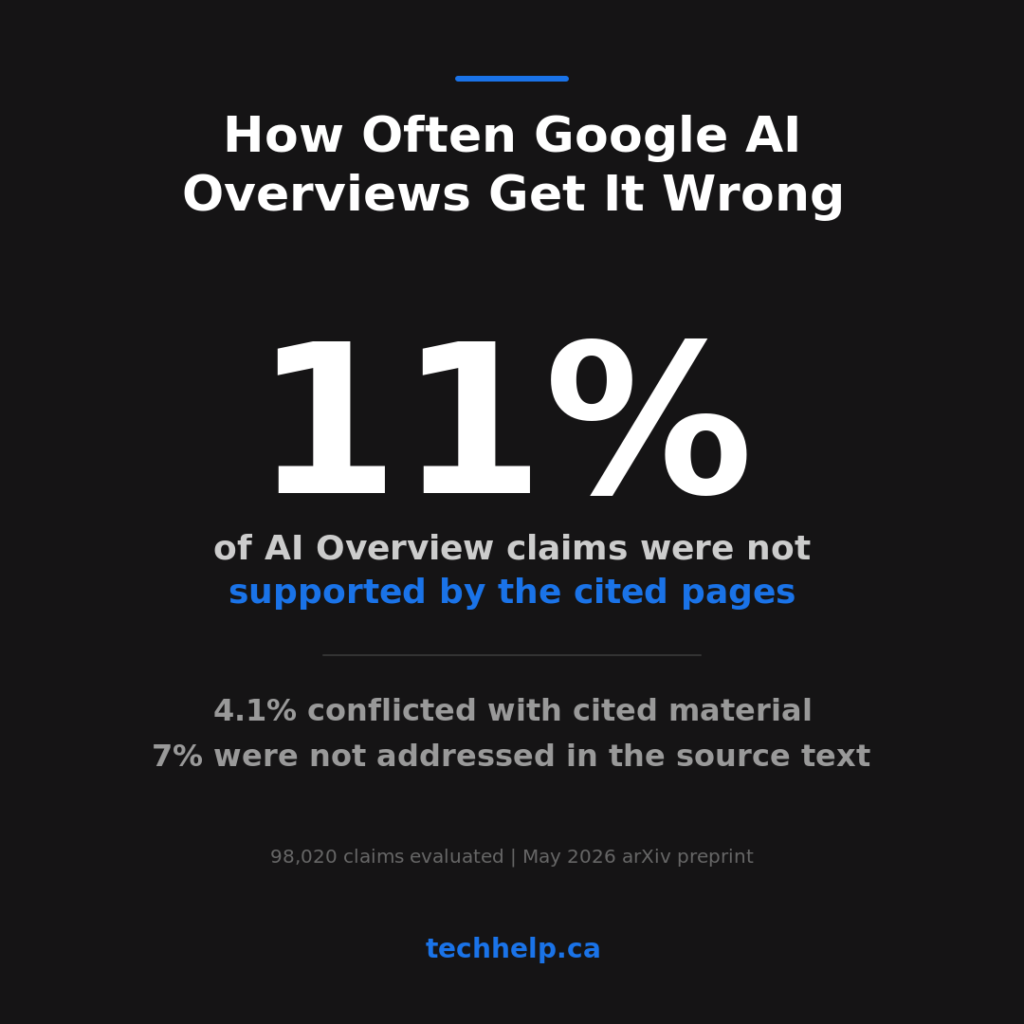
Research suggests the underlying citation problem extends beyond these cases. A May 2026 arXiv preprint evaluated 98,020 factual claims from Google AI Overviews and found that 11% weren’t supported by the cited pages. Of those claims, 4.1% conflicted with the cited material and another 7% weren’t addressed in the source text the researchers could retrieve. The study has limitations, including inaccessible or partially captured source material, but its results reinforce a practical warning: citations don’t guarantee that the summary accurately represents them.
Why the Munich court treated AI Overviews differently
Search engines have often received limited liability protection when they point users to material created by other people. In the United States, Section 230 generally prevents online services from being treated as the publisher of third-party content. European law has its own intermediary liability rules.
The Munich court found that AI Overviews crossed a line. Google wasn’t merely displaying links or short excerpts. Its system selected information, rewrote it, combined material from different pages, and produced a new, structured answer. Some statements didn’t appear in the cited sources at all.
That made the output attributable to Google under the court’s reasoning. The court also held that the hosting protection in Article 6 of the EU’s Digital Services Act didn’t apply because Google wasn’t acting only as a host for third-party material.
Google argued that users understand AI-generated information can be unreliable and can check the linked sources. The court rejected that as a reason to avoid responsibility. The overview was self-contained, confident, and understandable without opening anything else. It didn’t warn readers that its claims might be unreliable. The judges also noted that forcing users to verify every citation would undermine the convenience Google says the feature provides.
Notice played an important role too. The court considered whether Google’s duty to investigate might arise only after it learned of a possible violation. Here, the publishers had notified Google through multiple channels, yet another materially similar answer appeared afterward.
This reasoning hasn’t become a global rule. No US court has resolved whether Section 230 protects a search company when its own generative system creates the defamatory statement. The Wolf River case may test that question. MacIsaac’s Canadian case is unresolved as well. The Munich ruling is a significant legal signal, not a universal answer.
What this means for your business
If an AI Overview links your company to a lawsuit, scam, product failure, closure, or regulatory action that never happened, potential customers may see the accusation before they see your website.
The problem is difficult to monitor because AI answers depend on the query and can change between searches. A standard brand search may look fine while a search combining your name with “complaints” or “lawsuit” produces something damaging. Results can also vary by location, device, account, and time.
AI-generated errors can be mundane too. Incorrect hours, service areas, product details, ownership information, or pricing may never support a defamation claim, but they can still cost you business. Someone who sees the wrong answer may simply choose another company without telling you why.
You don’t need to wait for the law to settle before protecting your company. Start with a repeatable monitoring and evidence process.
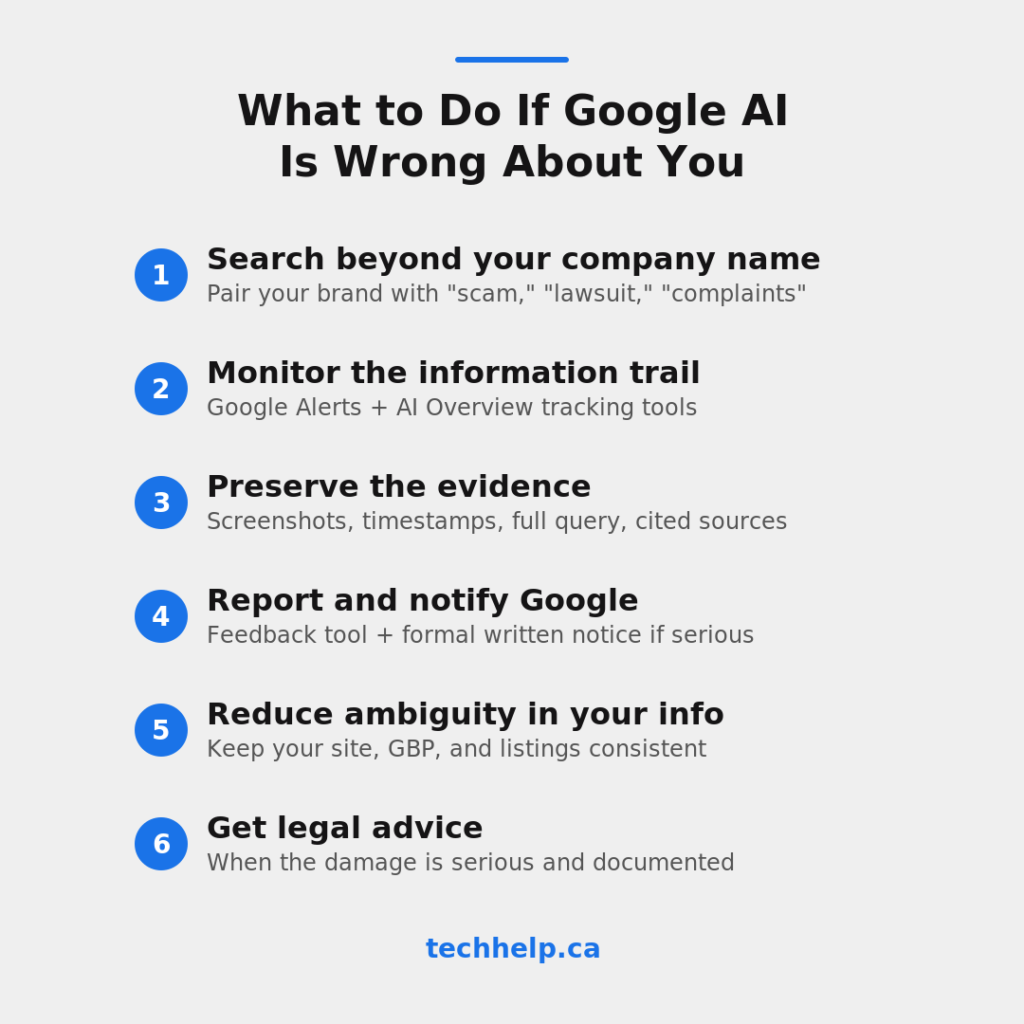
Search beyond your company name
Run searches for your brand name, key products, founders, and common misspellings. Then pair those terms with words customers may use when checking risk, such as “reviews,” “complaints,” “scam,” “lawsuit,” “recall,” “closing,” and “problems.”
Use a signed-out or private browser window to reduce personalization, but remember that location can still influence results. Ask people in other regions to test important queries when geography matters. Repeat priority searches on a schedule because an accurate answer today may change later.
Monitor the wider information trail
Google Alerts can flag new pages that mention your brand, although it won’t detect the text inside an AI Overview. Dedicated monitoring products such as Semrush’s AI Overviews Checker, Otterly.AI, and ZipTie can track selected queries and brand appearances. These services sample prompts and results; none can observe every answer every customer sees.
Google is also rolling out dedicated generative AI performance reports in Search Console to a subset of websites. Those reports can show visibility within features such as AI Overviews and AI Mode, but they aren’t a reputation-monitoring system. They won’t necessarily alert you when an answer makes a false statement about your company.
Preserve the evidence before the answer changes
Capture the entire screen, not just the false sentence. Your record should include the exact query, full AI Overview, cited sources, date, time, location, device, browser, and whether you were signed in. Save the destination pages or PDFs where possible, then note whether each source actually supports the claim.
AI answers can change quickly. A detailed record may be the only way to prove what appeared and how the system presented it.
Report the result to Google
Use the feedback or reporting option attached to the AI Overview. Identify the exact statement that is wrong, state the correct information, and explain why the cited pages don’t support the answer. Keep a copy of what you submit and any response you receive.
If the claim is serious, send a formal written notice that identifies the query, false statement, supporting evidence, harm, and requested correction or removal. The Munich judgment shows why notice can matter: the court specifically considered Google’s conduct after the publishers reported the problem.
Reduce ambiguity in your business information
Keep your website, Google Business Profile, industry listings, and other authoritative profiles consistent. Publish direct, current information about your ownership, locations, products, service area, and policies. Correct inaccurate third-party listings when you can.
Consistent source data can’t guarantee an AI system will get the answer right. It can reduce the conflicts and identity confusion that make false associations easier to generate.
Get legal advice when the damage is serious
Speak with a qualified lawyer if an AI-generated statement is defamatory, keeps returning after notice, or can be tied to cancelled contracts, lost customers, threats, or other measurable harm. The available claims and remedies will depend on your jurisdiction and the facts.
Don’t assume the Munich ruling automatically controls a Canadian or American case. Bring the evidence, timeline, copies of your reports to Google, and records showing financial impact. A lawyer can assess the legal path from there.
Your reputation now has an AI layer
The Munich court didn’t declare every AI hallucination unlawful. It made a narrower but consequential finding: when Google’s system creates new statements, presents them as a complete answer, and damages a business with unsupported claims, Google can’t always retreat behind the third-party pages it cites.
Google may overturn or narrow the ruling on appeal. Other courts may take a different approach. But businesses can’t wait for years of litigation before checking what customers see today.
Search for your company. Test the uncomfortable queries. Save anything false before it disappears, report it promptly, and keep records of the harm. An AI-generated accusation can reach a customer before your own explanation does.
Tech Help Canada Staff researches, writes, and reviews practical content for business owners and professionals. Our coverage spans business, marketing, SEO, technology, and the tools and systems people use to grow and operate online. We focus on clear, useful information backed by research, hands-on experience, and editorial review. Learn more about our team and editorial standards. Need help with something? Contact Us