If you run Google Ads, July 1, 2026 belongs on your calendar.
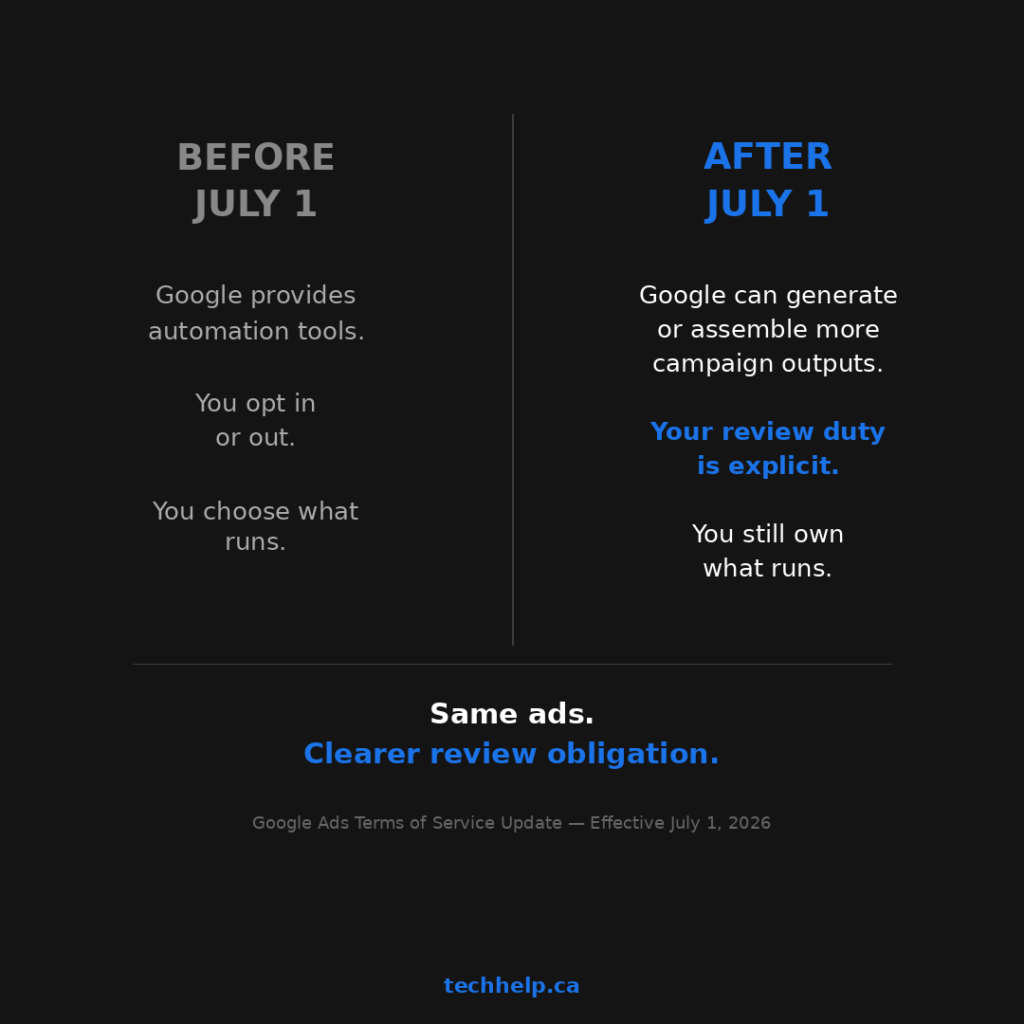
Google is updating its Google Ads Terms of Service on that date, and the change is more than routine contract housekeeping. The new language makes the role of automation harder to ignore: Google can use automated program features to format, select, or generate targets, ads, and destinations on an advertiser’s behalf.
The practical translation is simple. Google Ads can generate more of what users see, but the advertiser still has to review it, approve it, or remove it.
That may sound obvious until you look at how Google Ads works now. Performance Max, AI Max, automatically created assets, text customization, Final URL Expansion, and automated campaign setup can all create combinations or outputs you didn’t write line by line. Some of them may already be running in your account.
For small businesses and agencies, the risk isn’t that Google is using AI. The risk is assuming Google’s AI output is automatically safe because Google generated it.
What changes on July 1, 2026
Google’s Help Center says the new terms become effective on July 1, 2026, with current terms expiring on June 30. The update covers four areas that matter to advertisers: how inputs can be used, how URLs and accounts may be crawled, the advertiser’s review responsibility, and regional changes tied to arbitration, payment language, and regulatory fees.
The first change is about inputs. Google says information or URLs entered into conversational experiences and similar Google Ads features may be used across various Ads features to improve campaign performance. Google’s campaign-building tools no longer just take instructions. They can use your landing page, prompts, product details, and account context to generate assets or recommendations.
The second change is about crawling. If you provide URLs or grant access to accounts for automated campaign setup, the new terms formalize Google’s ability to crawl those assets in that context. That isn’t new as a product behavior. Dynamic Search Ads, Performance Max, automatically created assets, and AI Max already rely on website and feed data. The difference is that the contractual language now makes the permission clearer.
The third change is the one advertisers should feel operationally. Google says advertisers have a continued obligation to review, approve, or remove campaigns and ad assets generated automatically by Google Ads features. “Continued” is the important word. This isn’t just a setup checkbox. It’s an ongoing review duty in a system that can keep producing asset combinations over time.
The fourth change is more legal and regional. Google is changing arbitration language in the U.S., including batch arbitration for similar claims, and says some regions will see arbitration language modified or removed. Payment language is also being updated to include regulatory operating fees or other jurisdiction-specific fees where applicable.
Those legal details may matter to attorneys, large advertisers, and companies operating across many countries. For most small businesses, the immediate issue is simpler: who is watching what Google’s automation publishes under your account name?
The AI layer is no longer a side feature
The updated terms would be easier to shrug off if AI-generated advertising were still a small experiment. It isn’t.
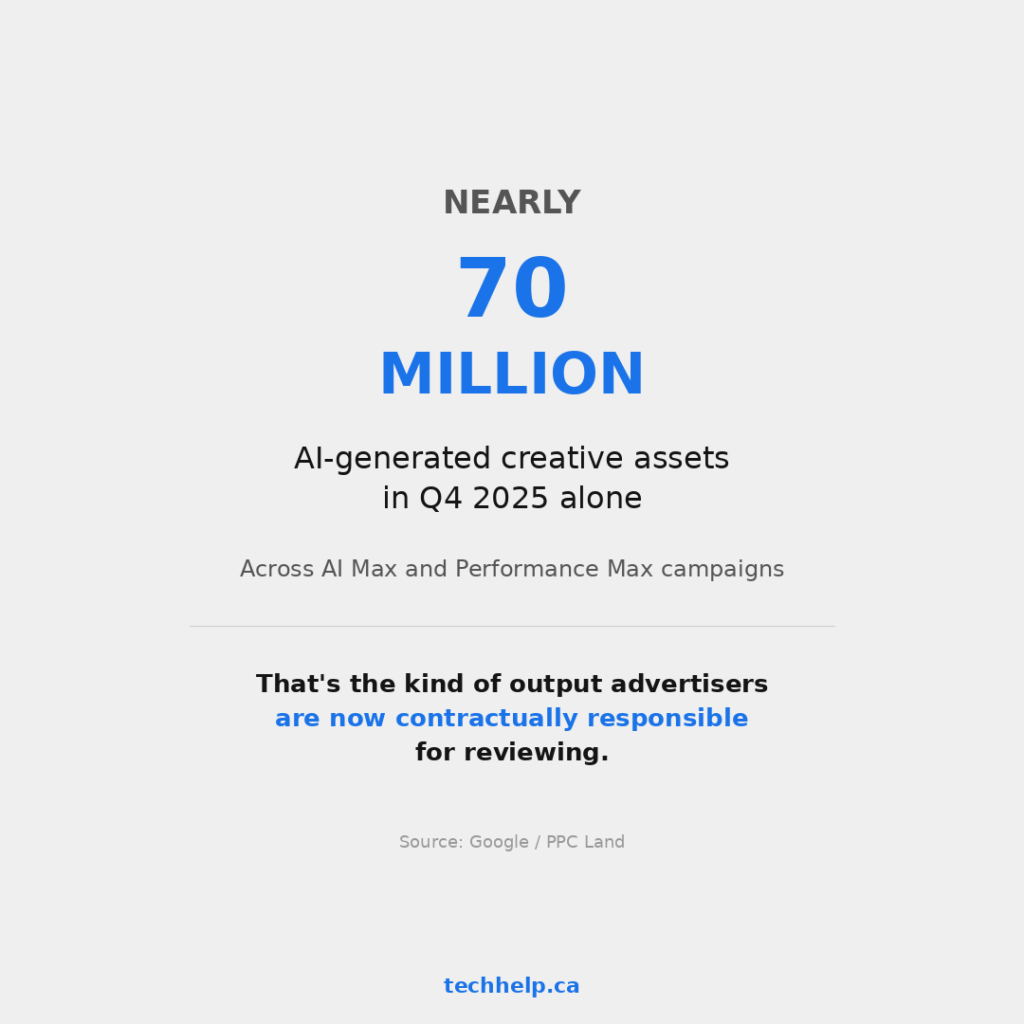
PPC Land reported that advertisers using Gemini-generated assets increased threefold in 2025, with nearly 70 million creative assets generated in the fourth quarter across AI Max and Performance Max campaigns. Google has also been pushing AI deeper into standard Search and Shopping workflows.
The most visible shift is Dynamic Search Ads. Google announced in April 2026 that Dynamic Search Ads, automatically created assets, and campaign-level broad match settings will begin upgrading to AI Max in September 2026. Existing DSA campaigns will transition, and advertisers won’t be able to create new DSA campaigns through Google Ads, Google Ads Editor, or the Google Ads API after the automatic upgrade begins.
That change matters because DSA has long been a practical tool for small businesses with large or changing websites. Instead of building every keyword and headline manually, Google crawled the site and generated relevant headlines and landing pages. AI Max moves that same logic into a broader AI-driven system with search term matching, text customization, and final URL expansion.
Google says AI Max for Search campaigns saw an average 7% lift in conversions or conversion value at a similar CPA or ROAS when advertisers used the full feature set compared with search term matching alone. That may be useful, but it also shows the direction of travel: Google wants advertisers to rely on more automated targeting and creative generation, not less.
The real risk is inaccurate claims
The danger isn’t that an AI-generated ad sounds a little awkward. The danger is that it says something your business can’t stand behind.
An automated headline could pull an outdated offer from an old landing page. A generated description could imply a service is available in a city where you don’t operate. A shopping ad could reuse feed language that sounds stronger than your actual warranty. A campaign could send users to a URL that technically exists but doesn’t match the promise in the ad.
Google’s own documentation on generative image tools makes the responsibility clear. Assets created by generative AI aren’t guaranteed to be approved by Ads Policy, and advertisers are told to review generated or suggested assets for accuracy, misleading claims, policy violations, and applicable laws before publishing.
That principle should be applied beyond images. If an automated system creates or assembles the ad, the business still owns the promise made to the customer. Google may generate the asset, but the advertiser’s name is attached to it.
This is where small businesses can get caught. A large advertiser may have legal review, brand safety workflows, and someone checking asset reports every week. A local service company may have a campaign launched months ago by an agency, a freelancer, or an employee who has since moved on. If automation keeps generating combinations in the background, nobody may be looking until a disapproval, suspension, or customer complaint arrives.
Be careful with broad AI label claims
Some compliance posts have framed 2026 as the year Google Ads requires visible “AI Generated” labels across every ad format using AI. That claim needs careful handling.
Google’s official Help Center pages do confirm several AI-related controls and disclosures. Generated images made inside Google Ads include identifiers such as open-standard markup and SynthID. Google also says generative AI content is subject to the same advertising policies as other content, including inappropriate content and misrepresentation. For certain political ads, Google Ads policy requires disclosure of manipulated media uploaded from third-party tools.
What Google’s public Help Center pages don’t clearly support is a universal visible “AI Generated” label requirement for every Search, Display, YouTube, Shopping, and Performance Max ad that uses AI-assisted copy or creative. If that changes, advertisers should follow the updated policy. As of June 9, 2026, though, the safer position is to avoid treating third-party compliance blog posts as if they’re Google policy.
The practical rule is still the same: disclose where disclosure is required, don’t use synthetic or manipulated media deceptively, and don’t assume AI-created content gets a lower standard of review.
Agencies need clearer ownership
The updated terms also create a practical problem for agencies and clients.
Google’s Help Center language speaks to the advertiser’s responsibility to review, approve, or remove automatically generated campaigns and assets. It doesn’t carve out a separate exception for situations where an agency, freelancer, or media buyer manages the account day to day.
That doesn’t mean the agency is automatically liable for everything in a legal sense. Contract terms, access rights, approvals, and local law all matter. But it does mean the working relationship needs to be clearer than “Google handled it” or “the campaign was automated.”
If an agency enables Performance Max, AI Max, automatically created assets, or Final URL Expansion, there should be a written agreement on who reviews generated assets, how often review happens, what claims are off limits, and who has authority to pause or remove assets. Clients also need to keep landing pages, pricing, product feeds, offers, and service-area details current because Google’s systems can use those inputs.
The worst setup is shared ambiguity: the agency thinks the client owns the claims, the client thinks the agency watches the ads, and Google’s AI keeps producing assets neither side has reviewed carefully.
Costs are rising while control narrows
The terms update lands at a moment when many advertisers already feel pressure from paid search costs.
Search Engine Land’s CPC inflation analysis found rising costs across several datasets, including double-digit annualized growth for top search terms in managed accounts. Even when the exact increase varies by industry, the direction is familiar to anyone buying clicks: paid traffic is getting harder to treat as cheap experimentation.
That makes review discipline more valuable. If clicks cost more, waste hurts faster. If Google decides more of the targeting and creative mix, weak inputs and loose controls can become expensive quickly.
Text guidelines help, but they don’t replace review. Search Engine Land reported in February 2026 that Google expanded AI Max text guidelines globally, giving advertisers a way to steer AI-generated ad copy with natural-language rules. You can use guidelines to avoid certain phrases, keep claims within brand limits, or stop Google’s AI from mentioning competitors, unsupported discounts, or language that doesn’t fit.
That’s useful. It’s also defensive. You’re setting guardrails around a system that can still generate, test, and assemble ads at scale.
What advertisers should check before July 1
The new terms are scheduled to take effect on July 1. Don’t wait for a dramatic “accept” moment before treating this as operational work. Before that date, advertisers should run a short but serious audit.
Start with automated features. Open Google Ads and identify campaigns using Performance Max, AI Max, automatically created assets, Final URL Expansion, dynamic ad groups, campaign-level broad match upgrades, or generative image tools. If you don’t know which campaigns use these settings, that’s the first problem to fix.
Then review the assets Google has already created or assembled. Look at asset reports, ad previews, combinations, final URLs, generated images, headlines, descriptions, and policy warnings. The goal isn’t to admire performance. It’s to find claims, destinations, and wording you wouldn’t approve if a person had written them manually.
Next, check your source inputs. Google can only generate from what it can access or infer. Outdated landing pages, old discounts, weak product feeds, vague service pages, or inconsistent location information can become bad ad copy. If the page says “same-day service” but you can only deliver that in one city, the ad system doesn’t understand the operational nuance unless the inputs make it clear.
After that, set text guidelines where they’re available. Add terms Google should avoid, claims that require approval, pricing language that changes often, competitor names, sensitive categories, and brand phrases that shouldn’t be altered. Treat those rules as guardrails, not as a full approval process.
Finally, assign ownership. Someone needs to check AI-generated and automatically assembled assets on a schedule. Weekly is a reasonable starting point for active accounts, and high-spend or regulated accounts may need more frequent review. If an agency manages the account, document who owns the review process and how exceptions get escalated.
If your business uses AI tools across marketing, the same governance issue shows up outside Google Ads too. Tech Help Canada’s guide to AI ethics in digital marketing explains why disclosure, human review, data use, and customer trust can’t be treated as afterthoughts when automation touches public messaging.
Treat automation like a publisher, not a helper
Google’s July 2026 terms don’t mean every advertiser should panic or turn off every automated feature. Automation can find queries, assemble assets, and test combinations faster than most small teams can manage manually.
But the relationship has changed. If Google’s systems can generate more of what your customers see, then your review process has to mature too. You can’t treat AI-generated assets like suggestions sitting safely in a draft folder when some campaign types can already assemble and serve combinations dynamically.
The better mental model is this: Google Ads is becoming a publishing system that can create, adapt, and distribute messages for you. That can be powerful, but only if someone is acting like an editor.
Before July 1, review your automated campaigns, tighten your inputs, set guardrails, and make someone responsible for what goes live. The ads may be generated by Google’s AI, but the promise is still yours.
Tech Help Canada Staff researches, writes, and reviews practical content for business owners and professionals. Our coverage spans business, marketing, SEO, technology, and the tools and systems people use to grow and operate online. We focus on clear, useful information backed by research, hands-on experience, and editorial review. Learn more about our team and editorial standards. Need help with something? Contact Us