Google still controls its search engine. But in the UK, parts of that control now have legal limits and deadlines.
In June 2026, the UK’s Competition and Markets Authority (CMA) imposed three conduct requirements covering publisher content, organic rankings, and search-data portability. The measures reach into AI Overviews and AI Mode, require more transparency around material ranking changes, and will give publishers new control over how Google uses their content in generative AI.
Google has already started testing two related Search Console tools with a subset of UK website owners: a report showing where sites appear in generative AI search features and a switch that can remove an entire site from those features without using that choice as a ranking signal in regular Search.
The requirements were imposed in June, but most provisions come into force later in 2026. One page-level AI control isn’t due until March 2027. The rules are set, but Google is still building parts of the system that will deliver them.
How the CMA gained authority over Google Search
The CMA designated Google as having Strategic Market Status in general search and search advertising on October 10, 2025. The regulator found that more than 90% of UK searches took place on Google and that the company held substantial, entrenched market power.
The designation wasn’t a finding that Google had broken the law. It gave the CMA authority under the Digital Markets, Competition and Consumers Act 2024 to impose targeted requirements intended to promote fair dealing, open choices, and trust.
Google’s regular search engine, AI Overviews, and AI Mode fall within the designation. The standalone Gemini assistant doesn’t. However, the publisher requirement can still regulate how content collected through Google’s search crawlers is used in broader generative AI services, including Gemini and the Vertex AI API.
What the CMA imposed
The three requirements address different relationships with Google. One protects publishers whose content feeds Search and AI. One limits discrimination and adds transparency around organic ranking. The third lets UK users move certain search data to authorized services.
They become enforceable requirements on the dates below; they aren’t recommendations. The CMA can monitor Google’s compliance, require reports, investigate suspected breaches, and take enforcement action under the UK digital-markets regime.
The publisher requirement separates AI participation from regular Search
The publisher conduct requirement was imposed on June 3. Once in force, it will require Google to give publishers effective controls over content collected through Googlebot or another crawler serving the same search function.
Those controls must cover the training and grounding of Google’s search-based generative AI features and broader generative AI services. The CMA’s interpretative notes treat fine-tuning as part of training. Google also won’t be allowed to deliberately bypass a publisher’s choice by reacquiring the same content through another source, although the notes leave room for legally obtained open-source datasets.
For grounding in AI Overviews, AI Mode, and similar search features, publishers must eventually be able to withhold content at both the directory and individual-page levels. A publisher may want product pages cited in AI search while keeping premium reporting, subscriber content, or traffic-dependent articles out.
The requirement also covers three protections beyond opting out:
Google must provide detailed engagement data, including impressions, clicks, and click-through rates for publisher content used in generative AI search features.
Google must take reasonable steps to provide clear, accurate attribution and a clear way for users to reach the source.
Google won’t be allowed to penalize opted-out content in regular organic Search merely because the publisher exercised the control.
Most of the publisher requirement comes into force six months after the June 3 notice, on December 3, 2026. The page-level grounding control has a nine-month timeline and is due on March 3, 2027. The CMA expects important controls to appear before the final deadline, which is already happening through Google’s limited Search Console rollout.
Fair ranking sets rules for organic results
The fair-ranking requirement was imposed on June 17 and comes into force six months later, on December 17, 2026. It applies to organic web, image, and video results shown to people in the UK, including organic results inside AI Overviews and AI Mode. Paid search results are excluded.
Google will have to use objective, non-discriminatory criteria when ranking and presenting those results. It won’t be allowed to rank a publisher differently because the publisher buys Google ads, has another commercial agreement with Google, opts out of Google’s AI features, or exercises legal or contractual rights against the company.
Google will also have to apply the same objective criteria to its own products and equivalent third-party products. There is a limited testing exception for new search and generative AI features, generally capped at six months and only to the extent needed to evaluate the feature.
The notice rules are more specific than a general promise to warn businesses before every algorithm update. Google will have to provide information ahead of a “material change,” which the CMA defines as either an actionable change or a significant change Google can explain. Actionable changes require at least 30 business days’ notice. Significant and explainable changes require at least 15 business days.
Minor everyday ranking improvements don’t qualify. Google may also withhold details that would enable search manipulation or seriously harm legitimate commercial interests, although it will have to explain those exclusions to the CMA.
The requirement adds complaint routes too. Publishers will have to be able to submit feedback when a material change may harm the functioning of a UK market. Google will also have to provide substantive responses to reconsideration requests involving manual actions and an alternative dispute process for publishers manually excluded from its search index.
That is more accountability than publishers have today, but it isn’t a right to appeal every traffic decline or demand restoration of a previous ranking.
Data portability applies to search data, not every Google product
The third requirement was imposed on June 17 and comes into force three months later, on September 17, 2026.
Google will have to let third parties authorized by signed-in UK consumers access specified search data free of charge through effective portability tools. The covered information is data supplied or generated by those users while using Google’s general search services, within the scope defined by the requirement.
Google can comply by extending the Data Portability API it already operates for the European Economic Area to UK users on the same terms and standard. The measure is meant to help other businesses build services that users can switch to or use alongside Google Search. It isn’t a general right to export all data from products such as Maps, YouTube, or Gmail.
What the new Search Console report shows
Google launched dedicated generative AI performance reports alongside the CMA announcement. The reports are rolling out to a subset of websites for testing and separate AI visibility from the standard Search Console performance view.
The Search report covers impressions in AI Overviews and AI Mode. A separate Discover report covers generative AI features there. Website owners can inspect which pages appeared and break the data down by country, device, and date.
Clicks and click-through rates are missing from the initial version. An impression tells you that Google displayed a link to your site inside an AI feature. It doesn’t tell you how many people clicked, how much traffic the feature delivered, or whether that traffic produced revenue.
That gap makes an immediate opt-out decision difficult. The CMA’s publisher requirement calls for impressions, clicks, and click-through rates to be separated from other search activity, with an identifiable way for publishers to assess the value of those visits. The current report is a start, not the finished compliance system.
The current opt-out is broad, not granular
Google’s new Search Console control lets participating website owners remove their entire site from AI Overviews, AI Mode, and AI Overviews in Discover. Sites that opt out stop receiving traffic and impressions from those features but can remain in regular Google Search and the standard Discover feed.
Google says the choice won’t be used as a ranking signal outside its generative AI search features. The CMA requirement goes further by prohibiting Google from deliberately downranking or otherwise disadvantaging opted-out content in regular Search relative to participating content.
The current switch doesn’t cover Gemini, and it doesn’t yet provide the page-level choice the CMA requires for grounding in search AI. Google’s existing Google-Extended control addresses some training and broader generative AI uses, but the final system still has to satisfy the CMA’s wider control, transparency, and anti-circumvention requirements.
Google says it is testing the new Search Console tools with a subset of UK website owners before rolling them out globally. It hasn’t announced a date for broad availability.
Should you opt out of Google’s AI search features?
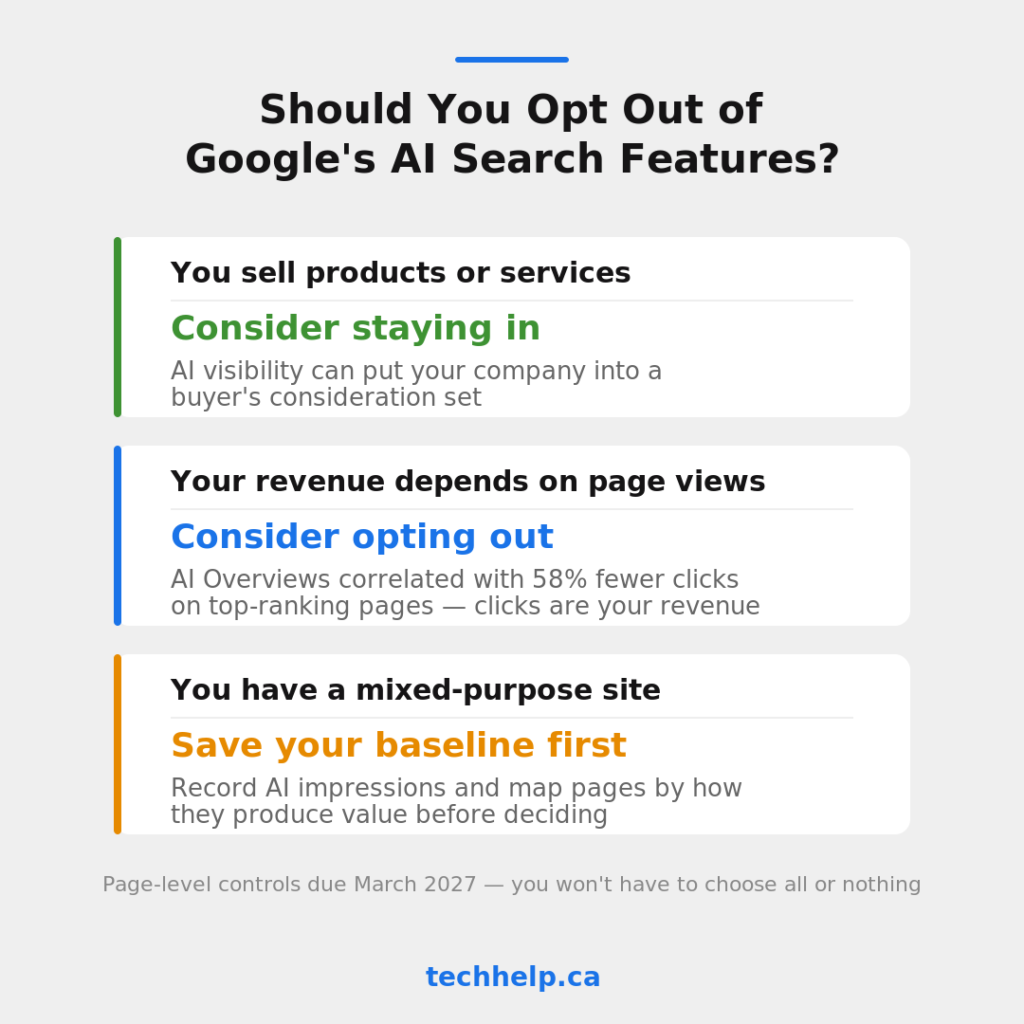
The answer depends on how each page creates value for your business. The current site-wide switch makes that decision harder because many websites contain pages with very different jobs.
If you sell products or services, AI visibility may help put your company into a buyer’s consideration set. A citation or product mention can create awareness even when it doesn’t produce an immediate click. Opting out removes that visibility as well as any traffic the feature might send.
If your revenue depends on page views, the trade-off is harsher. Publishers funded by advertising, affiliate commissions, or subscriptions need users to visit the original page. When Google answers the query itself, source attribution may not replace the lost session.
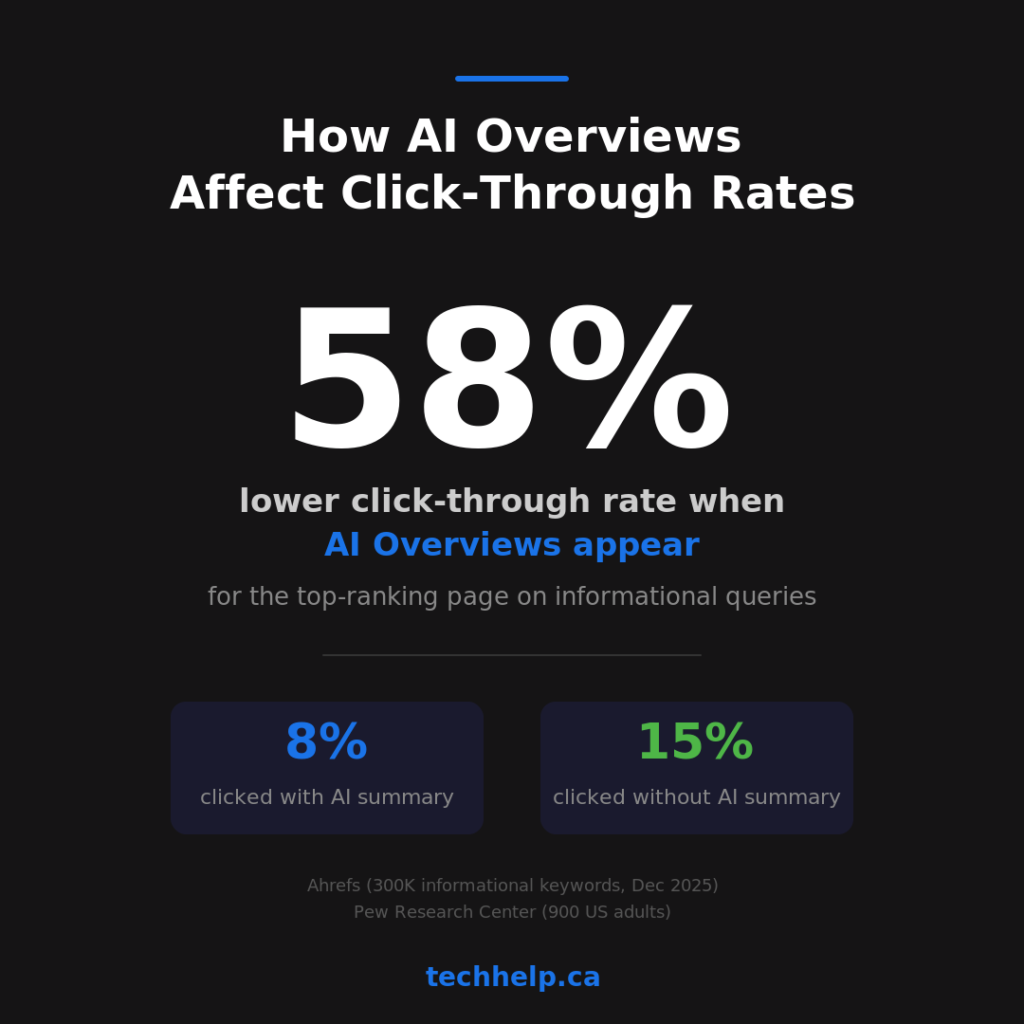
Two large studies show why publishers are cautious. Ahrefs analyzed 300,000 informational keywords and estimated that AI Overviews correlated with a 58% lower click-through rate for the top-ranking page in December 2025. Pew Research Center studied browsing behaviour from 900 US adults and found that users clicked a traditional result in 8% of visits with an AI summary, compared with 15% when no summary appeared.
Those figures don’t predict what will happen on every site. They cover different samples and methods, and commercial searches may behave differently from informational queries. Your business model and your own page-level results matter more than an industry average.
For most mixed-purpose business sites, the sensible move is to avoid treating the current toggle as a reflex. Record your AI impressions, preserve your traffic baseline, and map pages by how they produce value. When click reporting and granular controls arrive for your property, you’ll be able to make a better decision than the current all-site switch allows.
What fair ranking will and won’t change
The fair-ranking requirement doesn’t force Google to publish its algorithm. It doesn’t freeze rankings, prevent core updates, or guarantee that a site recovering from a traffic loss will regain its old position.
The transparency is also bounded. For changes to key ranking criteria, Google may explain the intended outcome without exposing the proxy signals used to calculate rankings. It can withhold details that would enable manipulation or seriously harm legitimate commercial interests. Publishers should receive more notice, not a public blueprint of Google’s algorithm.
The new feedback and dispute processes also create a record when a material change causes broader market harm or Google applies a manual action. That may give the CMA evidence it can use to investigate patterns instead of leaving every affected publisher to complain alone.
This is a meaningful change, but its value will depend on enforcement. The key test isn’t whether Google publishes more documentation. It is whether publishers receive enough notice and information to act, whether complaints receive substantive answers, and whether the CMA intervenes when Google falls short.
The UK rules can affect websites elsewhere
The conduct requirements apply to Google’s UK search activity and outputs shown to people located in the UK. A Canadian or American business doesn’t automatically gain the same legal rights for searches shown outside Britain.
The product impact will extend further. Google has said the new Search Console AI reports and opt-out control will roll out globally after the UK test, although it hasn’t provided a schedule. A company outside the UK may therefore receive the tools without receiving every protection or enforcement route created by the CMA.
A global interface isn’t the same as a global legal right.
What to do now
Start by checking Search Console for the generative AI reports and control. If they aren’t present, your property probably isn’t in the current test. Google says access will expand over time.
Next, save baseline data. Record organic traffic, conversions, revenue, rankings, and Search Console impressions for the pages most important to your business. The new AI impression report becomes more useful when you can compare it with what happened before and after access arrived.
Then classify your content by economic purpose. Separate product and service pages from ad-supported articles, subscriber material, original research, support documentation, and other resources. That map will help when directory- and page-level controls become available to your property.
Finally, watch the CMA and Google announcements rather than assuming the initial tools are finished. The controls, reporting, attribution rules, and complaint processes will develop across several deadlines:
September 17, 2026: the data-portability requirement comes into force.
December 3, 2026: most provisions of the publisher requirement come into force.
December 17, 2026: the fair-ranking requirement comes into force.
March 3, 2027: Google’s page-level grounding control is due under the publisher requirement.
Google Search now has enforceable boundaries
The CMA hasn’t taken control of Google’s algorithm, and it hasn’t guaranteed publishers more traffic. It has done something more targeted: set enforceable limits on discrimination, require notice for defined ranking changes, separate AI participation from regular Search, and demand better data about how publisher content performs inside generative AI features.
Google’s first Search Console tools don’t complete that work. The report lacks click data, the opt-out is site-wide, and the switch doesn’t cover every AI use addressed by the CMA requirement. Those gaps are exactly what the implementation deadlines are meant to close.
For website owners with access, the immediate advantage is visibility. Check whether the new report is available, save your baseline, and understand which pages need traffic versus which ones benefit from AI exposure. The decision to stay in or opt out should follow the economics of your content, not a blanket position on AI search.
Tech Help Canada Staff researches, writes, and reviews practical content for business owners and professionals. Our coverage spans business, marketing, SEO, technology, and the tools and systems people use to grow and operate online. We focus on clear, useful information backed by research, hands-on experience, and editorial review. Learn more about our team and editorial standards. Need help with something? Contact Us