
Most of the apps on this list became punchlines at some point. Some deserved it. Some got the last laugh, and a few cost their backers far more than any joke should.
Stupid apps are worth studying for a simple reason. When an app is built around one silly idea, there’s nowhere for the mistake (or the accidental good call) to hide. You can see exactly what the builders bet on and how the bet played out. The same bets show up in serious products every day, buried under more features and a nicer pitch deck.
Every app below is real, launched, and documented in reporting from the time, including one app-connected gadget that earned its spot. They’re listed in the order they appeared, from the early App Store days to 2025, with what actually happened and the lesson you can take into whatever you’re building, selling, or promoting.
1. I Am Rich (2008) charged $999.99 for nothing
On August 5, 2008, a German developer named Armin Heinrich released an iPhone app called I Am Rich for $999.99. It showed a picture of a red gem and a short mantra: “I am rich / I deserv it / I am good, healthy & successful.” Typo included.
That was the whole app. Eight people bought it. At least one buyer said the purchase was an accident, and Heinrich later said Apple had refunded two of them. Apple pulled the app the day after it launched, without explanation.
The price was the product. Nobody paid that much for a picture of a gem. They paid for what the price said about them, the same reason people pay extra for a designer label on a plain shirt. At $0.99, I Am Rich would have been a forgettable wallpaper app. At $999.99, it made headlines.
Your price talks before your product does. A low number can say “great deal” or “probably cheap.” A high one can say “premium” or “who do they think they are?” So when you set your pricing, decide what you want the number to tell people, then make sure the product backs that message up.
2. iFart (2008) topped the App Store with a joke
In September 2008, Apple rejected an app called Pull My Finger, telling its developers it was “of limited utility to the broad iPhone and iPod touch user community.” By mid-December, Apple had reversed course and approved it, and fart apps poured into the store.
iFart Mobile, from Joel Comm’s company InfoMedia, made the most of the opening. The $0.99 app held the top overall spot on the App Store and was pulling in around $10,000 a day in late December 2008. Comm later said it sold about 800,000 copies between 2008 and 2010.
Then everyone else showed up. By June 2010, TechCrunch was calling iFart a “former App Store king,” and Apple had rejected its iPad version for “minimal user functionality.” By 2016, there were more than 1,200 fart apps across Apple’s App Store and Google Play. And in June 2026, Apple’s revised review guidelines put fart and burp apps on a list of app types that “are mediocre, low-quality, or low-effort and do not add value to the App Store.”
A new channel’s early window closes fast. It’s hard to argue iFart got to the top on quality alone. It was a decent version of a silly idea, released when the App Store was five months old and Apple had only just let fart apps in.
You’ll see the same pattern whenever a new channel opens, whether it’s a social platform, an ad format, or a new kind of search. Early movers often get outsized attention for average work. If you spot one of those windows, move quickly. But put some of what you earn into something the copycats can’t recreate by next quarter, because they’re coming.
3. Whopper Sacrifice (2009) traded your friends for a burger
In January 2009, Burger King launched a Facebook app with a simple offer: unfriend 10 people and get a coupon for a free Whopper. The campaign came from Crispin Porter + Bogusky, and its cruelest touch was also its smartest. The app told each dumped friend they’d been traded for a burger, which invited them to try it too.
It worked. More than 82,000 Facebook users installed the app, and 233,906 friendships ended in about a week. Then Facebook stepped in. Unfriending was supposed to be silent, and the notifications broke that expectation. Facebook told Burger King to make the app more discreet, and Burger King ended the campaign instead. The site’s sign-off read, “Whopper Sacrifice has been sacrificed.”
If someone else owns the off switch, build on land you own. The notification that made Whopper Sacrifice spread was the same feature that got it shut down, and the rule it broke belonged to Facebook. Any campaign that runs inside someone else’s platform runs on that platform’s terms, and those terms can change mid-campaign.
Nearly a decade later, Burger King ran a very different stunt. In December 2018, Whopper Detour lived inside the company’s own app: get within 600 feet of a McDonald’s, and you could order a Whopper for one cent. It drove 1.5 million app downloads, and Burger King said its app was the most downloaded in Apple’s App Store for several days. This time, the campaign ended on Burger King’s schedule, and every install went to Burger King’s own app.
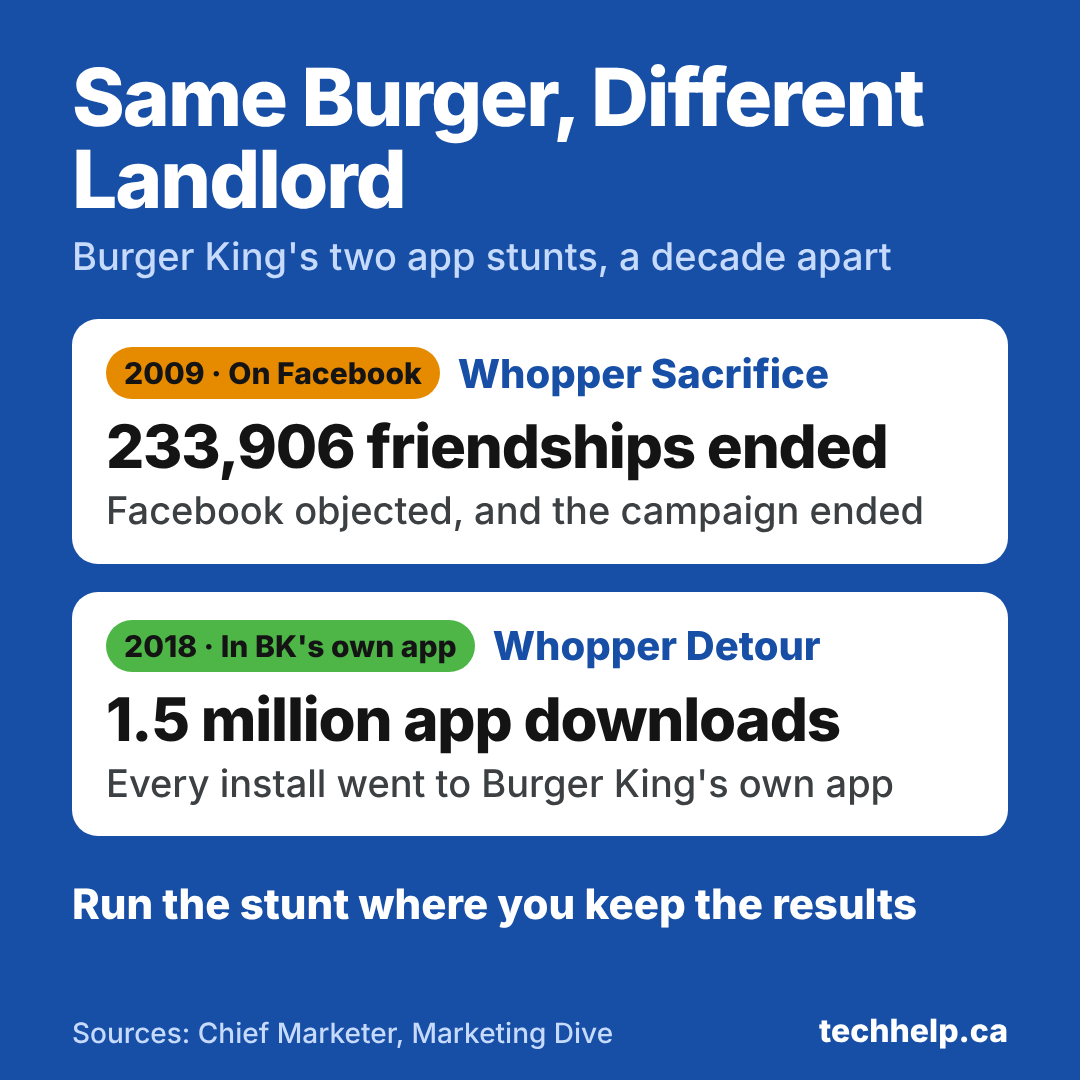
Use other platforms for reach. Just make sure the thing you walk away with, whether that’s an email list, app installs, or customer data you’re allowed to keep, belongs to you.
4. Color (2011) raised $41 million and launched into empty rooms
Color launched on March 23, 2011, already holding $41 million in funding, including $25 million from Sequoia Capital. The idea was bold. There was no friends list and no followers. The app shared your photos with anyone using Color within 150 feet of you, and people you didn’t keep running into slowly faded from your feed.
The trouble started the moment people opened it. If nobody nearby had Color, there was nothing to see. A writer at The Next Web, testing it in Manchester, England, said he was “posting pictures to myself.” The app even warned users, “Do not use Color alone!” It sat at two stars in the App Store. By June, TechCrunch was writing that “nobody is using the app,” and by October 2012, reports said Color was winding down.
If your product needs other people, it needs them close together first. Color launched everywhere at once, so many early users landed in empty rooms. Tech blogger Robert Scoble argued at the time that it should have rolled out city by city, starting with San Francisco and New York, so early users would actually find each other.
That advice fits any product whose value depends on other users: marketplaces, communities, review sites, group tools. Pick one city, one campus, one industry, or one niche, and make the product feel full there before you open the doors anywhere else. Ten active people in one place usually beat a thousand scattered ones.
5. Facebook Poke (2012) copied Snapchat in 12 days
By late 2012, Snapchat was sitting near the top of the App Store charts, and Facebook wanted in. A small team built Poke in about 12 days, with Mark Zuckerberg reportedly writing some of the code himself. It launched on December 21, 2012, for sending photos, videos, and messages that disappeared after a few seconds. It hit #1 on day one. Less than two weeks later, Fortune noted it had already fallen out of the top 50, while Snapchat hovered around #4. Facebook pulled Poke from the App Store in May 2014.
A copy needs a reason to switch or an audience that’s already there. Facebook copied Snapchat again in August 2016 with Instagram Stories, and by June 2017, Stories had 250 million daily users to Snapchat’s 166 million. Poke had asked people to download a new app to do something they could already do on Snapchat, with friends who were already there. Stories put the same idea inside Instagram, which had 700 million users by the time Stories passed Snapchat.
If you’re copying a competitor’s feature, you need a clearly better version or an audience you can bring it to. Without either, you’re asking people to move for nothing new.
6. Yo (2014) raised $1.5 million for one word
Yo launched on April Fools’ Day 2014. Its developer, Or Arbel, reportedly built it in about eight hours, and it did exactly one thing: send the word “Yo” to a friend. No text and no photos.
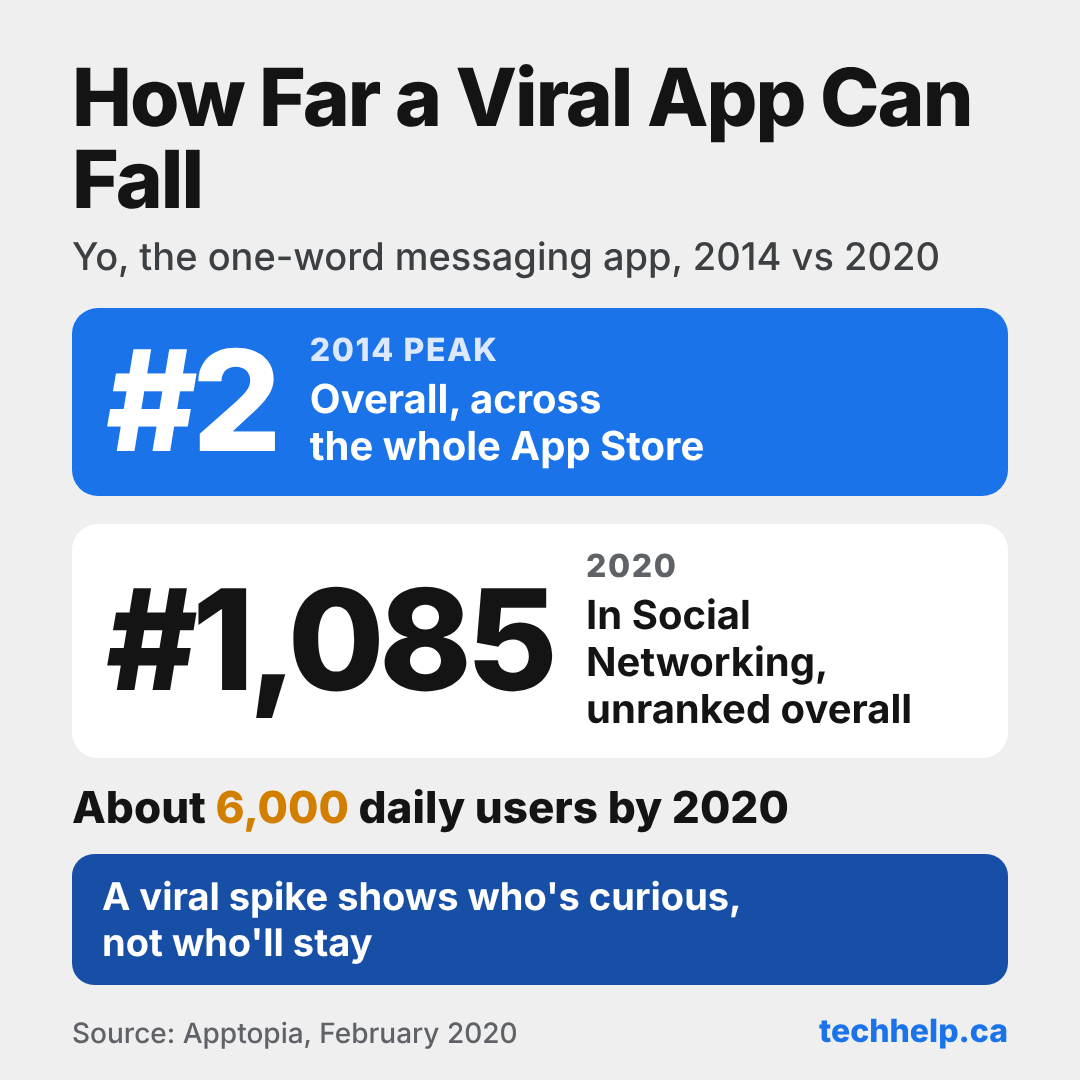
It went viral that June and, at its peak, ranked #2 overall in the App Store, according to analytics firm Apptopia. That same month, three Georgia Tech students hacked it and got access to users’ phone numbers. Arbel hired one of them. In July, Yo closed $1.5 million in seed funding at a $10 million valuation.
The attention didn’t last. TechCrunch put it bluntly in early 2015: “Most of those users quickly evaporated because Yo wasn’t very useful.” By then, Yo was leaning into alerts, from World Cup goal notifications in 2014 to a 2015 store of alerts from about 150 sources. By 2020, Apptopia estimated it had about 6,000 daily users.
Downloads measure curiosity, not value. Yo’s early numbers were big enough to win over investors. But a spike in downloads only tells you people were curious enough to try something. What they do in week two tells you whether they need it.
Yo’s more useful idea showed up later. A one-tap alert means something when the context is obvious: your team scored, your package arrived, a price moved. By the time Yo found that use, most of its early users were gone. Whatever you launch, track what people do after the first visit or download from day one, and treat a viral spike as a chance to learn what keeps people around.
7. Peeple (2015) tried to put star ratings on people
In fall 2015, Julia Cordray and Nicole McCullough announced an app that would let you rate other people from one to five stars, the way you’d rate a restaurant. Reviews would cover professional, personal, and romantic relationships. All anyone needed to create a profile for you was your phone number.
The detail that set people off was that you couldn’t remove yourself. If you joined, you couldn’t delete a bad review. If you didn’t join, only positive reviews would show, but anyone with your number could still list and rate you. The company, valued at $7.6 million, said it wanted to “spread love and positivity.” Within days, the backlash was everywhere and the company’s website was offline.
Peeple did launch in March 2016, in a softer form that let members choose which reviews appeared on their profiles. But Cordray also told TechCrunch the company was considering a paid “Truth License” that would let subscribers read everything written about someone, including reviews that person had chosen to hide.
The people your product affects get a vote, even if they never sign up. Peeple’s raters were its users. Everyone else was its raw material, and nobody asked them. The people being rated had every reason to fight the product and no reason to want it.
List everyone your product touches, including people who’ll never pay or download. Then picture the most skeptical of them reading a headline about you. If their reaction is “Wait, I can’t opt out of this?”, fix the product before you announce it.
8. Juicero (2016) built a $400 juicer your hands could replace
Juicero sold a Wi-Fi-connected juice press for your kitchen. You loaded a sealed pack of chopped produce, the machine read a QR code on the pack and checked it against an online database to make sure it hadn’t expired or been recalled, and then it squeezed. Hard. The company said the press applied four tons of force.
The press cost $699 when Juicero announced it in March 2016, with packs priced at $4 to $10 each. The price dropped to $399 in January 2017. Investors, including Google’s venture arm and Kleiner Perkins, put about $120 million into the company.
Then, in April 2017, Bloomberg reporters squeezed the packs by hand. They got nearly the same amount of juice, just as quickly and in some cases faster. Juicero’s response was that most people would still prefer the machine because the process was “more consistent and less messy.” The report set off a wave of mockery. On September 1, 2017, Juicero suspended sales of the press and packs and offered refunds on the machine.
Your toughest competitor might be free. Juicero’s press was a serious piece of engineering. It still couldn’t beat the free option attached to every customer’s wrists. Customers compare you to other companies, but they also compare you to doing nothing, doing it themselves, or using something they already own.
Ask the uncomfortable question early: if your product disappeared tomorrow, what would your customers do instead? If the honest answer is “about the same thing, slightly messier,” then you’re selling convenience, and you’d better be sure people will pay your price for it.
9. Binky (2017) built a social network where nothing happens
In June 2017, developer Dan Kurtz released Binky, a free iPhone app that looks and feels like social media. You scroll an endless feed of random images, like llamas, hot sauce, and historical figures. You can like them, swipe them, “re-bink” them, and type comments, but none of it goes anywhere. Nobody sees your likes, and nothing you do has consequences.
Kurtz called it “a nicotine patch for social media” and said it “started out as a joke.” It came from a real question, though. He’d noticed he couldn’t remember what he’d read on social media and wondered whether random images would hold his attention just as well. As he told NPR, “It turns out the answer is yes.”
Know whether people want the content or the ritual. Binky stripped social media down to the motion: the scroll, the tap, the small hit of something new. Kurtz’s experiment suggested that motion carries more of the appeal than most people would admit.
Try that test on your own product. When people open it, are they coming for the content, the result, or the ritual of opening it? If it’s the ritual, don’t bury it under new features. If it’s the result, a pleasant ritual won’t save you when the result disappoints.
10. Quibi (2020) raised $1.75 billion and didn’t last a year
Quibi had everything money could buy. Hollywood veteran Jeffrey Katzenberg and former eBay and HP chief executive Meg Whitman raised $1.75 billion from backers including Disney, NBCUniversal, and Viacom. They lined up stars like Reese Witherspoon, Steven Spielberg, and Jennifer Lopez. Quibi launched on April 6, 2020, with shows split into “chapters” under 10 minutes, made to watch on a phone.
The timing was rough, since much of the world was stuck at home. The product didn’t help. At launch, you couldn’t take screenshots or share clips to Twitter, Facebook, Instagram, TikTok, or Reddit, and options for watching on a TV came later and slowly.
In May, Katzenberg told The New York Times, “I attribute everything that has gone wrong to coronavirus. Everything. But we own it.” On October 21, 2020, Quibi announced it was shutting down. In their letter, Katzenberg and Whitman offered two possible reasons: “because the idea itself wasn’t strong enough to justify a standalone streaming service or because of our timing.” The app’s final day was around December 1.
Build for how people actually behave, and never block the behavior that spreads you. Quibi bet on one situation, which its CTO described as “these in-between moments,” and made it hard to use the product any other way. When the pandemic kept people at home, that bet looked even worse. Blocking screenshots and sharing also cut Quibi off from the way short video usually travels, which is people passing clips to each other.
Check how people already behave in your category before you lock your product into one way of being used. Then make the actions that bring in new users, like sharing, recommending, and showing a friend, as easy as you can. A product that can only grow through paid marketing has to keep paying for every new user.
11. Tea (2025) exposed the selfies and IDs its users trusted it with
Tea Dating Advice was built as a women-only space where users could ask about, and warn each other about, men they’d met while dating. To keep it women-only, Tea verified new users with a selfie and, until 2023, a photo ID. In July 2025, it shot to the top of the U.S. App Store.
That same week, Tea confirmed unauthorized access to a “legacy data storage system.” The exposed data included about 72,000 images, among them roughly 13,000 verification selfies, some showing photo IDs. Tea had pledged to delete verification images once review was complete. It said it had kept these to comply with law enforcement requirements related to cyberbullying prevention. A second exposure followed, involving about 1.1 million private messages. In October 2025, Apple removed Tea from the App Store, saying it didn’t meet requirements for moderation and user privacy.
If the concept sounds familiar, it should. Reviewing people who never signed up is close to what Peeple pitched a decade earlier. But Tea’s most damaging failure was its database.
Every piece of data you keep is a liability you’re responsible for. Tea collected selfies and IDs to make the app safer, and holding on to them created the most dangerous files the company had. The breach also came from an old system rather than the new one, which is a common place for forgotten data to sit.
You don’t need to run a dating app for this to apply. Customer lists, intake forms, uploaded documents, and old CRM exports all count. If you don’t need it, don’t collect it. If you promised to delete it, delete it and confirm the deletion happened. And put old systems on your security checklist, because the data you’ve forgotten about is the data nobody’s protecting.
What the dumbest apps have in common
Sort this list two ways, by how silly each idea sounded and by how much money it lost, and the two rankings barely line up. The silliest apps here were simple to build, and some of them made money. The biggest losses came from ideas that sounded serious. Quibi raised more than 40 times what Color did and still shut down faster.
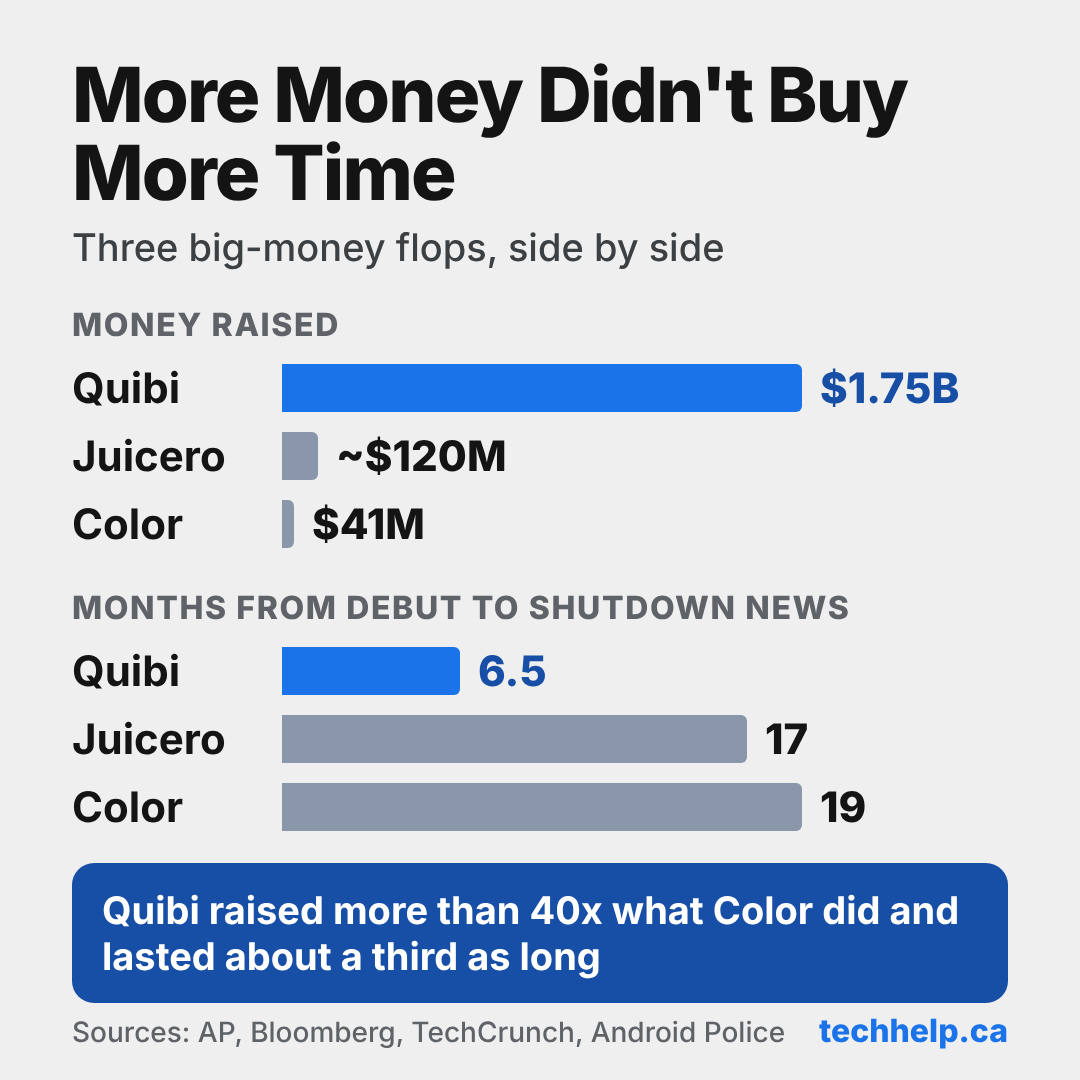
The stupid apps that worked knew exactly what they were. I Am Rich was a status joke, iFart was a novelty, and Whopper Sacrifice was a stunt. None of them needed the market to believe anything unproven. Color, Juicero, and Quibi each put tens of millions of dollars or more behind a belief about their customers that a cheap test could have challenged first.
So before you build, write down the one belief your product can’t survive being wrong about. Then find the cheapest way to test it this week, whether that’s a landing page, a waitlist, a one-week pilot, or a pair of bare hands and a bag of juice. A silly idea can survive being laughed at. An untested one still has to survive the market.

I can suggest related Tech Help Canada articles based on the topic you’re reading now.

Tech Help Canada Staff researches, writes, and reviews practical content for business owners and professionals. Our coverage spans business, marketing, SEO, technology, and the tools and systems people use to grow and operate online. We focus on clear, useful information backed by research, hands-on experience, and editorial review. Learn more about our team and editorial standards. Need help with something? Contact Us