On paper, You Can See Everything had plenty working against it. It’s a documentary. It runs 174 minutes. Its subject is Elizabeth Holmes and the Theranos scandal, which most people feel they already know. And A24 opened it in just 855 North American theaters.
Audiences showed up anyway. The film opened to an estimated $15 million (all figures in U.S. dollars), according to A24’s Sunday estimate. That’s good for No. 2, behind Paramount’s Street Fighter and ahead of 20th Century Studios’ Whalefall, a $60 million production.
Nathan Fielder (The Rehearsal) and Lance Oppenheim directed the film, which begins 34 days before Holmes reported to federal prison to start a sentence of more than 11 years for defrauding investors. The box office numbers make the headline. For anyone launching a product, the better question is how a subject that seemed exhausted got people to buy a ticket.
The numbers behind the surprise
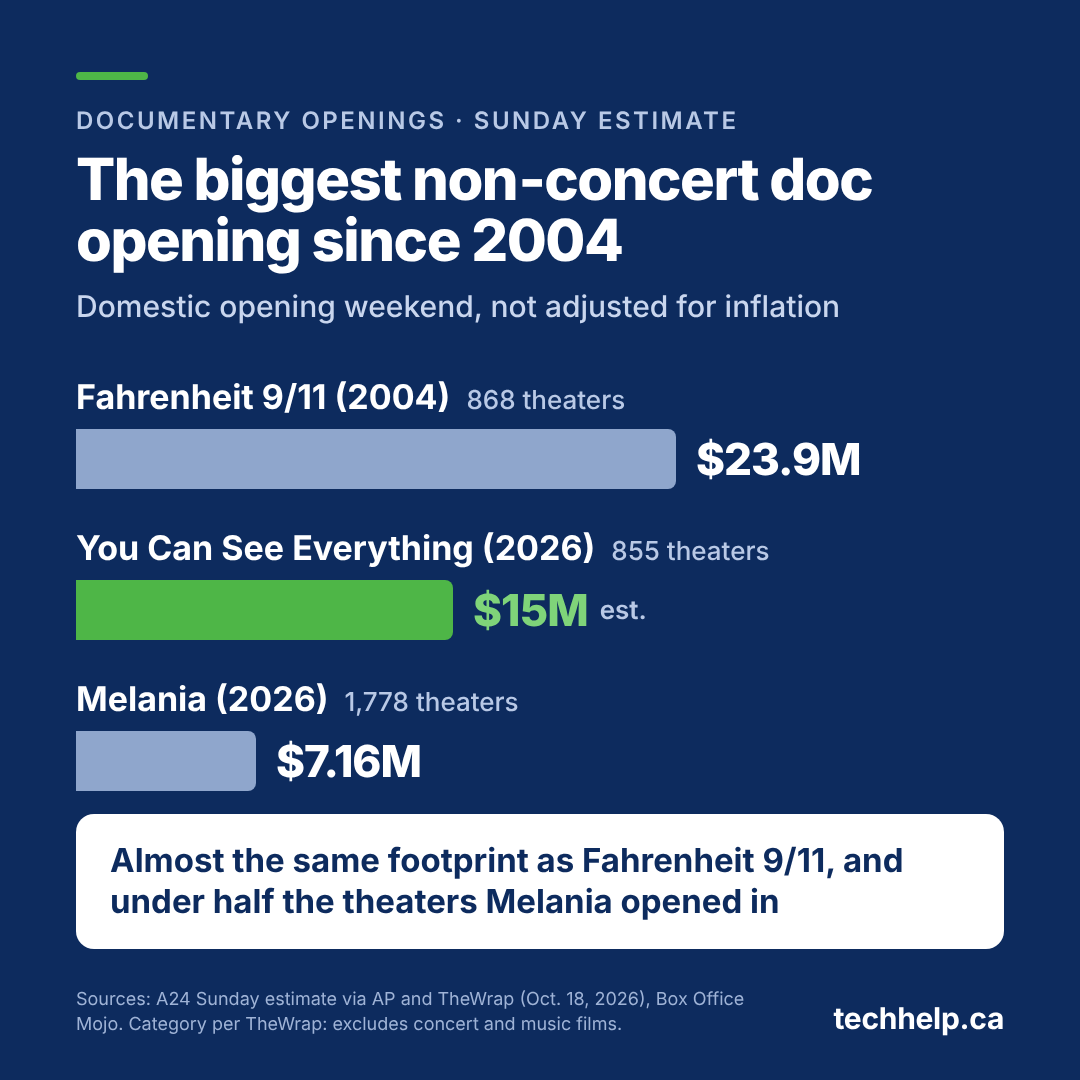
Before the weekend, Variety reported forecasts of a $7 million to $8 million opening. The film roughly doubled that. If the Sunday estimate holds, it’ll be the biggest opening for a documentary outside the concert and music category since Michael Moore’s Fahrenheit 9/11, whose $23.9 million debut in 2004 remains the category record, according to TheWrap. Neither figure is adjusted for inflation.
The opening also clears the most recent benchmark by a wide margin. Amazon MGM’s Melania opened to $7.16 million from 1,778 theaters in early 2026, which TheWrap counted as the biggest non-music documentary opening since the pandemic.
The figures for You Can See Everything and its competitors are Sunday studio estimates for Oct. 16–18, with final numbers expected Monday, Oct. 19.
A familiar scandal with one thing missing
By the time this film arrived, the Theranos scandal had been covered from just about every angle. John Carreyrou’s book Bad Blood came out in 2018. HBO’s documentary The Inventor followed in 2019, and Hulu turned the saga into a scripted series, The Dropout, in 2022. Fielder had read Bad Blood and, according to the Los Angeles Times, initially saw little reason for another documentary.
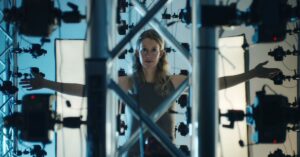
None of those projects had Holmes’s participation. She didn’t take part in either of the two earlier feature documentaries about her, The New York Times reported. This time, she and her partner, Billy Evans, opened their rented home in Southern California to a camera crew, in what the Times described as her effort to clear her name. Fielder had planned to stay behind the camera, but his interactions with the couple became so unsettling that he took a central role on screen.
Nobody can say for sure how much of the turnout came from Holmes’s notoriety, Fielder’s following or the reviews. What’s clear is that the film offered something none of the others could, a look at Holmes herself, at home, in her last weeks before prison.
That’s the part worth stealing for any business staring at a crowded market. A topic can be saturated while a particular view of it is still wide open. Content marketers often skip subjects because competitors already rank for them, when a better question than “has this been covered?” is “what can we show that nobody else can?” The answer might be first-hand experience, a company’s own customer data or a behind-the-scenes look at how the work gets done. People who know the broad strokes can still be curious about the part they haven’t seen.
Three years of secrecy, then a short runway
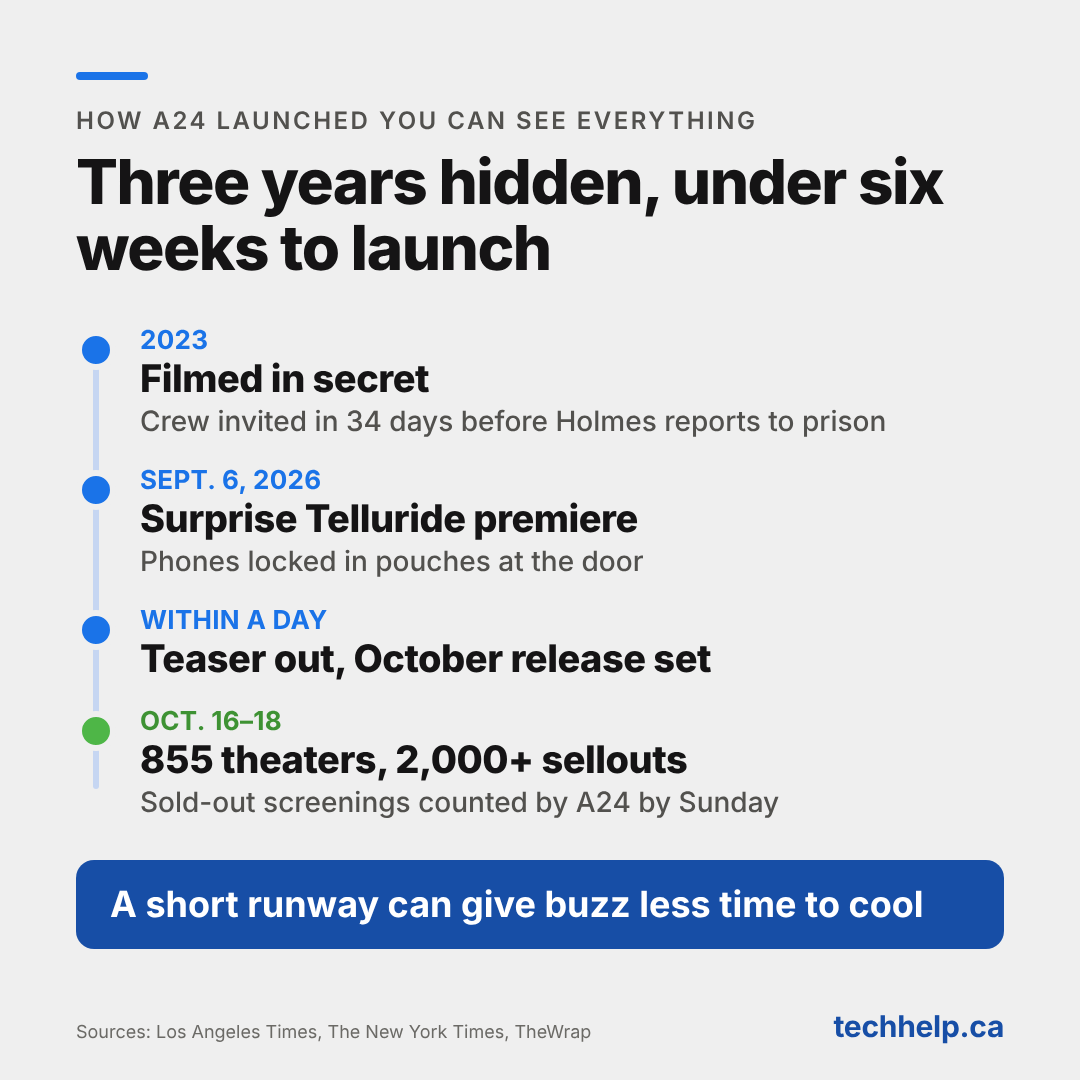
Fielder and Oppenheim made the film largely in secret over three years. It premiered at the Telluride Film Festival on Sept. 6 in an unannounced slot, and the audience found out what they were watching only after they’d taken their seats. According to the Los Angeles Times, moviegoers had to lock their phones in pouches before entering, while security guards with night-vision goggles watched for anyone with an accessible phone.
A24 released a teaser within a day of the premiere and announced that the film would open in October. Its Oct. 16 release left just under six weeks between the public reveal and opening day, much shorter than the months-long campaigns big studio releases often get.
The secrecy didn’t end at Telluride. Fielder and Emma Stone, who moderated the post-screening Q&A, asked viewers not to spoil where the film goes. When it played the New York Film Festival, the festival agreed with A24 to hold back video of its post-screening Q&A until after opening weekend, IndieWire reported.
For a small business, the takeaway is about curiosity. When the only way to find out what happens is to experience it before someone spoils it, waiting has a cost, and that can give people a reason to act early. A short runway can help preserve that interest by giving it less time to cool between the announcement and the moment people can buy. That only works when people already have a reason to care about the reveal and enough information to judge whether the offer is for them, so it won’t suit every launch. Where it does fit, a product launch or a one-off event can borrow the structure by keeping the reveal close to the date sales open.
There’s an irony in all this. Theranos ran on secrecy too, spending years in stealth mode, and that secrecy made it harder for outsiders to see that its technology couldn’t do what the company claimed. The difference is what the secrecy protected. Critics have been close to unanimous on You Can See Everything, which holds a 99% critics score on Rotten Tomatoes. Holding something back can build anticipation, but only a product that delivers turns it into goodwill. Otherwise, it just delays the letdown.
Fewer theaters, more money per theater
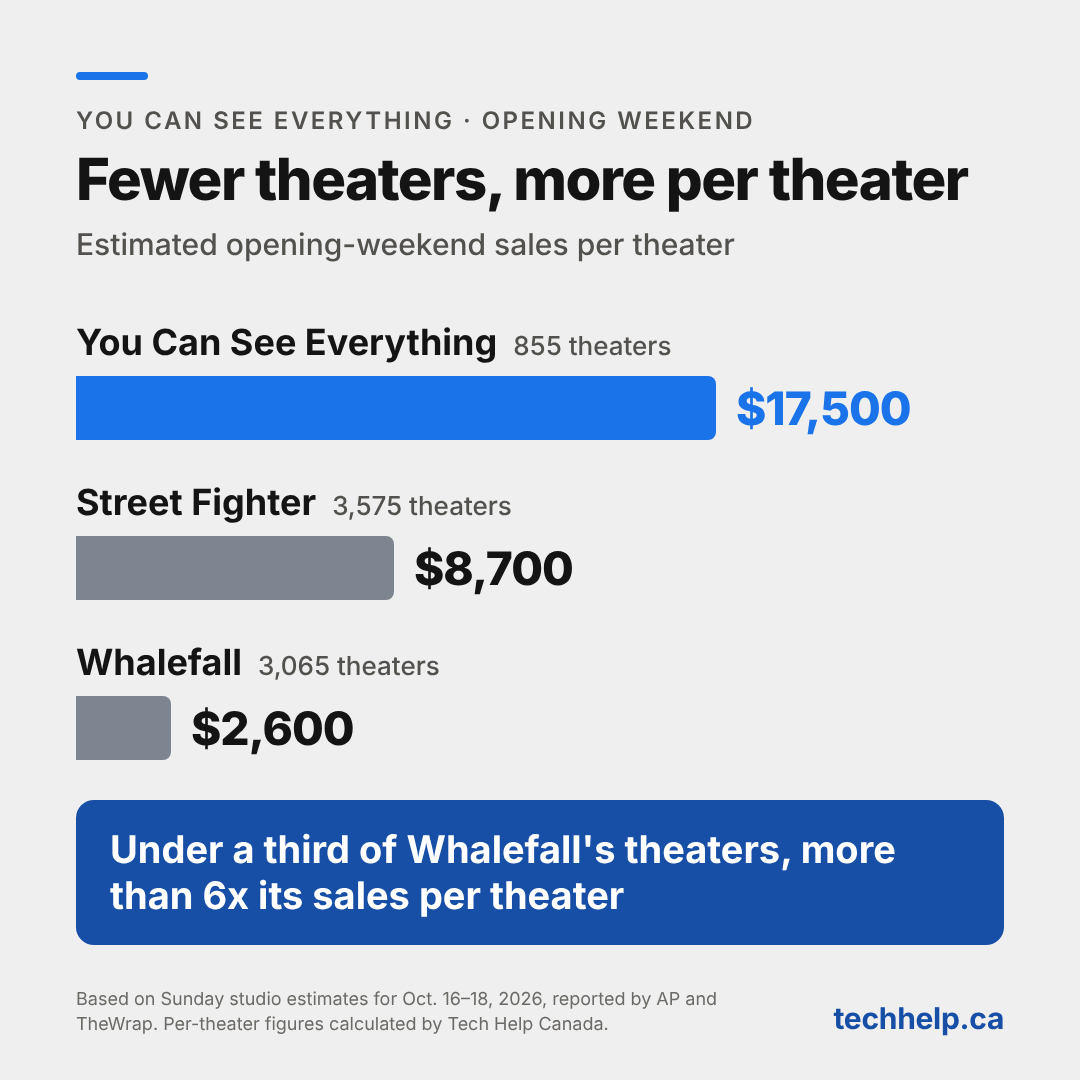
Street Fighter opened in 3,575 theaters and Whalefall in 3,065. You Can See Everything got far more out of its 855. Based on Sunday’s estimates, that works out to roughly $17,500 in ticket sales per theater, compared with about $8,700 for Street Fighter and about $2,600 for Whalefall. TheWrap reported that A24 counted more than 2,000 sold-out screenings as of Sunday morning.
Fahrenheit 9/11 is a useful comparison. It opened in 868 theaters in 2004, almost the same footprint, and expanded to 1,725 theaters the following weekend, according to Box Office Mojo.
A concentrated launch can help a business test demand in its strongest market before taking on the costs of expansion. A small launch that sells out provides evidence that people want the offer at the price and capacity available. Starting where interest is strongest can make that first result easier to interpret.
A small bet with a built-in exit
When A24 signed on, it wasn’t committing to a finished movie. According to the Los Angeles Times, the studio gave Fielder and Oppenheim no deadline and no obligation to deliver a film, and Fielder recalled being told, “you can just throw everything away.” TheWrap reported that the deal came together less than two months before Holmes’s sentence began, and that the filmmakers shot with a seven-person crew.
Costs stayed modest, too. Production and marketing combined reportedly came in under $20 million, according to TheWrap’s preview ahead of the release. Whalefall’s production budget alone is more than three times that, before any marketing spend. Box office revenue isn’t profit, of course. Theaters keep a large share of every ticket, and an opening weekend is only the start of a film’s run.
The arrangement gave the filmmakers room to explore without promising a finished film, while Holmes’s approaching prison date put a limit on the opportunity to film her at home. Small businesses can adapt that approach by setting a spending cap before testing a new product or partnership and agreeing in advance when to continue or walk away. Permission to quit is often what makes it possible to start.
What the second weekend will reveal
An opening weekend measures the first rush of ticket sales. The weeks that follow test whether demand lasts and reaches beyond the initial audience, though any expansion in theater count will also affect the total. Forbes reported on Oct. 16 that A24 planned to expand the film nationwide starting Oct. 23, while TheWrap reported on Saturday that A24 hadn’t announced whether it would go wider.
The early audience data looks encouraging. PostTrak exit polling put the film’s “definite recommend” score above 90%, according to TheWrap and Deadline, and Deadline reported that 62% of early audiences were between 18 and 34. Reach is the open question. Before the weekend, Box Office Theory pointed to strong interest in metro markets but said the film’s appeal beyond them and A24’s core cinephile audience may be more limited.
For a business, a strong launch can show that the core audience turned up. The next questions are whether those buyers return, whether they bring others along and whether people outside the core respond the same way. A strong launch demonstrates early demand. The second wave tests its staying power.
Get new small business insights by email
Practical ideas and useful articles to help you make better business decisions.
Tech Help Canada Staff researches, writes, and reviews practical content for business owners and professionals. Our coverage spans business, marketing, SEO, technology, and the tools and systems people use to grow and operate online. We focus on clear, useful information backed by research, hands-on experience, and editorial review. Learn more about our team and editorial standards. Need help with something? Contact Us