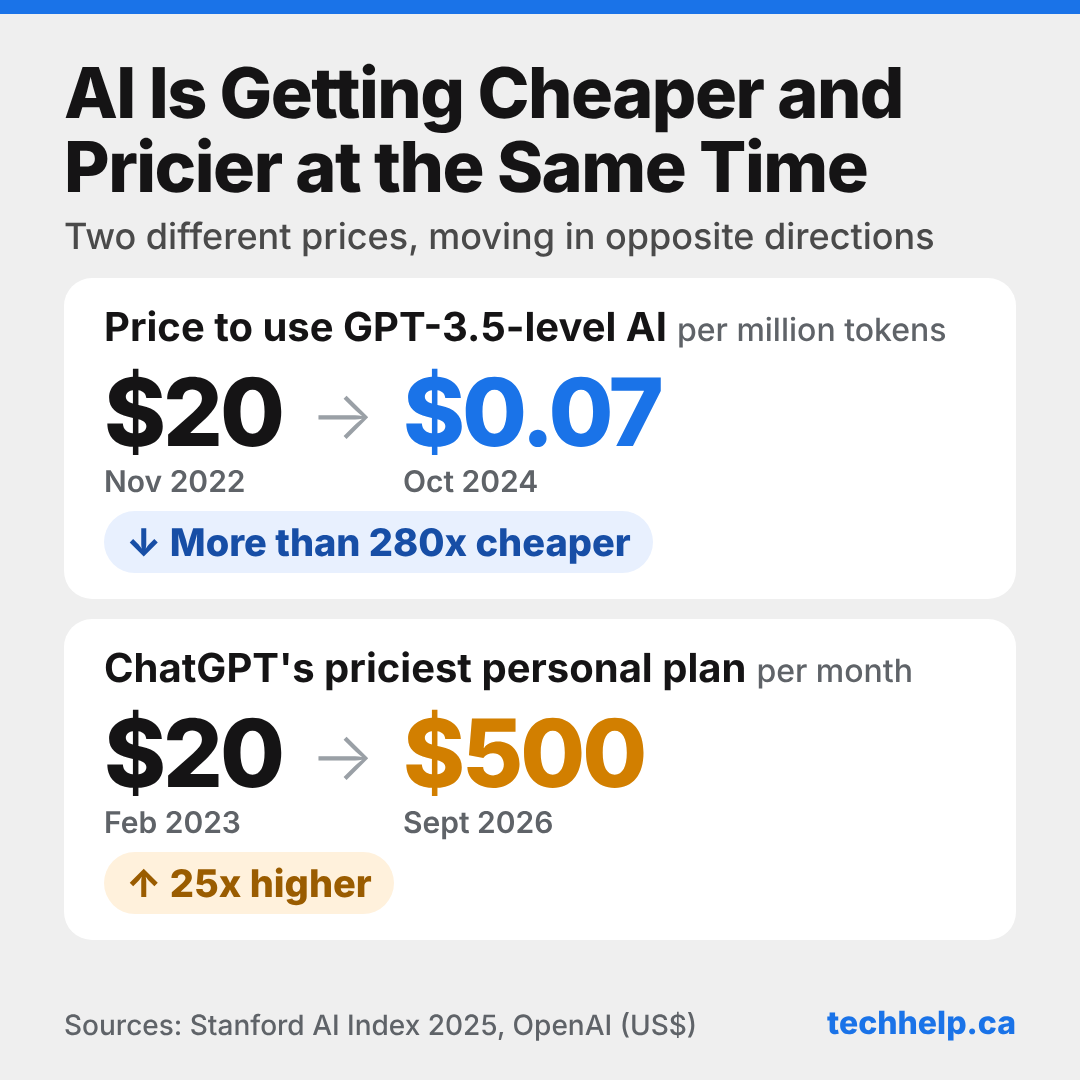
In early 2023, the priciest ChatGPT plan cost US$20 a month. Today, OpenAI’s top personal plan costs US$500.
AI has made it cheaper to start and run a business, because one person can now handle much of the work that used to take a team. But while the US$20 plans have kept improving, the most capable versions of these tools increasingly sit on pricier plans.
That raises a question bigger than whether US$100 or US$200 is too much to pay for a subscription. Almost anyone can get access to AI now. Will everyone be able to afford enough of it to compete?
Here’s how ChatGPT and Claude plans have expanded since 2023:
When
What changed
Feb 2023
OpenAI launches ChatGPT Plus at US$20/month, promising access during peak times, faster responses and priority access to new features
Sept 2023
Anthropic launches Claude Pro at US$20/month with five times the free tier’s usage
Dec 2024
OpenAI launches ChatGPT Pro at US$200/month, including o1 pro mode, which it said “uses more compute to think harder”
Apr 2025
Anthropic launches Claude Max at US$100 and US$200/month, built around higher usage limits and priority access to new models and features
Apr 2026
OpenAI adds a US$100 Pro tier for “longer, high-intensity” sessions in Codex, its coding tool
Sept 2026
OpenAI adds a US$500 Pro tier with its biggest usage allowance, 25 times what Plus includes
Where this goes isn’t settled yet. But the early evidence on who’s using AI, and who’s getting better at it, is worth taking seriously.
Two businesses, same tools, different limits
For a long time, money bought talent. A well-funded company can hire researchers, developers, analysts and marketers. Someone building something on their own or with a small team has probably been covering several of those jobs themselves, or going without.
AI changes that math. It can research a market, write and debug code, sort through data, draft marketing materials and pressure-test a decision before it’s final, all without adding anyone to the payroll.
Now picture two competing businesses that both use AI. One relies on a US$20 plan for research and the occasional first draft. The other pays for enough capacity to automate complex workflows, process large batches of documents and test idea after idea without running into a usage limit halfway through the day.
Paying more doesn’t guarantee better decisions or better results. What it buys is more room to do demanding work. Once that work feeds directly into revenue, usage limits stop being a minor annoyance and turn into a business constraint, and the difference between those two companies starts to look less like a software bill and more like a difference in staff.
What the extra money buys now
Higher-priced AI plans sell two different things: access to more capable tools, and more room to use the ones already included. Plenty of plans offer a mix of both.
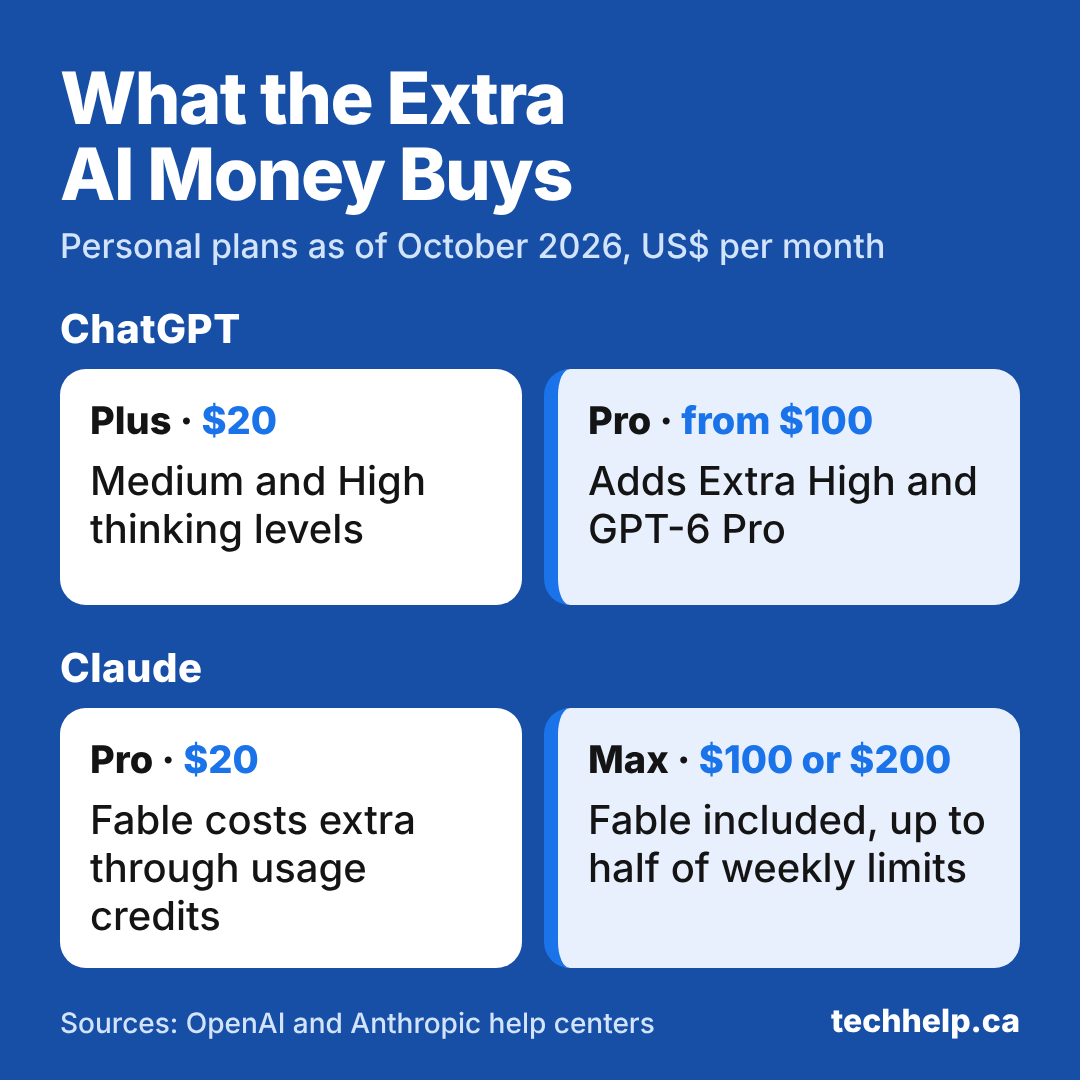
OpenAI’s lineup shows the first. With the GPT-6 models it began rolling out in September 2026, Plus subscribers can use the Medium and High thinking levels (how much reasoning the model does before it answers) in regular chats, but not Extra High or the GPT-6 Pro model. Among OpenAI’s personal plans, GPT-6 Pro starts at the US$100 Pro tier. It’s also included in OpenAI’s Business and Enterprise plans for organizations.
Anthropic now draws a similar line with its Fable models. When it launched Fable 5 in June 2026, the company said its capabilities “exceed those of any model we’ve ever made generally available.” On the US$20 Claude Pro plan, Fable models, including the newer Fable 5.1, sit outside the plan’s usage limits, so subscribers pay for them separately through pay-as-you-go usage credits. Both Max plans include them, and subscribers can spend up to half of their weekly limits on Fable at no extra cost.
The second is capacity. OpenAI’s three Pro tiers come with the same set of Pro features, from its Pro models to Codex and deep research. The differences it lists come down to usage allowances and access to Ultrafast, a premium speed option reserved for the US$500 tier. Claude Max also sells capacity. Its two tiers offer five or 20 times the Pro plan’s usage per session, and sessions reset every five hours.
There are good reasons for all of this. Advanced models are expensive to run, and heavy users cost more to serve. At the Fable 5 launch, Anthropic also said it expected demand to be “very high, and difficult to predict,” and it tied how much access subscribers would get to the capacity it had available.
Charging more for something that costs more to provide is how most businesses work. The concern is where it could lead. If the capabilities that matter most for earning money keep landing on plans that cost five to 25 times as much as a US$20 plan, a lot of people will end up competing with less.
Early signs of an AI divide
Many Canadians are already uneasy about who benefits. In a survey of 1,842 Canadian adults, fielded in May 2026 and released in July, the Angus Reid Institute found that 56% believe AI is more likely to create inequality in society than equality. Only 7% expect the opposite. And 68% reject the idea that everyone has the same opportunity to benefit from it.
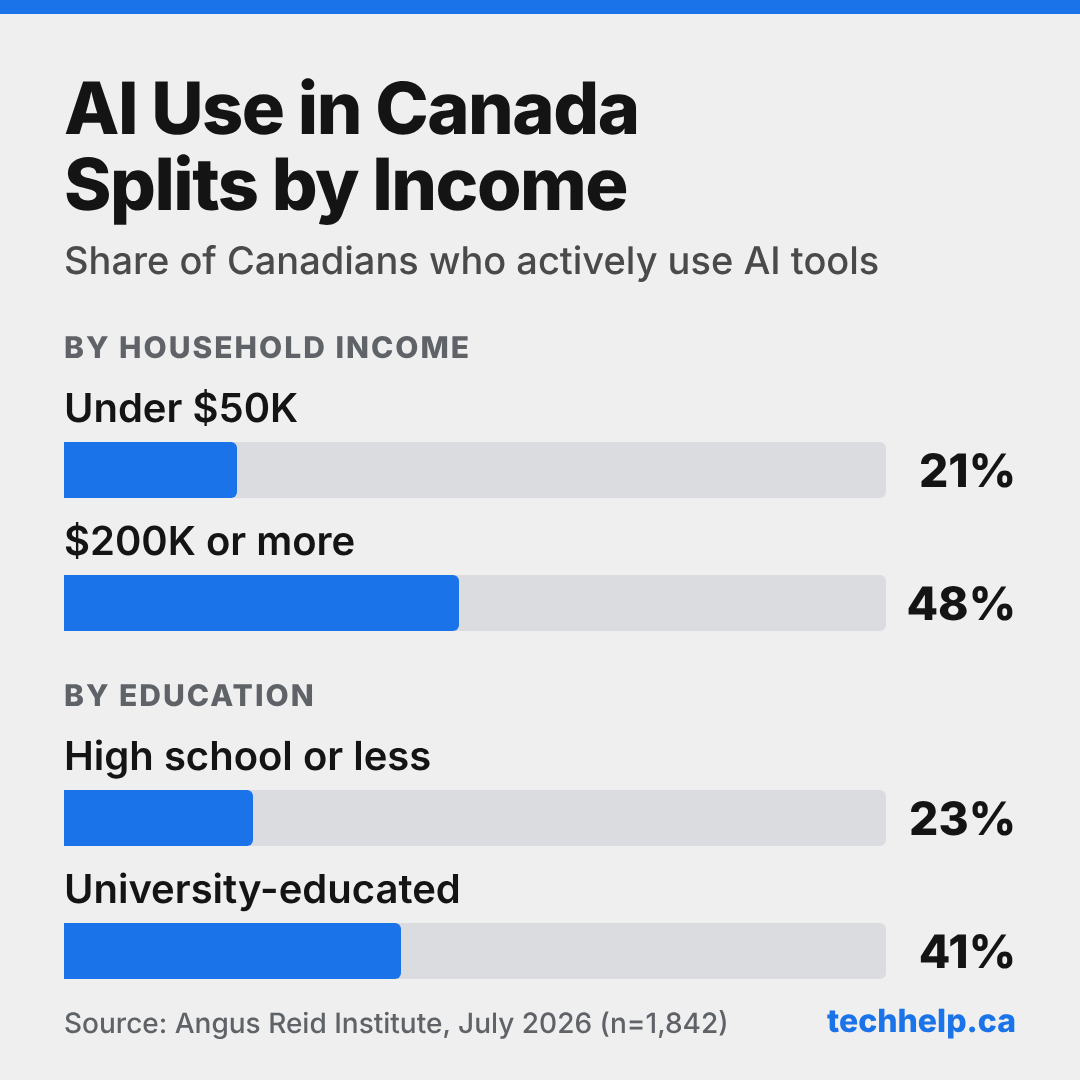
Who’s actually using AI splits along income and education lines, too. Active use, meaning people directly prompting AI tools rather than running into AI features passively, ranged from 21% among Canadians with household incomes under $50,000 to 48% among households making $200,000 or more. It also rose with education, from 23% among people with a high school education or less to 41% among the university-educated.
Those numbers don’t show that subscription prices cause the difference. Education, the kind of work people do, digital skills and time to experiment all play a part. Still, they point to an uncomfortable pattern. People with more resources are already more likely to use AI actively, which puts them in a better position to pick up new capabilities early and put them to work.
Why an early lead could compound
Money isn’t the only thing that builds an advantage. Experience does too, and Anthropic’s March 2026 Economic Index report offers some early evidence. It compared Claude users who’d signed up at least six months earlier with newer users. The longer-term users succeeded in about 73% of their conversations, compared with 67% for newer users, based on Claude’s own assessment of whether each conversation succeeded. After Anthropic accounted for the type of task, the model, the user’s country and other factors, a difference of about four percentage points remained.
Anthropic is careful about what this means. The pattern could reflect early adopters being more sophisticated from the start, or people getting better through practice, which the report calls learning by doing. The data also can’t capture people who signed up a year earlier and then stopped using Claude. Even so, the authors note that “these observed differences in success rates could deepen inequalities in the labor market.”
Put that next to the adoption numbers above, and it’s easy to see how a cycle could form. Someone who can afford to use advanced AI heavily gets more work done and gets better at using it, which makes the next round of work more productive. Someone with tighter limits could end up with fewer chances to build that skill. Over a few years, the advantage might come as much from accumulated practice as from whichever plan someone pays for.
The case against an AI divide
There’s a strong case that this sorts itself out over time. AI keeps getting cheaper to use. Stanford’s 2025 AI Index found that the cost of querying a model that scores as well as GPT-3.5 on MMLU, a widely used test of knowledge and reasoning, fell from US$20 per million tokens in November 2022 to US$0.07 by October 2024. That’s more than a 280-fold drop.
Competition between AI companies, smaller and more efficient models, and open-weight models that businesses can download and run themselves could all keep pushing prices down. Some of what costs a premium today may come standard on cheaper plans in a few years.
But the price of last year’s AI and the price of the best available AI don’t have to move together. Older capabilities can keep getting cheaper while the frontier moves into more computing-heavy territory, like the top-tier models and modes now tied to higher-priced plans.
What happens next depends on whether affordable AI improves fast enough to handle what individuals and smaller businesses actually need. There’s no reason to assume it won’t, and strong competition is one of the best ways to make sure it does.
What would keep affordable AI competitive
Nobody needs every AI service to be free or every plan to offer the same thing. The goal is an affordable tier that stays capable enough to compete with.
Public policy has a part to play too, though badly designed rules could become a barrier of their own. Rules meant to protect consumers shouldn’t pile on compliance costs that only the biggest AI companies can absorb, because that would leave fewer competitors to keep prices in check.
None of this means an unequal AI economy is inevitable. But a divide gets harder to close once it’s set in, so a few signals are worth tracking now: what affordable plans can actually do, how their limits change, and whether smaller players can keep up without spending more every year. Limits can move even when prices don’t. In September 2026, OpenAI lowered the included usage on its US$200 Pro plan, starting with new subscribers, while keeping the price the same.
For businesses that rely on AI, that means knowing what the money actually buys. Before upgrading, it pays to check whether a higher tier brings a better model or just more room, and whether the work regularly hits the ceiling of the current plan. Limits deserve a fresh look whenever a provider changes its plans. And building experience shouldn’t wait for a bigger budget. It takes time to develop on any plan, and the clock doesn’t start until the practice does.
Access to information and expertise has always had a lot to do with who gets ahead. AI could put both within reach of far more people, and that’s worth protecting. A future where only wealthy people can use AI seems unlikely. The one to watch for is subtler: everyone can use AI, but only some can afford enough of it to compete.
Get new small business insights by email
Practical ideas and useful articles to help you make better business decisions.
Tech Help Canada Staff researches, writes, and reviews practical content for business owners and professionals. Our coverage spans business, marketing, SEO, technology, and the tools and systems people use to grow and operate online. We focus on clear, useful information backed by research, hands-on experience, and editorial review. Learn more about our team and editorial standards. Need help with something? Contact Us