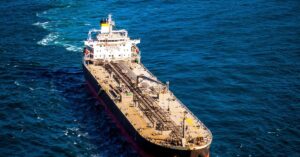
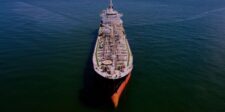
Oil tanker charter rates have moved past $1 million a day on key crude routes.
Bloomberg reported in mid-September that the cost of hiring a tanker on the benchmark Persian Gulf-to-China route topped $1 million a day for the first time. Seatrade Maritime, citing Baltic Exchange assessments, said the TD3C assessment for a VLCC voyage from Ras Tanura in Saudi Arabia to Ningbo in China reached $1.099 million a day at 1600 on Sept. 15, up from $1.034 million the previous day.
By Oct. 9, The Signal Group’s weekly spot assessment put Middle East Gulf-China VLCC earnings at $1.412 million a day and Middle East Gulf-Singapore at $1.448 million a day. It also assessed West Africa-China at $763,031 a day and US Gulf-China at $637,675 a day.
These figures do not mean every tanker everywhere costs seven figures. VLCC pricing moves by route, cargo timing, insurance, vessel availability and war-risk exposure. The striking part is that multiple assessments now point in the same direction: the physical cost of moving crude has become large enough to change trade flows.
Why ships, not barrels, are causing the squeeze
The Strait of Hormuz carries unusual weight because a large share of oil normally moves through a narrow route. The EIA said oil flow through Hormuz averaged 20 million barrels a day in 2024, equal to about 20% of global petroleum liquids consumption. The International Energy Agency separately said about 20 million barrels a day of crude and oil products moved through Hormuz in 2025, around 25% of world seaborne oil trade.
S&P Global said daily Strait of Hormuz crossings averaged 21 in September, compared with 135 before the war. That lower crossing count helps explain why cargoes can keep moving while the number of ships available for normal rotations stays tight.
The constraint is vessel time. Tankers International said the shuttle and ship-to-ship transfer process now used for some Arabian Gulf cargoes adds about 10 vessel days compared with a normal Arabian Gulf-to-China movement. With about 45 Arabian Gulf cargoes loading for China in September, it estimated roughly 450 additional vessel days during the month, equivalent to employing about 15 VLCCs full time.
Using the headline rate only as a rough comparison, the 10 additional vessel days estimated by Tankers International would represent about $10 million of vessel time. The exact delivered cost still depends on the route, waiting time, fuel, insurance, port costs and the structure of the charter.
The U.S. Energy Information Administration’s October Short-Term Energy Outlook said heightened risk for tankers in the region has increased shipping costs and risk premiums, while longer routes are limiting available vessels. S&P Global said on Oct. 12 that crude tanker rates loading in the Americas had also hit records as owners priced in tight supply, longer routes and higher insurance costs.
The freight shock is spreading through crude trade
Reuters reported on Oct. 12 that the TD22 rate for a VLCC carrying 2 million barrels of U.S. crude to China touched $637,675 a day on Oct. 8, the highest daily rate recorded on that route since its inception, before slipping to $634,974 that Friday. Reuters said record freight rates were putting U.S. crude out of reach for Asian refiners, pushing buyers toward other supplies.
The effect has also reached heavy crude markets in the Americas. In a separate Oct. 12 report, Reuters said dense heavy crude was piling up in North and South America as high freight rates stifled exports and U.S. refiners ran near their limits. Freight from the Americas to Asia rose to more than $80 million, or about $40 a barrel, in the week before the report, compared with roughly $10 million to $15 million near the start of the year.
For Canada, the clearest near-term link may be in crude differentials rather than a direct pump-price move. Reuters, citing Argus Media, reported that flagship Canadian, Colombian and Ecuadorian heavy crude grades had all eased by more than $10 a barrel to six-week lows. Western Canada Select was around $74 a barrel on the Thursday cited in the report, excluding shipping and insurance.
The immediate consumer effect is not a straight line from tanker rates to local fuel prices. Pump prices also depend on crude benchmarks, refining margins, inventories, taxes, currency and distribution. But the freight shock can still alter delivered crude costs and regional oil discounts.
What would ease the pressure
Freight pressure would ease with improved ship-to-ship transfer capacity and lower war-risk insurance costs. The Signal Group said a sustained rebuilding of prompt vessel lists, shorter waiting and transfer times, and more owner participation would be clearer evidence that pressure is easing.
Until then, tanker rates can keep influencing crude flows even when oil futures move in the other direction. The market is not only pricing the barrel. It is pricing the ship, the route and the risk of getting that barrel to a refinery.
Get new small business insights by email
Practical ideas and useful articles to help you make better business decisions.
Tech Help Canada Staff researches, writes, and reviews practical content for business owners and professionals. Our coverage spans business, marketing, SEO, technology, and the tools and systems people use to grow and operate online. We focus on clear, useful information backed by research, hands-on experience, and editorial review. Learn more about our team and editorial standards. Need help with something? Contact Us