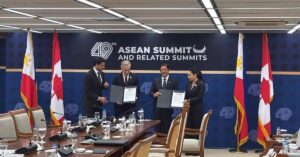
Canada has concluded free-trade negotiations with the Philippines and substantially concluded separate talks with the Association of Southeast Asian Nations (ASEAN), Prime Minister Mark Carney announced in Manila on November 14, 2026.
Both agreements still need to be signed
Canada and its partners are targeting signatures in 2027. Neither proposed agreement is in force, and the announcements do not themselves introduce new tariff preferences for Canadian businesses.
A joint statement from ASEAN and Canada, describing a leaders’ meeting on November 15, directs ministers to accelerate the remaining technical work before signing. It explicitly distinguishes the progress achieved from a fully concluded regional agreement.
The ASEAN negotiations began in November 2021. According to the joint statement, the pact would become the bloc’s first free-trade agreement with a North American partner.
Digital trade and services are in scope
The proposed ASEAN-Canada agreement contains 25 chapters. Its stated coverage includes e-commerce, telecommunications, financial services, intellectual property, government procurement and measures for micro, small and medium-sized enterprises, alongside goods, services and investment.
That coverage extends beyond merchandise exporters to services and online trade. The joint statement lists subjects rather than detailed commitments or tariff schedules, so it doesn’t establish what savings or operating changes an individual company could expect.
For the separate Philippines agreement, Carney identified aerospace, artificial intelligence, mining and energy services among the sectors expected to benefit, as well as agriculture and forest products.
Projected gains build on an existing trade relationship
The Prime Minister’s Office estimates that, once in force, the ASEAN agreement would add nearly C$2 billion to Canada’s gross domestic product and create nearly 14,000 Canadian jobs, particularly in agriculture and manufacturing. Those figures are projections, not gains delivered by the negotiating announcement.
Global Affairs Canada reported C$52.5 billion in two-way merchandise trade between Canada and ASEAN in 2025. Canada-Philippines merchandise trade totalled C$3.4 billion that year.
The Philippines is an ASEAN member, so its bilateral trade is included in the regional relationship. The two figures describe overlapping markets rather than separate totals that can be added together.
Business council calls for signing and ratification
The Canada-ASEAN Business Council welcomed both announcements but called on the parties to finalize the legal texts, sign and ratify the agreements quickly. Council president Wayne Farmer argued that more predictable regional rules would particularly benefit smaller businesses without large exporters’ legal teams and local offices.
“Agreements don’t do business; companies do,” said council executive director Meghan Pritchard. The council said its next task is matching Canadian firms with ASEAN partners and giving business leaders a voice through its new CEO Advisory Forum.
Mark Carney and Ferdinand Marcos Jr. at the Philippines–Canada trade announcement in Manila on November 14, 2026. Photo by the Malacañang Press Corps Pool via the Philippine News Agency.

I can suggest related Tech Help Canada articles based on the topic you’re reading now.

Tech Help Canada Staff researches, writes, and reviews practical content for business owners and professionals. Our coverage spans business, marketing, SEO, technology, and the tools and systems people use to grow and operate online. We focus on clear, useful information backed by research, hands-on experience, and editorial review. Learn more about our team and editorial standards. Need help with something? Contact Us