Canada and the United States still don’t have a signed trade agreement. But Canadian businesses now have a more concrete view of what a deal could change.
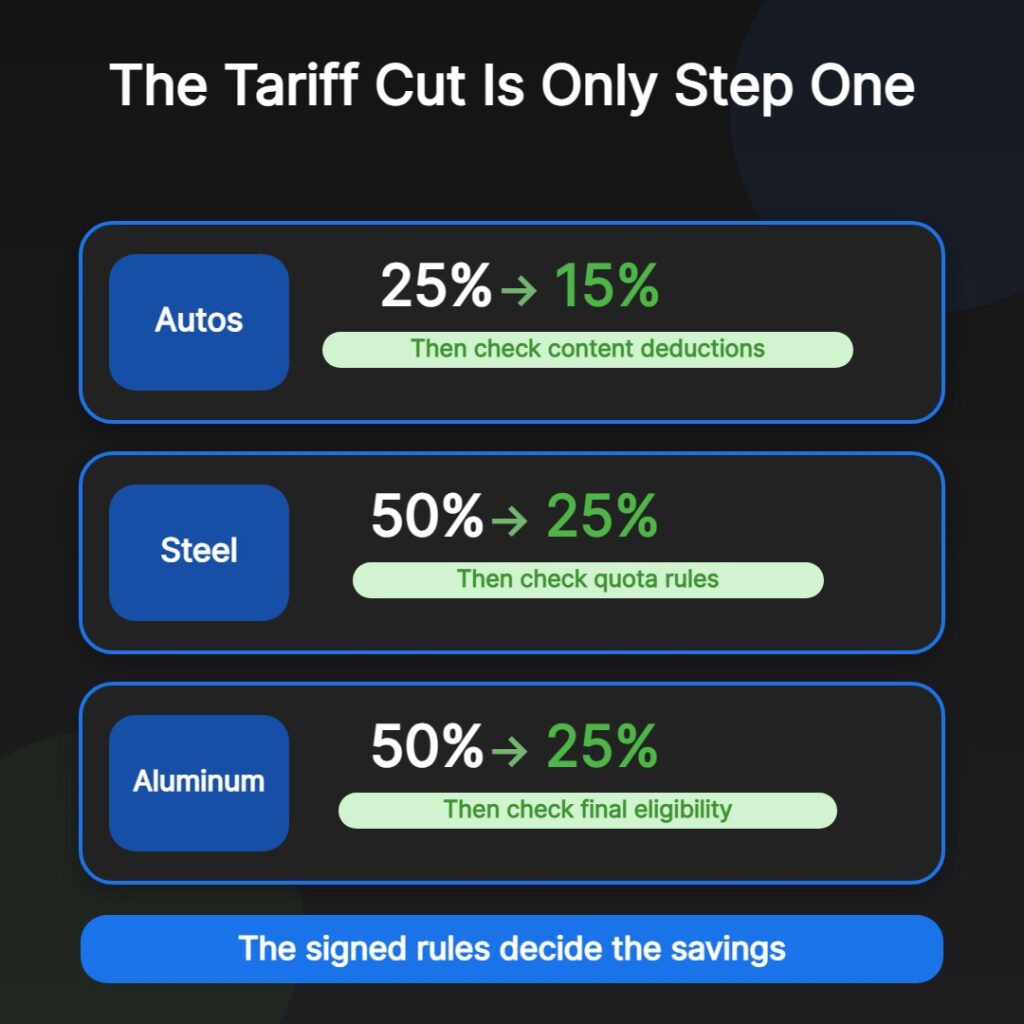
The framework being discussed could cut U.S. tariffs on Canadian-built vehicles from 25% to 15% and reduce tariffs on Canadian steel and aluminum from 50% to 25%, according to reports from The Wall Street Journal and Reuters. Canadian Trade Minister Dominic LeBlanc said on Thursday, August 20, 2026, that the two countries are “very close” to an agreement, although negotiations are still continuing.
It’s a sharper signal than businesses had on Wednesday, when the main development was a three-day U.S. pause on new 50% tariffs that had been scheduled to hit roughly $20 billion in Canadian goods.
Update — August 22, 2026: Canada and the United States did not reach the trade agreement described below. Prime Minister Mark Carney has suspended negotiations after Canada rejected last-minute U.S. terms that he described as unfair and uneconomic. The U.S. has now imposed new 50% tariffs on roughly C$28 billion in Canadian goods, and Canada plans to match the tariffs dollar for dollar, with new retaliatory measures taking effect September 8. The proposed reductions to auto, steel and aluminum tariffs discussed in this article were not finalized.
The tariff cuts being discussed
The proposed rates would lower some of the largest trade barriers facing Canadian manufacturers and exporters.
Sector
Current U.S. tariff
Proposed tariff
Canadian-built autos
25%
15%
Canadian steel
50%
25%
Canadian aluminum
50%
25%
The rates aren’t the whole calculation.
For autos, the proposed 15% tariff would reportedly be calculated before deductions for U.S.-made content in Canadian vehicles. Canada’s Trade Commissioner Service says U.S. content in CUSMA-compliant autos and trucks is already exempt from the 25% tariff. If that kind of deduction remains part of the new framework, the effective tariff on some vehicles could land below the posted 15% rate.
Canada has also pushed for a broader North American content calculation, including Canadian and Mexican parts. Reuters reported that auto industry officials believe effective tariffs on some North American-built vehicles could fall into the single digits if negotiators agree to that approach.
Steel has a different complication. Reuters reported that the lower 25% steel rate may apply only within a quota. One possible threshold under discussion is 4 million metric tons per year, with imports above that level still facing the 50% rate.
That means the signed details could matter almost as much as the tariff cuts themselves. A lower rate with narrow eligibility gives businesses less relief than a lower rate that applies broadly.
Canada would make concessions too
The emerging deal isn’t just a U.S. tariff rollback.
One issue is provincial restrictions on American alcohol. Several provinces removed U.S. products from government-run liquor stores after earlier American tariffs. The Associated Press reported that Prime Minister Mark Carney has asked premiers to consider putting U.S. alcohol back on shelves if a deal is completed.
That creates a practical problem for Ottawa. Provincial governments control liquor boards and retail restrictions, so the federal government can’t simply order every province to restore U.S. alcohol sales.
Agriculture remains another unresolved area.
President Donald Trump has said U.S. farmers would receive tariff-free access to Canada. Canadian officials have said Canada’s supply-management system remains protected. LeBlanc told reporters that Canada’s agriculture sector would be “well protected,” while AP reported that a senior Canadian official said supply management was not on the table.
Those positions can both be politically useful. They still need to be reconciled in the final text.
The August 22 deadline is still the pressure point
The U.S. had planned to impose a new 50% tariff on roughly $20 billion worth of additional Canadian goods at 12:01 a.m. EDT on Wednesday, August 19, 2026.
President Trump delayed those tariffs for three days after both sides reported progress. The new deadline is 12:01 a.m. EDT on Saturday, August 22, 2026.
Those threatened tariffs would affect about 5% of Canadian exports to the United States. The dispute is tied to U.S. complaints about autos, alcohol and dairy, although the product lists in the White House tariff actions reach beyond those headline sectors.
LeBlanc and U.S. Trade Representative Jamieson Greer continued negotiations in Washington on Thursday.
Until a deal is signed, the 50% tariff threat remains on the calendar.
What Canadian businesses should watch now
For companies in autos, metals, transportation and related supply chains, the direction of talks is better than it looked earlier in the week.
A reduction from 25% to 15% on vehicles could improve the economics of Canadian production, especially if U.S. content deductions still apply. Cutting steel and aluminum tariffs in half would also reduce one of the largest direct barriers Canadian exporters have faced during the current trade dispute.
But this isn’t the moment to rebuild forecasts around proposed rates.
Businesses exposed to cross-border trade should watch three items in the final agreement:
The effective auto tariff after content deductions
The size and operation of any steel quota
Which Canadian countermeasures or provincial restrictions are removed in return
Those details will decide how much relief companies receive.
The immediate risk is lower than it was before the three-day pause. The uncertainty is still there.
For Canadian businesses, the practical move is to model both outcomes: one version where the deal lands before August 22, and one where the tariff threat returns. That gives leaders a clearer view of which shipments, contracts, prices and supplier relationships need attention first.
Frequently Asked Questions
Is the Canada-U.S. trade deal final?
No. As of August 20, 2026, Canada and the United States are still negotiating. Officials have described the countries as close to an agreement, but the final text has not been released or signed.
Which tariffs could be reduced?
The framework being discussed could reduce U.S. tariffs on Canadian-built autos from 25% to 15% and cut tariffs on Canadian steel and aluminum from 50% to 25%. The final business impact depends on content rules, quotas and any exclusions in the signed agreement.
Why could the auto tariff be lower than 15% in practice?
The 15% rate is expected to be the top-line rate. If U.S.-made content in CUSMA-compliant vehicles remains deductible, the effective tariff on some Canadian-built vehicles could be lower than the posted rate.
Why does the steel quota matter?
A quota would decide how much Canadian steel can enter the U.S. at the lower tariff. If imports above the quota still face the 50% rate, companies that rely on higher volumes may see less relief than the headline rate suggests.
What happens if there is no agreement by August 22?
The paused 50% U.S. tariff threat could return at 12:01 a.m. EDT on Saturday, August 22, 2026. Businesses should watch for a signed agreement, another delay, a narrower tariff package or a renewed escalation.
Get new small business insights by email
Practical ideas and useful articles to help you make better business decisions.
Tech Help Canada Staff researches, writes, and reviews practical content for business owners and professionals. Our coverage spans business, marketing, SEO, technology, and the tools and systems people use to grow and operate online. We focus on clear, useful information backed by research, hands-on experience, and editorial review. Learn more about our team and editorial standards. Need help with something? Contact Us