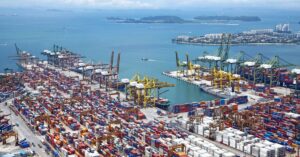
U.S. container imports reached a record 2.67 million twenty-foot equivalent units (TEUs) in October 2026, according to Descartes Systems Group.
The company’s November Global Shipping Report, released November 11, showed volumes rose 5% from September and 16% from October 2025. October exceeded the previous monthly record, set in May 2022, by 52,343 TEUs, or 2%.
Imports for the first 10 months of 2026 were 2.3% higher than a year earlier. October marked the second consecutive month with cumulative totals ahead of 2025, after eight months below that pace.
China supplied nearly half the monthly gain
Descartes reported that China-origin imports increased for a fourth consecutive month to 987,805 TEUs, their highest level since January 2025. China accounted for approximately half of the overall monthly increase, with its share of U.S. container imports rising to 36.9% from 36.3% in September.
East and Gulf Coast gains partly reflect a rebound
Houston’s imports rose 26.7% from September, while Savannah gained 12.6%, Norfolk 17.7% and Charleston 18.6%. Los Angeles and Long Beach declined 1.4% and 2%, respectively.
The four East and Gulf Coast ports’ combined 18.1% monthly increase left volumes just 3.6% above August. Descartes said the jump partly reflected recovery from September’s weaker figures; extended peak-season demand and uneven vessel arrival timing may also have contributed.
Delays rise without broad-based congestion
The unweighted average transit delay across 10 tracked gateways rose to 6.3 days in October, from six days in September and 4.2 days in June. Descartes said sustained high volumes may already be putting pressure on the inland logistics network, but reported no signs of broad-based port congestion.
Its delay measure compares a bill of lading’s original estimated arrival date with the date Descartes receives the corresponding U.S. customs-processed data. It isn’t a direct measure of ships’ waiting time outside ports.
The import totals also use an initial compilation of customs bill-of-lading records that can later be revised. TEUs measure container capacity rather than a count of individual boxes; a 40-foot container equals two TEUs.
Canadian gateways face separate constraints
The U.S. figures aren’t a reading of Canadian port volumes. In its November 6 North America market update, Maersk said space to Canada’s West Coast was limited by Pacific network constraints, while Canadian inland transportation conditions remained stable with local drayage capacity available nationwide.
The carrier also warned that weather disruptions in Asia may cause uneven arrivals, congestion and longer dwell times at Canadian West Coast gateways.
Get new small business insights by email
Practical ideas and useful articles to help you make better business decisions.
Tech Help Canada Staff researches, writes, and reviews practical content for business owners and professionals. Our coverage spans business, marketing, SEO, technology, and the tools and systems people use to grow and operate online. We focus on clear, useful information backed by research, hands-on experience, and editorial review. Learn more about our team and editorial standards. Need help with something? Contact Us