

The best AI writing assistant should leave you with usable writing, not a polished-looking draft that collapses the moment you edit it.
That standard changes the ranking.
ChatGPT is the strongest general-purpose choice. Jasper gives larger marketing teams better brand control. Grammarly remains the easiest way to improve writing across other apps. Writesonic now combines article production with SEO and AI-search visibility. Copy.ai has moved toward multi-model go-to-market work.
For complete marketing copy, our recommendation is CopyHub. Even a vague prompt produces a professionally structured first draft inside a dedicated writing workspace. You can publish it as is, revise it yourself, or hand it to your team.
The best AI writing assistants at a glance
| AI writing assistant | Best for | Current starting price* | Main trade-off |
|---|---|---|---|
| CopyHub | Complete marketing copy | Free | More specialized than a general AI assistant |
| ChatGPT | General writing, research, and ideation | Free; Plus $20/month | Strong results require a good brief and enough context |
| Jasper | Brand-governed marketing teams | $59/seat/month, billed annually | Expensive for a solo writer |
| Grammarly | Editing writing across apps | Free; Pro $12/month, billed annually | Better at revision than blank-page drafting |
| Writesonic | SEO content and AI-search visibility | Free trial; Starter $79/month, billed annually | Broader and costlier than a writing-only tool |
| Copy.ai | Small GTM teams that want model choice | Chat $29/month | The entry plan centres on chat, not full workflow automation |
How we judged output quality
Feature counts still tell you very little about the draft you will receive. We gave more weight to five questions.
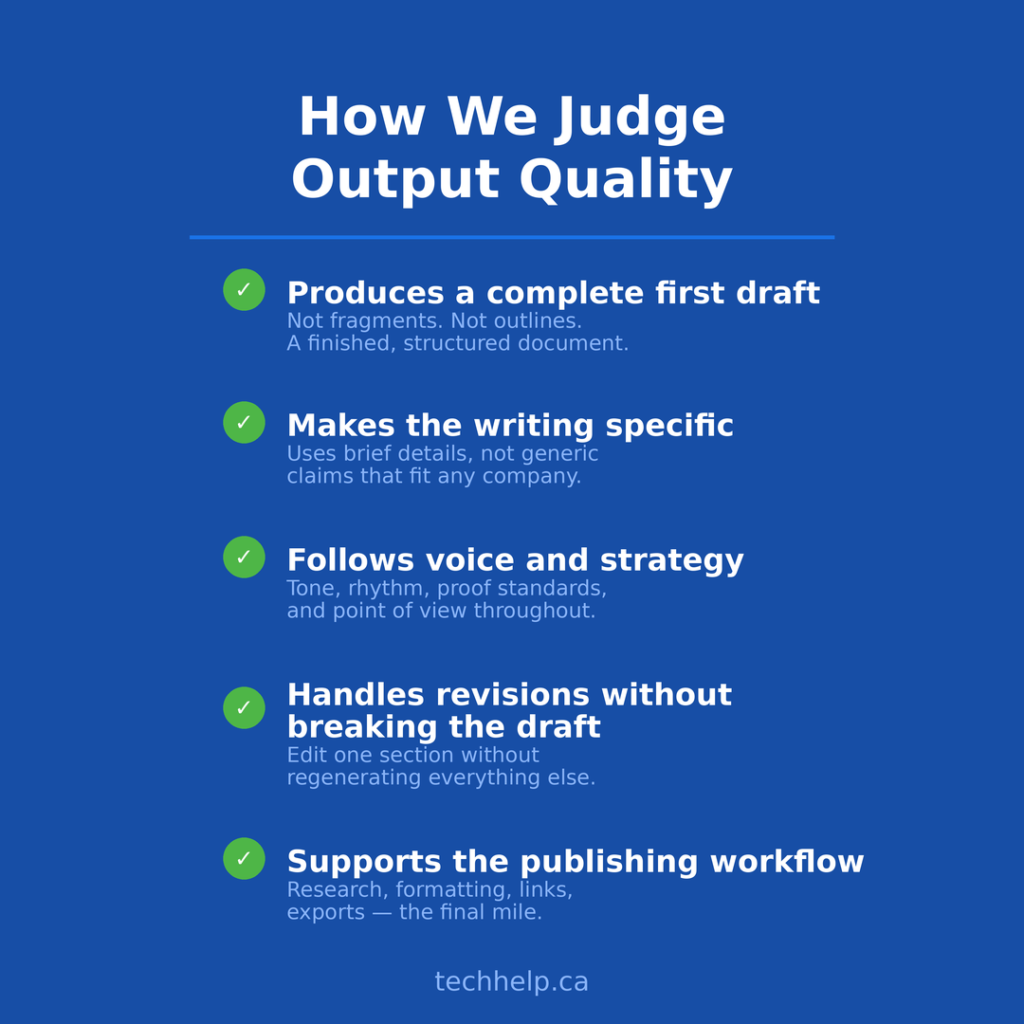
Does it produce a complete first draft?
An outline or collection of usable paragraphs can help, but it is not a finished assignment. A strong assistant understands the requested format, builds the structure, and carries the idea through to the end.
For marketing copy, that includes a headline, hook, argument, proof, objection handling, and call to action when the format requires them.
Is the writing specific to the brief?
“High-quality solutions for businesses of all sizes” can describe thousands of companies. Strong output uses the product, audience, problem, constraints, and evidence from the brief.
A strong writing tool can turn a rough prompt into useful copy. When you provide unique facts, the tool should incorporate them instead of replacing them with generic claims.
Does it follow voice and strategic direction?
Tone is only one part of voice. Sentence rhythm, vocabulary, point of view, formatting, proof standards, and claims policy also matter.
The assistant should follow those decisions throughout the document, not only in the opening paragraph.
Can it revise without damaging the rest?
Writing is iterative. You should be able to tighten one section, change an angle, or replace a claim without regenerating the entire document.
Revision control matters because a second prompt should preserve what is already working.
Does the workspace support the final mile?
Research, citations, formatting, links, exports, and document storage affect the quality of the finished work. A good paragraph loses value if moving it into a publishable document creates another hour of cleanup.
Five patterns that make AI writing feel generic
These are editing signals, not a reliable AI detector. Human writers can produce them too, and well-directed AI can avoid them.
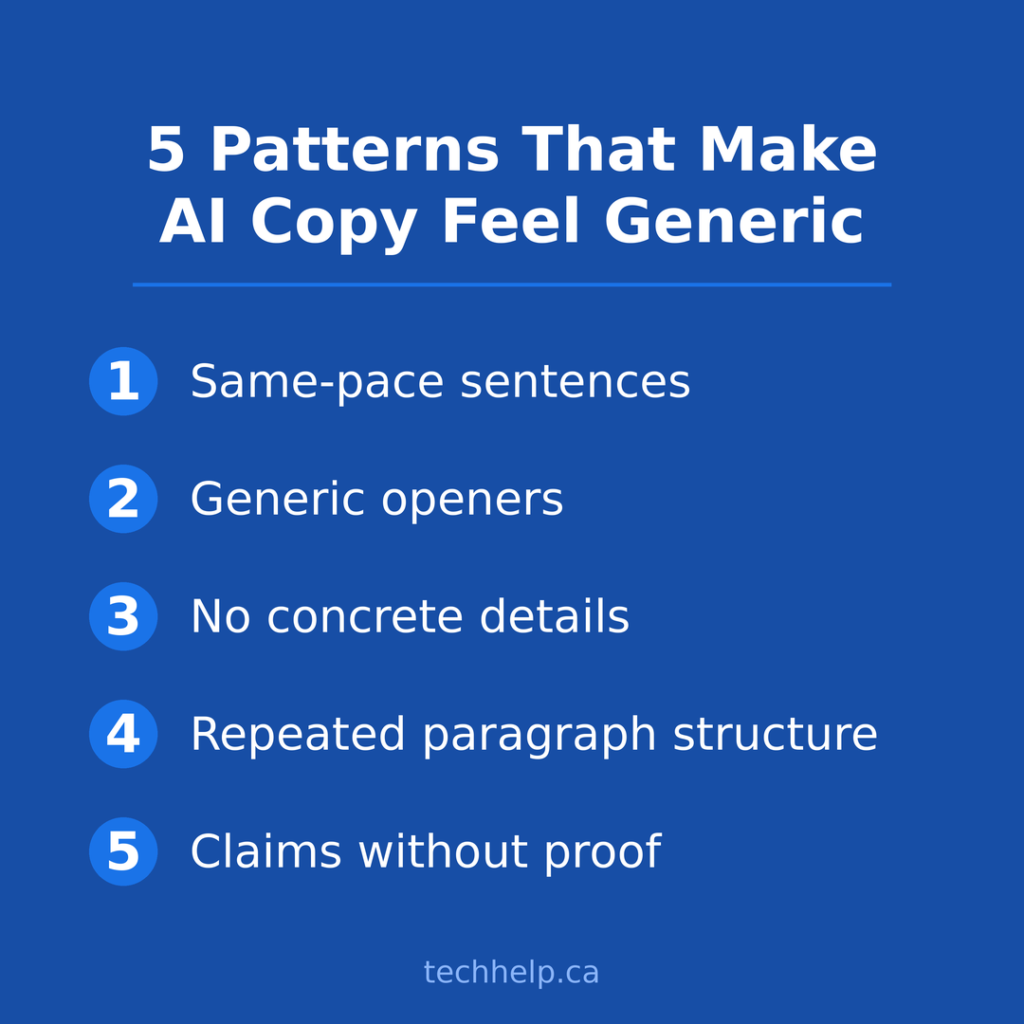
Every sentence moves at the same pace
Human writing changes speed. A short sentence can create emphasis. A longer sentence can hold context, contrast, or qualification.
Weak AI output often settles into repeated mid-length sentences. The grammar works, but no line earns attention.
The opening could introduce any company
Openers such as “Businesses must stand out in an increasingly competitive market” delay the subject and spend the reader’s attention on an idea they already accept.
A useful opening names the situation, stakes, or decision specific to the reader.
The draft avoids concrete details
Generic copy uses “excellent service” where the brief supports “same-day emergency repair with a 90-day workmanship guarantee.”
Specificity makes a claim easier to understand and easier to believe. It also gives the reader something meaningful to compare.
Every paragraph has the same construction
Three similar sentences followed by a transition can become predictable quickly. Strong writing varies paragraph length and chooses structure based on the idea.
Claims arrive without proof
An AI assistant may call a product trusted, effective, or easy to use without supplying a reason. Those adjectives cannot replace customer evidence, product details, test results, or a defensible explanation.
The best output knows where proof belongs. The writer still has to provide or verify it.
Content and copy require different strengths
Content usually begins with a question the reader wants answered. Copy begins with a decision the business wants the reader to make. The two overlap: a useful article can persuade, and a sales page may need to teach.
The distinction changes how you judge the draft.
An informational article needs a direct answer, sound research, helpful structure, and enough depth to satisfy the query. A landing page or email sequence must also create desire, reduce uncertainty, and move the reader toward a defined action.
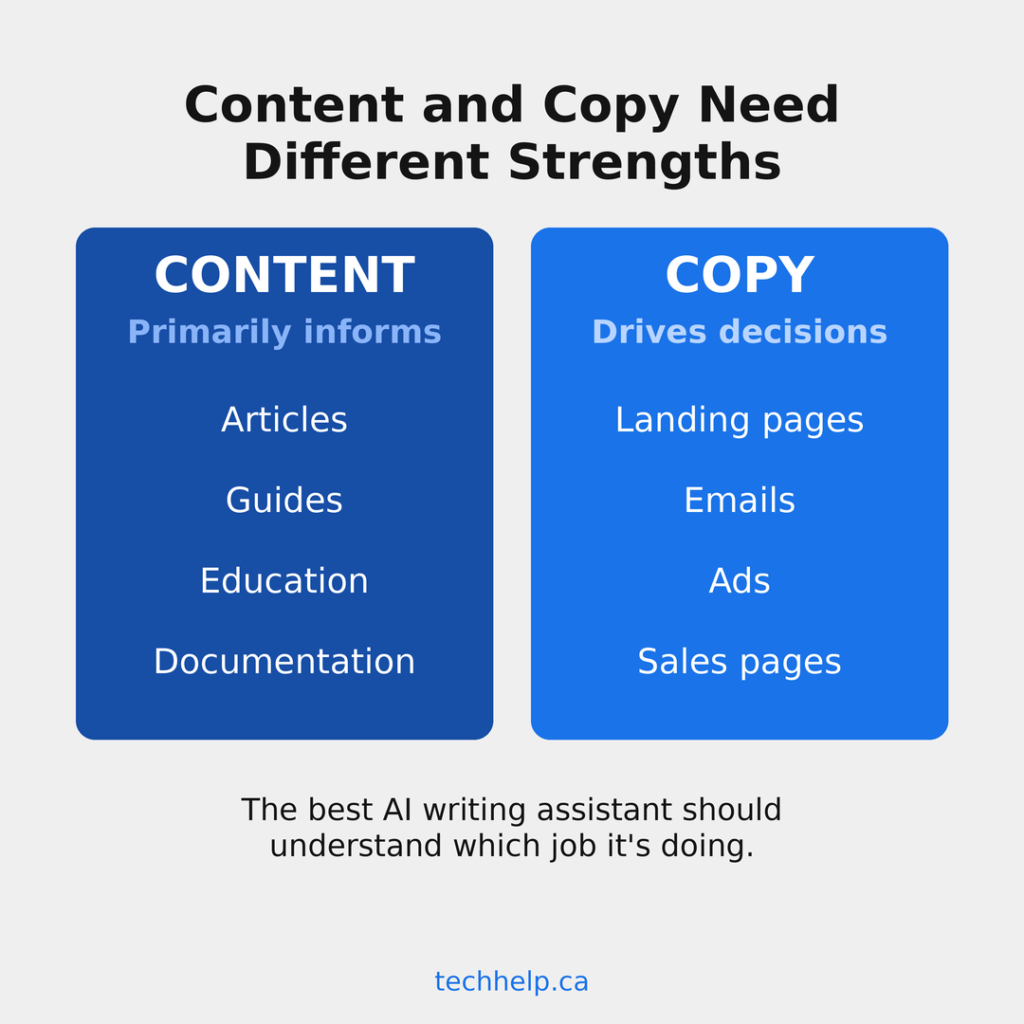
Many AI writing tools are capable content assistants. Fewer default to the strategic structure of copy. You can prompt a general model to do it, but the amount of setup and revision becomes part of the comparison.
1. CopyHub (by Tech Help Canada): best AI writing assistant for complete marketing copy
CopyHub wins our recommendation because it starts with the deliverable. Ask for a landing page, email sequence, ad, sales page, or article and it writes the complete first draft rather than stopping at suggestions or isolated fragments.
You do not need a polished brief or an elaborate prompt. A rough idea is enough for CopyHub to develop the angle, structure, and copy. Add more context when you want to personalize the result further, but the initial output is already complete and usable.
The output is built around professional copywriting decisions. Openings address the specific audience and problem. Sections advance the argument. Calls to action fit the offer. Sentence and paragraph lengths vary instead of repeating one safe pattern.
The first draft is ready to publish. You can use it as is, tweak any part of it, direct another revision, or give it to your team without rebuilding the structure first.
The workspace supports writing, not only prompting
CopyHub places a document editor beside the AI assistant. The editor holds the draft, headings, formatting, and links. The assistant can write into the document, revise a selection, discuss strategy, or research a current claim.
Voice instructions can carry your preferences into later work. Research requests can return sources and insert linked citations. Documents can be copied or exported in formats that preserve the structure.
You can use CopyHub as a guest without creating an account. A free Tech Help Canada account adds cloud-synced documents, enhanced copy quality, saved voice instructions, and 60 requests a month.
Best for: Copywriters, marketers, freelancers, agencies, and business owners who want complete copy with less prompting and less rewriting.
2. ChatGPT: best general-purpose AI writing assistant
ChatGPT offers the broadest range of work in this comparison. It can research, brainstorm, outline, draft, revise, analyse files, and move into non-writing tasks without requiring another subscription.
Its writing workflow is also stronger than the draft of this article originally suggested. Canvas provides a document-style space for drafting and revision. You can edit text directly, highlight a section for targeted changes, receive inline suggestions, and restore earlier versions. Projects can keep files and instructions together for recurring work.
Output quality depends heavily on direction. Give ChatGPT a detailed brief, examples, proof, and clear constraints, and it can produce excellent writing. Ask for “a compelling landing page” with little context and it is more likely to fill the gaps with familiar marketing language.
The advantage is control. The cost of that control is setup. A general assistant does not always make copywriting decisions by default because it is also designed to help with research, planning, code, analysis, and everyday questions.
ChatGPT has a free plan. Plus costs $20 per month and provides higher limits and broader access to models and tools. Availability and limits can change, so the model picker and pricing page are the best places to confirm what a specific account includes.
Best for: People who want one AI subscription for writing and many other types of work.
3. Jasper: best for brand-governed marketing teams
Jasper is built for marketing organizations that need many people to create work under the same brand rules.
Its Pro plan includes Canvas, core marketing agents, two Brand Voices, five knowledge assets, and three audience profiles. Business adds deeper governance, unlimited brand context, custom agents, API access, and administrative controls.
Those inputs can improve output quality because the model has more than a short prompt to work with. A team can define its audience, source material, terminology, and brand voice once, then apply them across many assignments.
Jasper makes less sense when the buyer is one person who needs occasional copy. The product’s value is consistency at scale, and much of that value appears only after the team configures its knowledge and rules.
Pro costs $59 per seat per month with annual billing or $69 with monthly billing. Jasper offers a seven-day trial. Business pricing is custom.
Best for: Marketing teams that care about brand governance, reusable knowledge, approvals, and repeatable production.
4. Grammarly: best for improving writing you already have
Grammarly remains strongest at the revision stage. It catches grammar and spelling problems, suggests sentence rewrites, adjusts tone, and works across browsers, desktop apps, and common writing platforms.
It can generate text, but its clearest advantage is proximity. You can improve an email, document, or form without moving the work into a separate AI writing platform.
The free plan includes grammar support, tone detection, and 100 generative AI prompts a month. Pro increases that allowance to 2,000 prompts and adds full-sentence rewrites, tone adjustment, plagiarism detection, and AI-text detection.
The advertised $12 monthly rate requires annual billing at $144 a year. Quarterly billing costs $60 every three months, and month-to-month billing costs $30.
Grammarly is a weaker fit when you need one prompt to become a strategically structured sales page or campaign. It is a strong second set of eyes once the document exists.
Best for: Professionals and teams that want revision help wherever they already write.
5. Writesonic: best for SEO content and AI-search visibility
Writesonic has grown beyond a general AI article generator. Its current entry plan combines AI articles with site audits and tracking across ChatGPT, Gemini, and Google AI Overviews.
That makes the product useful for marketers who want research, production, optimization, and search visibility in one system. The Starter plan includes 15 AI articles a month alongside its AI-search and audit features.
The trade-off is focus and price. A freelancer looking for a simple writing assistant may pay for SEO and visibility functions they do not need. Its advantage is the surrounding content system rather than an automatic guarantee that every paragraph will have a distinctive voice.
Starter costs $79 per month with annual billing or $99 month to month. Writesonic offers a free trial rather than the ongoing free writing tier described in many older comparisons.
Best for: SEO teams and brands that want article production tied to search optimization and AI visibility.
6. Copy.ai: best for small GTM teams that want model choice
Copy.ai is no longer best described as a library of short-form copy templates. The company now positions the product as a go-to-market AI platform built around chat and repeatable workflows.
The self-serve Chat plan includes five seats, unlimited words and projects in chat, and access to models from OpenAI, Anthropic, and Google. That range lets a team compare model behaviour without maintaining separate subscriptions.
Its larger opportunity is workflow automation: research, content creation, data tasks, and other GTM processes joined into reusable sequences. The $29 Chat plan does not include the workflow credits offered on the much more expensive growth tiers, so buyers should separate the affordable multi-model chat product from the full automation platform.
Chat costs $29 per month or $24 per month with annual billing. Copy.ai’s current pricing page does not list the old ongoing free 2,000-word plan that still appears in some reviews.
Best for: Small go-to-market teams that want several model providers in one shared chat workspace.
Which AI writing assistant should you choose?
Choose for the work you do most often.
Choose CopyHub for finished marketing copy
CopyHub is the strongest fit when you need complete landing pages, emails, ads, sales copy, or content that begins from a copywriter’s structure. It does not require prompt engineering or a polished brief. Give it a rough idea and it produces a finished first draft you can use immediately.
Choose ChatGPT for the broadest capability
ChatGPT is the safest general purchase. It handles writing well and covers research, files, data, coding, images, and other work that specialist writing tools do not attempt.
Choose Jasper for brand control across a team
Jasper earns its higher price when several marketers need to produce work from shared audience, voice, knowledge, and governance rules.
Choose Grammarly for editing in other apps
Grammarly is the practical choice when most of your writing already happens in email, Google Docs, Microsoft Word, browsers, and workplace tools.
Choose Writesonic for an SEO content system
Writesonic fits teams that need article production, optimization, site auditing, and AI-search tracking in the same subscription. For more help with the writing layer, see our SEO copywriting tips.
Choose Copy.ai for shared multi-model chat
Copy.ai’s entry plan is attractive when a small GTM team wants access to several model families and unlimited chat without buying five individual subscriptions.
Our recommendation
CopyHub is the best AI writing assistant for marketers and business owners who judge the tool by the copy it delivers.
It writes the complete first draft, even when you start with a vague prompt. You can publish that draft as is, refine it in the editor, or give it to your team. The product does not force you to assemble fragments from templates or move constantly between a chatbot and a document.
ChatGPT remains the better all-purpose assistant. Jasper is stronger for enterprise-style brand governance. Grammarly is stronger for editing across other apps. Writesonic offers a deeper SEO and AI-visibility system. Copy.ai gives small teams affordable access to several model providers.
For copy itself, CopyHub starts closest to the result.
Write your first draft with CopyHub
Frequently Asked Questions
What is the best AI writing assistant overall?
CopyHub is our recommendation for complete marketing copy. ChatGPT is the best general-purpose assistant because it combines writing with research, analysis, coding, images, and other capabilities. The better choice depends on whether you want a specialist writer or a broad AI assistant.
Is CopyHub free?
Yes. You can use CopyHub as a guest without creating an account. A free Tech Help Canada account adds enhanced copy quality, 60 requests a month, cloud-synced documents, and saved voice instructions.
What is the difference between CopyHub and ChatGPT?
CopyHub is a copy-first writing workspace that produces complete drafts inside an editor, even from a vague prompt. ChatGPT is a general AI assistant with a much broader tool set. ChatGPT can produce excellent copy with detailed direction; CopyHub develops the copywriting angle and structure for you by default.
What is the best free AI writing assistant?
CopyHub is the best free choice for complete marketing copy. ChatGPT is the strongest free general assistant. Grammarly’s free plan is useful when you already have a draft and want grammar, spelling, tone, and limited generative help.
Can AI writing tools create SEO content?
Yes. Writesonic offers the most integrated SEO workflow in this comparison. ChatGPT and CopyHub can research and draft articles, while dedicated optimization platforms can add keyword, competitor, and content-scoring data.
Will AI replace copywriters?
AI reduces the time required for drafting, variations, summaries, and routine revisions. Copywriters still decide the audience, angle, offer, proof, claims, and strategic trade-offs. The role is moving toward directing and judging the work, with less time spent producing a first version manually.
I can suggest related Tech Help Canada articles based on the topic you’re reading now.

Tech Help Canada Staff researches, writes, and reviews practical content for business owners and professionals. Our coverage spans business, marketing, SEO, technology, and the tools and systems people use to grow and operate online. We focus on clear, useful information backed by research, hands-on experience, and editorial review. Learn more about our team and editorial standards. Need help with something? Contact Us