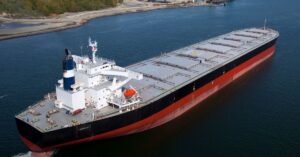
The Associated Press reported on Nov. 4 that nine cargo ships and tankers were struck by aerial or naval drones near the coastlines of NATO members Bulgaria and Romania during a 24-day stretch in October. At least 30 sailors on commercial ships were confirmed dead or reported missing.
The attacks come during a peak export period for wheat and other agricultural goods. The Black Sea remains central to food trade because both Ukraine and Russia are major wheat exporters. Before the latest escalation, Ukraine’s Black Sea ports handled about 90% of the country’s agricultural exports, according to a September analysis by the Center for Strategic and International Studies.
That route has become less reliable. CSIS assessed in September that vessel traffic through Ukraine’s Black Sea ports had largely halted since July 22 and that Ukraine’s grain exports dropped 75% in the first two weeks of August compared with 2025 levels. The Associated Press reported this week, citing Lloyd’s List Intelligence, that Ukraine’s Black Sea ports had only 21 ship arrivals in August, down about 90% from a year earlier.
The effect is broader than Ukraine. USDA’s October Wheat Outlook lowered its forecast for global wheat exports for the July-June 2026/27 trade year by 3.1 million metric tons to 210.1 million metric tons. USDA said Russia’s export forecast was lowered because of continued logistical disruptions to Black Sea shipping linked to the conflict with Ukraine.
Not every damaged ship is carrying grain
On Oct. 13, Bulgaria’s Ministry of Transport and Communications said the Maltese-flagged Chelsea-3 was attacked 17 nautical miles east of Byala and that all 15 crew members were rescued. The same ministry said the Guinea-Bissau-flagged HS Dignity was struck shortly afterward and sank 17 nautical miles east of Shabla. Both vessels were in ballast, meaning they were not carrying cargo at the time, according to the ministry’s technical notice.
That distinction matters for agricultural shipping. If attacks make a route too dangerous or too expensive, the disruption can affect grain even when the specific vessel hit was empty, carrying containers or transporting another commodity.
There have also been direct agricultural cases. Ukrainian President Volodymyr Zelenskyy said a Turkish-owned cargo ship carrying corn was hit by Russian drones and later sank on Oct. 5, according to AP. Romanian authorities reported two deaths and 11 rescues. On Oct. 23, AP reported that the Comoros-flagged Khoryv sank near Romania after a drone strike, killing one crew member and leaving three missing.
The cost shows up before the shortage does
Black Sea disruptions do not automatically mean there is no wheat available. USDA’s October report said global wheat production for 2026/27 was nearly unchanged from its September forecast. The issue is access to exportable grain, not only crop size.
That difference is already visible in trade expectations. USDA said many major wheat buyers were expected to import less because Russia’s export capacity had been reduced, with the largest month-to-month import reductions forecast for Nigeria, Bangladesh, Egypt and Turkey.
S&P Global Market Intelligence assessed on Oct. 29 that the blockade of commercial shipping to and from Russian and Ukrainian ports in the Black Sea and Sea of Azov would likely continue for at least three more months. It also assessed that strike risks were highest for cargo vessels, including agricultural shipments, and oil tankers.
Freight pricing has reflected the risk. In August, S&P Global Commodity Insights reported that five grain vessels had been hit near the Russian ports of Novorossiysk and Tuapse, while some shipowners were avoiding Russian ports. It reported that market sources were seeing freight requests of US$70 per metric ton from Black Sea deep-sea ports to Egypt, compared with US$48 per metric ton from the Baltics.
Alternative routes have limits
Russia and Ukraine are both trying to move agricultural goods through other rail and port corridors. Those workarounds can reduce the immediate damage, but they cannot always replace Black Sea capacity at the same cost or speed.
CSIS reported that Ukraine has turned to rail, road and Danube River routes, while Russia has rerouted some grain through Baltic ports. S&P Global Market Intelligence said those shifts are constrained by limited rail and storage capacity, delaying exports and pushing some buyers toward alternative suppliers.
The longer the disruption lasts, the more the effects can move from shipping schedules into farm finance. If grain stays backed up on farms or in storage, farmers have less cash for the next planting cycle. That is a logistics issue first, but it can become a production issue if it lasts long enough.
Regional governments are treating the attacks as a security problem
Bulgaria, Romania and Türkiye have moved toward a coordinated response. Bulgaria’s Ministry of Defence said on Oct. 28 that the three countries discussed steps to improve information exchange, situational awareness and early-warning capabilities in the Black Sea region.
The same statement said the three Black Sea countries condemned drone attacks on commercial vessels and called for an immediate halt to attacks threatening commercial ships, maritime infrastructure and maritime safety.
The timing underscored the problem. While the defence ministers were meeting in Sofia on Oct. 28, the Liberian-flagged container ship Contship Jet was struck by three maritime drones off Bulgaria’s coast, according to the Associated Press. The ship was heading from Haifa, Israel, to Constanța, Romania, with 421 containers aboard. All 18 crew members were rescued. On Oct. 29, AP reported that the vessel had sunk.
The Bulgarian government later said allied maritime patrol aircraft were operating with Bulgarian command centres. It said a French patrol aircraft detected drones roughly half an hour before the Contship Jet attack and relayed information that allowed the crew to evacuate.
Attribution remains contested
As of Nov. 5, responsibility for several incidents remained contested or under investigation. Ukrainian officials have blamed Russia for attacks on civilian vessels, while Romania’s president described the Oct. 23 sinking near Constanța as part of the consequences of Russia’s aggression against Ukraine. Russia rejected involvement in the early October attacks off Bulgaria, according to the Associated Press.
Bulgaria has been more cautious in public statements, saying evidence is still being examined. The Bulgarian government said on Oct. 29 that video footage and available evidence had been shared with allies and that expert examinations were underway to establish who was carrying out the attacks.
The operational effect is clearer than the attribution. Crews are being rescued from damaged ships, regional navies and border police are being pulled into maritime response, and agricultural exporters are dealing with fewer predictable routes out of the region.
What to watch next
The clearest near-term indicator will be vessel traffic. If arrivals at Ukraine’s deep-water ports and Russian Black Sea grain terminals remain depressed, the market impact is likely to persist even without a major new attack.
Freight and insurance pricing will be the next pressure point. Higher shipping costs can move through grain tenders before consumers see any effect at retail. Import-dependent countries in the Middle East and Africa are especially exposed because several rely heavily on Black Sea wheat.
The third indicator is whether rail, Danube routes and Baltic ports can handle enough volume to ease export delays.
Get new small business insights by email
Practical ideas and useful articles to help you make better business decisions.
Tech Help Canada Staff researches, writes, and reviews practical content for business owners and professionals. Our coverage spans business, marketing, SEO, technology, and the tools and systems people use to grow and operate online. We focus on clear, useful information backed by research, hands-on experience, and editorial review. Learn more about our team and editorial standards. Need help with something? Contact Us