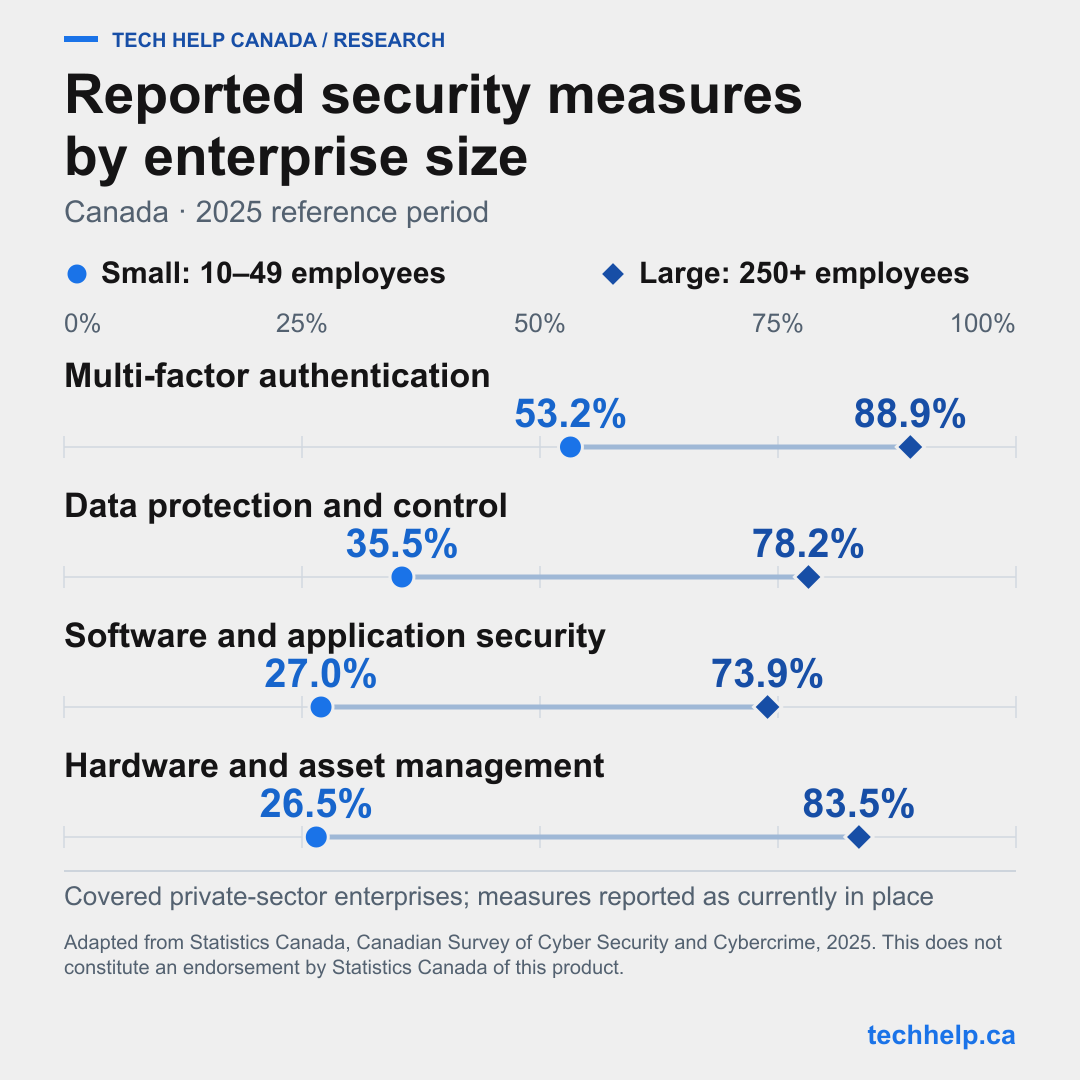
Among small Canadian enterprises, 53.2% reported using multi-factor authentication, compared with 88.9% of large enterprises. Tech Help Canada’s analysis of Statistics Canada data puts that divide at 35.7 percentage points.
Canadian security measures vary widely by business size
Small enterprises reported lower adoption of all 13 security measures than large enterprises in the 2025 Canadian Survey of Cyber Security and Cybercrime. Email security is among the more common measures, while software and application security, hardware management and data protection are less widely reported.
The results, released in October 2026, cover eligible private-sector enterprises with at least 10 employees. They describe security measures in place when businesses responded, including protection supplied by outside providers.
Adapted from Statistics Canada, Canadian Survey of Cyber Security and Cybercrime, 2025. This does not constitute an endorsement by Statistics Canada of this product.
Hardware and asset management has a particularly wide separation: 26.5% of small enterprises reported it, against 83.5% of large enterprises. That is a 57-percentage-point difference in a category that includes keeping an inventory of IT equipment.
Software and application security includes measures such as scheduled patching and restricting which applications can run. Its reported adoption is 46.9 points lower among small enterprises. Data protection and control, which includes encryption and rights management, is 42.7 points lower.
The size differences extend from account protection into the management of information and existing systems.
AI-based tools have the lowest reported adoption in all three size bands, with a 38.1-point small-versus-large difference. The wider differences in software and hardware management concern the continuing care of systems already in use.
Security work also depends on who carries it out
In 2025, 47.3% of small enterprises reported no employee with cybersecurity tasks among their primary responsibilities. The equivalent estimate for large enterprises was 16.6%.
A further 19.9% of small enterprises reported one employee with those responsibilities. That employee may work part time or have other primary duties; the measure is broader than a count of full-time security specialists.
Businesses without such an employee may still use external IT consultants or contractors, who are excluded from this count. The internal tasks measured include evaluating networks, maintaining software and recovering from incidents.
An outside service can supply protection, while the organization still has decisions to make about information access, system priorities and response responsibilities.
Reported incidents bring consequences beyond the IT team
During 2025, 15.2% of small enterprises were affected by cybersecurity incidents, compared with 21.0% of medium and 25.1% of large enterprises.
Larger enterprises report both more security measures and more incident experience. Different exposure, system complexity and detection can contribute to that pattern.
Among affected enterprises of all sizes, 19.9% reported additional time needed for employees’ day-to-day work. Revenue loss was reported by 16.3%, and 13.1% said employees were prevented from carrying out normal work. Enterprises could report several impacts.
The consequences run into staffing, customer service and cash flow. An incident can occupy people who would otherwise be handling orders, serving customers or maintaining operations, even when the technical response sits with an outside provider.
Only 11.0% of affected enterprises reported any cybersecurity incidents to a police service. Police records therefore capture a different slice of business experience from the survey.
Everyday email handling belongs in the security discussion
Protecting information also depends on what happens during ordinary business communication. The UK Information Commissioner’s Office records personal-data breaches across businesses, public bodies, charities and other organizations, including events that involve no cyberattack.
Among 77,226 reports received during 2019–2025, data emailed to the wrong recipient was more common than either phishing or ransomware.
ICO best-fit incident type
Reports received, 2019–2025
Share of 77,226 reports
Data emailed to an incorrect recipient
12,631
16.4%
Phishing
7,742
10.0%
Ransomware
4,692
6.1%
The same ordering held in each of the seven calendar years. In 2025, the counts were 2,499 misdirected-email reports, 1,539 phishing reports and 620 ransomware reports.
Each report receives one best-fit incident type, reflecting the most significant factor where several contributed.
Spam filters and malware scanning can coexist with a disclosure caused by sending information to an unintended recipient. Information has to remain protected during normal use, including when another organization handles it.
Shared services can extend a breach’s reach
In the U.S., the Department of Health and Human Services (HHS) publishes healthcare breach notifications through its Office for Civil Rights. These cover breaches of unsecured protected health information affecting at least 500 individuals.
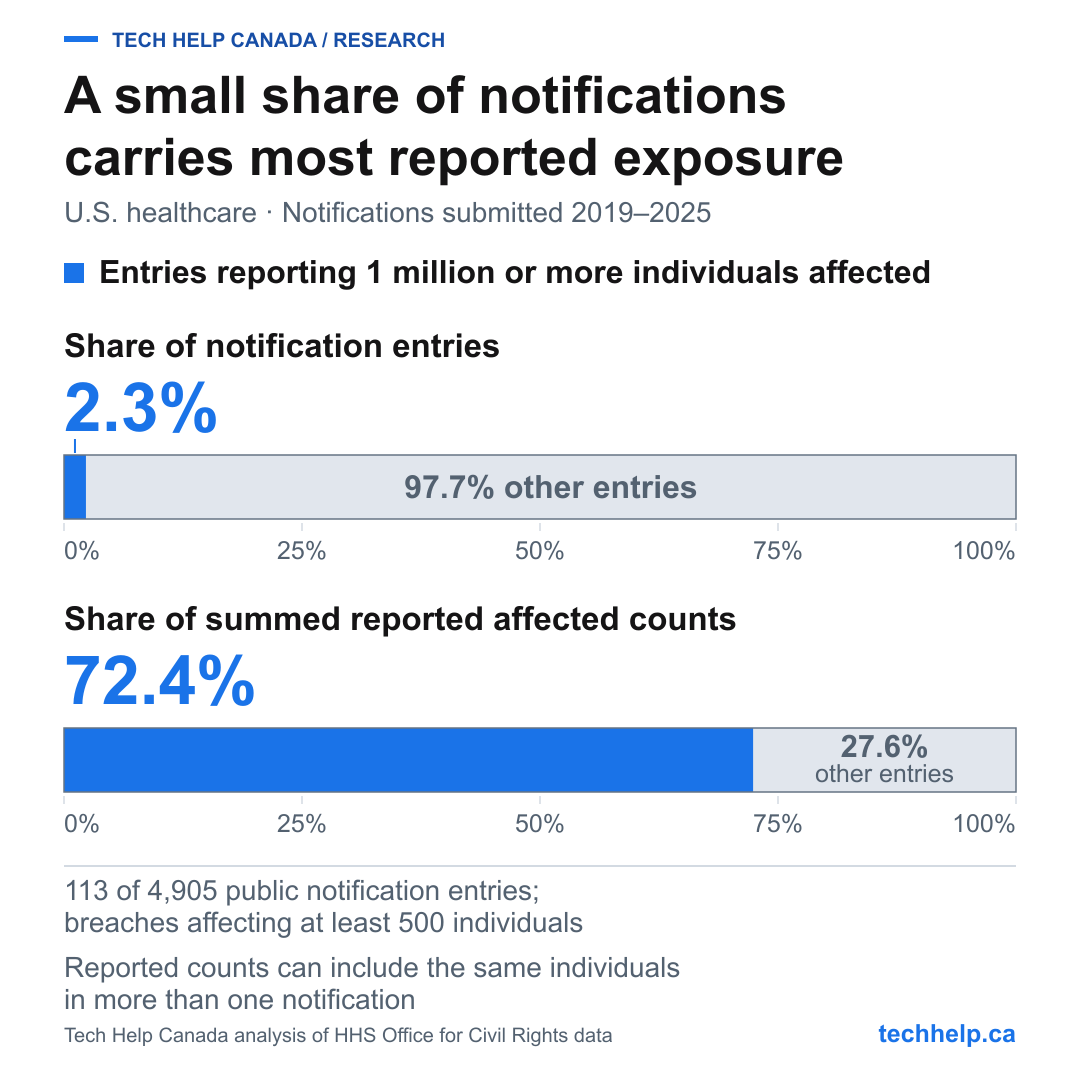
Among 4,905 entries for notifications submitted during 2019–2025, 113 listed at least one million individuals affected. Those entries made up 2.3% of the notifications and accounted for 72.4% of the sum of reported affected counts.
The median notification reported 5,807 individuals affected, far below the mean of about 167,728. A relatively small group of very large notifications pulls the average upward. The summed figures can include the same people in several notifications.
A small group of very large notifications accounts for most of the summed reported exposure.
Change Healthcare illustrates how one service relationship can reach across organizations. HHS says the company reported in July 2025 that approximately 192.7 million individuals had been affected by its 2024 breach. Its account describes notification arrangements involving Change Healthcare, covered entities and other business associates.
The case makes service dependency a business continuity concern as well as a data-protection concern. Organizations can depend on another company to process information essential to their work, while the effects of a breach reach their own customers and operations.
Newly listed vulnerabilities can be years old
The U.S. Cybersecurity and Infrastructure Security Agency (CISA) maintains the Known Exploited Vulnerabilities catalogue, identifying software weaknesses with evidence of exploitation. The National Vulnerability Database (NVD) records when vulnerability entries were published.
Tech Help Canada compared those dates for the 618 vulnerabilities CISA added to its catalogue during 2023–2025. For 201 entries, or 32.5%, the NVD publication date fell before the calendar year of catalogue addition.
Year added to CISA’s catalogue
Vulnerabilities added
NVD publication before that calendar year
Share
2023
187
60
32.1%
2024
186
61
32.8%
2025
245
80
32.7%
The share was close to one-third in each year. Across the combined period, 56 vulnerabilities had NVD publication dates at least five calendar years before their catalogue-addition dates.
Adobe’s ColdFusion bulletin announced hotfixes for CVE-2017-3066 on April 25, 2017. The vulnerability entered the catalogue on February 24, 2025, nearly eight years later. Catalogue dates record when vulnerabilities are listed; exploitation can begin earlier.
For businesses, the pattern puts older systems in the same discussion as new threat alerts. A current inventory connects a vulnerable component to the products and services an organization actually uses. That connection is especially relevant to small Canadian enterprises, whose reported adoption of hardware management and software security trails that of larger firms.
The Canadian Centre for Cyber Security’s baseline guidance addresses authentication, patching, staff awareness, incident response and oversight of outsourced services. For businesses and advisers, the benchmark supports a more specific discussion of which protections exist, who maintains them and how IT, operations and management share responsibility.
Frequently asked questions
How large is the Canadian small-business MFA gap?
Tech Help Canada’s analysis of Statistics Canada’s 2025 survey results found reported multi-factor authentication use of 53.2% among small enterprises and 88.9% among large enterprises, a difference of 35.7 percentage points. Small means 10–49 employees and large means 250 or more in the covered private-sector population.
Can a business have cybersecurity support without an internal security employee?
A business can use external IT consultants or contractors without having an employee whose primary responsibilities include cybersecurity. The Canadian survey’s employee measure excludes those outside providers. It measures internal staffing for cybersecurity tasks, including part-time employees, rather than the full amount of support a business receives.
Which email incident led the UK breach-report comparison?
Data emailed to an incorrect recipient led the comparison, with 12,631 of 77,226 personal-data-breach reports received by the UK Information Commissioner’s Office during 2019–2025. Phishing accounted for 7,742 reports and ransomware for 4,692. Misdirected email exceeded each of those categories in every year examined.
What does the report’s U.S. healthcare concentration figure measure?
Among 4,905 public healthcare breach-notification entries submitted during 2019–2025, 113 listed at least one million individuals affected. Those entries accounted for 72.4% of the sum of reported affected counts. This is a measure of concentration across notification figures, which can include the same individuals more than once.
What does the vulnerability analysis show about older software?
Of the 618 vulnerabilities CISA added to its known-exploited catalogue during 2023–2025, 201 had National Vulnerability Database publication dates before the calendar year of addition. The 32.5% share shows why monitoring newly listed exploited vulnerabilities also involves software weaknesses documented in earlier years.
Get new small business insights by email
Practical ideas and useful articles to help you make better business decisions.
Tech Help Canada Staff researches, writes, and reviews practical content for business owners and professionals. Our coverage spans business, marketing, SEO, technology, and the tools and systems people use to grow and operate online. We focus on clear, useful information backed by research, hands-on experience, and editorial review. Learn more about our team and editorial standards. Need help with something? Contact Us