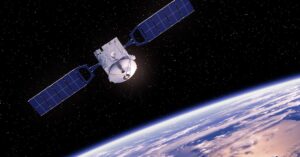
Google has received the first AI-generated response from its Project Suncatcher prototype satellite.
The company said on Oct. 30 that the satellite completed commissioning steps after its Oct. 1 launch, including powering up the host and TPU trays and running early machine-learning tests. Google described the latest step as a Hello World milestone: the first AI response from a data center-class Tensor Processing Unit in orbit.
During a ground-station pass, engineers uplinked a prompt to the onboard Gemma 4 open model, asking it to write a haiku about being in space. As the satellite passed by Svalbard, Norway, Google said the downlinked answer confirmed the test had worked:
Blue marble below Data streams in silent grace Starlight feeds my core.
Google also tested space-themed limericks and telemetry prompts reporting the technical status of the payload systems. The poem is the public-friendly part of the milestone. The more useful engineering result is the completed loop: a prompt sent from Earth, an AI model running on onboard hardware, and an answer returned from orbit.
Project Suncatcher is about AI infrastructure, not poetry
Project Suncatcher is Google’s research effort to test whether scalable machine-learning infrastructure could one day run in space. The prototype satellite was built with Planet and launched aboard SpaceX’s Transporter-18 rideshare mission on Oct. 1. Google said that day that it had confirmed contact with the satellite and that it was operating as expected.
The idea is tied to power. In a September briefing, Google said satellites in low Earth orbit can access near-constant sunlight and generate as much as eight times more solar power than comparable systems on Earth. A future Suncatcher system would try to use solar-powered satellites carrying TPUs and linked by high-bandwidth optical connections.
That is still a research case, not a product. Google’s own September briefing listed the engineering hurdles still being tested, including radiation, launch vibration, thermal control in vacuum, and satellite-to-satellite communication. For future satellite clusters, Google said high-bandwidth lasers would be needed to let neighboring spacecraft work together on larger AI workloads.
Google’s next test is reliability in orbit
The next phase is less photogenic than a haiku. Google said it will keep testing how the TPUs perform under thermal stress and radiation exposure in orbit.
Those are not side issues. Google’s briefing said a rocket launch can expose a spacecraft to sustained acceleration loads of 10 g, while individual components such as TPU chips can experience 50 to 100 g. It also said the team tested Trillium TPUs at UC Davis’s Crocker Nuclear Laboratory with a proton beam while running AI workloads, watching for errors such as bit flips.
Lab tests can reduce uncertainty, but they cannot replace long-running orbital data. Space hardware must survive radiation, temperature swings, limited cooling options, and intermittent communication windows while continuing to produce reliable results.
The first claim needs a narrow reading
Google’s claim is specific: the company says this is the first AI response from a data center-class TPU in orbit. It should not be read as the first use of AI in space.
NASA said in May 2026 that researchers had uploaded and demonstrated NASA and IBM’s Prithvi geospatial AI foundation model on two in-orbit platforms, calling it the first geospatial foundation model deployed in orbit.
What comes next
Google says verifying that its TPUs can reliably execute workloads in space would pave the way for its next milestone: twin interconnected satellites in 2027. That step is expected to focus on the connections between spacecraft, which are central to the idea of spreading AI workloads across multiple satellites instead of running isolated tests on one platform.
Get new small business insights by email
Practical ideas and useful articles to help you make better business decisions.
Tech Help Canada Staff researches, writes, and reviews practical content for business owners and professionals. Our coverage spans business, marketing, SEO, technology, and the tools and systems people use to grow and operate online. We focus on clear, useful information backed by research, hands-on experience, and editorial review. Learn more about our team and editorial standards. Need help with something? Contact Us