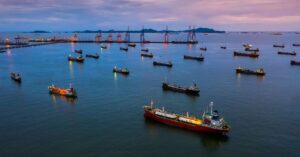
Commodity-vessel traffic through the Strait of Hormuz fell again at the start of the week, with preliminary Kpler data reported by Reuters showing four tracked transits on Monday, September 14, down from 10 on Sunday.
The drop keeps the waterway in a restricted operating state rather than a normal shipping corridor. The count excludes vessels crossing with Automatic Identification System transponders turned off, so it should not be read as a complete physical count. For cargo owners, procurement teams and planners, the signal is still clear: usable, insured and visible capacity remains fragile heading into Q4.
What the latest Kpler count showed
According to Reuters, Monday’s observed movements consisted of two dry bulk carriers exiting the waterway and two oil tankers entering in ballast. One of the dry bulk carriers was laden and the other was in ballast. Both oil tankers were empty.
The comparison is severe against pre-war norms. Reuters has reported that before the Iran war began on February 28, the strait typically handled about 125 large commercial vessels per day, including tankers, gas carriers, bulkers and container ships. The U.S. Energy Information Administration said oil flow through Hormuz averaged 20 million barrels per day in 2024, equal to about 20% of global petroleum liquids consumption, while about one-fifth of global LNG trade also crossed the route.
Those figures make small daily changes in tracked movement more than a shipping-detail story. Hormuz is a pricing input for energy, marine insurance, vessel availability, supplier lead times and fuel-linked surcharges.
Why the count has to be read carefully
Daily transit numbers are not all measuring the same thing. Kpler’s Reuters-cited figure is a commodity-vessel count based on tracked movement. IMF PortWatch data tabulated by Straits showed eight total AIS-detected transits on September 13, with one tanker and seven cargo vessels. That public series is updated with a lag and treats the latest rows as provisional.
The WTO and AXSMarine Strait of Hormuz tracker carries a similar caution around AIS-based readings: if transponders are disabled or interrupted during a Hormuz transit, displayed shipment volumes may understate actual activity. In a conflict zone where vessels may deliberately go dark, a low tracked count is best read as a visible-commerce signal, not a final estimate of barrels moved.
Security events are reinforcing the slowdown
The latest drop came after another burst of reported violence around the strait. The Associated Press reported that an Iranian cargo vessel was struck early Sunday off Qeshm Island, with Iranian state media saying one person was killed and four were wounded. AP also reported that the United Kingdom Maritime Trade Operations monitor said a vessel was hit by a projectile while transiting the strait; it was not immediately clear whether that referred to the same incident Iran had reported.
Planned regional talks in Oman on Hormuz shipping arrangements were also postponed, according to AP. Oman said the delay was “in the interests of consensus,” while AP reported that Saudi Arabia had raised concerns over the emerging Iran-Oman plan.
On Tuesday, AP reported that the U.S. military destroyed two small Iranian boats it said were trying to take a U.S. Navy sea drone. The State Department said Secretary of State Marco Rubio discussed Oman’s efforts to de-escalate tensions and reopen the strait with Oman’s foreign minister.
The cost issue is no longer only oil
Oil prices remain sensitive to the conflict, but the commercial burden also sits in the cost of moving cargo. S&P Global reported in late August that six months of disruption around Hormuz had driven tanker freight rates to record highs and tightened refined-products markets. Reuters reported on September 11 that the cost of shipping oil in the largest tankers hit record highs after attacks on shipping intensified.
Insurance is part of the same cost chain. Marsh’s global head of marine, cargo and logistics told Platts in July that additional war-risk premiums in the region had risen from 1% to 3% of hull value weeks earlier to 7.5% to 10%. That rate is not a retail fuel price, but it feeds the same landed-cost equation: fewer willing vessels, higher coverage costs and more expensive replacement routes.
Saudi pipeline closure reduces the margin for error
The shipping pressure is being compounded by trouble on routes designed to avoid Hormuz. AP reported Monday that Saudi Arabia closed its East-West pipeline after an attack it blamed on drones from Iranian-backed militias in Iraq. AP reported that regional officials expected repairs to take three to five weeks. Reuters later reported that U.S. Energy Secretary Chris Wright expected crude to begin flowing through the pipeline within days, while Reuters sources gave timelines ranging from an earlier partial restart to as much as five or six weeks for repairs.
The pipeline carries oil from the Persian Gulf side of Saudi Arabia to Yanbu on the Red Sea and had been an important relief valve while Hormuz traffic remained constrained. AP cited Rystad Energy as saying an average of 2.6 million to 4 million barrels per day had moved through the pipeline and out of Yanbu since late August, a volume now at risk of being removed from the market.
What this means for Q4 planning
For Q4 planning, the practical message is caution: a formal closure is not required for costs to stay elevated. A narrow set of visible transits, repeated security incidents and a damaged bypass route all point to a market where shipping capacity can change quickly.
Freight quotes may remain volatile. Vessel availability can move quickly when owners, insurers and charterers reassess risk.
Fuel-linked costs deserve wider buffers. The EIA’s September Short-Term Energy Outlook forecast Brent around $90 per barrel in the second half of 2026 and said constraints to Middle East exports are assumed through year-end.
Insurance risk can show up indirectly. Even companies that do not ship through Hormuz may see premiums, surcharges or vendor pricing reflect higher maritime risk.
Inventory timing may matter more than unit price. Delayed cargoes can produce stockouts, replacement buying or rushed air freight in sectors dependent on imported hardware, components or packaged goods.
For technology buyers, resellers and service providers, the exposure is less about one tanker count and more about second-order costs. Hardware, networking gear, backup power equipment, packaging, courier costs and field-service travel can all be touched by freight or diesel movements, even when the product did not cross Hormuz itself.
The planning takeaway
Monday’s count does not prove the Strait of Hormuz was closed. It does show that tracked, commercial movement remains thin at a moment when attacks, insurance pricing, tanker rates and alternative-route disruptions are all pointing in the same direction.
For the next quarter, the practical risk is cost persistence. Even if more cargo moves, freight and insurance prices may not reset quickly while security incidents continue and public tracking remains partial. Businesses setting Q4 budgets should treat fuel surcharges, shipping delays and supplier repricing as live variables, not edge cases.
Get new small business insights by email
Practical ideas and useful articles to help you make better business decisions.
Tech Help Canada Staff researches, writes, and reviews practical content for business owners and professionals. Our coverage spans business, marketing, SEO, technology, and the tools and systems people use to grow and operate online. We focus on clear, useful information backed by research, hands-on experience, and editorial review. Learn more about our team and editorial standards. Need help with something? Contact Us