Meta’s new Business Agent looks like an easy win for small businesses: switch it on, let AI answer customer questions, recommend products, book appointments, qualify leads, and hand off tricky conversations to a person when needed.
That’s useful. For a business owner who’s already answering the same questions across WhatsApp, Messenger, and Instagram every day, it may feel less like a chatbot and more like a missing team member finally showing up. The catch isn’t hidden in the feature list. It’s in the platform deal underneath it.
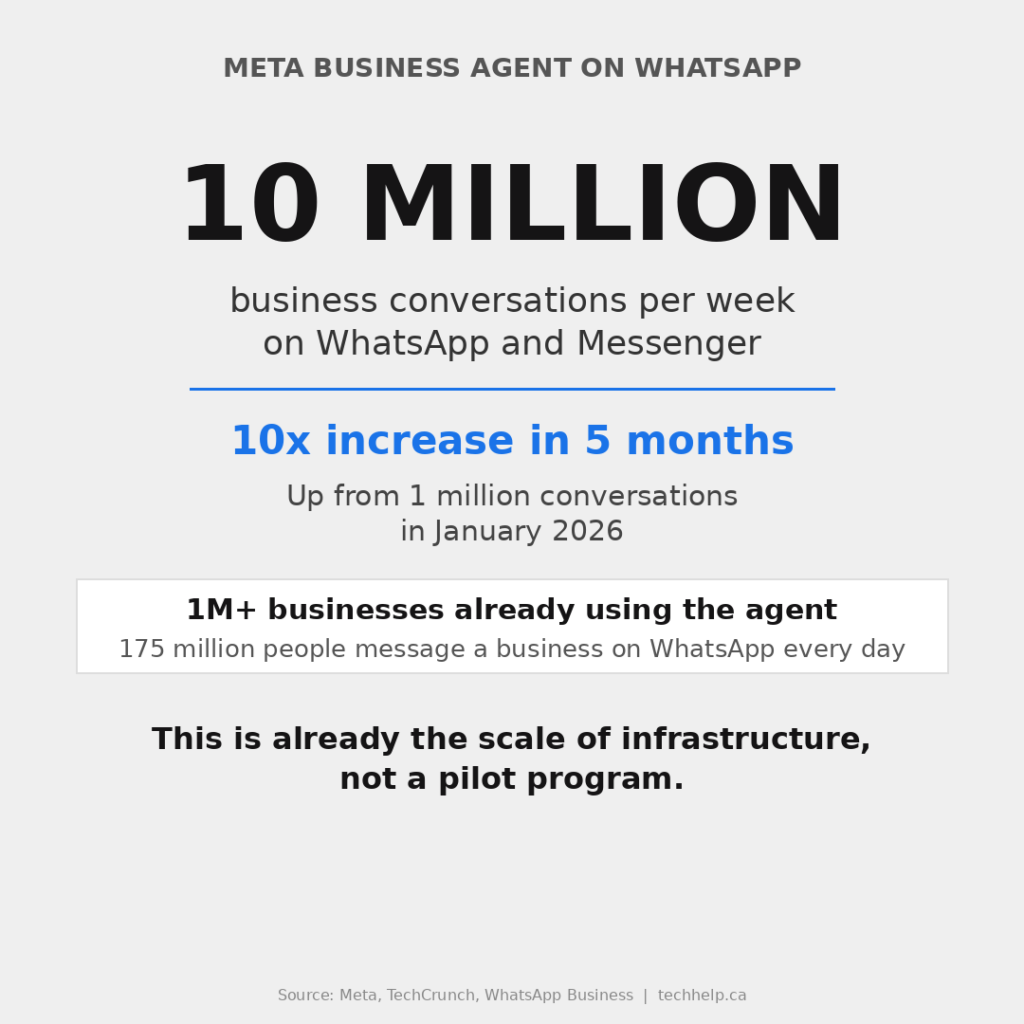
Meta introduced Business Agent on June 3, 2026, saying more than one million businesses already use a Meta Business Agent on WhatsApp and Messenger. TechCrunch also reported that Meta’s business AI tools were facilitating about 10 million conversations per week as of late March, up from one million at the start of the year.
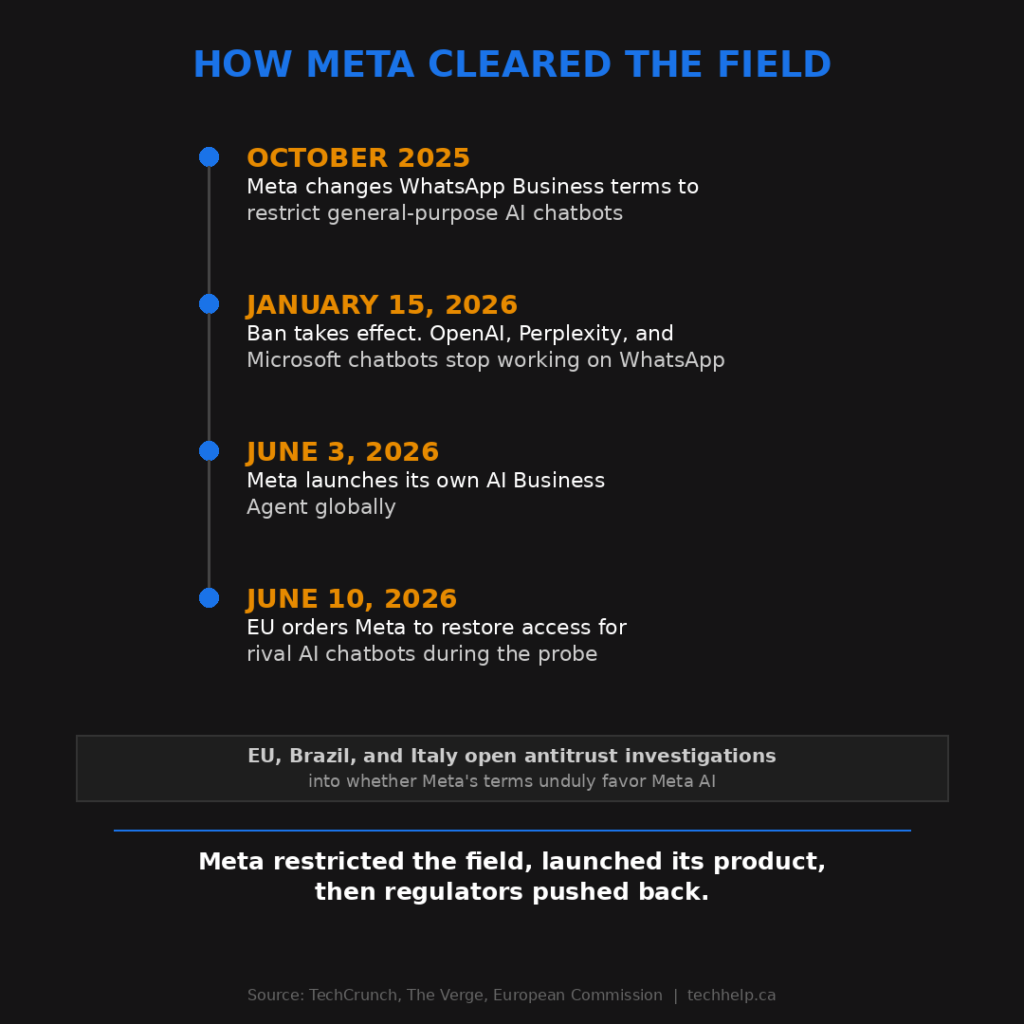
The product is free to get started. Paid subscription options are coming. And the launch arrived after Meta changed WhatsApp’s business terms to block general-purpose AI assistants from using WhatsApp as a distribution channel.
That’s the story small businesses need to understand: Meta isn’t just offering automation. It’s trying to become the customer conversation layer.
What Meta Business Agent does
Meta Business Agent is an AI assistant built for business conversations across Meta’s apps. On WhatsApp, Meta says eligible businesses can set it up inside the WhatsApp Business app, add business information, and let the agent respond to customers in multiple languages.
The agent can answer questions about hours, location, products, services, discounts, payment, shipping, and pricing. It can recommend products from a catalog, ask customers qualifying questions, request missing information, support sales conversations, and pass certain chats to a human.
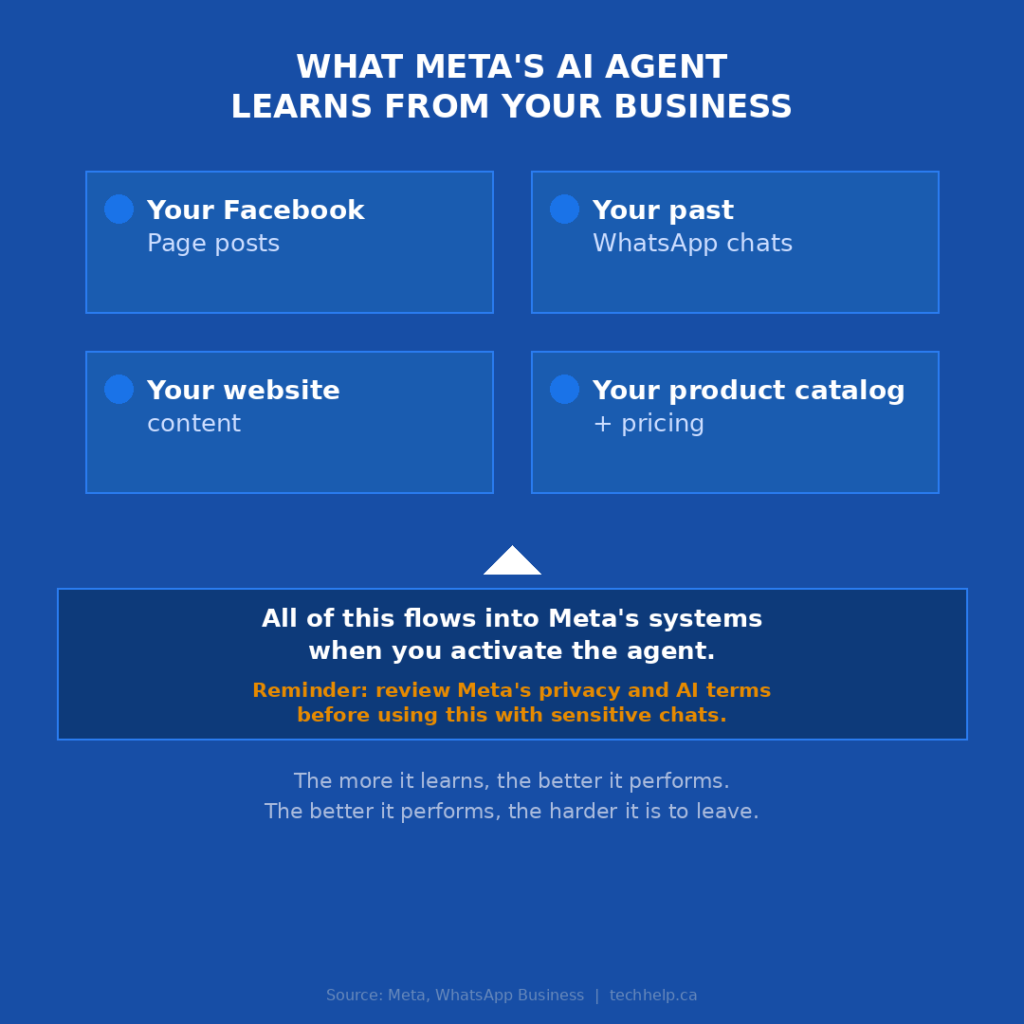
Meta’s own product page says the agent learns from business content such as social posts, product catalogs, FAQs, website information, past WhatsApp chats, product details, and price lists. Businesses can also control parts of the setup through knowledge, personality, audience, and handoff settings.
Those settings are practical safeguards. If the agent learns from outdated pricing, vague service descriptions, or messy FAQs, it can confidently give customers the wrong answer.
Meta is also testing a morning briefing feature that summarizes missed overnight chats and surfaces customer insights. For larger companies, Meta announced a Business Agent Platform that can connect to systems such as Shopify, Zendesk, and Shopee, giving agents more room to take action instead of only answering questions. This is more than customer support. It’s sales, discovery, lead qualification, and business intelligence wrapped into one messaging product.
Where the agent can actually help
For many small businesses, the pain point is real. Customers message after hours. They ask the same five questions. They abandon the conversation if nobody replies fast enough. They want product details, availability, pricing, appointments, or delivery information without waiting for a person.
An AI agent can help with that. If your business already gets meaningful customer demand through WhatsApp, Messenger, or Instagram, Meta Business Agent could reduce repetitive work and capture leads you’d otherwise miss.
This is especially relevant in WhatsApp-heavy markets where the app is already a normal way to talk to businesses. In those places, a fast response inside WhatsApp isn’t a novelty. It’s part of the buying experience.
The opportunity is smaller if your customers don’t use WhatsApp to reach you. If most of your customer conversations happen on Instagram DMs or Messenger, that’s where the agent may matter first. The right question isn’t “Is Meta’s AI agent impressive?” It’s “Are my customers already asking buying questions inside Meta’s messaging channels?”
If the answer is yes, this is worth testing. If the answer is no, don’t build your workflow around a channel your customers don’t use just because Meta made the AI part feel easy.
The platform play behind the free launch
Meta says getting started is free, but it also says businesses will access the agent through paid subscription offerings in the coming months. TechCrunch reported that larger businesses will pay based on token usage. That’s not a criticism by itself. Useful software costs money. The issue is dependency.
The more the agent learns about your products, prices, policies, customer questions, and sales process, the better it becomes. The better it becomes, the more your team relies on it. The more your team relies on it, the harder it is to leave when pricing changes, policies shift, or your needs outgrow the default setup.
That’s the classic platform pattern: remove friction early, become part of the workflow, then monetize the dependency. Small businesses shouldn’t panic about that. They should plan for it. If you test Meta Business Agent, treat it like a business system, not a toy. Know what data you’re giving it, what it controls, what it can and can’t export, and how you’d keep serving customers if you later decide to stop using it.
If you’re comparing this with other automation options, our AI agents vs RPA breakdown is useful background. The real decision isn’t just whether to automate. It’s which workflow deserves an adaptive AI agent, which parts still need human review, and where the business needs guardrails before speed.
Meta banned the competition first
The launch looks different when you place it beside WhatsApp’s AI chatbot policy change.
In October 2025, TechCrunch reported that WhatsApp changed its Business API policy to bar general-purpose AI chatbot providers from using WhatsApp Business Solution when the AI assistant is the primary product being offered. The rule was set to take effect on January 15, 2026, and TechCrunch reported that OpenAI, Perplexity, and Microsoft had already announced their WhatsApp chatbots would stop working.
Meta said the policy didn’t block businesses from using AI for customer service. A travel company, for example, could still use a bot to serve its own customers. The restriction targeted AI providers using WhatsApp as a distribution channel for general-purpose assistants, and that distinction matters legally and competitively. If WhatsApp becomes a major doorway for AI assistants, controlling which assistants can live there is a powerful move.
Regulators noticed. The EU, Italy, and Brazil opened probes into Meta’s WhatsApp AI restrictions. Then, on June 10, 2026, The Verge reported that the European Commission had ordered Meta to restore free WhatsApp Business API access for rival AI chatbots while the EU’s antitrust investigation continues. The order requires Meta to reinstate access under the same terms that existed before the ban, and Meta has said it plans to appeal.
So yes, Meta is giving businesses a useful AI tool. But it’s doing that while regulators are questioning whether Meta used WhatsApp’s control over distribution to disadvantage competing AI assistants. That’s not a footnote. That’s the center of the story.
What you’re handing over
To make the agent useful, you give it knowledge. That may include your Facebook Page content, past WhatsApp chats, website information, product catalog, price lists, FAQs, documents, photos, and instructions about your brand voice.
Some of that information may already be public. Some of it may not be. Either way, once you connect it, you’re turning business knowledge into a system Meta operates.
For a retail shop, that may be a reasonable trade. For a healthcare clinic, financial advisor, legal office, HR service, or any business dealing with sensitive customer information, the bar should be much higher. You need to review the privacy, retention, consent, and compliance terms before putting customer conversations through an AI agent.
The risk isn’t only “Meta has data.” The bigger operational risk is that your customer experience starts depending on a black-box assistant you don’t fully control. If it gives the wrong refund answer, misstates availability, recommends the wrong product, or mishandles an upset customer, your business owns the fallout. That’s why the handoff rules matter. The agent should know when to stop.
How to evaluate it before you switch it on
Start with the channel, not the technology. If customers already message you through WhatsApp, Instagram, or Messenger with repeatable questions, the agent may be worth a controlled pilot. If those channels barely produce customer conversations, the tool won’t fix that on its own.
Next, decide which tasks are safe to automate. Basic hours, location, product details, appointment requests, shipping questions, and lead qualification may be good candidates. Complaints, refunds, pricing exceptions, regulated advice, emotionally charged conversations, and anything involving judgment should route to a person.
Build a narrow knowledge base first. Don’t feed the agent every file you have just because the setup allows it. Start with current product information, pricing, FAQs, policies, and approved answers. Then review its responses before expanding what it can access.
Set handoff rules before launch. If the customer asks for a refund, mentions a legal issue, shares sensitive personal information, gets angry, or asks something the agent can’t answer with confidence, the conversation should move to a human.
Measure it like a real customer channel. Track response time, lead quality, booked appointments, sales assisted, handoff rate, customer complaints, wrong answers, and time saved. A high automation rate doesn’t mean much if it creates cleanup work later.
You should also think about ownership. Can you export customer conversation history? Can you recreate the agent’s knowledge base elsewhere? What happens if Meta changes pricing, eligibility, or platform rules? These questions sound boring until they’re urgent.
If your business already uses direct customer messaging, our direct digital marketing guide can help you place WhatsApp, Instagram, Messenger, email, SMS, push notifications, and chat inside a broader communication strategy.
Use it like a tool, not a new boss
Meta Business Agent may become one of the most practical AI tools small businesses get this year. It meets customers where many of them already are, removes repetitive work, and gives owners a way to respond faster without hiring a bigger team. But “free to start” doesn’t mean free from tradeoffs.
You’re bringing Meta deeper into your customer conversations. You’re giving the system more business context over time. You’re building habits around a platform that will eventually charge for more of the value it creates. And you’re doing all of this while WhatsApp’s role as an AI distribution channel is under active regulatory scrutiny. That’s not a reason to avoid it. It’s a reason to test it with discipline.
Use it for narrow, repeatable, low-risk conversations first. Keep humans close to anything sensitive or high-value. Review what it says. Keep your business knowledge organized outside Meta too. And don’t confuse convenience with control.
Meta didn’t just give businesses an AI employee. It offered them a place inside its customer conversation machine. For some businesses, that trade will be worth it. For others, the smartest move will be to watch, test lightly, and keep the exit door unlocked.
Tech Help Canada Staff researches, writes, and reviews practical content for business owners and professionals. Our coverage spans business, marketing, SEO, technology, and the tools and systems people use to grow and operate online. We focus on clear, useful information backed by research, hands-on experience, and editorial review. Learn more about our team and editorial standards. Need help with something? Contact Us