When someone clicks a website link, they should leave Google. That shouldn’t be controversial.
A search engine’s job is to help people find the best source, then send them there. That was the basic bargain of the web for decades. Publishers, businesses, creators, forums, bloggers, journalists, reviewers, and independent experts created the content. Google organized it. Users searched. Websites earned the visit.
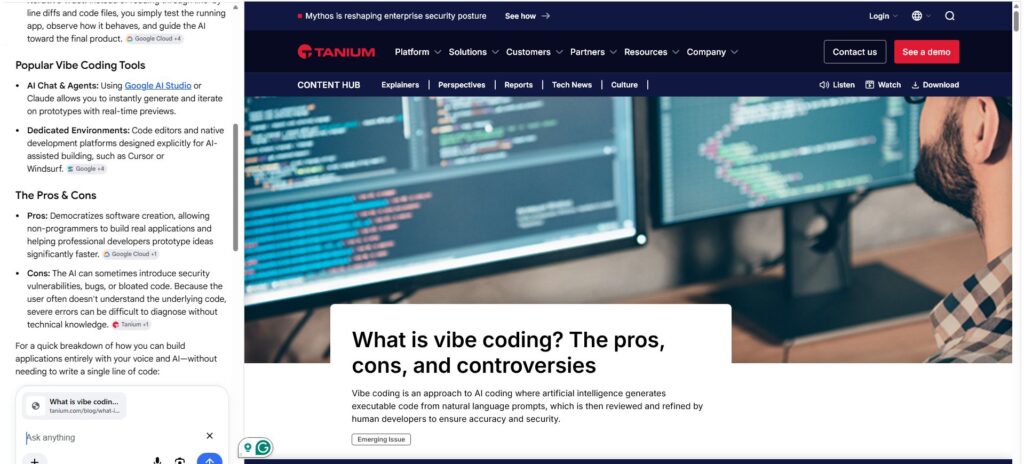
That bargain is breaking. Google’s AI search experience is no longer just pointing people to websites. It’s increasingly replacing the website experience before the visitor ever arrives. In some newer interfaces, even when the source page opens, Google keeps an AI panel beside it with summaries, citations, and a follow-up box ready for the next question.
The website is technically visible. The session still belongs to Google.
The click is being redefined
A recent Google AI search experience captures the issue clearly. A user searches a question, gets an AI-generated answer in a Google-controlled panel, and sees the source page open beside it. The original website appears on screen, but Google still owns the left rail, the cited snippets, the follow-up prompt, and the next obvious action.
That isn’t a clean handoff. It’s retention design.
Google doesn’t have to lock the browser to keep users inside its experience. UX works through defaults, framing, friction, visual hierarchy, and the next easiest action. If Google answers the question, displays the source as supporting material, and leaves an “ask anything” box in view, the natural next move isn’t to explore the website. It’s to ask Google another question.
That distinction matters. A source can be visible and still be demoted. A link can exist and still be functionally weak. A website can load and still lose the relationship because Google remains the primary interface.
That’s why “Google includes links” isn’t enough. Links aren’t the same thing as traffic. Citations aren’t the same thing as visits. A preview isn’t the same thing as letting the user experience the source.
A website click should belong to the website
There needs to be a simple rule for search: if a user clicks a website result, the user should land on that website without Google continuing to frame the experience around itself.
Not inside a split-screen AI environment. Not beside Google’s assistant. Not in a search-controlled session where the source page becomes one pane in Google’s answer machine.
The click should belong to the website because that click isn’t just a technical action. It’s the moment where the user chooses the source. It’s the moment where a business, publisher, or creator gets a chance to explain, educate, sell, build trust, and create a relationship.
When Google keeps its AI layer in the foreground after that point, it isn’t just helping people find the web. It’s standing between the searcher and the source. That’s where search stops being a doorway and starts becoming a gate.
This is bigger than publisher traffic
A lot of the AI search debate focuses on publishers, and for good reason. If Google can summarize an article, cite it, and satisfy the search without sending traffic, publishers lose the economics that make reporting, editing, and expert analysis possible.
But this isn’t only a media problem. It’s a business problem.
A company website isn’t just text on a page. It’s a sales environment. A good landing page carries the offer, proof, positioning, product details, screenshots, testimonials, case studies, demos, calculators, lead magnets, booking forms, chat, internal links, and calls to action. That full experience only works if the visitor actually reaches the site and has room to explore it.
Your landing page can’t convert a visitor Google never really sends you. That is the business side of the issue. A small company can spend years building useful content, improving service pages, adding tools, tightening calls to action, publishing original insights, and making its website genuinely helpful. But if Google answers the user’s question first, keeps the source inside a Google-shaped frame, and makes the next follow-up happen inside Google, the business may never get a fair chance to serve that visitor.
The website becomes raw material, and Google becomes the destination.
Google is competing for the whole session
The old version of Google competed to be the best search engine. This newer version competes to own the whole session.
Search. Google summarizes. Google cites sources. Google keeps the follow-up. Maybe the user clicks if the answer isn’t enough.
That “maybe” is doing a lot of damage. Once the source becomes optional, the open web loses leverage. Google can say AI Mode and AI Overviews include helpful web links, and technically that’s true. Google’s own AI Mode announcement says users can ask follow-up questions and get AI-powered responses with links to learn more.
But a link technically existing isn’t the same thing as a meaningful referral.
The practical design is what matters. Where is the user’s attention? Where is the next prompt? Who controls the frame? Who handles the follow-up question? Who gets the relationship if the user wants to know more? In this new experience, the answer is usually Google.
The data backs up the concern
This isn’t just a feeling from one screenshot. Pew Research Center analyzed nearly 69,000 Google searches from 900 U.S. adults in March 2025. Users who encountered a Google AI summary clicked a traditional search result in 8% of visits. Users who didn’t encounter an AI summary clicked a traditional result nearly twice as often, in 15% of visits.
The source links inside the AI summary performed even worse. Pew found that users clicked a link inside the AI summary in only 1% of visits with an AI summary.
Pew also found that users were more likely to end the browsing session entirely after seeing an AI summary: 26% of visits with an AI summary ended the session, compared with 16% of pages with only traditional results.
That is zero-click behavior in plain numbers. When Google gives people the answer, fewer people leave. When fewer people leave, websites lose opportunities to earn trust, revenue, leads, subscribers, bookings, and customers.
Recent academic work points in the same direction. One 2026 study of Google AI Overviews found that the feature appeared for 13.7% of tracked trending queries overall and 64.7% of question-form queries. Another 2026 paper using Wikipedia traffic found that exposure to AI Overviews reduced daily traffic to affected English articles by about 15%. Preprints should be read carefully, but the pattern is consistent: answer-first search changes where attention goes.
Google disputes some external studies on publisher traffic and often argues that AI features create new opportunities for discovery. But the user behavior pattern Pew captured is hard to brush aside. If the answer is already sitting inside Google, the website has to fight uphill for the click.
“But Google gives sources” misses the point
Google’s defense usually sounds reasonable at first. AI search includes links. AI Overviews help users understand topics faster. AI Mode helps users ask more complex questions. These experiences can help people discover web content they might not have found through a standard search. Some of that is true.
The problem is the exchange. If Google summarizes the answer, keeps the follow-up prompt, displays the source as evidence, and makes the original website feel like supporting material, the source is no longer the destination. It’s a citation attached to Google’s answer.
That may help the searcher in the short term. It may even feel convenient. But it weakens the system that produced the information in the first place.
Websites don’t live on citations. They live on visits, subscriptions, sales, ads, memberships, leads, demos, consultations, relationships, and trust. A tiny source chip beside an AI response doesn’t replace a real visit.
Google still gets the user. The website gets a footnote. That’s not a fair exchange.
The open web made Google powerful
This is the part that feels especially wrong. Google became Google because of the web. It didn’t create all the articles, tutorials, reviews, videos, documentation, research, product pages, community answers, and expert explainers that made search useful. The web did that.
Businesses created landing pages. Writers created guides. Developers wrote documentation. Reviewers tested products. Journalists reported stories. Creators made videos. Forum users answered niche questions. Independent publishers built libraries of useful information.
Google organized that work and became the front door to the internet. Now Google is using that position to become the room itself.
That is the betrayal. The web helped Google dominate, and now Google’s AI search experience risks weakening the web that made it valuable.
Regulators should examine the interface, not just the content rules
Regulators are already circling the broader issue. On June 3, 2026, the UK’s Competition and Markets Authority imposed a publisher conduct requirement on Google. The CMA said Google must provide publishers with effective controls over how their search content is used in generative AI, explain how that content is used, provide metrics on engagement with publisher content in generative AI search features, and take reasonable steps to attribute search content clearly and accurately.
That’s a meaningful step.
But regulators should go further. They should examine the interface itself.
This isn’t only about whether publishers can opt out of AI summaries or training. It’s also about what happens after a user actively chooses a website result. If the user clicks the source, Google shouldn’t keep wrapping the source inside an AI-led Google session.
The question isn’t only “Can publishers control whether their content is used?”
The question is also “Does the user get a real path to the source?”
Attribution without meaningful traffic isn’t enough. Control without a clean user handoff isn’t enough. A citation that keeps the relationship inside Google isn’t enough.
This specific UX needs to end
This isn’t an argument against AI in search altogether. AI can help people understand complicated topics, compare options, summarize long documents, and break complex questions into smaller pieces. Google’s AI Mode announcement describes exactly that kind of use case: complex, multi-part questions, follow-ups, comparisons, and reasoning.
Fine. Let AI help with that.
But when a user clicks a website, the experience should shift to the website. Google should stop acting as the main interface, assistant, interpreter, and gatekeeper at that point.
There should be a clean handoff. Search helped the user find the page. Now the page gets to do its job. That’s how the web works, or at least how it should work.
Small businesses should care
Some people will look at this and think it’s mostly a publisher fight. It isn’t.
If your business depends on organic traffic, this affects you. If you publish blog posts to attract leads, this affects you. If you create educational content to build trust, this affects you. If you invest in service pages, product pages, calculators, tools, downloads, webinars, comparison pages, or on-site chat, this affects you.
All of those assets depend on the same thing: the user has to arrive.
Google’s AI search experience threatens that basic step. When the user doesn’t arrive, your best content, strongest offer, clearest CTA, and most helpful website features never get a chance to work.
That’s why this isn’t just a technical SEO issue. It’s a market access issue. It’s a competition issue. It’s an open web issue.
Publisher controls are one side of the problem. This article is about the user experience side: even if websites get more controls, Google still needs to respect the click.
Google shouldn’t own discovery and the destination
Google can be a search engine. Google can build AI tools. Google can improve search. But Google shouldn’t use its dominance in search to turn other people’s websites into background sources for its own destination experience. That’s the boundary Google shouldn’t be allowed to cross.
The web doesn’t survive if everyone creates content and Google captures the relationship. It doesn’t survive if businesses invest in helpful websites and Google keeps users inside its own AI interface. It doesn’t survive if publishers do the work, Google summarizes the work, and the source gets reduced to a small citation.
A healthy web needs traffic to move. It needs users to visit sources. It needs businesses to own customer relationships. It needs publishers to earn from the work they produce. And it needs search engines to respect the click.
When someone clicks a website link, they should leave Google.
Anything else turns the open web into Google’s supply chain.
Tech Help Canada Staff researches, writes, and reviews practical content for business owners and professionals. Our coverage spans business, marketing, SEO, technology, and the tools and systems people use to grow and operate online. We focus on clear, useful information backed by research, hands-on experience, and editorial review. Learn more about our team and editorial standards. Need help with something? Contact Us