The negotiating power around remote work has changed. The pandemic era accelerated work from home, but since then, the market has changed. Remote work statistics show it remains a significant part of the labor landscape, but it’s unevenly distributed by job type and is often offered more selectively than many job seekers prefer.
Below is a data-based snapshot of remote work statistics showing where remote work stands today, drawing on government surveys, labor-market platforms, and large-scale workforce studies.
What people often get wrong is treating remote work as either “over” or “everywhere.” The reality is a stable baseline, unevenly distributed by job type, and often more competitive than the headlines suggest.
Remote Work Has Stabilized Into a New Baseline
One of the best baseline remote work statistics is whether people usually work from home (not occasionally). This matters because it filters out one-off flexibility and captures where work has settled.
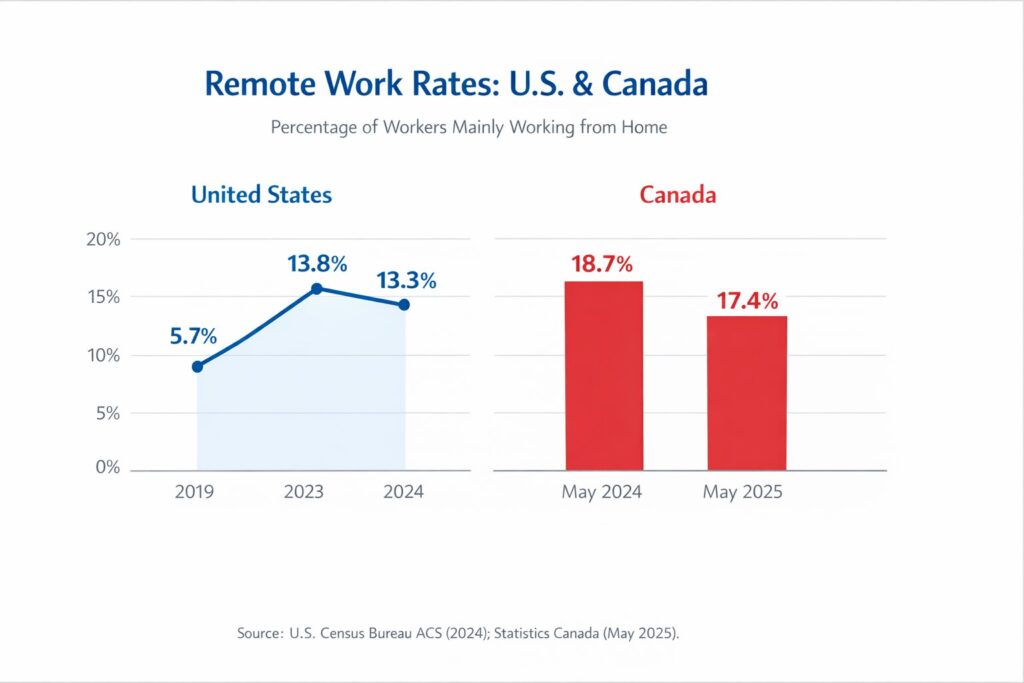
The U.S. Census Bureau’s American Community Survey shows 13.3% of workers worked from home in 2024, slightly lower than 13.8% in 2023—a small shift that signals stabilization rather than a continued surge.
Statistics Canada reports that in May 2025, 17.4% of employed people mostly worked from home, down from 18.7% in May 2024. Over the same period, the share who commuted (worked most hours outside the home) rose. Among commuters, the share who usually worked some hours from home also ticked up to 5.1% (from 4.8%).
Hybrid Is Common Where Work Is Remote-Capable
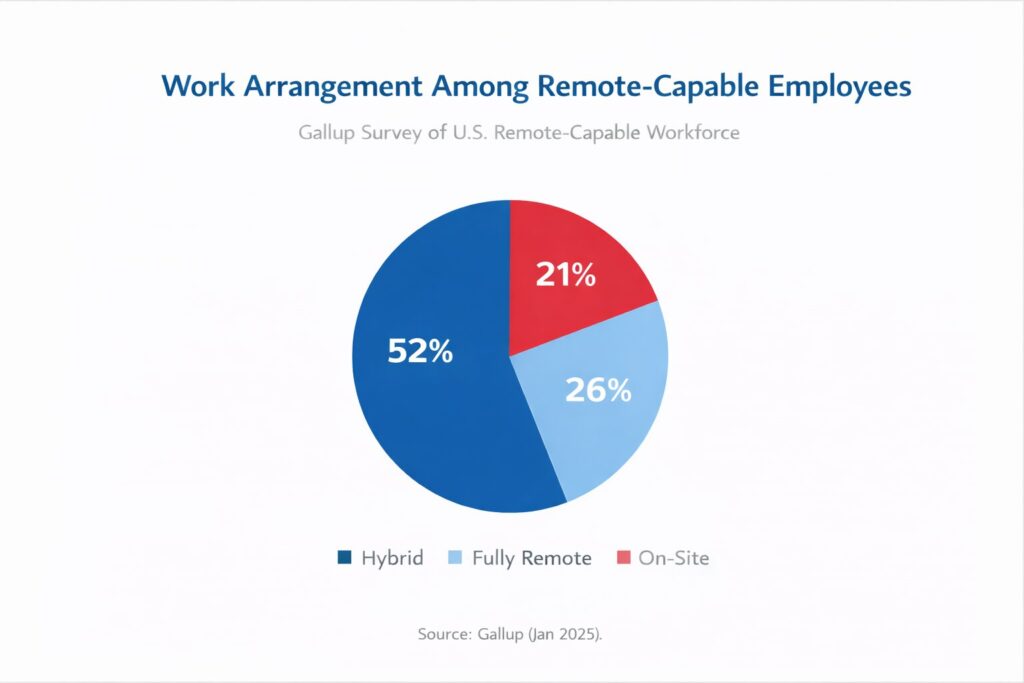
Gallup estimates remote-capable roles make up about half of the U.S. workforce. Within that group, Gallup’s latest indicator shows hybrid as the dominant setup with 52% hybrid, 26% exclusively remote, and 21% on-site (Gallup defines hybrid as working remote 10% to less than 100% of the time).
On average, Gallup finds hybrid employees spend about 46% of their workweek in the office, roughly 2.3 days/week. That’s up from 42% in 2022, but the key detail is that the increase happened earlier; Gallup notes no movement in the past year.
Statistics Canada’s Labour Force Survey reporting shows the overall share of workers who usually work both at home and outside the home has held at 10% (May 2025). What’s shifting is how those hybrid hours are distributed. Among these workers, 44.7% worked at least half their hours outside the home in the reference week (up from 43% in May 2024).
What Global Work From Home Looks Like
Stanford’s SIEPR summary of the Global Survey of Working Arrangements shows that the post-pandemic settled version of remote work is usually partial, not full-time (surveyed 16,000+ college/university graduates across 40 countries, Nov 2024–Feb 2025).
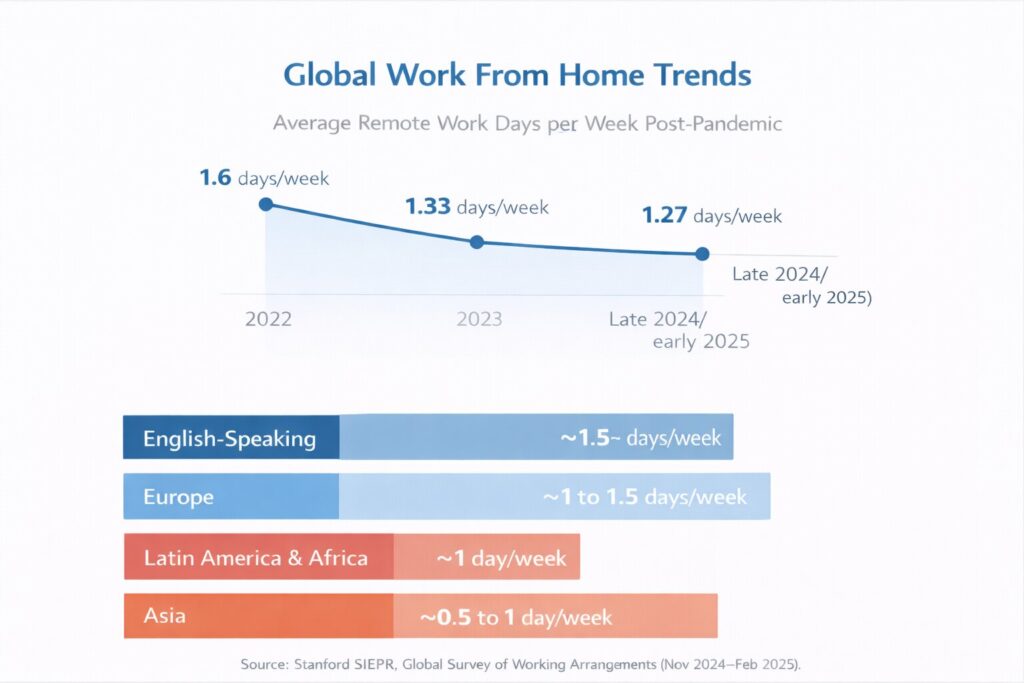
Across a balanced set of 22 countries surveyed consistently in recent waves, average work-from-home levels declined from 1.6 days/week (2022) to 1.33 (2023) and then stabilized around 1.27 days/week (late 2024 / early 2025).
What makes this data especially useful is that it doesn’t just give a global average. It shows the range:
English-speaking countries (including the U.S., Canada, UK, Australia): ~1.5 to 2 days/week
Europe: ~1 to 1.5 days/week
Latin America & Africa: ~1 day/week
Asia: ~0.5 to 1 day/week
So globally, work from home usually means about one to two home days built into the week, depending on where you live and work.
The Remote Work Gap
Remote work has become harder to secure, and recent remote work statistics show why: the number of people seeking remote roles hasn’t fallen as quickly as the number of remote opportunities being offered.
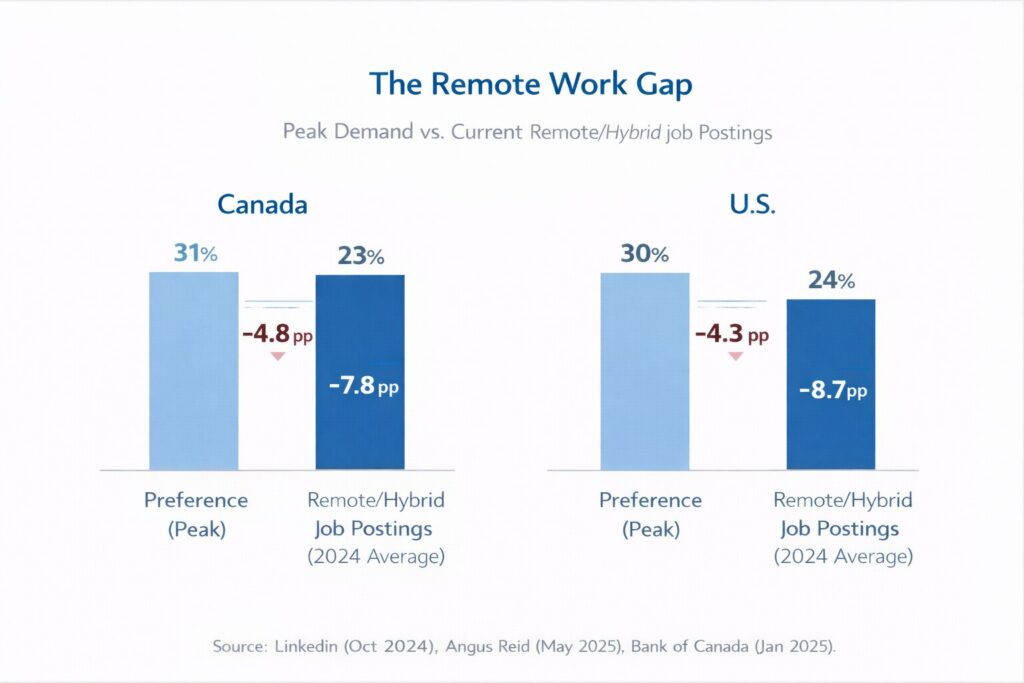
LinkedIn’s Economic Graph captures this well by comparing (1) remote-only applicants (people applying exclusively to remote roles) with (2) the share of remote jobs available in the market.
In Canada, remote-only applicant demand peaked at 16.4%, while remote job availability peaked at 21.2%. However, in 2024, demand was only 4.8 percentage points below its peak, whereas supply was 7.8 percentage points below its peak—indicating that supply cooled faster than demand.
The same pattern appears in the U.S. as well. Remote-only demand stayed relatively steady, while remote job availability fell more sharply from its peak. Indeed Hiring Lab reports that remote or hybrid postings peaked at 10.4% (Feb 2022) and declined to 7.8% by the end of Oct 2024.
Taken together, remote work remains a significant part of the market, but competition has intensified. A lot of candidate attention concentrates on a smaller slice of roles than it did at the peak.
Preferences Still Lean Strongly Toward Flexibility
Preference surveys aren’t the same as employer behavior, but they do explain why return-to-office debates stay heated. Most workers still choose flexibility when asked directly.
In FlexJobs’ 2025 State of the Workforce survey (3,000+ U.S. professionals), 98% preferred some form of flexibility. 58% wanted fully remote, 40% preferred hybrid, and only 2% preferred full-time in-office.
FlexJobs also found that flexibility influences decisions:
76% would look for a new job if remote work were eliminated
69% would accept a pay cut to keep remote work (often 5–10%)
85% said remote work is the top factor motivating them to apply
For Canada, Angus Reid’s 2025 polling points in a similar direction. 59% of working-age Canadians said they’d prefer either fully remote work (29%) or more remote than in-office (30%), while 21% preferred being in the office full-time.
In knowledge-economy/professional sectors under heavier return-to-office pressure, 68% preferred working from home most of the time, and 9% preferred fully on-site.
What These Remote Work Statistics Tell Us About Remote Work
Remote work has settled into a durable baseline rather than a temporary spike, but that baseline looks different depending on role type. Where work is remote-capable, hybrid is usually the dominant model. Globally, the most common pattern is roughly one to two work-from-home days per week, depending on the region.
At the same time, demand for remote roles remains strong, while the share of remote opportunities is smaller than it was at the peak. So remote roles can feel disproportionately competitive. Preference remote work statistics also point in the same direction: when workers are asked directly, flexibility is the overwhelming choice.
FAQ
What’s the difference between remote, hybrid, and work from home?
Remote usually means the role is designed to be done off-site. Hybrid means the schedule is split between home and on-site.
Work from home is often used as an umbrella phrase, but many official datasets measure usual work location (mostly at home vs mostly outside the home).
That’s why different sources can look inconsistent at first glance.
Are remote job scams common, and what are the biggest red flags?
They’re common enough that remote-work communities warn about them constantly. Watch for interviews conducted only by text, pressure to move fast,
requests for upfront fees, any situation involving a mailed check to buy equipment, and recruiter emails that don’t match a real company domain.
Why do many remote roles still require you to live in a specific country, province, or state?
Because remote does not automatically mean work from anywhere. Employers often restrict locations due to payroll and tax rules, benefits administration,
data and security requirements, and employment law compliance.
What does hybrid usually mean in practice, and why is it so vague?
Hybrid is a broad label, not a standard schedule. In practice, it can mean anything from occasional office visits to office-heavy routines.
If a posting doesn’t specify expectations, it’s safer to treat hybrid as a category and confirm the actual cadence during the hiring process.
When is it normal to share sensitive personal information in a remote hiring process?
Usually only after you’ve verified the employer and you’re moving into formal offer and onboarding steps.
If someone requests banking details, ID scans, or other sensitive information early, treat it as a major risk signal.
Do remote jobs tend to pay less than on-site roles?
Sometimes, depending on the role, location, and company policy. Some employers benchmark pay to geography, while others pay the same regardless of location.
It’s not universal, so it’s best read as a market and company-level choice.
Why do some remote job postings feel fake or impossible to land?
Remote postings often attract outsized applicant volume, and some are used to build a talent pipeline even when hiring is slow.
That combination can make remote roles feel disproportionately competitive compared to similar on-site roles.
Tech Help Canada Staff researches, writes, and reviews practical content for business owners and professionals. Our coverage spans business, marketing, SEO, technology, and the tools and systems people use to grow and operate online. We focus on clear, useful information backed by research, hands-on experience, and editorial review. Learn more about our team and editorial standards. Need help with something? Contact Us