SaaS marketing used to be easier to explain: publish helpful content, run paid ads, offer a free trial, nurture leads, and wait for recurring revenue to compound. That version still exists, but it doesn’t describe the pressure software companies are under now.
Buyers have more tools to compare. Finance teams are more involved. AI search is changing how prospects discover software. Generic content is easier to produce and easier to ignore. Free trials don’t mean much if users never reach the first useful moment. Retention has become part of marketing because acquisition alone can’t carry weak customer economics.
That’s the stronger way to look at SaaS marketing in 2026. It’s not a list of channels. It’s the system that helps the right people discover, trust, try, adopt, renew, and expand with a recurring software product.
What is SaaS marketing?
SaaS marketing is the process of attracting, converting, retaining, and expanding customers for a software product sold through a subscription or recurring revenue model.
That last part changes the entire strategy. A SaaS company doesn’t win just because someone buys once. It wins when customers activate, keep using the product, renew, expand their plan, and recommend it to others.
That means SaaS marketing has to work across more of the customer relationship than traditional campaign marketing. It touches positioning, content, search, paid acquisition, onboarding, lifecycle email, product education, customer proof, pricing communication, retention, and expansion.
For a simple consumer product, a good campaign can drive a sale. For SaaS, a good campaign only starts the relationship. The product still has to prove itself after the signup.
The SaaS marketing model that still holds up
Every SaaS company has its own motion, but the strongest marketing systems usually do five jobs well.
| Job | What it means | Common metrics |
|---|---|---|
| Positioning | Make the product easy to understand and easy to compare | Direct traffic, branded search, demo quality, win rate |
| Discovery | Show up where buyers research options | Organic visibility, AI search visibility, reviews, referral traffic, paid efficiency |
| Proof | Reduce risk before the buyer talks to sales or starts a trial | Case study engagement, comparison page visits, review performance, sales-qualified leads |
| Activation | Help new users reach value quickly | Trial activation, product-qualified leads, free-to-paid conversion, time to value |
| Retention | Keep customers engaged after the first purchase | Net revenue retention, churn, expansion revenue, renewal rate |
Because SaaS revenue is earned over time, lead volume can’t be the only measure of success. If marketing only focuses on lead volume, the company may generate pipeline that looks good in a dashboard and weakens the business later.
A better SaaS marketing strategy asks a harder question: which prospects are most likely to become successful customers?
Why SaaS marketing is changing in 2026
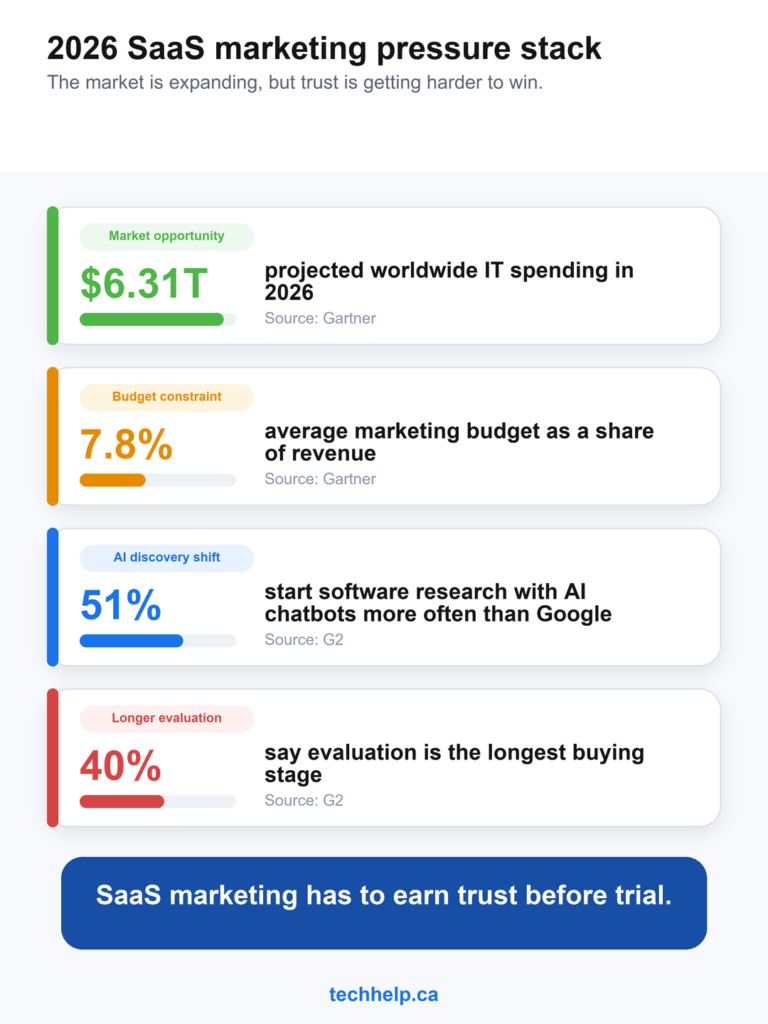
The broad software market is still huge. Gartner’s April 2026 forecast put worldwide IT spending at $6.31 trillion for 2026, with software spending projected at roughly $1.44 trillion.
That sounds like good news for SaaS companies. It is. But bigger markets attract more competitors, more automation, more content, more sales outreach, and more buyer skepticism.
Marketing budgets are under pressure too. Gartner’s 2026 CMO Spend Survey reported that marketing budgets rose only slightly to 7.8% of company revenue, while CMOs allocated 15.3% of marketing budgets to AI. The same survey found that 56% of CMOs said their marketing organization lacked the budget required to deliver its 2026 strategy.
That combination is the heart of modern SaaS marketing: growth is still possible, but lazy acquisition gets expensive fast.
SaaS marketing trends worth acting on
Trends only matter if they change decisions. A useful SaaS trend should affect your positioning, budget, channels, sales handoff, product experience, or retention strategy.
These are the SaaS marketing trends that deserve attention because they’re tied to measurable changes in how buyers discover, evaluate, and keep software.
AI search is becoming part of software discovery
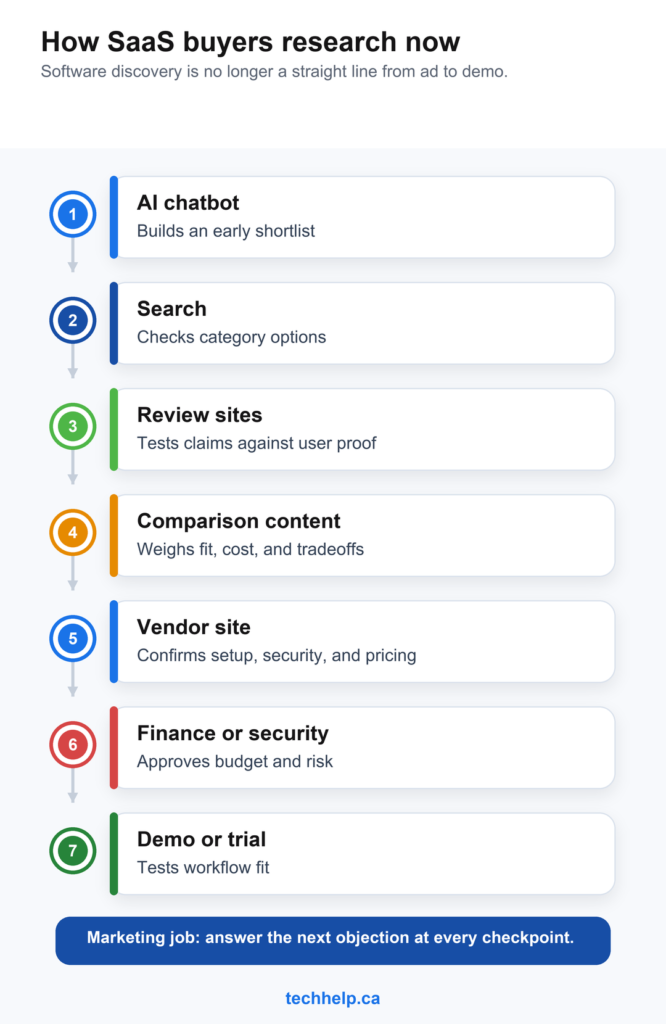
G2’s 2026 AI Search Insight Report found that 51% of B2B software buyers start their research with an AI chatbot more often than Google. The report also found that 71% rely on AI chatbots somewhere in the software research process. That’s a serious discovery shift for SaaS companies.
Search is no longer only about ranking a blog post in Google and waiting for clicks. Buyers may ask ChatGPT, Perplexity, Gemini, Claude, Copilot, Reddit threads, YouTube, review sites, and comparison pages before they ever visit your website.
For SaaS marketers, this changes the job from SEO alone to discoverability across answer surfaces. The question becomes: does the market understand what your product does, who it’s for, and why it should be considered?
You still need strong pages on your own site. But you also need proof that can be understood outside your site: reviews, third-party mentions, comparison content, documentation, customer stories, structured product pages, and consistent positioning across the places AI systems and buyers pull from.
If AI search is becoming a meaningful part of your acquisition path, review our guide to answer engine optimization and apply the same thinking to your SaaS website, help docs, comparison pages, and customer proof.
Generic AI content is losing its advantage
AI has made content production faster. It has also made weak content easier to spot.
Most SaaS companies don’t have a publishing problem anymore. They have a trust problem. Their content sounds like everyone else’s, answers the same beginner questions, repeats the same list of benefits, and never gives the buyer enough confidence to act.
HubSpot’s 2026 marketing research found that 40.6% of marketers were updating SEO strategies in response to AI-powered search. That response can’t just mean producing more content with AI. It has to mean creating content that’s harder to copy: original data, benchmarks, product screenshots, teardown-style comparisons, expert workflows, pricing explanations, implementation guides, and customer evidence.
The strongest SaaS content now does at least one of three things: it helps buyers make a decision they were already trying to make, shows proof they couldn’t get from a generic search result, or teaches customers how to succeed after they buy.
That’s where SaaS content marketing becomes a growth asset instead of a publishing habit. If you need a broader framework for building that kind of asset, our guide to content marketing strategies is a useful companion.
Buyers are doing more research before they talk to sales
Software buyers don’t want to be pushed into a demo before they understand the product. They want proof, pricing context, feature clarity, integration details, implementation expectations, reviews, and signs that the product will fit their workflow.
G2’s 2026 Buyer Behavior Report found that 40% of buyers now describe evaluation as the longest stage of the software buying journey, ahead of research and decision. The same report found that review sites and AI chatbots were the top sources influencing shortlist decisions. That should change how SaaS teams build websites.
Your website can’t be a brochure that hides the useful parts behind a demo form. It needs to help serious buyers qualify themselves. Every SaaS company has different limits around pricing, security, and product detail, but the page should still answer the questions that determine whether a buyer keeps going or leaves to compare someone else.
Strong SaaS product pages usually answer:
| Buyer question | Page element that helps |
|---|---|
| Is this built for a company like mine? | Use cases, customer segments, industry examples |
| Can I trust it? | Reviews, case studies, security details, recognizable customers |
| Will it work with our stack? | Integrations, API notes, supported platforms |
| How hard is setup? | Onboarding steps, implementation timeline, migration guidance |
| What happens after signup? | Trial flow, success resources, support model |
| How do I justify the cost? | ROI examples, comparison pages, value calculators |
The buyer is already researching. SaaS marketing needs to make that research easier.
Product-led growth is becoming more disciplined
Product-led growth isn’t going away. But the easy version of it, where companies assume a free trial or freemium plan will naturally create growth, is fading.
ProductLed’s benchmark research, based on 600+ SaaS businesses, found that 58% of surveyed B2B SaaS companies had a product-led growth motion. It also found that product-qualified lead usage was associated with roughly three times higher free-account conversion, while activation was tracked only 34% of the time. The signal is clear: the product still sells, but the handoff from product usage to revenue has to be intentional.
ChartMogul’s SaaS conversion research also found that free trials and freemium models behave differently. In its dataset of more than 200 SaaS products, free trials made up 57% of acquisition models and freemium made up 26%. Median visitor-to-paid conversion was 8.0% overall, but conversion performance varied widely by model, with credit-card-required trials converting at a higher rate than free trials without card requirements or freemium plans.
The lesson isn’t that every SaaS should require a credit card. The lesson is that signup model, onboarding, activation, and sales handoff are marketing decisions.
If users sign up and don’t reach value, the company doesn’t have a traffic problem. It has an activation problem.
Retention and expansion are becoming marketing work
SaaS marketers used to focus mostly on acquisition. That made sense when growth capital was cheap and new logos were rewarded above almost everything else. Now, retention is harder to separate from marketing.
Paddle’s SaaS metrics guide defines net revenue retention as expansion revenue plus retained revenue minus contraction and churn, divided by starting recurring revenue. A business with strong net revenue retention can grow even if new acquisition slows. A business with weak retention has to keep replacing revenue before it can grow.
That changes the marketing team’s responsibilities. Customer education, onboarding emails, product newsletters, feature adoption campaigns, success stories, release notes, training content, and expansion messaging all become part of growth.
SaaS companies should stop thinking of lifecycle marketing as “after the sale.” It’s part of the sale because it shapes whether customers stay long enough to become profitable.
In B2B SaaS, renewal risk often starts long before renewal month. If users don’t understand the value, don’t adopt the right features, or don’t see progress, the account becomes vulnerable.
Customer proof is moving closer to the buying decision
Buyer trust doesn’t come from your claims. It comes from evidence that reduces risk.
That evidence can take many forms: review volume, review quality, public customer stories, product screenshots, migration notes, security documentation, implementation timelines, comparison pages, analyst mentions, and community discussion.
G2’s AI search research found that 45% of B2B software buyers said review site citations were the most confidence-inspiring signal in an AI answer. Its buyer behavior report also found that review sites and AI chatbots were the leading sources influencing buyer shortlists.
For SaaS companies, proof can’t live only on one case study page that nobody visits. It should appear throughout the journey.
A homepage should show who the product is for. A product page should show how it works. A comparison page should show where it fits and where it doesn’t. An onboarding flow should show the first useful outcome. A renewal email should remind the account what changed because of the product.
The best SaaS marketing teams treat proof like infrastructure. It supports every channel.
Personalization is only as good as the data behind it
AI makes personalization sound easy. The harder part is knowing what should be personalized and whether the data is strong enough to trust.
Salesforce’s State of Marketing research found that 75% of marketers had adopted AI. Salesforce also reported that 78% of marketers need more personalized content than they’re able to produce, 98% face barriers to personalization, and 69% struggle to respond to outreach promptly.
HubSpot’s 2026 research reported that 93.2% of marketers said personalized or segmented experiences led to more leads and purchases, while only 65% said they had high-quality audience data. For SaaS marketers, the warning is obvious: hyper-personalized campaigns won’t help much if the underlying data is weak.
Good personalization starts with meaningful segments. A five-person startup evaluating your tool doesn’t need the same message as a 500-person company replacing a legacy system. A trial user who invited teammates doesn’t need the same onboarding sequence as someone who logged in once and disappeared.
Before adding more AI personalization tools, SaaS teams should tighten the data they already have: firmographics, role, use case, acquisition source, activation events, plan type, feature usage, support history, and renewal status.
For more on making the experience feel relevant after someone lands on your site, see our guide to personalized customer experience.
Pricing and packaging are becoming part of the marketing message
Pricing used to sit mostly with founders, finance, or product. In SaaS, it now affects marketing directly because buyers are more cautious about software spend.
G2’s 2026 Buyer Behavior Report found that nearly half of finance teams have vetoed purchase decisions already approved by other departments. It also reported that AI budgets were rising quickly, with many buyers reallocating more than 10% of existing software budgets toward AI. That means even good products may be fighting budget reshuffling.
SaaS marketing has to help buyers explain the purchase internally. That requires sharper messaging around total cost, time saved, risk reduced, revenue influenced, implementation effort, and what happens if the company keeps its current process.
Pricing pages, ROI calculators, procurement-ready security pages, and comparison pages can help. They don’t replace sales. They reduce the amount of friction sales has to fight later.
Communities and partner ecosystems are becoming distribution channels
SaaS discovery doesn’t only happen through search and ads. Buyers ask peers, communities, consultants, agencies, creators, Slack groups, Reddit threads, LinkedIn connections, newsletters, and integration partners. That creates a distribution opportunity for SaaS companies that are willing to earn trust before asking for a demo.
The strongest community and partner plays usually don’t start with promotion. They start with usefulness: templates, benchmark reports, implementation examples, education, diagnostic tools, and expert answers.
For SaaS companies with technical products, partners can be especially powerful because they already influence buying and implementation decisions. Agencies, consultants, fractional operators, and integration specialists often know which tools are painful to adopt and which ones actually work.
Marketing should make it easier for those people to recommend the product. That may mean partner pages, co-marketing assets, certification resources, integration documentation, and short proof packs they can share with clients.
SaaS content is becoming more decision-focused
Many SaaS blogs were built for traffic. That isn’t enough anymore.
Traffic can still matter, but traffic that doesn’t influence discovery, trust, evaluation, activation, or retention is just activity. The better question is what job each piece of content performs.
Some content should attract new buyers by explaining the problem. Some should help buyers compare options. Some should support sales. Some should help trial users activate. Some should reduce churn. Some should give partners something credible to share.
The best SaaS content mix usually includes:
| Content type | Main job |
|---|---|
| Educational guides | Capture demand and teach the category |
| Comparison pages | Help buyers evaluate alternatives |
| Use case pages | Connect product value to a specific problem |
| Customer stories | Add proof and reduce perceived risk |
| Implementation content | Explain setup, migration, integrations, and security |
| Benchmark reports | Earn links, press, sales credibility, and AI search citations |
| Product education | Improve activation, retention, and expansion |
The linkable asset opportunity is especially strong for SaaS companies because many categories lack useful benchmark content. If your company has anonymized product data, customer workflow data, pricing insights, adoption patterns, or implementation timelines, you may have material your market would cite.
SaaS marketing metrics that deserve more attention
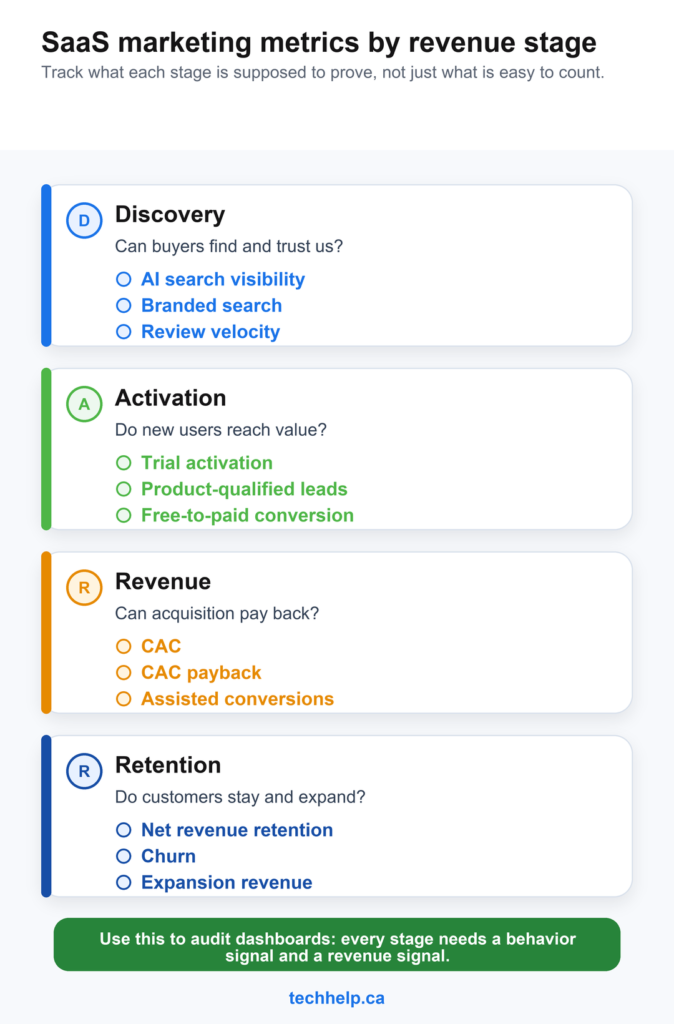
SaaS marketers still need channel metrics, but channel metrics don’t tell the whole story. A lower cost per lead may look good until those leads fail to activate, churn quickly, or never pass finance review.
These metrics are more useful because they connect marketing to the subscription model.
| Metric | What it tells you |
|---|---|
| Customer acquisition cost | How expensive it is to acquire a customer |
| CAC payback period | How long it takes to recover acquisition cost |
| Free-to-paid conversion | Whether your trial or freemium model creates revenue |
| Activation rate | Whether users reach the first meaningful product outcome |
| Product-qualified leads | Which users show buying intent through product behavior |
| Net revenue retention | Whether existing customers expand, contract, or churn |
| Expansion revenue | Whether customer marketing and product adoption are working |
| Review velocity | Whether customer proof is growing over time |
| Assisted conversions | Which content or channels support conversion indirectly |
| AI search visibility | Whether answer engines understand and mention your product |
No single metric tells the whole truth. The value comes from seeing how metrics relate.
For example, a campaign that drives cheap trials may look successful until you compare activation and free-to-paid conversion. A blog post with moderate traffic may be more valuable than a high-traffic article if it supports comparison searches or helps sales answer late-stage objections.
How SaaS marketing changes by company stage
A useful SaaS marketing strategy depends on stage. A startup with 20 customers shouldn’t copy the playbook of a mature company with a large sales team and established category awareness.
Early-stage SaaS
Early-stage SaaS companies need clarity before scale. The main goal is to prove who the product is for, what painful problem it solves, and what message makes the right buyers pay attention.
At this stage, marketing should focus on customer interviews, positioning, founder-led content, use case pages, direct outreach support, early customer stories, and a website that explains the product quickly.
Paid ads can be useful for testing messages, but they shouldn’t become a crutch. If the positioning is unclear, paid traffic only sends more people into confusion.
Growth-stage SaaS
Growth-stage SaaS companies usually need a stronger system. They have some market proof, but growth gets harder because the easy audience has already been reached.
At this stage, marketing should build stronger SEO, comparison content, product-led handoffs, lifecycle campaigns, review programs, partner channels, and sales enablement assets.
The goal is no longer just awareness. The goal is repeatable acquisition that doesn’t damage retention or unit economics.
Mature SaaS
Mature SaaS companies have more brand awareness, but they also deal with more complexity. Multiple products, multiple audiences, channel conflict, enterprise sales cycles, procurement reviews, and retention pressure can weaken the message.
Marketing should focus on category leadership, customer expansion, market education, partner ecosystems, benchmark reports, executive content, retention campaigns, and clear product architecture.
At this stage, consistency matters. If buyers, customers, partners, and sales teams describe the product differently, the market gets confused.
A practical SaaS marketing strategy for the next 90 days
If you’re refreshing SaaS marketing now, don’t start by chasing every trend. Start by fixing the parts of the system that most affect revenue quality.
| Timeframe | Focus | What to improve |
|---|---|---|
| Days 1-30 | Clarity | Positioning, homepage, product pages, audience segments, core use cases |
| Days 31-60 | Proof | Reviews, case studies, comparison pages, customer quotes, security and implementation answers |
| Days 61-90 | Activation and retention | Trial onboarding, lifecycle email, product education, expansion messaging, activation metrics |
The goal isn’t to launch a massive campaign in 90 days. It’s to make your marketing easier to understand, easier to trust, and more connected to the product experience.
For broader planning beyond SaaS specifically, our social media marketing vs. digital marketing guide can help you connect channels, audience, and measurement.
What SaaS companies should stop doing
Some SaaS marketing habits are expensive because they look productive while creating weak outcomes.
Publishing content only because a keyword exists is one of them. If the article doesn’t help a buyer understand a problem, compare options, adopt the product, or justify a decision, traffic alone won’t save it.
Another is hiding too much behind demo forms. Gated sales motions can work for complex products, but blocking basic evaluation information often pushes buyers back to review sites, AI search tools, and competitors with clearer answers.
SaaS teams should also stop treating AI as a substitute for point of view. AI can help draft, analyze, summarize, and personalize, but it can’t invent credible proof the company doesn’t have.
Finally, companies should stop separating acquisition from retention in the way they measure marketing. If marketing brings in customers who don’t activate or renew, the campaign didn’t really work.
The SaaS marketing advantage now is trust before trial
The best SaaS marketing in 2026 won’t come from chasing every new channel. It’ll come from making the buying journey easier to trust.
Buyers want answers before demos. They want proof before risk. They want to understand pricing before fighting for budget. They want to see how the product fits their workflow before they invest time in setup. They want fewer promises and more evidence. That gives SaaS companies a clear path: build a strategy around the full subscription relationship, not just the first signup. Show up where buyers research. Make your positioning specific. Create content that helps people decide. Use AI where it improves speed and relevance, but make proof the center of the message. Treat onboarding and retention as marketing responsibilities too.
SaaS marketing is getting harder for companies that depend on volume alone. It’s getting better for companies that know their customer, explain their value clearly, and prove it at every step.
Frequently Asked Questions
What is SaaS marketing?
SaaS marketing is the process of attracting, converting, retaining, and expanding customers for a software product sold through a subscription or recurring revenue model. It includes positioning, content, search, paid acquisition, onboarding, lifecycle messaging, customer proof, and retention-focused marketing.
How is SaaS marketing different from traditional marketing?
SaaS marketing doesn’t end when someone buys. Because revenue depends on renewals and expansion, SaaS marketing has to support the full customer journey: discovery, signup, activation, adoption, renewal, and upsell. A one-time sale is less important than long-term customer success.
What are the most important SaaS marketing trends?
The most important SaaS marketing trends include AI search discovery, proof-heavy content, more self-serve buyer research, disciplined product-led growth, retention-focused marketing, stronger review programs, better personalization, and clearer pricing and packaging communication.
What metrics should SaaS marketers track?
SaaS marketers should track more than traffic and leads. Useful metrics include customer acquisition cost, CAC payback period, free-to-paid conversion, activation rate, product-qualified leads, net revenue retention, expansion revenue, review velocity, assisted conversions, and AI search visibility.
Is content marketing still useful for SaaS companies?
Yes, but generic SaaS blog content is weaker than it used to be. Content works best when it helps buyers make decisions, compare options, understand implementation, build trust, or succeed after signup. Original data, customer proof, screenshots, comparison pages, and product education usually create more value than broad beginner articles.
What is the best SaaS marketing strategy for a startup?
Early-stage SaaS companies should focus on positioning, customer interviews, use case clarity, founder-led content, early customer proof, and a website that explains the product quickly. Paid ads can help test messages, but they won’t fix unclear positioning or a weak activation experience.
References
- https://www.gartner.com/en/newsroom/press-releases/2026-04-22-gartner-forecasts-worldwide-it-spending-to-grow-13-point-5-percent-in-2026-totaling-6-point-31-trillion-dollars
- https://www.gartner.com/en/newsroom/press-releases/2026-05-11-gartner-2026-cmo-spend-survey-finds-cmos-allocate-15-point-3-percent-of-marketing-budgets-to-ai-but-only-30-percent-are-ready-to-scale-ai-capabilities
- https://learn.g2.com/g2-2026-ai-search-insight-report
- https://sell.g2.com/2026-buyer-behavior-report
- https://www.salesforce.com/news/stories/state-of-marketing-2026/?bc=OTH
- https://blog.hubspot.com/marketing/hubspot-blog-marketing-industry-trends-report
- https://chartmogul.com/reports/saas-conversion-report/
- https://productled.com/blog/product-led-growth-benchmarks
- https://www.paddle.com/resources/the-ultimate-saas-metrics-guide

I can suggest related Tech Help Canada articles based on the topic you’re reading now.

Tech Help Canada Staff researches, writes, and reviews practical content for business owners and professionals. Our coverage spans business, marketing, SEO, technology, and the tools and systems people use to grow and operate online. We focus on clear, useful information backed by research, hands-on experience, and editorial review. Learn more about our team and editorial standards. Need help with something? Contact Us