
The Canadian dollar was hovering near 70 U.S. cents in early July 2026. At the same time, the U.S. declined to give CUSMA the long-term renewal Canada and Mexico wanted.
For Canadian businesses, those two pressures hit the same place: margins.
If you pay vendors in U.S. dollars, import from American suppliers, sell into the U.S. market, or rely on cross-border pricing, the weak dollar raises your costs today while trade uncertainty makes it harder to plan tomorrow. The companies that handle this best won’t be the ones waiting for certainty. They’ll be the ones that know exactly where their exposure sits and what they can control now.
CUSMA is still alive, but the certainty changed
CUSMA didn’t expire on July 1, 2026. The agreement remains in force, and its trade rules still apply.
The change is subtler than the headline suggests. Under CUSMA’s review rules, the three countries were supposed to decide at the six-year review whether to extend the agreement for another 16-year term. Canada and Mexico supported renewal. The U.S. declined to confirm a long-term extension.
That decision doesn’t kill the agreement. It moves CUSMA into annual reviews. The countries can still agree later to extend it for another 16 years, but until they do, the remaining life of the agreement gets shorter each year.
For Canadian businesses, the practical result is this: preferential access to the U.S. market still exists, but the planning window is less stable. A supplier contract, factory investment, warehouse lease, or export push that made sense under a long-term trade framework now carries more political risk.
That’s the business problem: less certainty, not immediate collapse.
The weak dollar is already showing up in your bills
The currency pressure is easier to see because it hits invoices directly.
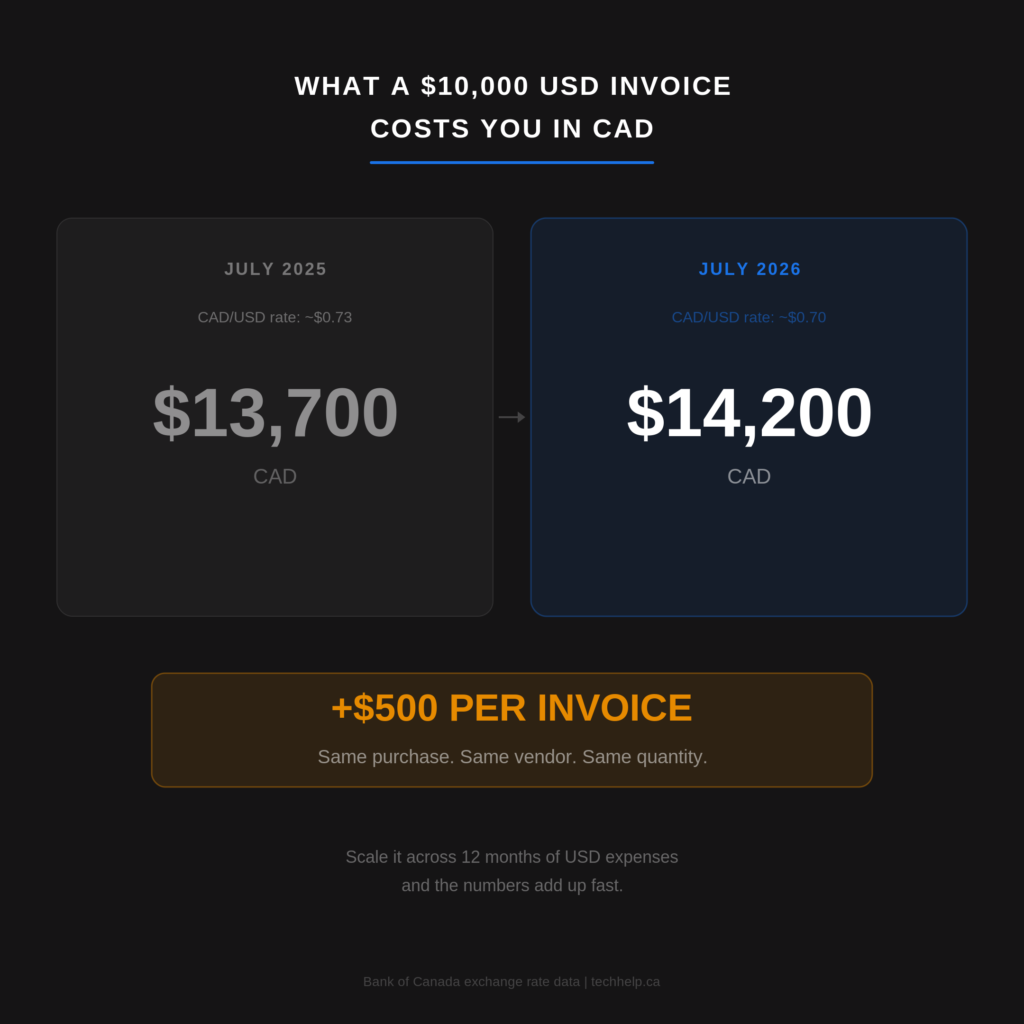
Bank of Canada exchange data put the USD/CAD rate around 1.42 in early July 2026. That means one U.S. dollar cost about $1.42 CAD, leaving the Canadian dollar near 70 U.S. cents.
A $10,000 USD invoice at that rate costs roughly $14,200 CAD. Around the same period last year, the exchange rate was closer to 1.37, so that same invoice would have cost about $13,700 CAD. That is roughly $500 more for the same purchase before any tariff, shipping, wage, or vendor price increase enters the picture.
For a one-time expense, that’s annoying. Across a full year of U.S.-dollar costs, it can become a margin problem.
Software is one of the easiest places to miss it. Many Canadian teams pay for tools that are priced in U.S. dollars or closely tied to U.S.-dollar pricing. That includes ad platforms, marketing tools, project management software, analytics platforms, and products like Microsoft 365. If your monthly software stack costs $5,000 USD, a 3.5% currency shift adds thousands of Canadian dollars a year without changing a single seat, feature, or workflow.
Digital advertising can hurt the same way. If your Google Ads or Meta Ads spend is planned around U.S.-dollar budgets, the cost per click, lead, or sale may look stable in-platform while getting more expensive in the currency your business actually earns.
Inventory, equipment, components, trade shows, U.S.-based contractors, and cross-border freight all follow the same pattern. The invoice stays the same in U.S. dollars. Your cost in Canadian dollars rises.
Tariffs don’t stop at the border
CUSMA still protects much of the trade moving between Canada, the U.S., and Mexico, especially when goods qualify under the agreement’s rules. But sector-specific tariffs and trade actions are already affecting areas such as steel, aluminum, autos, and lumber.
You can feel that pressure even if your business doesn’t import those goods directly.
If your supplier buys U.S. aluminum, your costs can rise through their pricing. If your manufacturer uses tariff-affected inputs, your unit economics can change without you ever filing a customs document. If your customer base is exposed to higher costs, payment delays or order reductions can show up downstream.
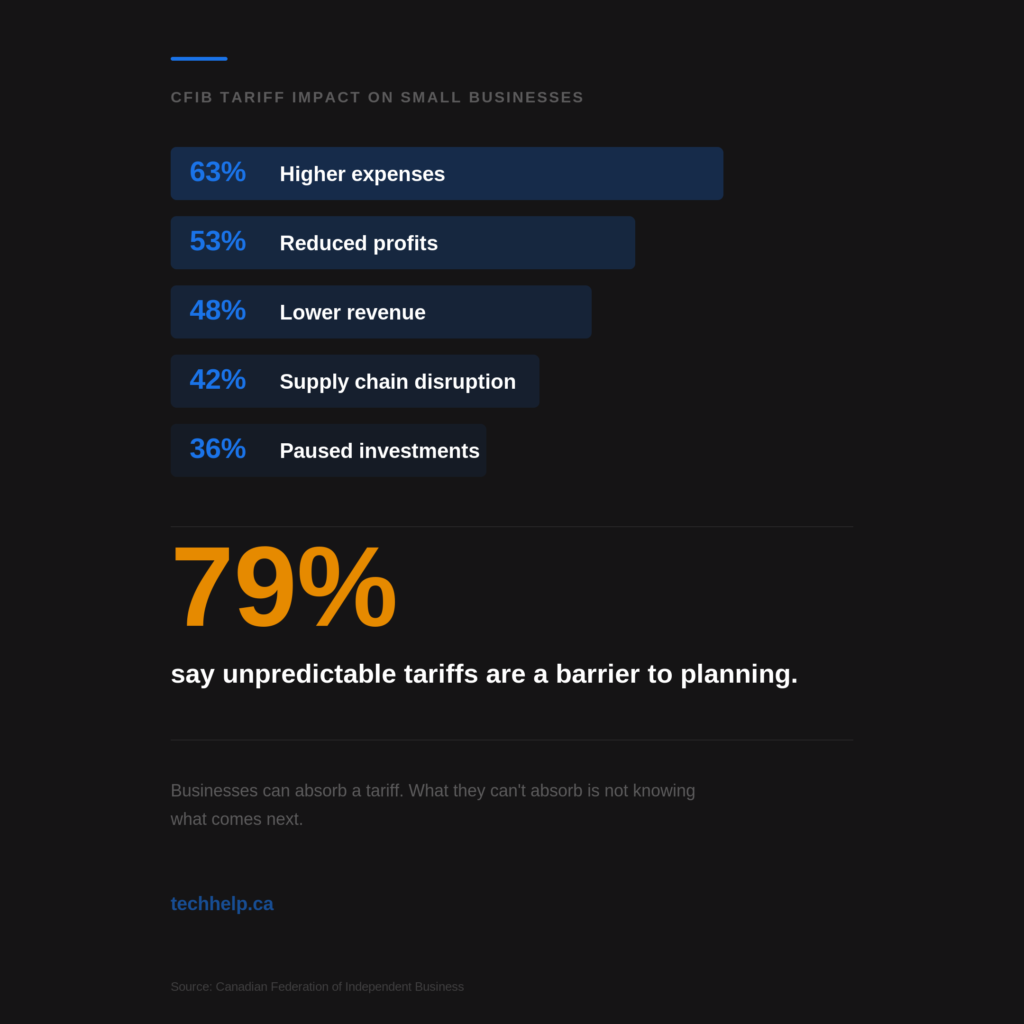
The Canadian Federation of Independent Business has been tracking the strain on small businesses. In its tariff impact research, 63% of surveyed small businesses reported higher expenses, 53% reported reduced profits, 48% reported lower revenue, 42% reported supply chain disruption, and 36% had paused investments. CFIB also found that 79% saw unpredictable tariffs as a barrier to planning.
For small businesses, the effect is practical. Tariffs can become higher vendor prices, weaker cash flow, delayed expansion, and lower confidence.
Uncertainty hits before the deal expires
The annual review cycle creates a quieter cost: hesitation.
Businesses don’t need CUSMA to vanish before they start changing behavior. They only need enough uncertainty to delay decisions. A manufacturer may wait before signing a long-term supply contract. A retailer may avoid a large U.S. inventory commitment. A service firm may slow its U.S. hiring or keep prices conservative because it doesn’t know what cross-border demand will look like next year.
That kind of hesitation is hard to see in a single financial statement, but it changes the direction of a business. Projects move slower. Expansion gets postponed. Owners hold more cash than they would prefer. Suppliers become harder to trust on long-term pricing.
Canadian officials have already warned that annual reviews could chill investment because businesses need predictable rules to commit capital. It lines up with what small businesses are feeling now. The agreement still exists, but business confidence around it has weakened.
For owners, the point isn’t to predict the next negotiation. It’s to stop running the business as if the trade environment is still predictable.
Start with your U.S.-dollar exposure
You can’t control the exchange rate, but you can control how much of your business is exposed to it.
Start by listing every recurring U.S.-dollar cost. Include software, ads, inventory, contractors, subscriptions, shipping, equipment, hosting, payment tools, consultants, and marketplace fees. Many owners think they know this number until they add it up.
Then separate those expenses into three groups.
First, costs you can move to Canadian-dollar billing. Some vendors offer CAD billing, annual plans, or account options that reduce currency volatility. It’s worth asking, especially for larger subscriptions.
Second, costs you can naturally hedge. If you earn U.S.-dollar revenue and pay U.S.-dollar expenses, a U.S.-dollar bank account can help you avoid converting money back and forth. You can use U.S.-dollar revenue to pay U.S.-dollar bills, then convert only what is left.
Third, costs that need active planning. Larger inventory purchases, equipment orders, or supplier payments may justify talking to your bank or foreign exchange provider about forward contracts. A forward contract can lock in an exchange rate for a future payment, which gives you cost certainty even if the dollar moves.
You don’t need a corporate finance department to do this. You need a monthly exposure number, a list of the biggest U.S.-dollar vendors, and a habit of reviewing currency risk before major purchases.

Build flexibility into your supply chain
Currency is only one side of the problem. Trade policy is the other.
If your business depends on U.S. inputs, look at business diversification through a supply chain lens. The goal isn’t to abandon U.S. suppliers overnight. It’s to know where your alternatives are before you need them.
Start with the products or inputs that would hurt most if pricing changed quickly. For each one, identify at least one alternative supplier in Canada, one outside the U.S. if practical, and one substitute product or material if the exact item becomes too expensive.
Then review your contracts. Look for clauses tied to tariffs, currency adjustments, delivery delays, minimum purchase commitments, and price-change notice periods. If a vendor can raise prices with little notice but you can’t reprice your own customers quickly, your margin is exposed.
If you import or export goods under CUSMA, review the paperwork too. Rules of origin, tariff classifications, and certificates matter more when enforcement and costs are under pressure. A customs broker review can uncover documentation gaps, incorrect classifications, or duty payments you may be able to reduce.
Domestic sourcing may also deserve a fresh look. It won’t work for every input, and Canadian suppliers aren’t automatically cheaper. But when you factor in currency risk, tariff risk, shipping time, compliance friction, and customer preference for Canadian options, a domestic supplier can be more competitive than the unit price suggests.
Reprice before the margin disappears
Many small businesses wait too long to adjust pricing because they don’t want to upset customers. That instinct is understandable, but it can be expensive.
If your U.S.-dollar costs have risen, your pricing model needs to show it. That doesn’t always mean raising prices immediately across the board. It may mean adding a currency review clause to new contracts, changing quote validity windows, separating shipping and duty charges, adjusting minimum order values, or building a currency buffer into future proposals.
For product businesses, review your gross margin by SKU, not just total revenue. A weak dollar can quietly turn a strong-selling item into a weak-margin item. For service businesses, review tools, contractors, and platform costs by client or project. If one client requires expensive U.S.-dollar tools or U.S.-based subcontractors, their account may be less profitable than it looks.
This is also the time to shorten the distance between cost changes and pricing decisions. If you review pricing once a year, you may be absorbing currency and trade shocks for months before acting. A quarterly pricing review is more realistic in this environment.
The move now is an exposure audit
The weak Canadian dollar and CUSMA uncertainty are different issues, but they’re hitting the same businesses at the same time.
The dollar raises the Canadian cost of U.S.-dollar bills. Trade uncertainty makes long-term planning riskier. Tariffs and countermeasures can move through suppliers even when you’re not directly importing affected goods.
You don’t need to predict the currency market or the next trade negotiation. You need to know where your business is exposed, which costs can be controlled, and where you need more flexibility before the next shock arrives.
Start with the audit: U.S.-dollar vendors, U.S.-sourced inputs, cross-border contracts, tariff-sensitive products, and customer accounts where costs have already moved. Then decide what needs to be hedged, renegotiated, diversified, repriced, or monitored more closely.
The next annual review is a year away. The next currency swing could happen this week. Your margins will feel both, so your planning should too.

I can suggest related Tech Help Canada articles based on the topic you’re reading now.

Tech Help Canada Staff researches, writes, and reviews practical content for business owners and professionals. Our coverage spans business, marketing, SEO, technology, and the tools and systems people use to grow and operate online. We focus on clear, useful information backed by research, hands-on experience, and editorial review. Learn more about our team and editorial standards. Need help with something? Contact Us