If you’ve been buying PlayStation games on disc for years, Sony just put an expiration date on that habit.
On July 1, 2026, Sony announced through the official PlayStation Blog that physical disc production for all new games released on PlayStation consoles will end starting in January 2028. After that cutoff, new releases will be sold through the PlayStation Store or at retailers in digital formats only.
Sony says games already released on disc, or games released on disc before January 2028, won’t be affected by the transition. VGC also reported on July 4 that developers will still be able to reorder discs after the cutoff for titles released before January 2028. For new games, Sony is expected to offer some form of retail product with digital codes instead.
A box with a code is still a digital license, not a disc you own.
The announcement landed beside another Sony update: the PlayStation Store on PS3 will begin closing in select markets in August 2026, followed by wider PS3 and PS Vita store closures by July 2027. Sony said players will still be able to download previously purchased content “for the foreseeable future,” but the wording alone shows the issue. Digital access depends on the platform continuing to support it.
Sony’s business logic is easy to understand. Gamers are still right to be angry.
Sony’s business case is hard to ignore
From a business standpoint, Sony’s move isn’t confusing.
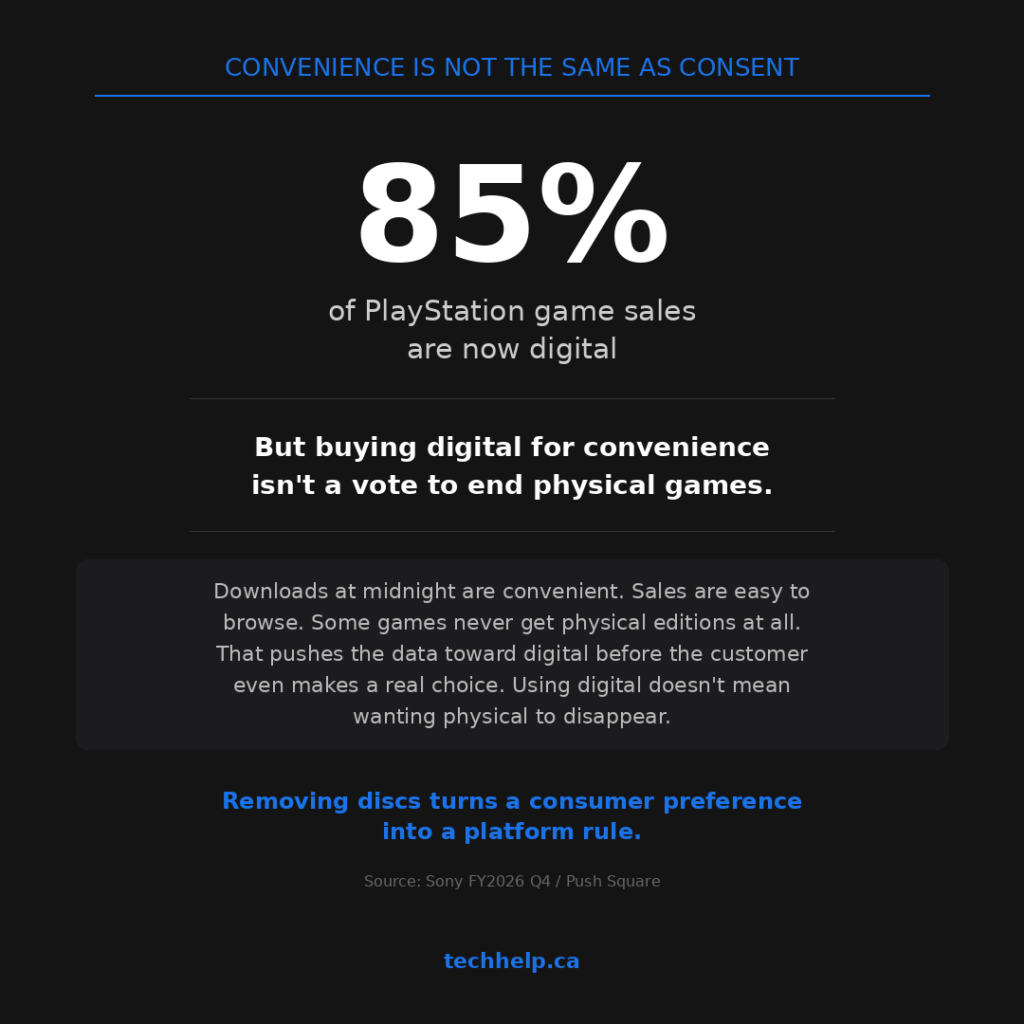
Sony said the change reflects “shifting trends in consumer preference.” The numbers support the broad direction. Push Square, citing Sony’s latest financials, reported that 85% of PlayStation software purchases in the quarter ending March 31, 2026 were digital, up from 80% a year earlier. For the fiscal year, digital represented 78% of software purchases.
The revenue split is even more lopsided. Push Square reported that physical game sales represented about $109 million in revenue during the quarter, while digital accounted for about $1.5 billion.
GameSpot also pointed to the longer trend. When the PS4 launched, less than 10% of PlayStation game sales were digital. In Sony’s latest fiscal year, that figure was about 80% for full-game sales.
Digital games are better for Sony’s margins. There are no discs to press, cases to package, boxes to ship, or retailer shelves to fight for. A PlayStation Store sale also gives Sony more control over distribution and pricing. GameSpot cited Niko Partners analyst Daniel Ahmad, who framed the move as a platform-led decision to cut costs, reduce exposure to the resale market, and push more revenue through Sony’s own storefront.
The business case may be rational, which is also why so many players don’t trust the framing.
Convenience is not the same as consent
Sony’s argument treats digital sales as proof that players prefer a digital-only future. That reading is too simple.
Plenty of people buy digital games because they’re convenient. A download can start at midnight. Sales are easy to browse. Subscription libraries normalize account-based access. Some games never receive physical versions at all, which pushes the data toward digital before the customer even makes a choice.
So when Sony says most players prefer digital, the better reading is that most players often use digital. Those aren’t identical ideas.
Many players want both options. They may buy some games digitally and still want discs for major releases, collector’s editions, resale value, lending, preservation, or simply the feeling that they own what they paid for. Removing discs turns a consumer preference into a platform rule.
The backlash isn’t just nostalgia. It’s a reaction to losing leverage.
The ownership problem is no longer hypothetical
The timing made Sony’s announcement harder to swallow.
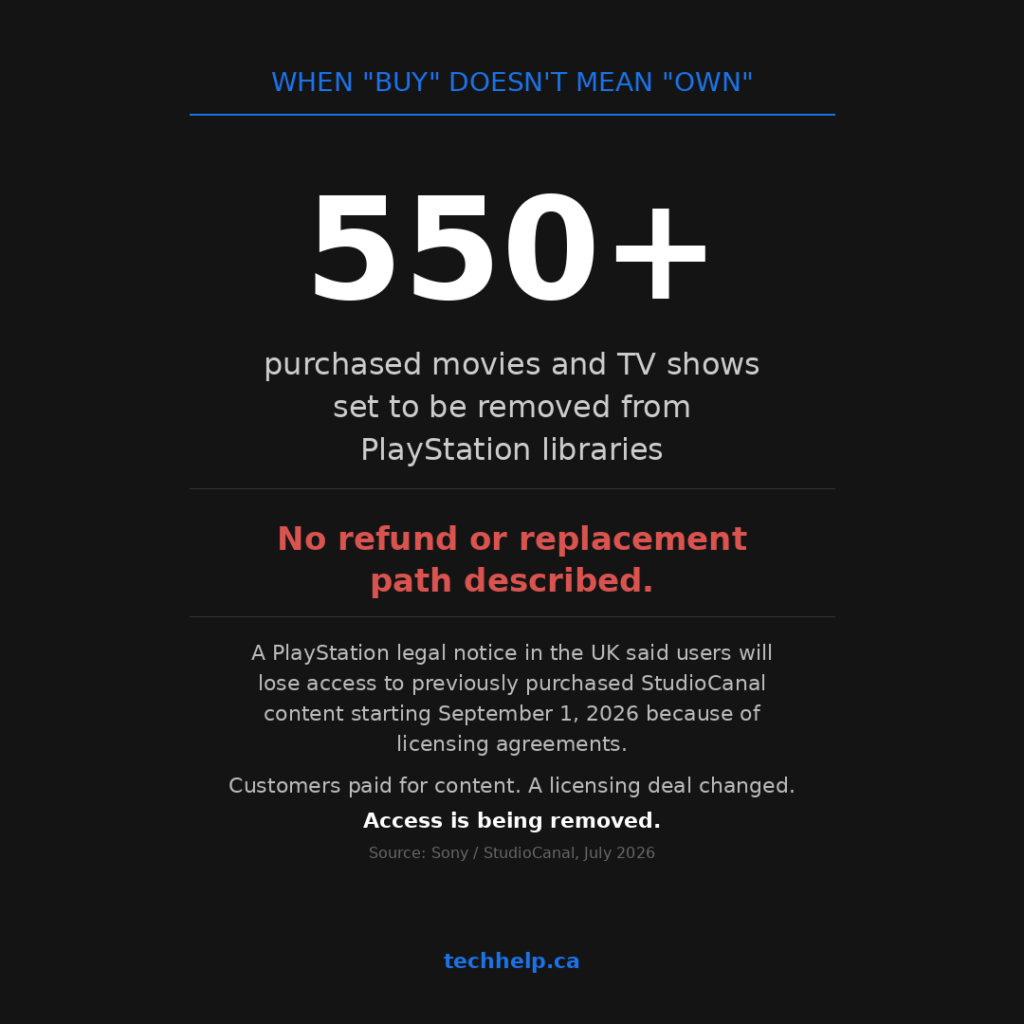
In the same week Sony confirmed the end of physical PlayStation game discs, a PlayStation legal notice in the UK said users will lose access to previously purchased StudioCanal content starting September 1, 2026 because of licensing agreements. The list covers more than 550 affected titles. Sony’s notice doesn’t describe a refund or replacement path.
Those aren’t PlayStation games, but they sit inside the same digital media model. Customers paid for content. A licensing deal changed. Access is being removed.
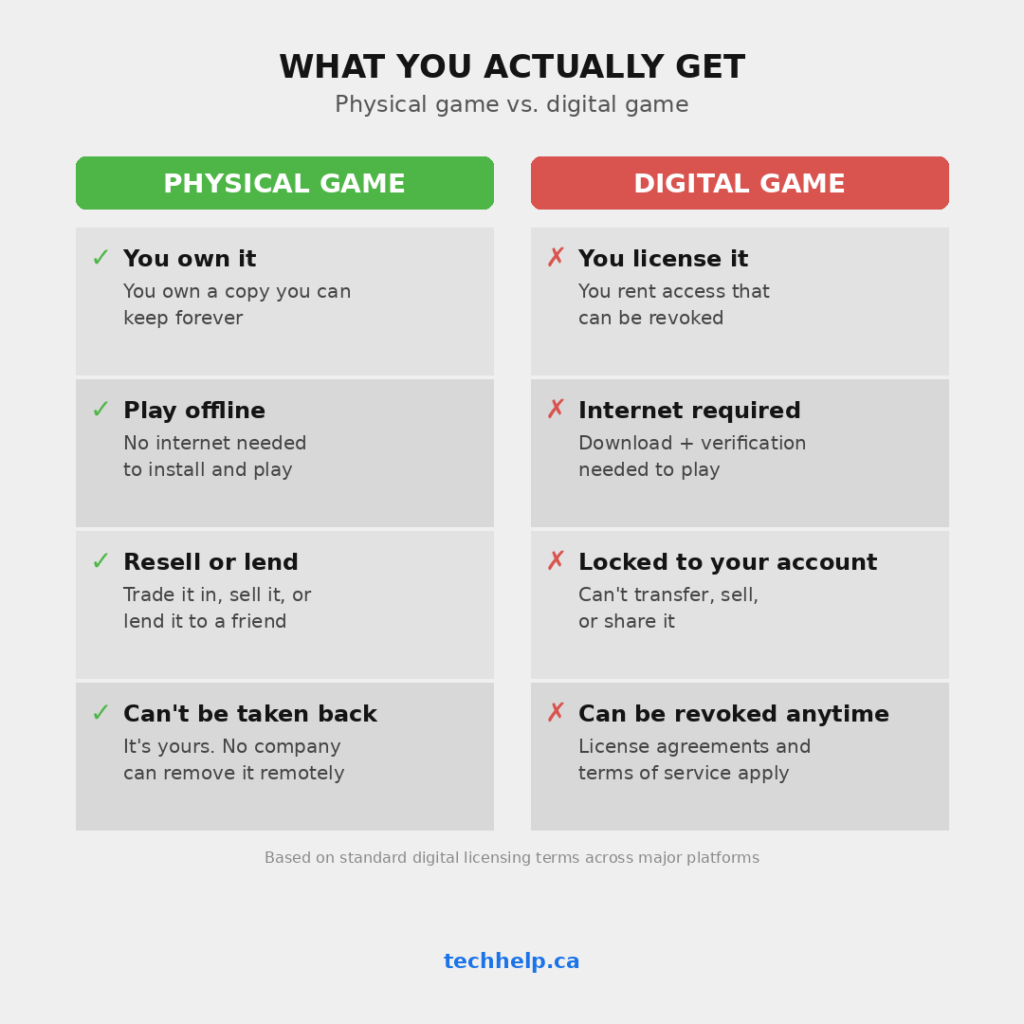
The core fear with digital-only ownership is control. When you buy a disc, you own a copy that can be lent, resold, collected, archived, or used long after the storefront changes. A disc isn’t perfect anymore, especially when games need patches, servers, or online features. But it still gives the buyer more control than an account-bound license.
Digital purchases sit on different ground.
Access can depend on licensing terms, platform accounts, storefront support, authentication systems, regional rules, and server availability.
The Crew showed how fragile that can be. Ubisoft shut down the online-only racing game’s servers in 2024, making it unplayable even for people with physical copies. Players sued, arguing they were sold a game they could no longer use. Ubisoft’s position, as reported by Kotaku, was that players had purchased a limited license.
California lawmakers have already recognized the confusion. AB 2426, which took effect in 2025, requires clearer disclosure when companies sell access to digital goods that can be revoked. If a company says “buy” or “purchase,” it may need to make clear that the customer is receiving a license, not ownership.
AB 2426 isn’t a full fix, but it shows lawmakers are now treating digital ownership language as a consumer protection issue.
A code in a box won’t replace a disc
Sony may still keep games visible at retail through download codes. That helps retailers participate in the sale, and it gives gift buyers something physical to wrap.
But a code in a box doesn’t preserve what players value about physical games.
You can’t resell a redeemed code. You can’t lend it to a friend. You can’t put it into a future console and install from the disc. You can’t preserve the game as an independent copy. The box becomes packaging for the same digital dependency players are worried about.
Retail code boxes may be useful for Sony and retailers. They shouldn’t be presented as a true replacement for disc-based ownership.
Why gamers are right to push back
Sony can make the financial case and still be making the consumer experience worse.
Physical games give players a secondary market. You can trade them in, buy used copies, lend them, borrow them, or recover some value after finishing a game. That market creates price pressure. It gives players options when digital storefront prices stay high.
Digital-only removes that pressure. If every new PlayStation game has to flow through Sony-controlled digital access, Sony gains more control over pricing, availability, and distribution. Retailers may still sell codes, but the used-game market doesn’t exist in the same way.
Physical games also matter for preservation. The Video Game History Foundation has warned that digital-only games need better legal preservation frameworks, especially for archives and researchers. A disc on a shelf isn’t a perfect preservation solution in 2026, but it remains one of the few consumer-level tools that doesn’t rely entirely on a storefront staying alive.
There’s also the access problem. Digital-only assumes fast, reliable broadband and enough storage space. That may be normal for some players. It isn’t universal. TechRadar reported that former PlayStation executive Shawn Layden raised similar concerns after Sony’s announcement, including the effect on players with limited internet access and military personnel.
The strongest argument against Sony’s move is simple: digital convenience didn’t require killing physical choice. Both could exist.
The reaction shows this is bigger than collecting
The response from players, retailers, developers, and preservation groups has been fast.
GameSpot reported that iam8bit, a company known for physical gaming collectibles and releases, said it was “profoundly disappointed.” GameFly said physical products still matter to its business. The Video Game History Foundation described the news as unfortunate for consumer rights, the resale market, and creators whose businesses depend on physical releases.
Push Square reported that Animal Well creator Billy Basso said releasing a physical version of his game was a major motivator, and that Sony’s decision hurt his desire to develop for PlayStation. Push Square also reported that multiple online petitions launched after the announcement, including one from the owner of Canadian video game retailer PNP Games.
Retailers are reacting for obvious reasons. Physical games bring people into stores. They support rentals, resale, preorders, collector demand, and trade-ins. Developers and boutique publishers are reacting because physical editions can be part of a game’s identity and revenue strategy.
Players are reacting because the decision takes away something they still value, even if they don’t use it for every purchase.
Nintendo may become the contrast case
Sony’s decision also puts more attention on Nintendo.
Nintendo Wire reported that Circana analyst Mat Piscatella doesn’t expect Nintendo to abandon physical games during the Switch 2 lifecycle. Nintendo still faces digital pressure, and the company has already faced criticism around game-key cards, where the physical card works more like a download key than a full game cartridge.
Still, Nintendo’s continued retail presence gives players a contrast. If one major console maker keeps physical options alive while another removes them, consumer choice becomes part of the platform comparison.
Sony’s move matters beyond PlayStation because it may set the tone for what the rest of the console market thinks players will accept.
Where this leaves PlayStation players
Sony’s decision may be profitable. It may even be where much of the industry was heading anyway.
But profitable isn’t the same as consumer-friendly. A digital-only future gives platforms more control and players fewer ownership rights. The same customer who loves the convenience of digital downloads can still want the protection, flexibility, and permanence that physical media provides.
So yes, gamers are right to push back.
The issue isn’t whether every game should be bought on disc or whether digital games are bad. The issue is choice, and ownership shouldn’t disappear just because the more profitable option won the spreadsheet.
If physical games matter to you, the next move is practical: buy physical releases while they still exist, support publishers and retailers that keep making them, and pay attention to laws that force clearer digital ownership disclosures.
Sony can argue that the market has moved digital. Gamers can argue that convenience was never permission to take ownership away.
Get new small business insights by email
Practical ideas and useful articles to help you make better business decisions.
Tech Help Canada Staff researches, writes, and reviews practical content for business owners and professionals. Our coverage spans business, marketing, SEO, technology, and the tools and systems people use to grow and operate online. We focus on clear, useful information backed by research, hands-on experience, and editorial review. Learn more about our team and editorial standards. Need help with something? Contact Us