
Big clients. Bigger wins. If your growth strategy is ready to move beyond small deals and into game-changing territory, it’s time to think bigger—much bigger. Whale hunting offers a focused, strategic way to pursue those high-value opportunities that can redefine your business trajectory.
In this guide, you’ll discover what whale hunting really involves, who it suits, and the proven tactics to identify, approach, and close enterprise-level accounts.
What Is Whale Hunting?
In B2B sales, a “whale” is a high-value client or account that can make a meaningful impact on revenue with a single deal. These accounts often have bigger budgets, longer engagement potential, and recurring needs—but they also tend to come with more stakeholders, more scrutiny, and longer buying cycles.
Whale hunting is the strategy of pursuing those accounts intentionally. Instead of relying on volume and quick wins, it focuses on a smaller number of high-fit opportunities where a long-term partnership is realistic. That usually means more research, more tailored outreach, and a higher standard of delivery once you’re in the door.
This approach is common in industries where enterprise buying is complex with multiple decision-makers, internal reviews, and real risk management on the client’s side. The upside can be substantial, but success typically depends on trust, consistency, and a clear, credible path to ROI.
Key Strategies for Whale Hunting
Whale hunting is less about selling harder and more about operating in the reality of enterprise buying: longer timelines, more decision-makers, and more perceived risk. The strategies below focus on what tends to matter most when you’re pursuing high-value accounts (fit, timing, stakeholder alignment, and de-risking the decision). That way, you’re building winnable opportunities.
Define Your Whale (Fit First, Not Fame)
Before you write a single email, get clear on what a “whale” actually means for your business. It’s easy to equate whales with famous brands or massive headcount, but the better definition is simpler.
A whale is an account where one win can materially move revenue and where your team can realistically deliver at the level the client expects.
That starts with fit, not bragging rights. A true whale aligns with your capabilities, your delivery capacity, and your business model.
If you need a certain margin to support higher-touch service, or your process works best in specific industries, your whale list should reflect that. Otherwise, you end up targeting accounts you can’t win—or worse, accounts you can win and then struggle to retain.
It also helps to think in terms of expansion potential, not just first-contract size. Some accounts start with a limited scope but have the right internal structure for long-term growth. For example, multiple teams that share the same problems, recurring needs, and budget owners who can sponsor broader rollouts over time.
Alongside fit, timing matters. Enterprise deals are often triggered by change, such as a new leadership, budget reshuffles, vendor dissatisfaction, reorganizations, acquisitions, rapid hiring, new product lines, or regulatory pressure.
You’re not trying to manufacture urgency. You’re looking for evidence that priorities have shifted in a way that makes a purchase more likely now than it was six months ago.
A strong whale target usually checks three boxes.
Value: The account has enough budget and scope to justify the effort.
Winnability: You can credibly deliver results at their level of complexity.
Timing: There’s a visible reason the status quo might be questioned right now.
When those three align, you spend less time trying to force deals that were never going to close.
Need to craft a personalized pitch for your next whale? Use HelperX Bot to write strategic outreach emails, proposal drafts, and stakeholder messaging tailored to enterprise clients.
Engineer Your Positioning for Enterprise Risk
Enterprise buyers rarely evaluate you the way small businesses do. It’s not just “can you do the work?” It’s also “are you safe to bet on?” At whale size, the decision carries internal consequences—reputational risk, implementation risk, security risk, stakeholder risk.
Even when you’re clearly capable, deals can stall if your positioning doesn’t make the choice feel low-drama and defensible inside their organization. So the goal of enterprise-grade positioning isn’t to sound bigger. It’s to look safe, stable, and easy to approve.
Start with what they see first, such as your site, your case studies, your deck, your proposals, and your overall public presence. Consistency also matters. Gartner found 69% of B2B buyers reported inconsistencies between information on a supplier’s website and what sellers said, and that kind of mismatch creates immediate doubt.
In general, every touchpoint should signal outcomes and operational maturity—not clever wording. A decision-maker wants to quickly answer these questions.
- What do you do?
- Who do you do it for?
- What results have you produced that look like our world?
- What happens after we say yes?
That last question is where most small-to-mid providers fall short. Enterprise buyers don’t just want proof of past success—they want confidence that delivery won’t become a hidden project they regret.
Your positioning should make the “after yes” feel structured. Onboarding, timelines, responsibilities, communication cadence, reporting, and what you do when something goes sideways come to mind.
This is where proof packaging matters more than promises. A strong case study for whale hunting is less “here’s what we did” and more of the following.
Context: What was happening in the client’s business (and what was at stake).
Constraint: What made the situation harder (stakeholders, timeline, risk, systems).
Change: What you implemented and how it fit their environment.
Outcome: Measurable results, plus the timeframe.
Why it worked: One or two grounded reasons, not hype.
If you don’t have true enterprise experience yet, you can still build enterprise credibility by showing you understand enterprise constraints.
That can look like clear security language, well-defined scope boundaries, strong documentation, and realistic implementation expectations. “We know what we’re responsible for—and what we’re not” is surprisingly reassuring at this level.
Finally, your messaging should match the way executives think. They don’t buy features; they buy outcomes tied to strategy, such as revenue, risk reduction, operational efficiency, speed, retention, cost control, or competitive advantage.
Your positioning should make that connection obvious without turning into buzzword soup.
Whale hunting becomes dramatically easier when your marketing assets do part of the selling for you. Gartner found 61% of B2B buyers prefer an overall rep-free buying experience, which means buyers often form an opinion before they ever talk to you.
Map the Buying Group (and Reduce Internal Friction)
Whale deals rarely hinge on one person. Even when you start with a single contact, enterprise buying usually turns into a group decision—different departments weighing in, different priorities competing, and plenty of quiet veto power along the way.
Forrester reports that 13 internal stakeholders and nine external participants on average influence a B2B purchase decision. If you treat the process like a one-to-one sale, you’ll lose momentum the moment the conversation expands internally. So the job isn’t only to persuade. It’s to help a buying group align.
Gartner found 74% of B2B buyer teams demonstrate unhealthy conflict during the decision process, underscoring the importance of consensus. In the same survey, buying groups that reached consensus were 2.5 times more likely to report they ended up with a high-quality deal.
A useful way to think about it is that most enterprise purchases have a mix of people who can approve, people who can influence, and people who can block. Your early goal is to identify which roles are likely involved and what each one needs to feel comfortable.
Common stakeholders in whale deals include the following.
Economic buyer/budget owner: Cares about ROI, payback period, and strategic relevance.
Champion: The internal advocate pushing the project forward; cares about credibility and internal momentum.
Technical reviewers (IT/security/data): Care about feasibility, integration, risk, and workload.
Procurement/legal: Cares about contract terms, liabilities, compliance, and vendor standards.
End users/operators: Care about adoption, friction, and whether this makes their life easier.
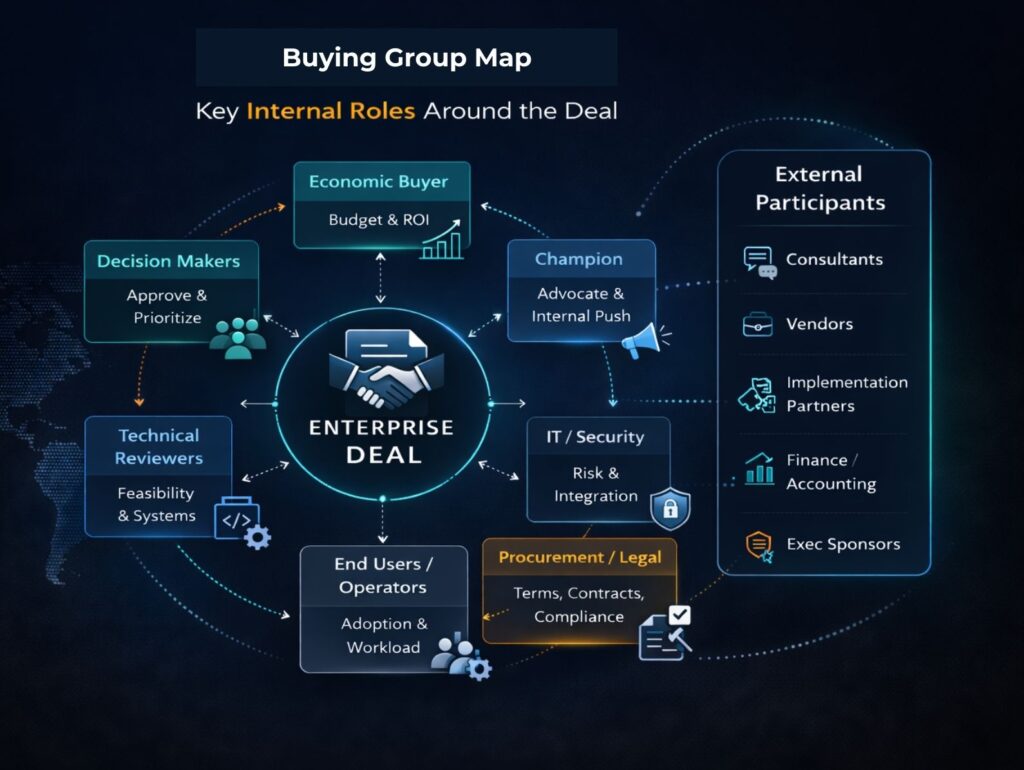
Once you know the likely cast, you can build a stakeholder map with each name (or role), priority, concerns, influence level, and what success looks like for them.
This is also where multi-threading matters. Instead of waiting for your champion to socialize everything, you look for ways to support parallel conversations.
That might mean giving your champion an internal summary, offering a short technical walkthrough for IT, or a risk/terms overview that procurement can quickly scan.
The biggest mistake here is assuming your champion can carry the full internal sale alone. Most champions want to help, but they’re busy and navigating politics. If you make their job easier, you become easier to buy.
A strong champion kit often includes the following.
- One-page summary of the problem, the approach, and the expected outcomes
- A simple ROI narrative (not a giant spreadsheet unless they ask)
- Clear scope boundaries (what’s included, what’s not, what assumptions exist)
- A short risk section that proactively answers common concerns
- A description of implementation steps at a high level (so stakeholders don’t imagine chaos)
This is how you reduce internal friction. You give the organization a way to agree.
When whale hunting works, it often feels like the buyer is moving themselves forward. In reality, you’ve just done the behind-the-scenes work that makes consensus less painful.
Run Multi-Threaded Outreach That Leads With Relevance
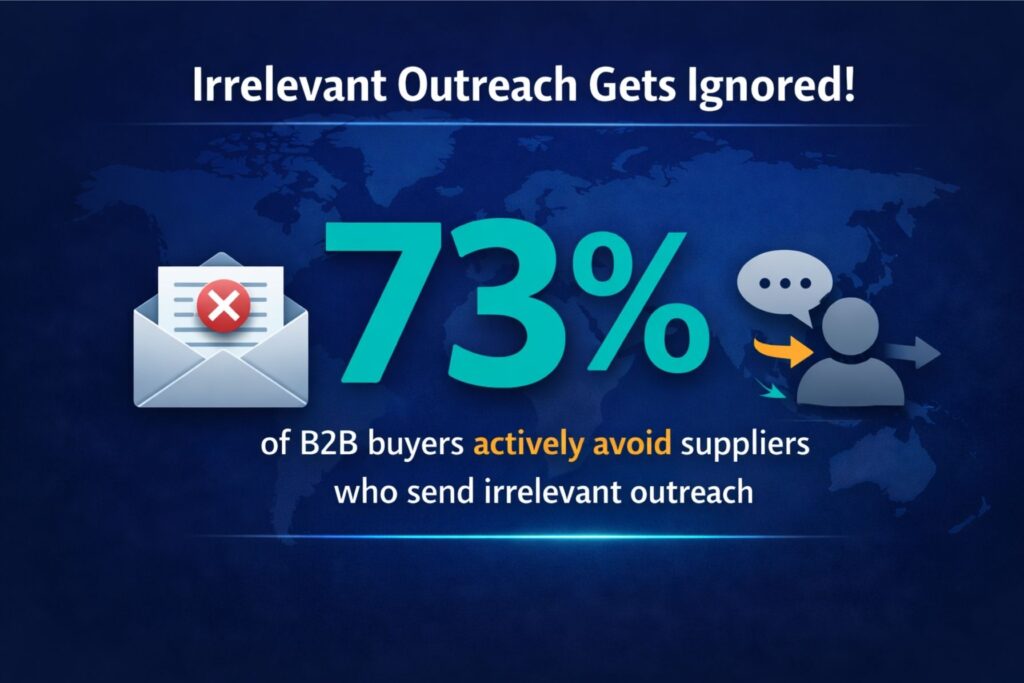
Enterprise outreach fails because most of it doesn’t give the account a reason to care right now. Big companies get pitched constantly. In a Gartner survey of B2B buyers, 73% said they actively avoid suppliers that send irrelevant outreach. If your message reads like it could’ve been sent to anyone, it will be treated like it was sent to everyone.
Whale hunting outreach works best when it feels timely, specific, and decision-relevant.
A practical approach is to anchor your outreach to a visible change in the account’s world. That could be a leadership shift, a new product line, a hiring surge, an acquisition, a geographic expansion, a vendor change, a public initiative, a security or compliance push, or even a strategic pivot they’ve talked about publicly.
The point isn’t to show that your timing is connected to reality. From there, lead with an insight, not a template. The simplest structure is as follows.
- What you noticed,
- Why it matters,
- What you’d explore together.
That’s it. If you can’t state those three things clearly, the message is usually still too generic.
This is also where multi-threading becomes a strategic advantage. Instead of placing all your bets on one contact, you can start building a parallel presence across the likely buying group.
That doesn’t mean spamming a company. It means being intentional and reaching out to the most relevant roles with a message that fits their priorities.
For example, the economic buyer may respond to an outcome narrative and risk framing. A director-level operator may respond to time savings, workflow friction, or operational efficiency. A technical stakeholder may care less about outcomes and more about feasibility and integration.
Same account, different angle—without changing the truth of what you offer.
Format can also help you stand out, but only when it reinforces relevance. A short custom video, a one-page micro-audit, or a short slide presentation can work well because it signals effort and specificity. Make it obvious you’ve done more thinking than the average cold pitch.
Here are two important guardrails to keep in mind.
- Don’t over-claim. Enterprise buyers can smell inflated certainty instantly.
- Don’t over-personalize. Excessive detail can feel creepy or speculative. Stick to what’s public and defensible.
Strong whale outreach is about making a small number of accounts feel like you’re speaking directly to their situation—because you are.
Control the Sales Motion Without Becoming Pushy
One of the quickest ways to lose a whale deal is to confuse activity with progress. Enterprise cycles are long, and a lot can happen between “this is interesting” and “we’re signing.”
If you don’t shape the process, the deal tends to drift. For example, a stakeholder may change, urgency fade, or internal priorities shift.
The fix isn’t pressure. It’s usually clarity.
In enterprise sales, control usually looks like discipline. Every call has an agenda, every conversation ends with a documented next step, and every stakeholder interaction is tracked so nothing important sits in someone’s memory.
A few practices tend to keep deals from stalling.
Agree on milestones, not dates: Instead of chasing “when can we close,” align around decision checkpoints, like stakeholder review, technical assessment, budget approval, legal/procurement pass, pilot decision. If those milestones are clear, the timeline becomes less mysterious.
Write down assumptions: Enterprise deals often fall apart because different people thought different things were included. After meaningful calls, a short recap that confirms scope, responsibilities, constraints, and success criteria prevents future misalignment.
Keep the narrative consistent: When a buying group is involved, the story of the deal has to survive retelling. If your champion explains it one way and procurement hears another, you’ve created friction. Clear one-page summaries help prevent the “telephone effect.”
Use follow-ups to add value, not noise: A good follow-up gives a stakeholder something useful, like a clarified risk answer, a better outcome framing, or a relevant example they can share internally. “Just checking in” doesn’t move anything forward.
It’s also normal for enterprise deals to go quiet for reasons that have nothing to do with you, such as internal reprioritization, budget freezes, leadership turnover, or an initiative getting paused. A controlled sales motion doesn’t fight those realities—it stays useful and stays present without becoming a nuisance.
If you’re dealing with multiple stakeholders, organization is key. You want to know who said what, what concerns were raised, what was resolved, and what still needs answering.
De-Risk the “Yes” With Deal Design
Even when an enterprise buyer likes what you offer, final approvals often come down to one question: What could go wrong if we choose you? Procurement, legal, IT, finance, and leadership all look for ways the decision could create trouble later. If your proposal doesn’t reduce perceived risk, it can stall even when the value is obvious.
This is where deal design matters. You’re not only presenting price and scope. You’re presenting a path that’s easy to approve internally.
One approach is to offer a lower-risk first step that still leads somewhere meaningful, such as a limited pilot, a phased rollout, or a smaller initial scope tied to clear success criteria. The point is to make the first “yes” feel defensible and manageable, especially when stakeholders don’t want to bet big before seeing your delivery.
Another key is anticipating the friction that shows up late in enterprise deals. A few common choke points include the following.
Security and data questions: How information is handled, access controls, retention, and compliance
Implementation workload: Who does what, what internal resources are required, and what dependencies exist
Contract terms and liability: Redlines, indemnities, termination language, IP, and service-level expectations
Scope ambiguity: Unclear deliverables or undefined support that creates uncertainty
You don’t need to turn your proposal into a legal document. But you can make it far easier to move forward by addressing these areas before stakeholders have to ask.
A short risk-and-readiness section inside the proposal can be enough. It can include key assumptions, what you need from the client, what you’re responsible for, what you’re not responsible for, and how issues are handled if they arise.
Pricing and packaging can also reduce friction when they match the way the organization thinks. Instead of a single take-it-or-leave-it quote, you can frame options around rollout paths, such as the following.
- A limited first phase that proves value
- A broader phase that scales the impact
- A longer-term option that supports expansion across teams
This creates flexibility without weakening your positioning. It also gives the buying group choices they can align around, which helps when budget owners and operators aren’t perfectly aligned at the start.
At whale size, the deal often closes when the internal story becomes: This is the right move, it’s low-risk to start, and we understand exactly what happens next.
Land the First Win, Then Expand the Account
With whales, the first deal is rarely the whole opportunity. It’s the entry point. The accounts that become truly high-value over time are the ones where early delivery creates confidence inside the organization and that confidence spreads.
This is why closing isn’t the finish line. The real advantage comes from planning for expansion while you deliver the first scope.
A strong pattern is to define an early win that matters to the buying group. Not a vanity metric. Something that supports the reason they said yes in the first place, such as reduced friction, faster execution, better visibility, cost control, improved performance, lower risk, or a measurable business outcome.
When the first win is clear, it becomes easier to communicate internally, and that internal communication is what opens doors to adjacent teams.
It also helps to treat the first engagement as a credibility-building phase. That means tightening operations so onboarding feels organized, communication stays consistent, reporting is understandable, and decisions are documented. Enterprise clients tend to reward predictability. If your delivery is clean, stakeholders relax, and a relaxed stakeholder is more willing to expand scope.
As you deliver, you can look for expansion paths that naturally follow the work, like:
- Similar problems in other departments
- Related initiatives that depend on the same foundation
- Additional regions, teams, or business units
- Adjacent use cases that keep momentum moving
One practical lever is making outcomes shareable. When you document results early, including what changed, what improved, and what it took, you create internal proof that travels. That proof can be used by your champion, referenced in leadership updates, and shared with teams who weren’t part of the original decision. In enterprise, growth often comes from internal visibility more than external selling.
A simple rhythm can help keep expansion opportunities from getting lost. Periodic reviews that reconnect the work to business goals can surface what’s next. Some teams call these QBRs, but the name matters less than the function. The goal is to keep leadership aligned, clarify priorities, and identify the next highest-value problem you can solve.
When whale hunting works well, expansion doesn’t feel like upselling. It feels like the organization recognizing, This is working—let’s apply it more broadly.
Benefits of Whale Hunting
Going after big clients takes more effort upfront, but the upside can be meaningful. When it works, whale hunting can create stability and momentum that’s harder to achieve through smaller, one-off deals.
Predictable Revenue From Fewer Clients
Large accounts often come with longer engagements, renewals, or recurring retainers that can stabilize your revenue. Instead of constantly chasing small wins, your team can focus on deepening value with a smaller number of high-fit clients. Fewer active accounts can also mean simpler operations and cleaner forecasting, which gives you more room to hire, reinvest, or scale with confidence.
Higher Customer Lifetime Value (CLV)
Whales often stay longer, invest more deeply, and expand scope over time. With strong delivery and consistent outcomes, lifetime value can be significantly higher than that of a typical client, especially when work expands across teams or business units. Larger budgets can also make it easier to propose broader initiatives, as long as the value and risk are clearly framed.
Increased Brand Credibility and Influence
Landing an enterprise client can strengthen your market credibility, even if you never use a logo publicly. It’s easier to win future deals when you can point to enterprise-grade work, measurable outcomes, and references where appropriate. In many cases, a single strong whale relationship can elevate how prospects perceive your maturity and reliability.
Operational Leverage and Process Maturity
Serving whales tends to sharpen your operations. Systems, onboarding, reporting, and service quality usually need to level up. The upside is that these improvements don’t just benefit one client, they create structure you can reuse across the business. Enterprise clients also tend to give clearer feedback on process and risk, which can improve your delivery standards over time.
Strategic Growth Opportunities
Big clients often have needs across departments or regions, which creates natural expansion paths. If you perform well in one area, it’s often easier to extend into adjacent teams without starting from zero. Over time, strong relationships can also lead to introductions across partner ecosystems, vendor networks, or internal referrals.
Final Thoughts on Landing Whales
Whale hunting isn’t a quick win. It’s a deliberate strategy that rewards preparation, positioning, and patience. The businesses that succeed tend to treat enterprise buying as a long cycle with real risk considerations, not a faster version of small-business sales.
When you land a whale, you don’t just close a deal. You can anchor your business with steadier revenue, stronger credibility, and more room to grow. The key is staying focused, being consistent, and treating each touchpoint like it matters, because at this level, it usually does.
Frequently Asked Questions
How long does it typically take to land a whale client?
It varies by industry and deal size, but enterprise sales cycles often take several months. Longer timelines usually come from multi-stakeholder approvals, security or legal reviews, and budget timing. A steady follow-up rhythm helps, especially when you’re adding useful context rather than just checking in.
What industries benefit most from whale hunting strategies?
Whale hunting tends to work best in B2B categories where purchases involve multiple decision-makers and longer-term relationships. Examples include software, consulting, marketing and agencies, logistics, and manufacturing, but the bigger factor is complexity, not the label. If deals require coordination, risk review, and high-touch delivery, this approach can be a strong fit.
Is it risky to rely on a small number of large clients?
Yes. Concentration risk is real if one account becomes too large a percentage of revenue. Many businesses manage this by keeping a healthier account mix, building strong delivery systems, and staying close to stakeholder satisfaction so renewals and expansions don’t come as a surprise.
Should you discount to land a whale client?
Discounting can help in some situations, but it can also lock you into a low-margin relationship that’s hard to sustain at enterprise expectations. One approach is to protect your core pricing and offer flexibility through scope, rollout, or contract structure instead. For example, you might reduce risk with a smaller first phase, or adjust payment terms, without cutting the value of the work itself.
How do you know if an enterprise prospect is stringing you along?
A long timeline is normal in enterprise. The difference is whether there is real movement. Progress usually looks like new stakeholders joining, clear next steps, scheduled reviews, or requests tied to procurement, security, or implementation. If conversations stay vague, meetings keep getting pushed, and no one commits to a decision path, the deal may be stuck. In that case, it can help to ask what needs to be true for a decision to happen and whether there is an internal timeline you should align with.
What should you have in place before onboarding your first whale?
Enterprise clients tend to expect structure. That often includes a clear onboarding plan, defined roles and responsibilities, a communication cadence, and reporting that ties work to outcomes. It also helps to have clean documentation for scope, timelines, and what support looks like so expectations do not drift once the work begins.
How do you handle procurement and vendor onboarding requirements?
Procurement can add time and complexity, especially if it is your first enterprise deal. You may be asked for vendor forms, security questionnaires, insurance details, payment terms, and contract reviews. The best way to reduce friction is to respond quickly, keep your documentation organized, and be clear about anything you cannot accommodate. When procurement steps are treated as part of the process, not an unexpected obstacle, deals tend to move more smoothly.
Can a small business win whale clients without big-brand case studies?
Yes, but it usually depends on how well you reduce perceived risk. Clear scope boundaries, measurable outcomes from smaller but relevant clients, strong documentation, and a confident delivery plan can go a long way. Some enterprise buyers care less about brand names and more about whether you feel predictable, credible, and easy to work with.
Related:
- Customer Acquisition vs Retention: The Growth Blueprint
- Lifecycle Marketing Strategies to Engage and Retain Buyers
- How to Scale Your Business with Strategic Moves
Sources:
- https://www.gartner.com/en/newsroom/press-releases/2025-06-25-gartner-sales-survey-finds-61-percent-of-b2b-buyers-prefer-a-rep-free-buying-experience
- https://www.gartner.com/en/newsroom/press-releases/2025-05-07-gartner-sales-survey-finds-74-percent-of-b2b-buyer-teams-demonstrate-unhealthy-conflict-during-the-decision-process
- https://www.digitalcommerce360.com/2026/01/22/forrester-b2b-buying-ai-2026/

We empower people to succeed through practical business information and essential services. If you’re looking for help with SEO, copywriting, or getting your online presence set up properly, you’re in the right place. If this piece helped, feel free to share it with someone who’d get value from it. Do you need help with something? Contact Us
Want a heads-up once a week whenever a new article drops?