

Canada’s new AI strategy is trying to fix a simple problem: the country is strong at inventing AI, but weak at using it inside normal businesses.
On June 4, 2026, Prime Minister Mark Carney launched AI for All, Canada’s new national artificial intelligence strategy. The headline number is large — more than $2.3 billion across adoption, skills, compute, commercialization, public safety, and Canadian AI capacity.
The political promise is even larger. Ottawa wants to raise business AI adoption from just over 12% to 60% by 2034, support the creation of up to 250,000 AI-related jobs by 2031, and unlock about $200 billion in GDP gains from higher labour productivity.
If you run a small or medium-sized business, though, the practical question is narrower. Does this create a real path to funding, tools, or support for your company?
Yes, but not in the “free AI money for everyone” way some headlines imply. The clearest business-facing pieces are BDC LIFT, the Regional Artificial Intelligence Initiative, AI readiness tools, and expanded compute support. Each one serves a different kind of company, and some of the biggest dollars are aimed at AI builders rather than businesses simply trying to adopt AI in operations.
That distinction matters. A retailer, contractor, accountant, manufacturer, SaaS startup, and AI model company won’t benefit from this strategy in the same way.
The adoption gap is the real story
The strategy exists because Canada’s AI adoption problem is no longer theoretical. Statistics Canada reported that 12.2% of Canadian firms used AI to produce goods or deliver services in 2025, double the previous year’s share, with another 14.5% planning to adopt within 12 months. The federal strategy presents the SME picture as even sharper: only about 8% of Canadian SMEs have adopted AI, compared with 29% to 42% in Nordic countries, 26% in Germany, and 18% in France.
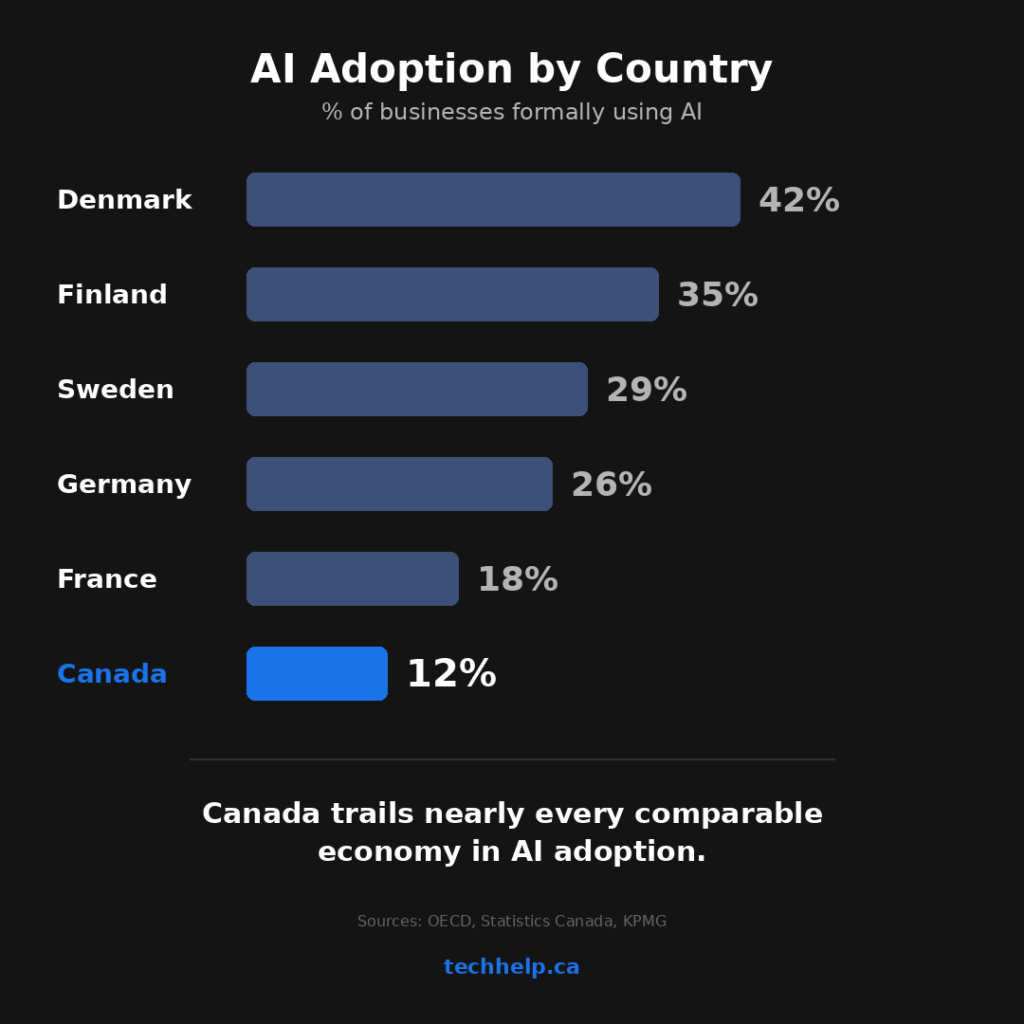
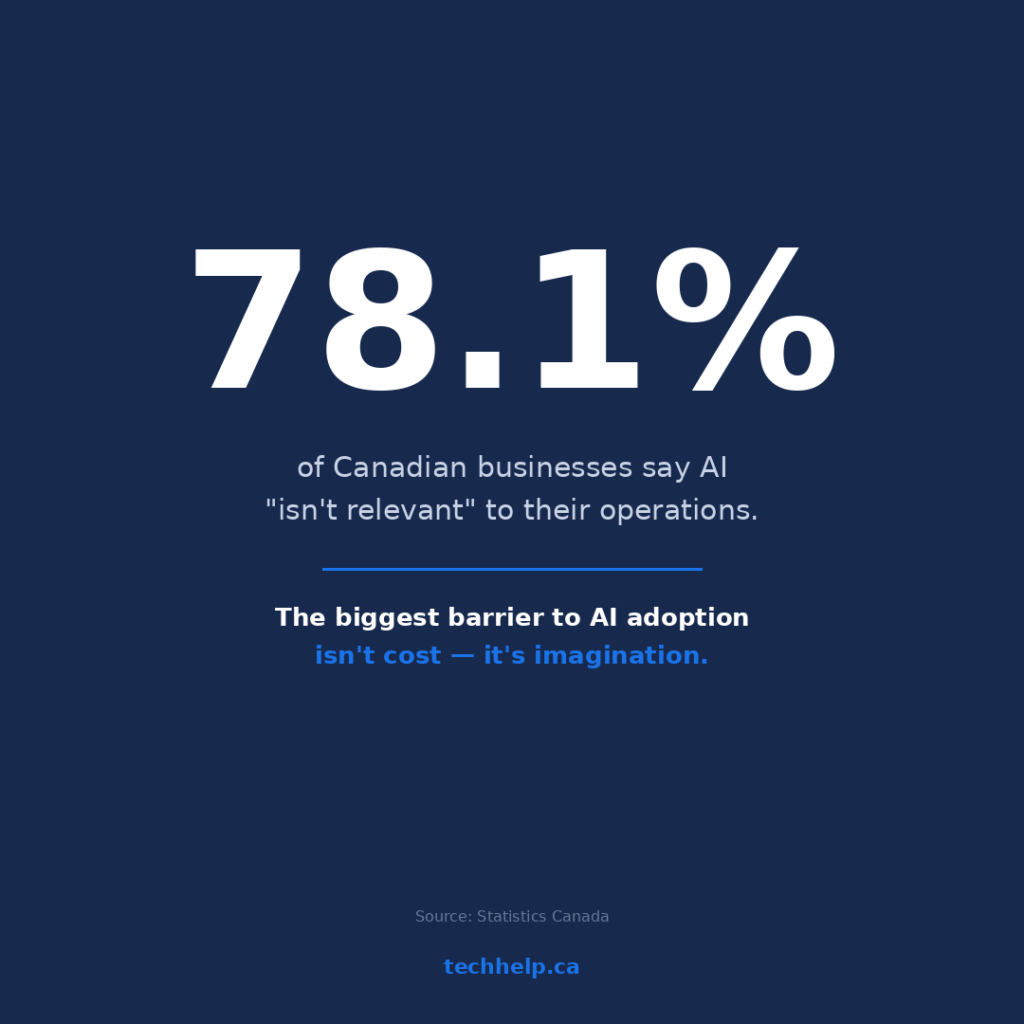
That gap isn’t only about software budgets. ISED says 78% of non-adopting firms don’t see how AI benefits the goods or services they provide. That’s the real adoption problem. Many business owners have tried ChatGPT or heard about AI, but they haven’t translated it into a workflow that saves time, reduces waste, improves quality, or creates new revenue.
Statistics Canada’s productivity research also adds an important caution. AI adopters showed a 16.8% higher labour productivity level in a benchmark comparison, but that advantage fell once researchers controlled for pre-existing productivity and complementary capabilities such as R&D, cloud computing, data analytics, robotics, and employee ICT training. In other words, AI works best when it sits inside a broader digital improvement plan. Dropping a tool into a messy workflow won’t automatically fix the workflow.
That’s the lens small businesses should use when reading AI for All. The money is useful, but the bigger question is whether the programs help companies turn AI from experimentation into operational change.
The $2.3 billion package isn’t one simple cheque
AI for All isn’t a single grant program. It’s a policy package spread across several pillars: trust, skills, SME adoption, compute infrastructure, Canadian AI companies, global partnerships, and government procurement.
For SMEs, the most relevant pieces are narrower than the headline number. The strategy names a $500 million BDC LIFT program for AI and advanced technology adoption, a $500 million expansion of the Regional Artificial Intelligence Initiative, online readiness tools for SMEs and entrepreneurs, and an additional $700 million in affordable sovereign compute through the Compute Access Fund.
Those are meaningful commitments, but they don’t all work the same way. BDC LIFT is a financing and advisory program. Regional funding will be delivered through regional development agencies. Compute support is designed for companies developing AI products or services, not every business using AI tools. Readiness resources are still being developed.
So the question for a business owner isn’t “How do I get part of the $2.3 billion?” It’s “Which lane, if any, matches the project I’m actually prepared to run?”
BDC LIFT is the clearest route for established SMEs
BDC LIFT is the most concrete program for established small and medium-sized businesses that want to adopt AI, digital tools, cybersecurity, automation, robotics, or advanced equipment.
BDC describes LIFT as a $500 million initiative designed to help more than 1,000 SMEs, with loans ranging from $25,000 to $5 million. It combines financing with advisory support, which is the part many owners should pay attention to. For the digital transformation and AI stream, BDC says a BDC Advisory Services plan is required before financing. That means you’re not just borrowing money for software; you’re expected to build a roadmap.
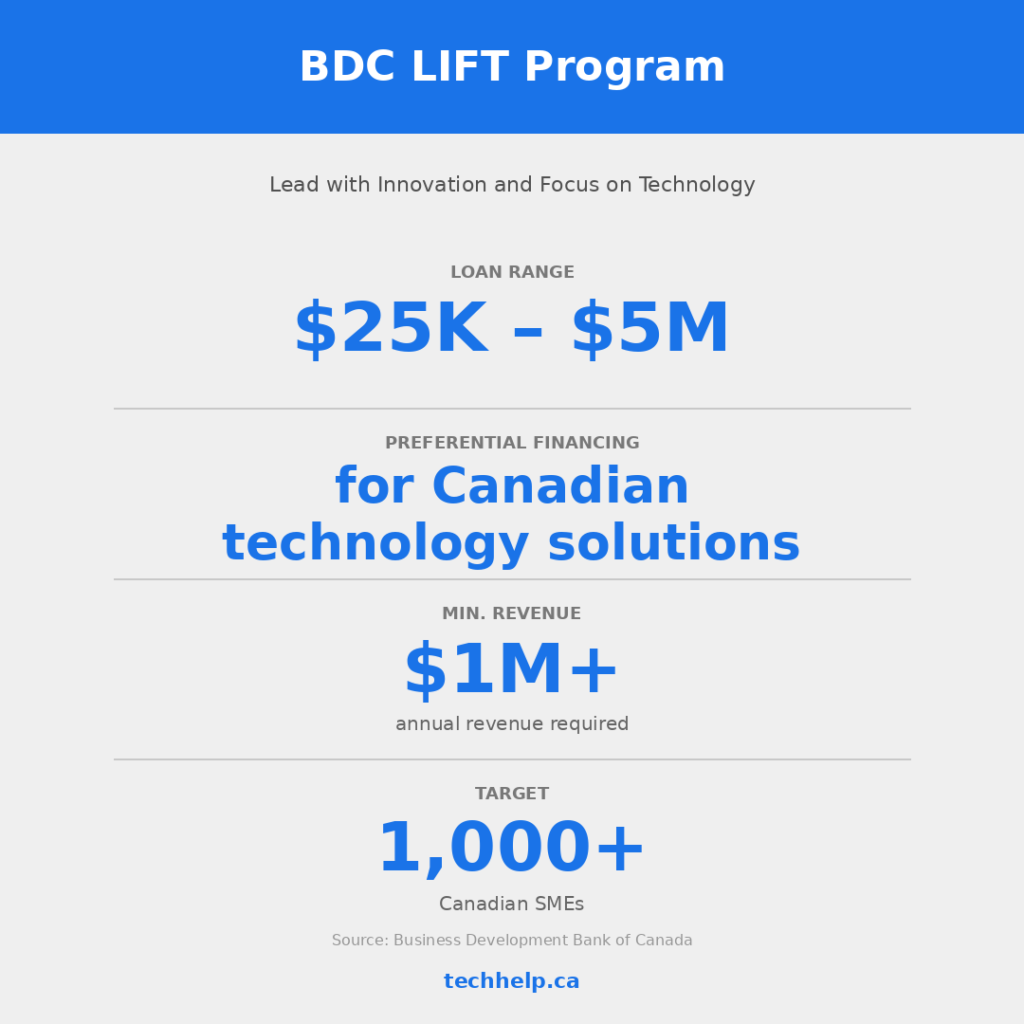
Eligibility isn’t universal. BDC’s current LIFT page says the digital transformation and AI path is for businesses with at least $1 million in annual revenue. The productivity and advanced equipment path, which can support robotics, automation, and equipment, starts at $5 million in annual revenue and is limited to specific sectors such as manufacturing, transport and warehousing, wholesale, construction, agriculture, engineering-related services, mining, and oil and gas extraction.
That makes LIFT useful, but not ideal for every small business. A growing manufacturer with a clear automation project may fit well. A small consulting firm with $400,000 in revenue probably won’t. A company that wants to test a chatbot without a clear data, workflow, or implementation plan may also struggle to make the case.
The strongest candidates will likely have a specific business problem, a measurable result, and a Canadian supplier or integrator in mind. BDC also says preferential financing rates and terms are available when technology solutions are sourced from Canadian suppliers, though its public LIFT page doesn’t list the 2.25% rate claimed in some drafts and discussions. Unless BDC publishes that figure clearly, it shouldn’t be treated as confirmed.
Regional funding will depend on where you operate
The Regional Artificial Intelligence Initiative is the second major SME-facing piece. AI for All commits $500 million to expand and enhance the program through Canada’s regional development agencies.
This could matter a lot because AI adoption doesn’t look the same in every region. A food processor in Atlantic Canada, a mining supplier in Northern Ontario, a logistics firm in the Prairies, and a clean-tech manufacturer in British Columbia have different constraints, suppliers, workforce needs, and funding routes.
Regional delivery can make the support more practical. It can also make the rollout uneven. Some agencies may move faster than others. Some programs may favour local clusters, priority sectors, or companies tied to regional growth strategies. That’s normal for RDA-led funding, but it means business owners shouldn’t assume a national announcement equals a ready application in their province this week.
The practical move is to contact your regional development agency before you build the whole project plan. Ask what AI adoption or commercialization supports are open, which ones are expected, and what kind of project documentation they want to see. Early conversations won’t guarantee approval, but they can stop you from building an application around the wrong program.
Compute support is narrower than it sounds
The expanded Compute Access Fund is one of the most important parts of the strategy for Canada’s AI ecosystem, but it’s easy to misunderstand from an SME perspective.
The strategy says Canada will provide SMEs with an additional $700 million in affordable sovereign compute through an expansion of the Compute Access Fund. Compute is the processing power needed to train, test, and deploy AI models. For companies building AI products, it can be one of the biggest costs.
But this isn’t a general AI adoption fund for every small business. ISED’s current AI Compute Access Fund page says the program is closed as of June 8, 2026. The most recent call for proposals closed on July 31, 2025. The existing eligibility language says applicants must be Canadian-registered, for-profit companies developing AI products or services, have fewer than 500 full-time employees, maintain R&D activity in Canada, and show a path to commercialization.
That makes the fund relevant if you’re building an AI product, commercializing a model, or scaling AI infrastructure tied to Canadian R&D. It’s much less relevant if you’re a service business trying to use AI for email drafting, customer support, reporting, or internal automation.
The funding mechanics are still worth understanding. Under the existing program details, eligible projects could include compute costs from $100,000 to $5 million over up to three years, with support covering two-thirds of eligible costs for Canadian cloud-based AI compute and half for non-Canadian cloud-based AI compute. Those details may change when the expansion is implemented, so companies should watch ISED updates rather than assume the old intake rules will carry forward unchanged.
Readiness tools may matter more than the money
One of the more practical parts of AI for All may end up being the least dramatic: the planned AI Literacy and Adoption Assessment tool for SMEs and entrepreneurs. ISED says the tool and related online resources are meant to help businesses assess readiness, identify practical use cases, understand business impacts in a low-risk environment, and connect with programs and development agencies.
That sounds modest, but it targets the hardest part of adoption: knowing where AI actually fits. Many businesses don’t need a frontier model, a custom chatbot, or a massive automation project. They need to know whether AI should touch quoting, scheduling, sales follow-up, inventory planning, customer support, quality checks, bookkeeping review, training, or reporting.
This is also where the strategy’s literacy work connects to real adoption. Ottawa is promising free entry-level AI training, AI learning content for 1 million post-secondary students, training for more than 3,000 educators, and AI-related work placements. Those commitments won’t transform SME capability overnight, but they can improve the talent pool and make AI less mysterious inside smaller companies.
The best use of readiness tools will be boring in the right way: map the workflow, identify the bottleneck, estimate the benefit, define the data needed, test on low-risk work, and decide whether the project deserves investment.
Ottawa also wants to be an AI buyer
AI for All isn’t only about helping companies buy AI. Ottawa also wants Canadian AI firms to sell.
The strategy says the federal government will act as a strategic anchor customer and use the Buy Canadian policy to give domestic AI scale-ups the revenue and validation they need to export. It also points to a Canada Trusted AI Certification program, transparency measures such as watermarking AI-generated content, and renewed support for AI standards and quality assurance.
For companies that build, resell, implement, or integrate AI systems, this is a market signal. Government procurement can validate suppliers, create reference customers, and push companies toward stronger governance. It can also create a clearer category for “trusted” Canadian AI if certification becomes meaningful.
For ordinary buyers, the certification idea is worth tracking but not relying on yet. The program is still early. Until the rules, tests, and enforcement model are clear, business owners should keep doing their own diligence on privacy, security, training data, vendor lock-in, model performance, and human oversight.
The gaps business owners shouldn’t ignore
The strategy has real money behind it, but several gaps remain. First, the privacy and regulatory pieces are still light on specifics. BetaKit reported that the strategy offers few details on new privacy protections or how the sector will be regulated. KPMG Canada made a similar point, noting that the plan commits to future privacy and online harms legislation, an expanded Canadian AI Safety Institute, certification, and transparency measures, but doesn’t yet introduce a full AI-specific regulatory framework.
That uncertainty matters for businesses adopting AI in customer service, HR, finance, health, legal, marketing, or any workflow involving sensitive data. You may get faster tools before you get clearer rules. That means governance can’t wait for Ottawa.
Second, program delivery is still the test. A $500 million initiative can look strong in a strategy document and still be hard for smaller firms to navigate if applications are slow, advice is generic, or requirements favour companies that already have grant-writing capacity.
Third, compute sovereignty won’t be solved quickly. The strategy is clear that Canada wants more domestic compute, cloud, data, and infrastructure under Canadian control. It also acknowledges that many Canadian SMEs building AI products still rely on foreign cloud platforms. The extra $700 million helps, but physical capacity, suppliers, energy, and procurement systems take time to build.
Finally, AI adoption still depends on management discipline. Statistics Canada’s research suggests AI’s productivity payoff is tied to complementary capabilities. Put another way: companies with better data, clearer processes, digital infrastructure, and trained staff are in a stronger position to benefit. The strategy can lower barriers, but it can’t supply internal focus.
What small businesses should do next
Start with one business problem, not with the technology. Pick a workflow where time, errors, cost, delays, or customer frustration are already visible. Good starting points include quote preparation, invoice review, customer inquiries, appointment scheduling, inventory forecasting, document summarization, sales follow-up, and internal reporting.
Then turn that workflow into a business case. Estimate the hours lost, the error rate, the revenue affected, and the risk level. A vague interest in AI won’t be enough for financing or serious implementation. A clear project with measurable impact gives advisors, lenders, and suppliers something real to evaluate.
If your company has at least $1 million in annual revenue, review BDC LIFT and contact BDC before choosing a vendor. For larger equipment, robotics, or automation projects, check whether the productivity stream fits your sector and revenue level. If you fall below the revenue threshold, look first to regional agencies, local innovation organizations, and lower-cost internal pilots.
If you’re developing AI products or services, monitor the Compute Access Fund closely. As of June 8, 2026, the public ISED page still listed the intake as closed, but the strategy’s additional $700 million suggests future program updates are likely. If your project depends on compute, get your commercialization plan, Canadian R&D documentation, supplier quotes, and customer evidence in order before the next intake opens.
If you’re simply trying to adopt AI inside your operations, don’t wait for a grant to start learning. Build an internal AI use policy, decide which data can’t be entered into public tools, assign human review for high-risk outputs, and test small. If the work is predictable and rules-based, business automation may be the better starting point. If the work involves language, context, and decisions, compare the idea against AI agent and RPA concepts before you spend.
Canada’s strategy will be judged by delivery
AI for All sends a clear signal: Ottawa no longer sees AI as a research story alone. It sees adoption, productivity, Canadian suppliers, compute sovereignty, and trust as one competitiveness problem.
But the strategy’s value will come down to execution. Can BDC LIFT move fast enough for SMEs? Will regional agencies make the $500 million practical across provinces and sectors? Will the compute fund reopen with terms AI companies can actually use? Will privacy and certification rules give buyers confidence without slowing useful adoption?
For small businesses, the smart response is neither hype nor hesitation. Treat the strategy as a reason to get organized. Identify one practical AI use case, check which program lane fits, clean up your data and governance, and build a case around measurable business value.
The companies that benefit most won’t be the ones chasing AI because Ottawa announced money. They’ll be the ones that can show exactly where AI improves the work.
Related
- AI agents: the ultimate guide to intelligent systems
- What is RPA: the ultimate guide to robotic process automation
- AI ethics in digital marketing: make values your edge
References
- https://www.pm.gc.ca/en/news/news-releases/2026/06/04/prime-minister-carney-launches-ai-all-canadas-new-national-artificial
- https://ised-isde.canada.ca/site/ised/en/canadas-national-artificial-intelligence-strategy-ai-all
- https://www.bdc.ca/en/about/mediaroom/news-releases/bdc-launches-lift-getting-canadian-smes-off-the-ai-sidelines
- https://www.bdc.ca/en/solutions/lift
- https://ised-isde.canada.ca/site/ised/en/canadian-sovereign-ai-compute-strategy/ai-compute-access-fund
- https://www150.statcan.gc.ca/n1/pub/36-28-0001/2026004/article/00002-eng.htm
- https://betakit.com/canadas-ai-strategy-contains-2-3-billion-in-spending-few-details-on-new-privacy-regulations/
- https://kpmg.com/ca/en/insights/2026/06/canadian-national-ai-strategy-ai-for-all.html
I can suggest related Tech Help Canada articles based on the topic you’re reading now.

Tech Help Canada Staff researches, writes, and reviews practical content for business owners and professionals. Our coverage spans business, marketing, SEO, technology, and the tools and systems people use to grow and operate online. We focus on clear, useful information backed by research, hands-on experience, and editorial review. Learn more about our team and editorial standards. Need help with something? Contact Us