Shopify has given U.S. vape sellers until July 7, 2026, to remove affected products from their stores or risk suspension, according to notices reviewed by Token of Trust. The notice says Shopify no longer supports the sale of Electronic Nicotine Delivery Systems, including e-cigarettes, e-liquids, vaporizers, parts, and refills, regardless of nicotine content.
If you don’t sell vapes, this may sound like someone else’s problem. It isn’t.
This is a platform-risk story. One infrastructure provider decided an entire product category no longer fit its risk tolerance, and sellers suddenly had days to protect inventory, revenue, customer access, and years of work. The product category happens to be vaping. The lesson applies to any seller whose business depends too heavily on a platform it doesn’t control.
What Shopify did
In late June 2026, Shopify began notifying U.S. merchants that it no longer supports ENDS products. The affected category includes vaping products and related parts, even when products don’t contain nicotine.
Token of Trust, which works with regulated ecommerce businesses, said it reviewed a Shopify notice instructing ENDS merchants to remove affected products by July 7, 2026 UTC, or submit a successful appeal. Token of Trust also reported that affected Shopify Plus merchants were being offered the opportunity to exit contracts early without penalty if they moved to another platform.
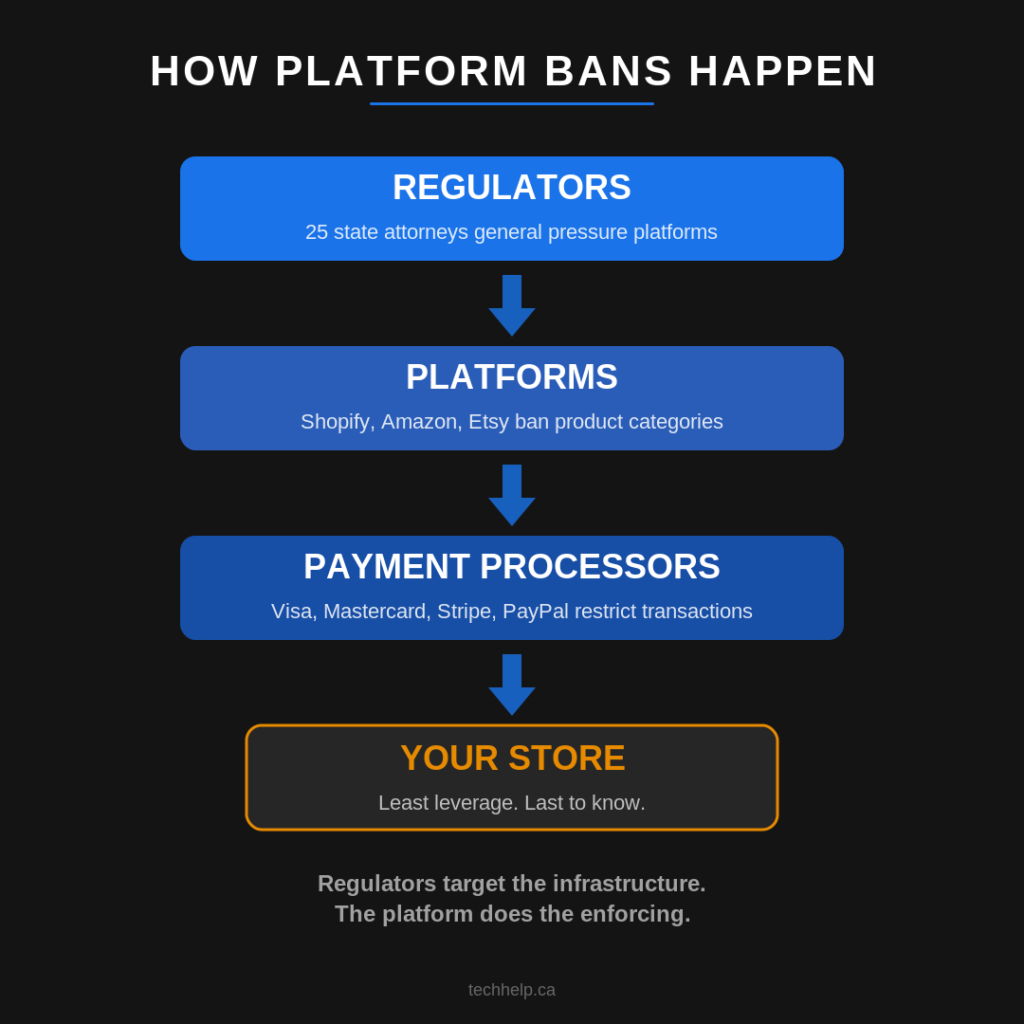
The move followed months of pressure from state attorneys general. In November 2025, California Attorney General Rob Bonta and the City of New York co-led a bipartisan coalition of 25 attorneys general that urged Shopify to take stronger action against merchants using its services to sell illegal tobacco products, especially e-cigarettes.
That November letter identified 29 illegal e-cigarette websites hosted on Shopify and more than 200 additional websites known to sell illegal tobacco products. The coalition argued that Shopify’s existing policies weren’t enough because merchants continued using the platform to sell unlawful products.
By June 24, 2026, multiple attorneys general were publicly welcoming Shopify’s decision to ban all e-cigarette sales on its platform. Minnesota Attorney General Keith Ellison described the move as a direct response to the coalition’s November 2025 call for action.
The key shift is that Shopify didn’t appear to target only the specific sellers named by regulators. Based on the merchant notices described by Token of Trust and a Reuters report carried by The Globe and Mail, the platform moved against the broader ENDS category in the United States.
For affected sellers, the legal distinction between “authorized,” “unauthorized,” “nicotine,” and “non-nicotine” became less important than Shopify’s policy decision. If the product falls inside the category Shopify no longer wants to support, the merchant has a problem.
Regulators are learning to pressure the infrastructure
The most important part of this story isn’t the vape category. It’s the enforcement model.
Regulators don’t have to chase every seller one by one if they can pressure the infrastructure those sellers depend on. Platforms, payment processors, banks, marketplaces, app stores, ad networks, logistics providers, and search engines can all become enforcement chokepoints. That’s what makes this moment worth watching.
The California AG’s November 2025 release said the coalition had taken action against individual e-cigarette sellers before, but found many sellers were able to offer illegal e-cigarettes by using Shopify’s services. Bonta’s office framed the platform as a point of origin where unlawful sales could be addressed faster. That’s a very different kind of pressure than a single seller lawsuit.
Once a platform receives enough legal, reputational, or payment-risk pressure, it may decide the safest move isn’t to sort every seller with perfect nuance. It may simply remove the category. From the platform’s perspective, that reduces risk. From the seller’s perspective, it can erase a channel overnight.
The Federal Trade Commission’s March 2026 warning letters to PayPal, Stripe, Visa, Mastercard, and other financial executives show how closely regulators are watching infrastructure-level access in other contexts too. That FTC action focused on concerns around de-banking and payment access, not Shopify’s vape decision. But it reinforces the broader reality: online commerce depends on private infrastructure, and that infrastructure is now a major policy battlefield.
Shopify’s terms already give it broad power
Most merchants don’t read the terms of service closely until something goes wrong. Shopify’s current terms say it may suspend or terminate an account “for any reason, without notice and at any time,” unless otherwise required by law. The terms also say Shopify may reject an account application or cancel an existing account at its sole discretion, and may modify the services or any part of them for any reason, without notice and at any time, except where prohibited by law.
That’s not unusual for a hosted commerce platform. It’s the standard bargain sellers accept when they choose convenience, speed, built-in tools, and managed infrastructure. But it means your store isn’t the same thing as your business.
Shopify can be an excellent storefront. Amazon can be an excellent marketplace. Etsy can be an excellent discovery channel. Payment processors can make transactions easy. None of that changes the underlying risk: when another company controls the account, the rules, the checkout, and the customer touchpoint, you’re operating inside someone else’s risk model. That may feel fine until your category, claim, supplier, payment pattern, content, customer complaints, chargeback rate, or regulatory profile triggers attention.
This is bigger than restricted products
It’s easy to dismiss this as a high-risk-product issue. Vapes are regulated. Tobacco products are politically sensitive. Youth access concerns are serious. Of course platforms are cautious. All true.
But platform dependency isn’t limited to restricted products. Sellers in ordinary categories can still be affected by policy changes, payment reviews, intellectual property complaints, chargebacks, search algorithm shifts, advertising restrictions, or automated enforcement. The difference is usually speed.
In regulated categories, the risk is obvious. In mainstream categories, the risk is often hidden until the platform changes the rule, reprioritizes the algorithm, tightens enforcement, or responds to outside pressure.
The same operating principle applies either way: if one platform controls most of your sales, most of your customer access, and most of your checkout flow, your business has a single point of failure.
That doesn’t mean Shopify is bad. It doesn’t mean merchants should avoid platforms. It means platforms should be treated as channels, not foundations.
What sellers should do now
The answer isn’t to panic or rebuild everything overnight. Most businesses use hosted platforms because they solve real problems. They make it faster to launch, easier to manage products, simpler to accept payments, and cheaper to operate without a large technical team. The lesson is to reduce dependency before you need to.
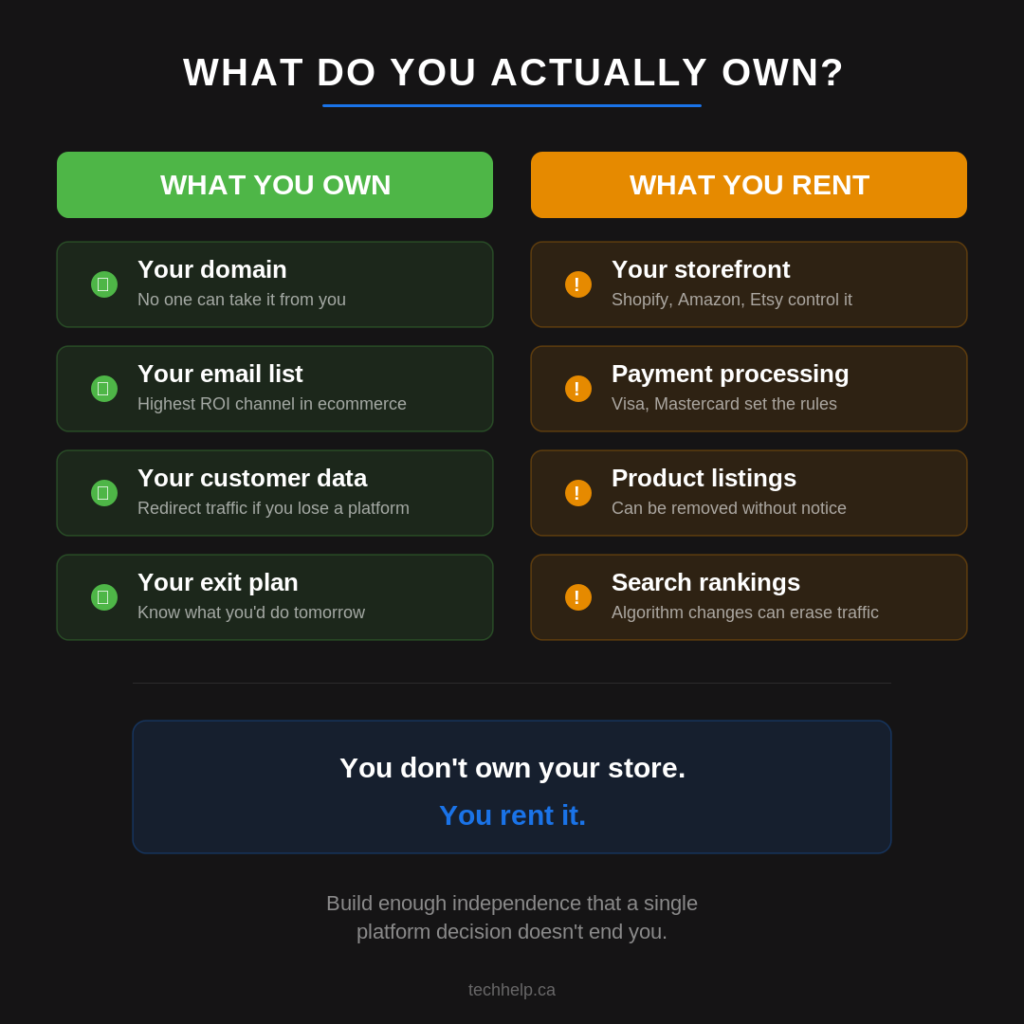
Start with ownership. Your domain, customer list, product data, order history, content, brand assets, and analytics should be portable. If your platform account disappeared tomorrow, you should know what you’d still have and what you’d lose.
Then look at customer access. If your only way to reach buyers is through a platform dashboard, you’re renting the relationship. Email remains one of the strongest owned channels in ecommerce because it lets you redirect attention when a platform, algorithm, or marketplace changes. Tech Help Canada’s guide to email marketing ROI explains why that channel still matters for online sellers.
Next, review your channel mix. A single sales channel may be simpler, but it also concentrates risk. A seller using Shopify, Amazon, wholesale, direct email, organic search, and a secondary storefront has more options than a seller whose entire revenue depends on one admin login. Diversification isn’t only a growth strategy. It’s insurance.
You should also separate critical infrastructure where possible. If your domain, storefront, email, payment gateway, analytics, and customer communication all depend on the same provider, one account issue can affect more than sales. It can affect your ability to communicate, redirect traffic, export records, or recover quickly.
Finally, write the exit plan before you’re forced to use it. Which products would move first? Where would customers go? Who has access to exports? Which provider could replace the current checkout? How long would a migration take? Which compliance requirements would follow you to the new platform? Those questions are boring until they become urgent. Then they’re everything.
The real warning
The Shopify vape ban is today’s example, but the warning is broader. Online sellers often talk about building a brand, when what they really have is a storefront inside someone else’s system. That can work beautifully for years. Then one policy update, regulator letter, processor concern, automated flag, or platform strategy shift can expose how little control the seller actually has.
The businesses that survive those moments aren’t always the biggest. They’re the ones with options. They own their customer relationships. They can move their data. They can redirect demand. They can keep communicating with buyers. They don’t confuse platform access with business ownership.
Shopify’s decision may be defensible from a legal and public-health-risk perspective. It may also create severe disruption for sellers who believed compliance would protect them from a category-wide platform decision. Both things can be true.
The lesson for every other seller is simple: don’t wait until your category is in the headline to find out whether your business can survive without its favorite platform.
Get new small business insights by email
Practical ideas and useful articles to help you make better business decisions.
Tech Help Canada Staff researches, writes, and reviews practical content for business owners and professionals. Our coverage spans business, marketing, SEO, technology, and the tools and systems people use to grow and operate online. We focus on clear, useful information backed by research, hands-on experience, and editorial review. Learn more about our team and editorial standards. Need help with something? Contact Us