Canada’s economy is growing again after a weak start to 2026. That’s the good news.
The harder question for business owners is whether that recovery is strong enough to justify hiring, buying equipment, opening another location, increasing inventory, or entering a new market.
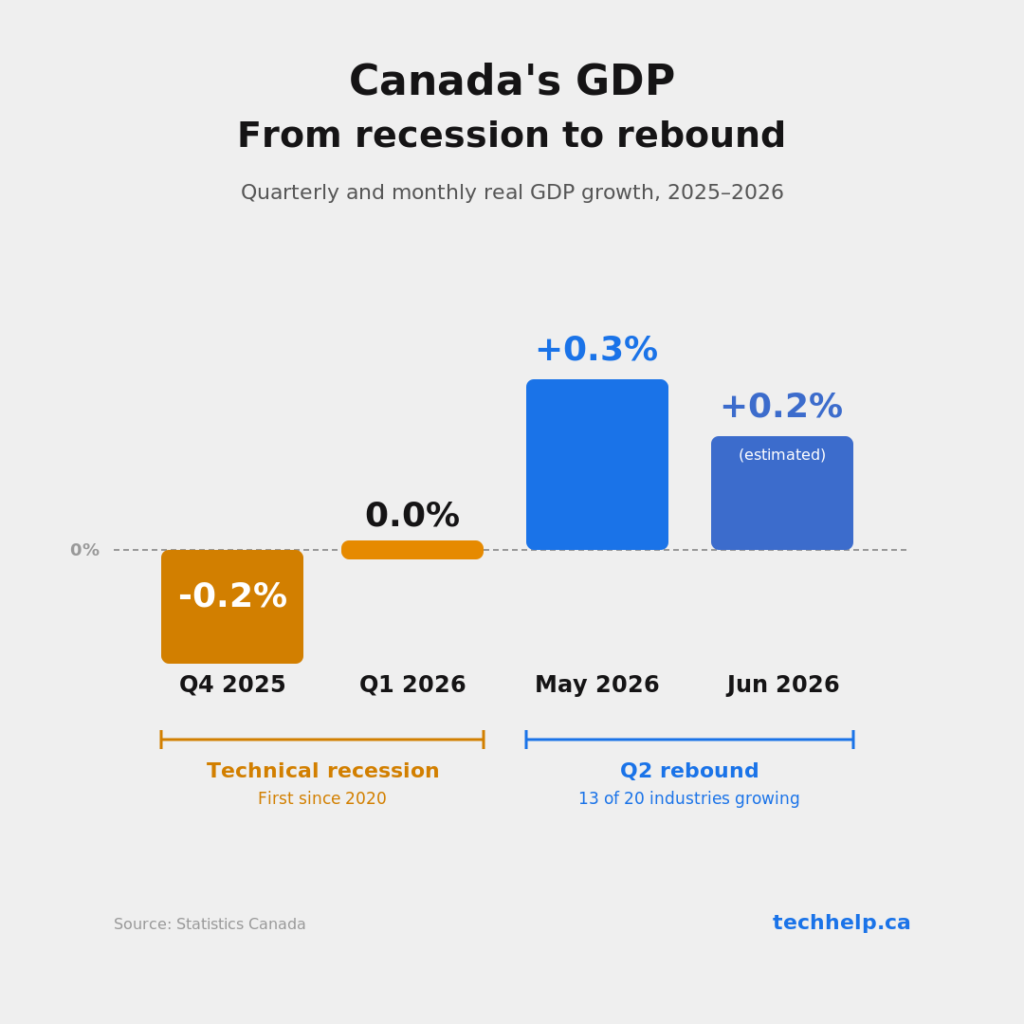
Statistics Canada reported that real GDP was unchanged in the first quarter of 2026 after falling 0.2% in the fourth quarter of 2025. That combination was weak enough to spark technical recession headlines, especially because some annualized readings showed a slight decline. Then monthly GDP started moving the other way. The economy grew 0.3% in May, and Statistics Canada’s advance estimate pointed to another 0.2% increase in June.
So yes, the economy has regained some momentum. But expansion still needs to be judged by your sector, your margins, your customers, and your exposure to tariffs, fuel, labour, and financing costs.
A headline rebound doesn’t automatically mean your business should expand. It means the decision deserves a fresh look.
What the recovery actually looks like
The first-quarter data was messy. Statistics Canada said real GDP by expenditure was flat in Q1 after declining in Q4. Imports rose sharply, with gold imports playing a large role. Exports edged lower, partly because passenger vehicle exports were affected by US tariffs. Business capital investment fell for the fifth straight quarter, and government capital investment also pulled back.
That isn’t the kind of broad strength that makes every expansion decision easier.
The second quarter looked better. In May, real GDP by industry grew 0.3%, with 13 of 20 sectors contributing to the gain. Goods-producing industries rose 0.6%, while services-producing industries rose 0.2%. Statistics Canada’s advance estimate for June pointed to another 0.2% increase, bringing estimated second-quarter GDP by industry growth to 0.8%.
The Bank of Canada also described clear signs that growth had resumed in the second quarter, estimating Q2 growth at about 2.5% on an annualized basis. RBC’s July forecast update tracked Q2 at 2.2% annualized.
That sounds stronger, but the full-year outlook is still cautious. The Bank of Canada projects 0.7% GDP growth for 2026. RBC’s July update also put full-year 2026 growth at 0.7%. The OECD’s June outlook was a little higher at 1.2%.
The short version: Canada appears to be recovering, but this isn’t a boom. It’s a rebound from a weak patch, and the growth is uneven.
What supports expansion right now
The first helpful signal is interest-rate stability. The Bank of Canada held its policy rate at 2.25% on July 15 and said the current rate remained appropriate to support the recovery while bringing inflation back toward target. For businesses modelling new debt, lease commitments, equipment purchases, or working-capital needs, a steadier rate environment makes planning easier than it was during the steep rate-reset period.
The second signal is improving demand in parts of the economy. The Bank of Canada pointed to continued solid consumer spending, and Statistics Canada’s May GDP data showed gains across areas such as construction, real estate and rental and leasing, manufacturing, finance and insurance, transportation and warehousing, and public administration.
The labour market also looks less fragile than it did earlier in the year. The unemployment rate was 6.5% in June, and employment had improved after earlier losses. That still isn’t a tight labour market, but it suggests conditions are no longer deteriorating the way they were at the start of 2026.
Business failures also aren’t accelerating in the way a recession panic might imply. Office of the Superintendent of Bankruptcy data, summarized by CAIRP, showed business insolvencies fell 7.5% year-over-year in the first quarter, though they rose 9.8% from the previous quarter and remained above pre-pandemic levels. That’s a mixed signal: fewer failures than a year earlier, but still plenty of pressure.
There are also public supports for specific growth moves. As of early August 2026, CanExport SMEs is still open for non-US market projects until August 31, 2026, with successful projects eligible for up to $50,000 in funding. BDC has tariff-related financing options, including Pivot to Grow for businesses affected by the current trade environment and a separate support program for steel, aluminum, and copper companies directly hit by tariffs.
For the right business, that combination of stable rates, improving demand, and available support can create a window to move.
What still argues for caution
The biggest risk is trade uncertainty. Canadian businesses are still dealing with US tariff pressure, especially in steel, aluminum, copper, autos, and related supply chains. CFIB warned in July that new US tariff threats could quickly weaken small business confidence again, even after its Business Barometer improved to 58.3 points.
Manufacturers are feeling that pressure most directly. CFIB reported that manufacturing confidence was stuck at 53.7 points in July, still below its historical average. The same release found that 63% of manufacturers reported shipping and receiving costs as a constraint, more than double the 29% recorded in February 2026.
Inflation is another reason to be careful. The Consumer Price Index rose 3.2% year-over-year in May before easing to 2.8% in June. Gasoline prices were still elevated because of Middle East conflict-related energy volatility, and the Bank of Canada’s consumer expectations survey showed a slightly larger share of Canadians expected inflation above 3% over the next 12 months.
Population growth has also shifted. Statistics Canada estimated Canada’s population fell by 55,025 people in the first quarter of 2026, a 0.1% decline. Demand doesn’t disappear because of one quarter, but businesses that grew by riding population growth, especially in housing-adjacent, local services, education, and consumer categories, may need to rethink assumptions.
Consumer spending is becoming more divided too. Higher-income households are still spending on travel, experiences, and premium products. Middle-income households are more likely to delay larger purchases, wait for promotions, or trade down. A “consumer recovery” looks very different depending on which customer segment you serve.
That’s the core tension. The economy is recovering, but many of the costs behind small business margins are still unstable.
Your sector matters more than GDP
GDP tells you what the economy did on average. Your business doesn’t operate in the average economy.
Statistics Canada’s planned capital spending data shows the split clearly. Overall non-residential capital spending intentions for 2026 point to growth, but that growth isn’t evenly spread. Some industries are investing, while others are cutting. C.D. Howe’s analysis of the same data warned that capital spending growth is concentrated in a few sectors, leaving much of the private economy more cautious.
That divide matters more than the national headline.
If you’re in construction, transportation, logistics, healthcare, clean technology, energy-related services, defence supply chains, or certain export categories, expansion may have a stronger case. Those areas have visible investment, hiring demand, public spending, or market access momentum.
If you’re in tariff-exposed manufacturing, housing-dependent services, discretionary retail, or a category where customers are trading down, expansion needs more proof. You may still have an opportunity, but the market won’t carry weak assumptions.
Clean energy and energy storage are good examples of targeted growth rather than economy-wide strength. The Canadian Renewable Energy Association reported that Canada’s wind, solar, and storage capacity grew 46% from 2019 to 2024, with energy storage capacity up 192% over that period. It also expects installed wind, solar, and storage capacity to grow by about a third by 2029. For companies serving that ecosystem, the opportunity is more specific than “Canada’s economy is growing.”
The same logic applies in reverse. If your customers are manufacturers facing tariff costs, or consumers delaying large purchases, national GDP growth won’t rescue a weak demand signal.
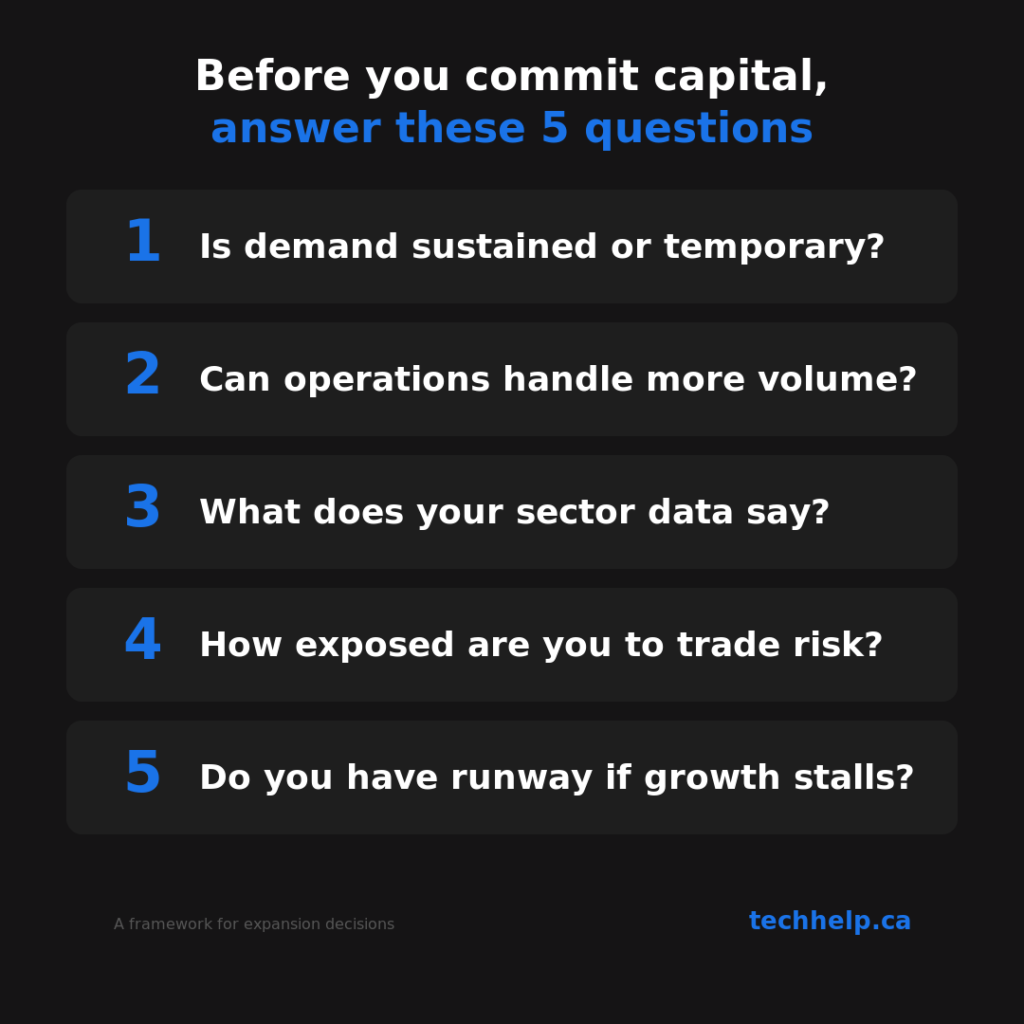
Five questions to answer before you commit capital
If you’re considering expansion, the macro data gives you context. The decision should still come from your own numbers.
Is demand sustained or just temporarily higher?
A single strong month isn’t enough. Look for repeat purchases, longer waitlists, rising close rates, stronger search demand, better retention, or improving revenue across multiple months.
If demand rose because of a seasonal spike, a one-time promotion, or a competitor’s temporary issue, don’t treat it like a structural trend. Expanding on temporary demand can leave you with permanent costs.
Can operations handle more volume?
Expansion exposes weak systems. If you’re already dealing with delivery delays, quality issues, staff burnout, supplier misses, or customer service strain, more demand may make the business weaker instead of stronger.
Before adding capacity, check whether your current workflows can handle more volume without damaging the customer experience. If they can’t, the first expansion move may be operational improvement rather than more sales.
What does your sector data say?
Look beyond GDP and check sector-level signals. Statistics Canada’s capital expenditure survey, CFIB’s Business Barometer, Bank of Canada business surveys, industry association data, and your own sales pipeline can tell you whether your market is investing or pulling back.
If your sector is cutting investment, expansion needs a stronger margin of safety. If your sector is gaining investment and customers are actively buying, waiting too long may carry its own cost.
How exposed are you to tariffs and supply chain disruption?
If you export to the United States, import US inputs, or depend on suppliers who do either, tariff risk belongs in your expansion model. The exposure may show up through prices, lead times, contract terms, customer hesitation, or thinner margins.
Businesses with less US exposure, more domestic demand, or credible non-US opportunities may have more room. But diversification still takes time, money, and focus. It shouldn’t be treated like an emergency switch you can flip after costs rise.
Do you have runway if the recovery slows?
Build your expansion model around the low end of the forecast range. If the deal only works under the best-case scenario, it isn’t ready.
Cash reserves, access to credit, supplier flexibility, and a plan for cutting costs if demand weakens are what separate a calculated expansion from a risky bet. This is where business uncertainty needs to become a planning input, not just a feeling.
Expansion moves that don’t require betting everything
Expansion doesn’t have to mean signing a new lease, doubling inventory, or hiring a full team before demand is proven.
One safer move is improving capacity through technology. If software, AI, or automation lets you serve more customers without adding the same amount of labour, you can expand margin before expanding fixed costs. That could mean better quoting, inventory planning, customer support, bookkeeping, scheduling, reporting, or fulfilment workflows. Canada’s national AI strategy and related small business programs are pushing more companies in that direction, and the same principle applies whether you’re adopting AI tools or improving business automation.
Another option is limited-market testing. Before opening a second location, test demand with a pop-up, partnership, delivery zone, pilot product, waitlist, or smaller inventory run. Before entering a new export market, test with distributor conversations, trade missions, paid research, or a narrow customer segment.
Market diversification is also worth considering if your US exposure is high. Canada has trade access through agreements such as CETA with the European Union and CPTPP across Pacific markets, and Canada-ASEAN negotiations remain part of the broader diversification push. Programs such as CanExport SMEs can reduce some of the cost of testing international markets, though funding is competitive and eligibility matters.
Financing can help too, but it should support a specific plan. BDC’s Pivot to Grow loan is designed for businesses affected by the current trading environment. Tariff-focused programs for steel, aluminum, copper, and related supply chains can also help eligible companies buy time, adjust supply chains, or pursue new markets.
The strongest expansion moves in this economy have one thing in common: they increase options without locking the business into costs it can’t carry if the recovery disappoints.
So, should your business expand?
Canada’s economy is growing again, but that doesn’t make expansion automatic.
If your demand is sustained, your margins can absorb cost volatility, your operations can handle more volume, and your sector is investing, this may be a reasonable time to move. Borrowing costs are steadier. Competitors may still be cautious. Some government programs are built specifically to support productivity, export diversification, and tariff resilience.
If your sector is under tariff pressure, your customers are delaying purchases, your cash position is thin, or your growth plan depends on optimistic forecasts, the better move may be preparation. Improve margins. Shorten decision cycles. Test new markets in smaller ways. Build the systems that make a later expansion less risky.
The worst move isn’t expanding. It isn’t staying put either.
It’s making either decision because the headline GDP number changed.
Use the recovery as a signal to reassess, not as permission to ignore your own data.
Frequently Asked Questions
Is Canada in a recession in 2026?
Canada had a weak start to 2026, with real GDP declining in late 2025 and essentially flat in the first quarter of 2026. That sparked technical recession headlines, but monthly GDP growth resumed in the second quarter. The better read is that Canada is recovering from a weak patch, not entering a broad boom.
Should small businesses expand when GDP starts growing again?
Not automatically. GDP growth is useful context, but expansion should depend on your own demand, margins, cash runway, operational capacity, and sector exposure. A business in a growing niche may have room to move, while a tariff-exposed or cash-tight business may need to strengthen operations first.
What should you check before expanding your business?
Check whether demand is sustained, whether your operations can handle more volume, whether your sector is investing or pulling back, how exposed you are to tariffs and supply chain disruption, and whether you have enough runway if the recovery slows.
What are safer expansion moves in an uncertain economy?
Safer moves include improving productivity with technology, testing a new market before committing heavily, launching a limited product run, building partnerships, applying for targeted funding, and expanding into lower-risk customer segments before adding large fixed costs.
Get new small business insights by email
Practical ideas and useful articles to help you make better business decisions.
Tech Help Canada Staff researches, writes, and reviews practical content for business owners and professionals. Our coverage spans business, marketing, SEO, technology, and the tools and systems people use to grow and operate online. We focus on clear, useful information backed by research, hands-on experience, and editorial review. Learn more about our team and editorial standards. Need help with something? Contact Us