Lifetime deals have a bad reputation for a reason.
The standard warning is never sell lifetime access because you’ll end up supporting customers forever without receiving another dollar from them.
That warning isn’t completely wrong. But it misses the sharper point.
A lifetime deal isn’t automatically a bad business decision. An underpriced lifetime deal with an undefined promise is.
Handled properly, a lifetime offer can give a business a useful cash injection without debt or equity dilution. Handled poorly, it can leave the company serving demanding customers years after their original payments have been spent.
The decision comes down to four questions:
How much profit would the customer normally generate?
How much will it cost to serve them over time?
How clearly can you limit the promise?
What will the upfront money allow the business to do?
Once you answer those questions, lifetime pricing becomes a math problem instead of a philosophical debate.
A lifetime deal is a financing decision
A subscription spreads revenue across the customer relationship.
A lifetime deal pulls a large portion of that potential revenue forward. The customer gives you more money today in exchange for avoiding future payments.
The business gets immediate cash. The customer gets long-term access or benefits.
That makes a lifetime deal a form of customer-funded financing. It isn’t legally a loan, but the economic trade is similar: you receive capital now and accept an obligation that continues into the future.
That capital might help the company build a major product feature, hire additional help, expand into another location, fund a proven marketing campaign, improve infrastructure, or create enough runway to reach profitability.
The offer becomes harder to justify when the money has no defined purpose. Selling lifetime access to cover an ongoing cash shortage may postpone the problem while adding another obligation.
The strongest lifetime deals fund something that improves the company’s future earning power.
Define what lifetime means
Customers may hear “lifetime access” and assume it means access for the rest of their lives.
Businesses sometimes mean something different.
AppSumo, one of the better-known marketplaces for lifetime software deals, defines lifetime access as access for the lifetime of the product. As long as the product remains available, the buyer keeps access.
That definition still leaves several questions:
What happens if the company is acquired?
Does the customer receive every future feature?
Are third-party services included?
Can usage limits change?
Does access continue if the product is renamed?
What happens if the original product is replaced?
Are support, updates, and integrations included?
The offer should answer these questions before customers pay.
“Lifetime” should never live only in the headline while the company privately assumes it can change the deal later. The public promise, checkout language, and terms should describe the same offer.
For a software product, one possible definition might be:
Lifetime access means access to the purchased plan for as long as the product remains commercially available. The plan includes the features and usage limits listed at the time of purchase. Third-party services, optional add-ons, and separately released products may require additional payment.
The right language will depend on the business and jurisdiction. A lawyer can help review the final terms, especially when a large amount of future service is involved.
Usage can stop while the obligation stays alive
One argument in favour of lifetime deals is that lifetime customers eventually churn too.
Some buyers close their businesses. Some outgrow the product. Others buy the deal, log in twice, and forget about it.
All of that can reduce actual usage.
But there’s a difference between usage churn and contractual churn.
A customer who hasn’t logged in for three years may still return. Their account may continue consuming storage. The business may still need to maintain security, data, integrations, and access rights.
The buyer may be inactive, but the company’s promise remains active.
This doesn’t make lifetime deals unworkable. It means the pricing model shouldn’t assume every inactive user has disappeared permanently.
A safer forecast estimates how many customers will remain active, how many may return, and what every account costs even when usage is low.
Start with subscription contribution LTV
A common lifetime-pricing shortcut compares the offer with subscription revenue.
Suppose a product costs $50 per month and the average customer remains for 10 months. That customer generates $500 in revenue, so the owner concludes that any lifetime price above $500 must be profitable.
The problem is that revenue isn’t profit.
The business may have payment-processing fees, infrastructure costs, customer acquisition expenses, onboarding work, and ongoing support costs.
A better calculation uses contribution lifetime value:
Subscription contribution LTV =
(Monthly price – monthly variable cost) x average paid lifespan – acquisition and onboarding costs
Variable costs are the costs that increase as the customer uses or receives the product. Depending on the business, they could include hosting, API usage, payment fees, materials, shipping, or labour.
Stripe’s subscription analytics estimate subscriber lifetime value using average revenue per user and churn. A business evaluating a lifetime offer should go further by including customer-level costs.
Consider a subscription with these numbers:
Input
Amount
Monthly price
$50
Monthly variable cost
$8
Average paid lifespan
10 months
Acquisition and onboarding cost
$75
The calculation becomes:
($50 – $8) x 10 – $75 = $345
The customer generates $500 in revenue, but the estimated contribution is $345.
That $345 provides a more useful comparison for the lifetime offer.
Calculate the lifetime deal contribution
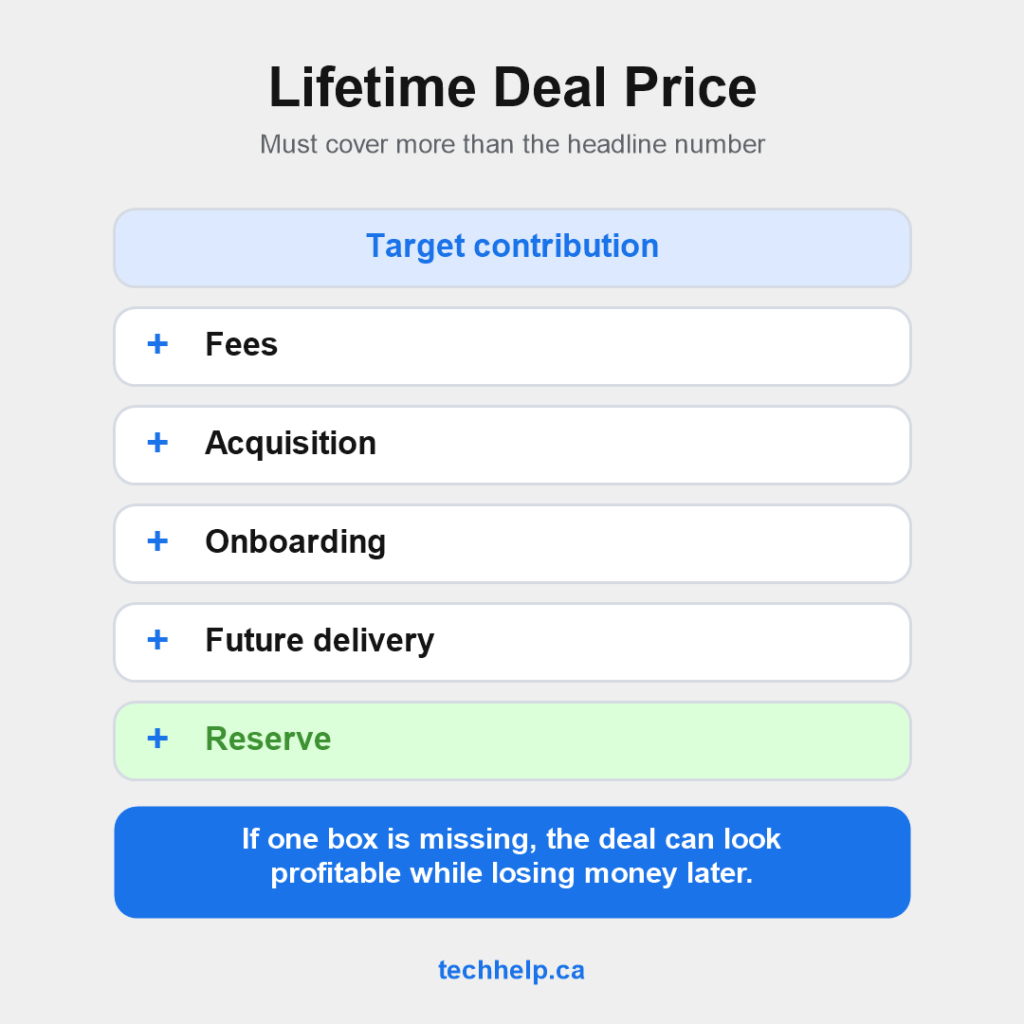
The lifetime price must cover more than the customer’s expected subscription value.
The target contribution might equal the subscription contribution LTV. A business facing high uncertainty may require more.
There’s no universal multiplier that works for every company. A digital course with little ongoing delivery risk doesn’t need the same margin as an AI product paying for every user request.
Like any good pricing strategy, the price should reflect the risk inside the promise.
Add a margin for uncertainty
Lifetime pricing relies on predictions about a future you can’t see.
Costs could increase. Customers could remain active longer than expected. A third-party provider could change its pricing. Buyers might require more support. A feature that’s cheap today could become expensive to maintain.
A safety margin helps absorb those surprises.
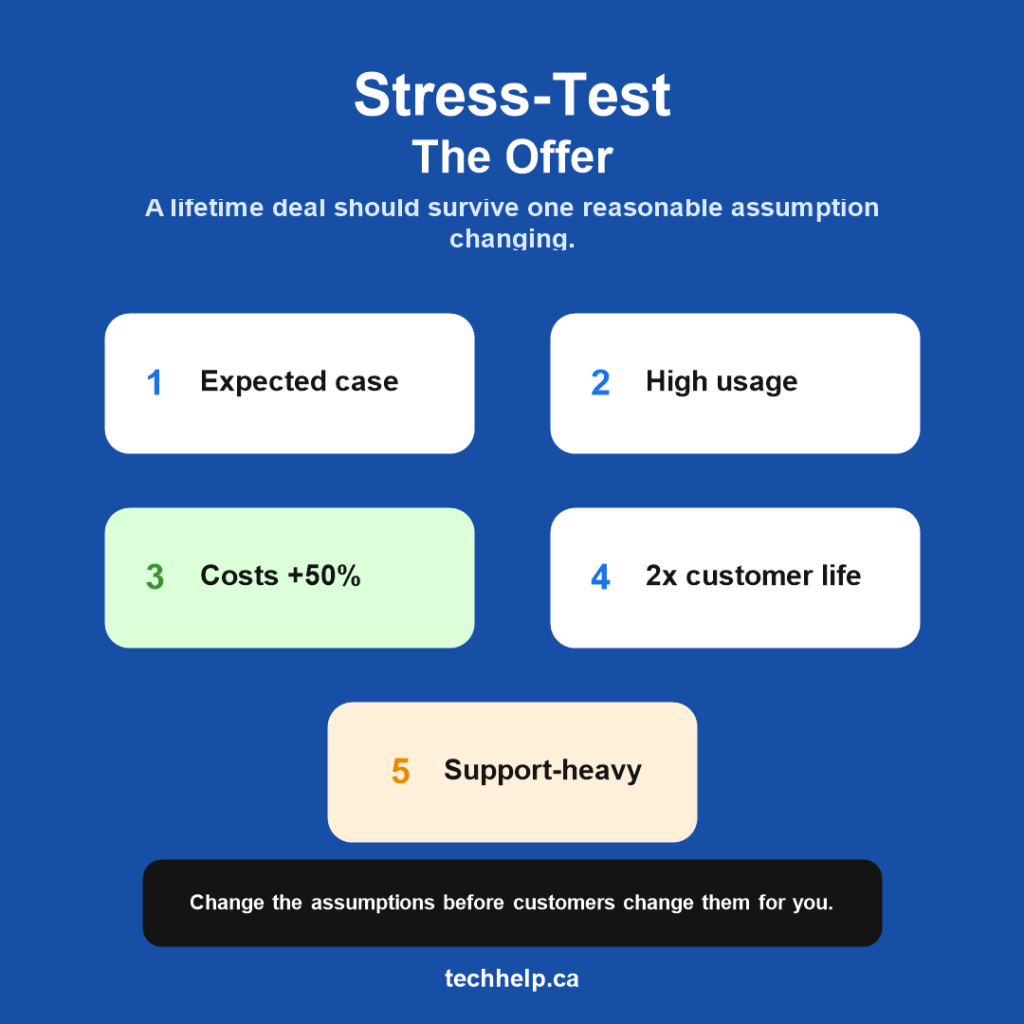
Rather than multiplying the price by two or three without context, test the offer under several scenarios:
Scenario
Question to answer
Expected case
What happens if costs and usage follow your current estimates?
High-usage case
What happens if more customers remain active than expected?
Cost-increase case
What happens if infrastructure or delivery costs rise by 50%?
Long-life case
What happens if active customers remain twice as long as forecast?
Support-heavy case
What happens if customer service costs exceed your estimate?
The deal doesn’t need to produce the same profit in every scenario. But it shouldn’t become financially damaging after one reasonable assumption changes.
SaaS lifetime deal example
Imagine a self-serve software company charging $20 per month.
Its numbers look like this:
Input
Amount
Monthly subscription price
$20
Variable infrastructure cost
$2 per active month
Average paid lifespan
18 months
Combined acquisition and onboarding cost
$40
The subscription contribution LTV is:
($20 – $2) x 18 – $40 = $284
Now the company considers a $599 lifetime offer.
It estimates:
Lifetime deal cost
Amount
Payment and selling fees
$20
Acquisition and onboarding
$40
Expected long-term infrastructure cost
$120
Support and contingency reserve
$70
The lifetime contribution is:
$599 – $20 – $40 – $120 – $70 = $349
Under those assumptions, the lifetime deal generates $65 more contribution than the average subscription customer. The company also receives the money immediately.
That doesn’t make $599 automatically safe.
If infrastructure expenses double and support costs rise, the advantage could disappear. The company may need usage limits to prevent a small number of customers from creating unlimited costs.
This is especially relevant for AI software. AppSumo’s AI credits guidance explains why some AI lifetime deals use credit bundles, annual credit refreshes, or bring-your-own-API-key options instead of promising unlimited usage forever.
A lifetime SaaS plan could include a fixed number of projects, monthly or annual usage credits, defined storage limits, limited team seats, standard support, and paid upgrades for additional capacity.
The customer still receives lifetime value. The company avoids writing a blank cheque for future infrastructure.
Limit the launch
The company could also sell the deal in stages:
Offer tier
Quantity
Price
Gross cash
First tier
25 accounts
$499
$12,475
Second tier
75 accounts
$599
$44,925
Total
100 accounts
$57,400
The 100-account cap limits the company’s long-term exposure. It also gives the team a known group whose costs and behaviour can be monitored.
If the first lifetime group remains profitable, the company can consider another controlled offer later. If it doesn’t, the damage is contained.
Membership and information-product example
Lifetime deals often work better for self-serve memberships than for offers requiring regular one-on-one work.
Consider an educational membership that charges $30 per month. The membership includes recorded courses, templates, a resource library, and occasional new lessons.
Assume:
Input
Amount
Monthly price
$30
Variable monthly cost
$3
Average paid lifespan
12 months
Acquisition and onboarding cost
$30
The subscription contribution LTV is:
($30 – $3) x 12 – $30 = $294
Now consider a $499 lifetime plan.
Estimated costs are:
Lifetime deal cost
Amount
Payment fees
$15
Acquisition and onboarding
$30
Future platform, support, and content reserve
$80
The estimated lifetime contribution is:
$499 – $15 – $30 – $80 = $374
The lifetime plan produces more estimated contribution than the average subscriber while giving the business cash sooner.
The economics would change quickly if the offer included unlimited private coaching, custom reviews, or weekly consulting.
A library can serve another customer without requiring another hour of the founder’s time. Private service can’t.
Service businesses should sell lifetime benefits, not unlimited labour
A lifetime offer becomes more dangerous as human delivery increases.
Suppose a consultant runs a group program for $300 per month.
The average client stays for eight months. Delivering the service costs about $120 per client each month when the consultant’s time and support are allocated across the group. Acquisition and onboarding cost another $150.
The subscription contribution LTV is:
($300 – $120) x 8 – $150 = $1,290
A $2,500 lifetime plan may appear generous to the business. But if a client remains for three years, the allocated delivery cost alone could reach:
$120 x 36 = $4,320
The lifetime offer loses money before accounting for acquisition, administration, or inflation.
The consultant could create a safer offer by selling lifetime access to the parts that don’t require unlimited labour. That could include lifetime access to a training library, permanent preferred-client pricing, priority booking, a private template collection, one initial strategy session, access to a member community, or discounts on future projects.
Future consulting and implementation remain billable.
This structure turns the lifetime promise into an access or membership benefit rather than a commitment to work indefinitely.
Physical businesses face capacity risk
Gyms show why low apparent delivery costs can be misleading.
Suppose a gym charges $80 per month and the average member remains for 15 months.
If the gym estimates $15 in variable monthly costs and $75 for acquisition and onboarding, the expected contribution is:
($80 – $15) x 15 – $75 = $900
A $1,500 lifetime membership looks attractive compared with that average.
But a customer who continues attending for 10 years could create at least $1,800 in variable costs:
$15 x 120 months = $1,800
The larger problem is capacity.
That member occupies equipment, classes, parking, lockers, and facility space that could otherwise serve a paying subscriber. The opportunity cost rises as the gym becomes busier.
A physical business could reduce the risk by offering a three-year or five-year prepaid membership, lifetime access to digital workouts, a permanent founding-member discount, lifetime access limited to one location, or paid upgrades for premium classes and services.
Sometimes the better “lifetime deal” isn’t lifetime access. A long prepaid term can deliver most of the cash benefit while placing an end date on the obligation.
Limit the promise, quantity, and sales window
A cap is more than a marketing tactic. It controls liability.
The business should decide how much future exposure it can reasonably accept, then set the quantity accordingly.
A company that can safely support 100 lifetime accounts shouldn’t sell 500 because the launch is performing well.
The sales window should also have a genuine end date. False countdowns, fake quantities, and repeatedly extended deadlines can cross from aggressive marketing into deceptive marketing. Canada’s Competition Bureau says businesses should claim an offer is time-limited or in short supply only when that’s genuinely the case.
The same principle applies to the advertised discount.
A business shouldn’t invent an inflated regular price to make the lifetime offer appear more valuable. The Competition Bureau identifies made-up ordinary selling prices as a form of misleading advertising.
If the offer closes Friday, close it Friday. If the offer has 100 spots, stop at 100.
Honest limits can create urgency without creating a credibility problem.
Explain what the money will fund
Customers are more likely to understand a lifetime offer when the company explains why it exists.
The business might be raising money to finish a product, add capacity, open a location, or fund a major improvement.
A specific explanation also creates internal discipline. The company is less likely to treat the cash as ordinary revenue when it has already assigned the money to a productive purpose.
A SaaS company might say:
We’re opening 100 lifetime memberships to fund the next stage of product development without taking outside investment.
A gym might say:
We’re offering 50 founding memberships to help fund the equipment and buildout for our second location.
The explanation should be true. Customers don’t need access to every financial detail, but they should understand why the business is making an offer that won’t remain available indefinitely.
Don’t spend every dollar
Receiving the money doesn’t erase the future obligation.
A portion of the proceeds should remain available for refunds, customer support, infrastructure, product maintenance, payment disputes, and unexpected delivery costs.
The right reserve will depend on the offer. A self-paced course may require less than a software platform with ongoing hosting and API expenses.
The accounting treatment also deserves attention. IFRS 15 distinguishes between performance obligations satisfied at a point in time and those satisfied over time. A company receiving upfront cash while continuing to provide services may not be able to treat the entire payment as earned revenue immediately.
An accountant can determine how the proceeds should be recorded and recognized for the specific business.
A lifetime deal pricing worksheet
Before launching an offer, fill in these numbers.
Subscription economics
Input
Your number
Monthly or annual price
Variable delivery cost per period
Average paid customer lifespan
Acquisition and onboarding cost
Subscription contribution LTV
Use:
(Price – variable cost) x lifespan – acquisition and onboarding
Lifetime economics
Input
Your number
Proposed lifetime price
Payment and selling fees
Acquisition and onboarding
Expected future delivery cost
Support reserve
Refund and contingency reserve
Lifetime contribution
Use:
Lifetime price – all expected costs and reserves
Risk checks
Then ask:
Is the lifetime contribution at least as strong as the subscription contribution?
Does the offer remain profitable if costs rise?
Can one heavy user create unlimited expense?
Does the plan include ongoing human work?
Is lifetime defined in writing?
Is the number of available accounts capped?
Is the closing date genuine?
Does the business have a specific use for the cash?
Will part of the proceeds remain reserved for future delivery?
A “no” doesn’t always kill the idea. It shows where the offer needs to change.
When a lifetime deal can make sense
A lifetime deal is more likely to work when the product is self-serve, gross margins are high, and future delivery costs are predictable.
It can also make sense when the business has a strong use for upfront capital and can limit the number of buyers.
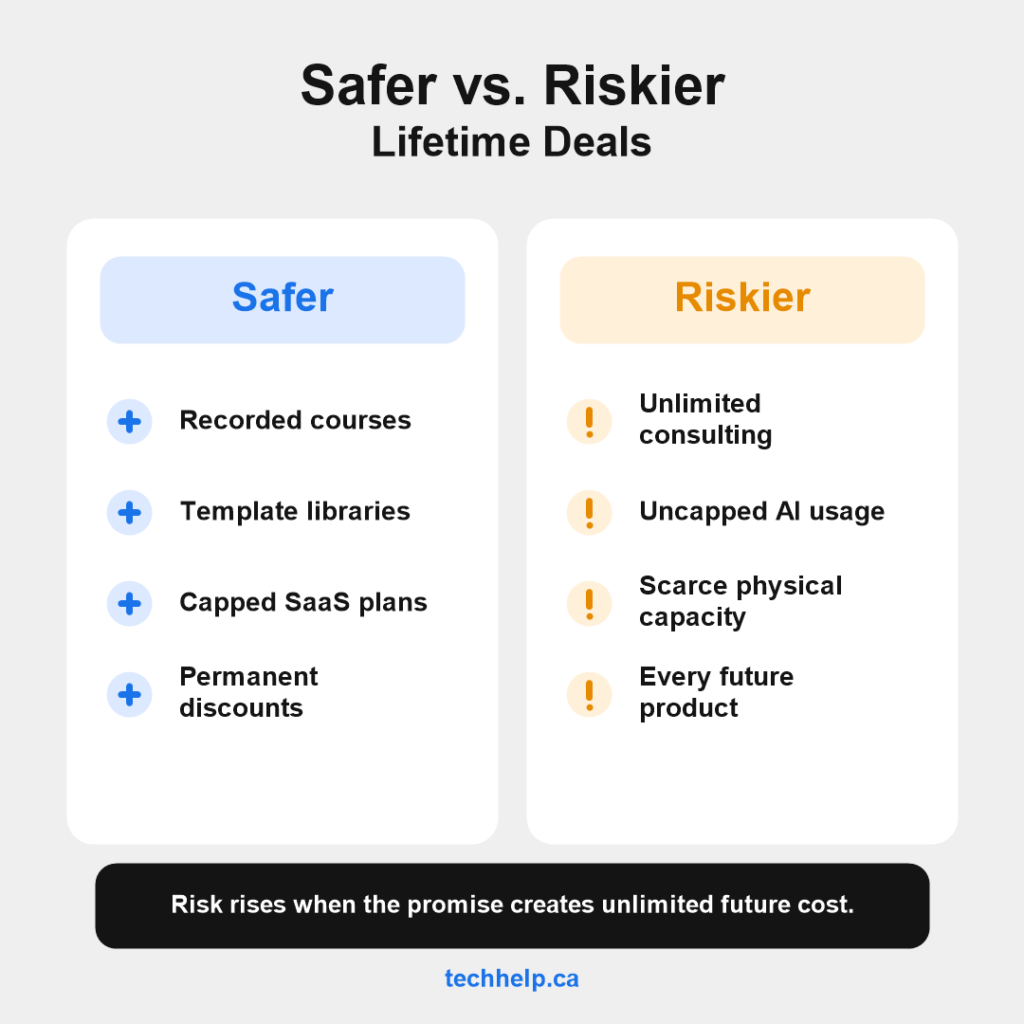
Good candidates often include digital courses, template libraries, membership archives, software with controlled usage limits, founding-member programs, permanent discounts or preferred-client benefits, and products with low incremental delivery costs.
When to avoid one
A lifetime offer is much riskier when it includes unlimited labour, uncapped third-party expenses, or access to scarce physical capacity.
Be cautious when every customer requires personal service, usage creates large API or infrastructure costs, the company doesn’t know its normal customer lifetime value, the offer includes every future product, the business needs the cash to cover routine losses, the terms leave lifetime undefined, the company can’t reserve money for future delivery, or a few heavy users could destroy the economics.
In those situations, an annual plan, multi-year prepayment, or founding-member discount may provide a safer alternative.
Lifetime deals aren’t always bad. Bad math is.
A lifetime deal trades future recurring revenue for immediate capital.
That can be a smart exchange when the upfront price covers the customer’s expected value, the future obligation is predictable, and the company has a productive use for the money.
It becomes dangerous when the business assumes inactive customers have disappeared, promises unlimited human service, ignores future costs, or spends the proceeds as soon as they arrive.
The goal isn’t to find the lowest lifetime price customers will accept.
It’s to find a price and structure that customers see as valuable without leaving the company regretting the sale five years later.
Frequently Asked Questions
What is a lifetime deal?
A lifetime deal is a one-time payment offer where the customer receives long-term access or benefits instead of paying a recurring subscription. For the business, it pulls revenue forward and creates an obligation that may continue for years.
How do you price a lifetime deal?
Start with subscription contribution LTV, then add transaction fees, acquisition costs, onboarding costs, expected future delivery costs, support reserve, and a contingency reserve. The lifetime price should cover the value you would normally earn from the customer plus the future cost and risk of serving them.
Are lifetime deals bad for SaaS businesses?
Not always. A lifetime deal can work for SaaS when usage is capped, support is controlled, infrastructure costs are predictable, and the number of buyers is limited. It becomes dangerous when the offer promises unlimited usage, every future feature, or uncapped AI and hosting costs.
What should lifetime access include?
Lifetime access should clearly state which product, plan, features, usage limits, support level, updates, integrations, and add-ons are included. It should also explain what happens if the product is renamed, replaced, acquired, or discontinued.
What is safer than selling lifetime access?
Safer alternatives include annual plans, multi-year prepaid plans, founding-member discounts, lifetime access to a limited resource library, or lifetime preferred pricing. These options can create upfront cash without promising unlimited future service.
Tech Help Canada Staff researches, writes, and reviews practical content for business owners and professionals. Our coverage spans business, marketing, SEO, technology, and the tools and systems people use to grow and operate online. We focus on clear, useful information backed by research, hands-on experience, and editorial review. Learn more about our team and editorial standards. Need help with something? Contact Us