Anthropic is rolling out invisible text watermarking for Claude in response to the EU AI Act. Future Claude models will include the watermark, while models launched before August 2, 2026 are being transitioned over the coming months. Not a visible stamp. Not a disclaimer. A statistical pattern hidden inside the word choices themselves — one you can’t see while reading and that can be disrupted by sufficiently substantial rewriting.
Anthropic built this system to comply with the EU AI Act’s Article 50, which now requires AI providers to mark generated content in a machine-readable format. Google did something similar with SynthID. Around 190 organizations signed the same EU Code of Practice on Transparency of AI-Generated Content.
The stated goal is transparency. The risk is that a fragile tracking system creates perverse economic incentives, pulls human writers into provenance disputes, and pushes some users toward the very workarounds regulators hoped to avoid.
This has nothing to do with the visible watermarks on stock photos or banknotes. AI text watermarking doesn’t add anything to the text. No hidden characters. No invisible ink. The mechanism is subtler and more fundamental than that.
When a language model generates text, it predicts one token at a time. At each step, it assigns probabilities to many possible next tokens and samples from that distribution according to the model’s generation settings. Several choices may be plausible in context. “The weather was cold and overcast” can be functionally similar to “The weather was cold and grey.” Watermarking works by subtly influencing that sampling process without inserting visible markers into the text.
Claude uses a version of Google DeepMind’s SynthID-Text approach. A secret key and the preceding text influence the randomness used when Claude chooses among plausible next tokens. Across a long enough passage, those choices create a statistical pattern that someone with the key can test for. The result is probabilistic evidence of model involvement, not a visible label and not proof of authorship.
Anthropic says this process doesn’t affect output quality, doesn’t cost more, has a negligible impact on model speed, and produces no extra tokens. A Google DeepMind study served watermarked Gemini responses to a portion of their traffic and found no statistically significant difference in user ratings compared to unwatermarked responses.
That all sounds reasonable on paper. The problems start when you look at what the watermark can and can’t actually do.
Where the watermark goes silent
Text is a uniquely weak carrier for hidden data. An image has millions of pixel values. That leaves plenty of room to embed information without the viewer noticing. Audio has similar depth. Written language doesn’t. You’re working with a finite vocabulary, strict grammatical rules, and syntax that leaves very little room to maneuver without altering meaning.
This constraint creates three categories where the watermark barely registers.
Code is one of the most commercially significant blind spots. Working code is syntactically rigid. Identifiers must match declarations, indentation and structure matter, and only a narrow set of token sequences produce valid output. That leaves fewer discretionary choices for a watermark to influence. Anthropic’s own documentation acknowledges that code has “generally less watermarking than some other forms of text,” although comments and other flexible elements can still carry some signal.
Short text carries a weaker signal. The statistical pattern needs enough model-chosen words to accumulate into something detectable. Anthropic hasn’t published a minimum Claude token threshold and says detection works poorly on small samples, becoming more reliable as passages get longer. A Slack message, a brief email reply, or a commit subject line may therefore provide too little signal for confident detection.
Factual passages leave the watermark less room to act. When there’s only one natural or correct next word, as in “Isaac Newton’s most famous work was called Principia…”, the model has fewer plausible alternatives it can choose among without changing meaning or accuracy. The more constrained the subject matter, the weaker the signal.
The fragility problem
Even long-form prose can be vulnerable to meaning-preserving paraphrasing.
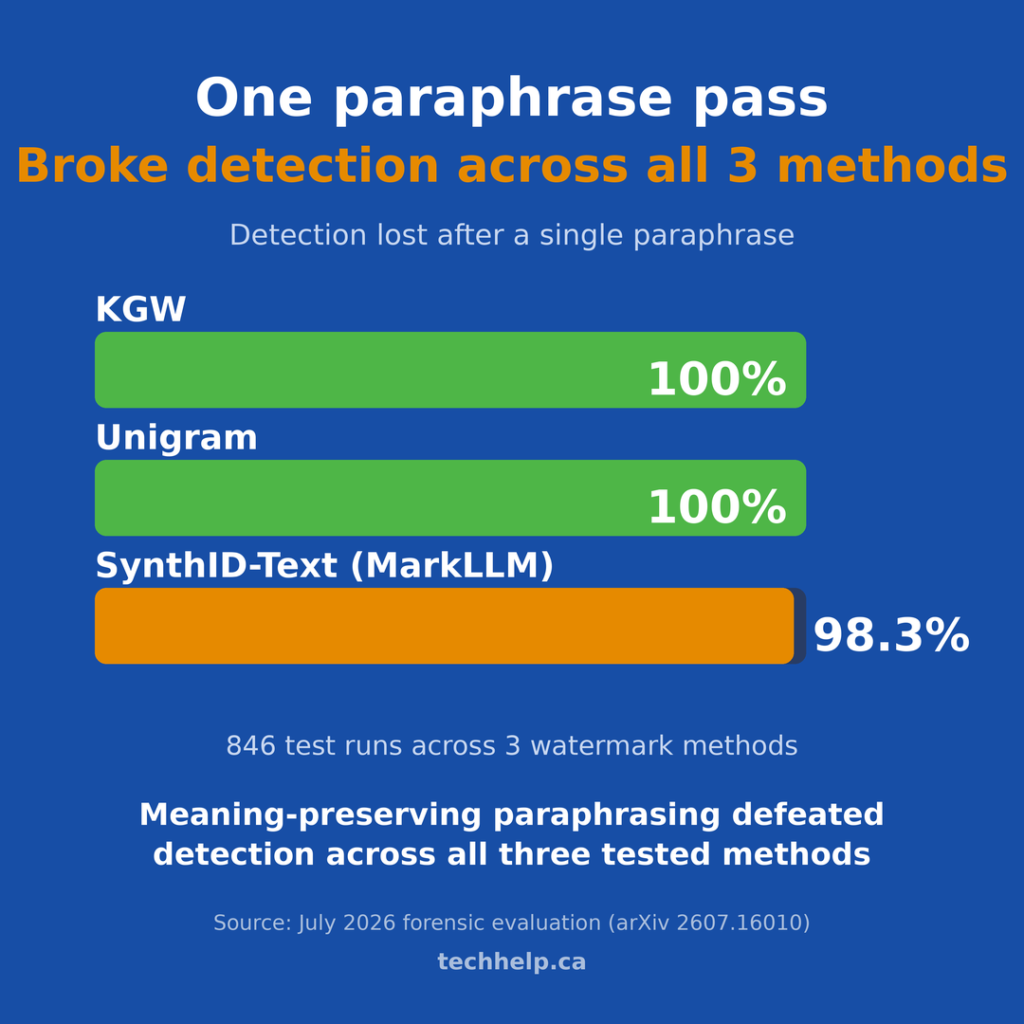
A July 2026 forensic evaluation tested three watermark methods against meaning-preserving paraphrase across 846 runs. KGW and Unigram lost detection in 100% of initially detected cases after a single paraphrase pass. The tested MarkLLM implementation of SynthID-Text lost detection in 98.3% of cases. The researchers did not test Anthropic’s production Claude watermark, so the result demonstrates the fragility of representative implementations rather than proving Claude’s exact failure rate.
Translating already-watermarked text through another system can disrupt its statistical pattern. Heavy editing can degrade it. Even mixing marked text with unmarked text from another source can dilute the signal. That is different from asking Claude itself to translate text. A translation generated directly by Claude can carry Claude’s watermark because Claude is choosing the words in the translated output.
And this isn’t just a practical limitation. Researchers at ICML 2024 proved an impossibility result for strong watermarking under a specified set of assumptions about what an attacker can do. As the gap between watermarked and unwatermarked high-quality text narrows, an attacker with access to quality-preserving transformations can evade detection. The result points to a deeper structural constraint, not merely an engineering problem that disappears with a better implementation.
The compliance costs around AI watermarking
The EU AI Act’s Article 50 carries real teeth. Non-compliance penalties reach up to €15 million or 3% of global annual turnover, whichever is higher. That’s the regulatory pressure that set this entire system in motion.
Anthropic’s response is broad. Watermarking is being deployed globally at the model level, not just for EU users. Anthropic says future Claude models will contain the watermark, while models launched before August 2, 2026 are being transitioned over the coming months. The system is intended to cover Claude across its major surfaces, and Anthropic has not announced an end-user opt-out.
That alone isn’t the problem. The problem is what comes next.
The detection API and the verification overhead
Anthropic has confirmed that a watermark detection API is coming, a tool that will let third parties check whether a piece of text carries Claude’s statistical signature. No pricing, access tiers, rate limits, or SLA details have been announced.
This is where the economic structure gets uncomfortable.
Anthropic says the watermark itself costs nothing extra. No additional tokens, and only a negligible impact on model speed. Under the EU Code of Practice, signatories are generally expected to make their detection solutions available free of charge. That means the bigger cost may not be the API call itself. It may come from integrating detection into workflows, reviewing disputed results, documenting provenance, and handling client or compliance questions.
Even when detection itself is free, the ecosystem-level costs can still be real. Compliance workflows, internal review processes, and third-party verification platforms add friction and expense. The watermark may be free to apply and detect, but the infrastructure organizations build to respond to it may not be.
And because providers may use different marking methods, cryptographic keys, and detection systems, verifying a document that drew from multiple AI sources could require multiple verification paths. The risk is a fragmented compliance layer built around provider-specific detection infrastructure.
The evasion oracle paradox
Here’s the structural contradiction at the center of this system.
Anthropic signed the EU Code of Practice, which commits signatories to provide detection mechanisms that users and legitimate third parties can use.
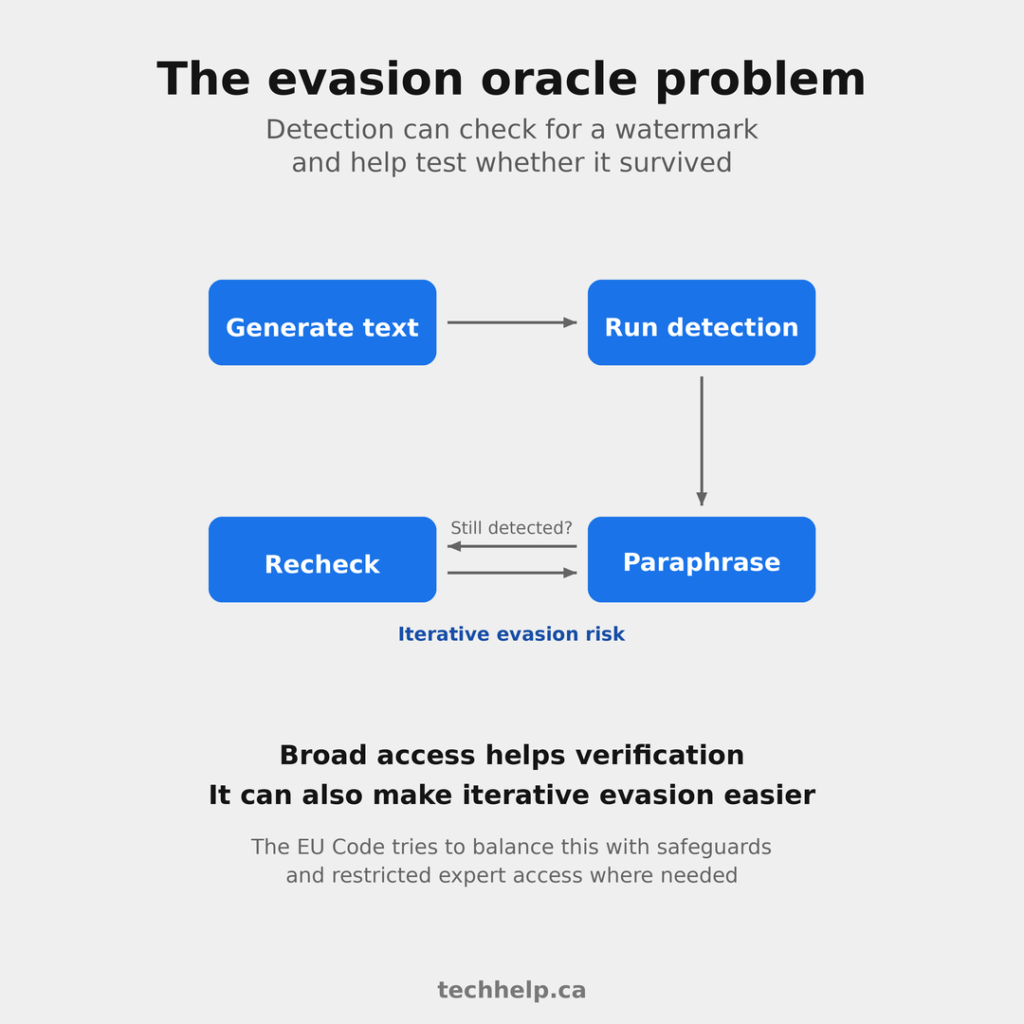
That creates a genuine tension. Broad access can make iterative evasion easier: someone trying to remove a detectable mark can generate text, test it, paraphrase it, and test again. Repeated paraphrasing can be cheap enough to automate at scale. But tightly restricted access weakens independent verification. The EU Code tries to manage that tension with free access, security safeguards, and, for less reliable free-form text detection, the option to restrict access to verified expert users. Whether that balance works in practice is still an open question.
Days after Anthropic confirmed Claude’s watermarking, developer Guillaume Meyer released an open-source tool designed to remove several classes of AI provenance signals, including metadata and invisible characters, while using rewriting as a best-effort attack against statistical text watermarks.
How watermarking can create problems for human writers
The most overlooked problem with AI text watermarking isn’t technical. It’s what happens when the watermark’s limited signal gets treated as proof.
Processing is not authorship
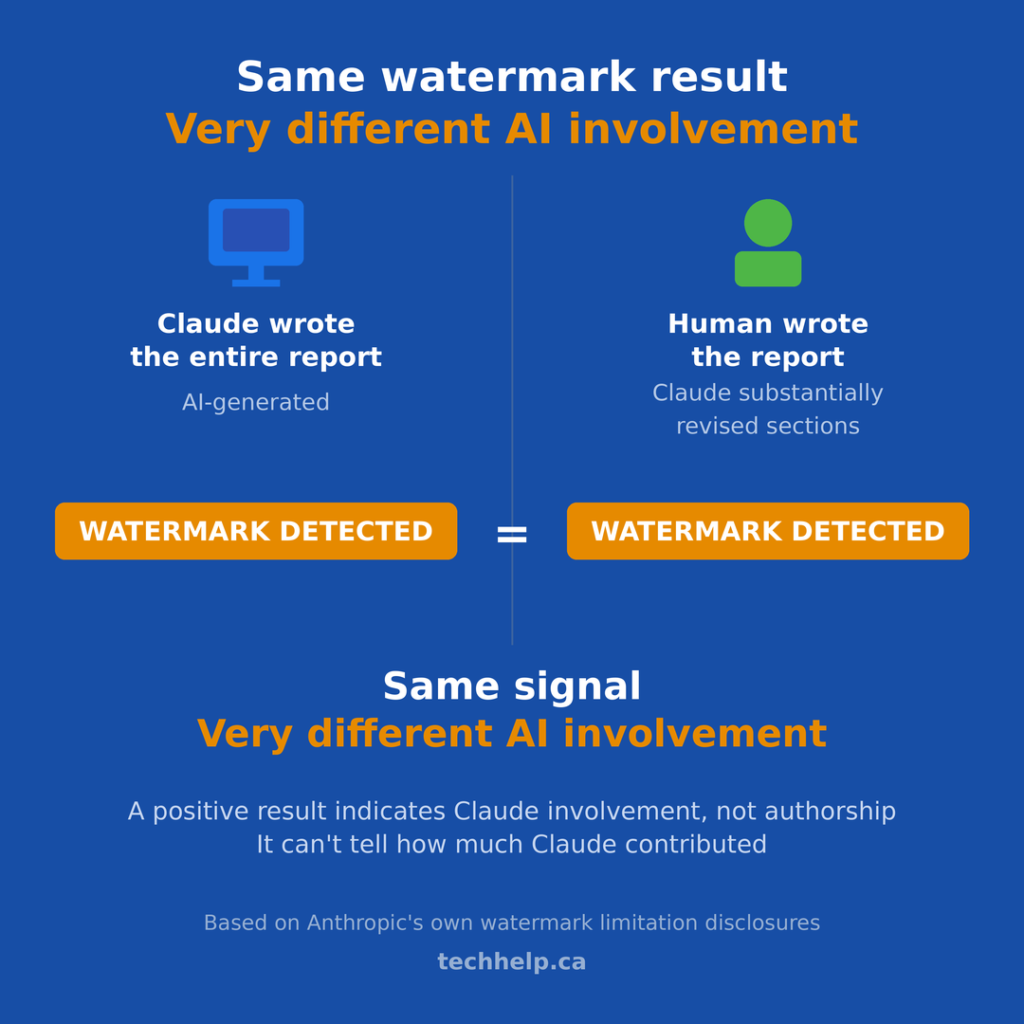
Anthropic is explicit about this limitation: the watermark indicates processing, not authorship. A detected mark doesn’t confirm Claude wrote the content. It indicates that Claude was likely involved at some point, which can include proofreading, spell-checking, translating, summarizing, or reformatting text that a human wrote from scratch.
If you write a 3,000-word report yourself and then ask Claude to substantially rewrite sections for clarity, structure, or tone, the resulting text may contain enough Claude-generated choices for its involvement to become detectable. The mark still can’t tell whether Claude supplied the underlying ideas or merely reshaped work a human already created. Light proofreading or a couple of typo fixes may leave too little changed text to produce a detectable signal at all.
This distinction matters enormously because schools, employers, publishers, and platforms using detection tools may be tempted to treat a positive result as “AI wrote this,” especially when provenance gets collapsed into a simple yes-or-no judgment. The system was built to answer “was Claude involved?” but it may be used to answer “did a human write this?” Those are fundamentally different questions, and the watermark can’t distinguish between them.
The verification tax on human writers
In a world where watermark detection tools exist, the pressure doesn’t fall only on people who use AI to generate content. It falls on everyone.
An agency that relies on human writers can still face a new cost. If a client runs submitted copy through a detector and gets a hit because a writer used Claude to substantially rewrite a passage for clarity, structure, or tone, that writer may now be under suspicion. The watermark may correctly detect Claude’s involvement while remaining unable to explain the extent of that involvement. The agency must then explain the workflow, document authorship another way, or absorb the reputational friction.
Meanwhile, companies that openly market AI-generated output face less ambiguity about authorship: a positive watermark result confirms something their customers already expect. The reputational pressure can therefore fall harder on businesses trying to use AI as a supplementary tool while still presenting the underlying work as human-led.
The evidence may not meet a courtroom standard
A July 2026 forensic evaluation tested whether watermark detection evidence meets the Daubert standard, the admissibility test U.S. courts apply to expert scientific evidence. The study evaluated five commonly cited Daubert considerations: testability, peer review and publication, known or potential error rates, standards controlling the technique, and general acceptance in the scientific community.
None of the three watermark methods tested satisfied more than two of these five factors. SynthID showed a 5.4% false-positive rate and an 18.6% paradox rate — cases where the system produced contradictory results. Eighty percent of SynthID’s own watermarked output landed in an uncertainty zone where the system couldn’t determine whether the text was marked.
The practical consequence is narrower but still serious. Institutions planning to use watermark detection in misconduct proceedings, employment decisions, or compliance audits should not treat these signals as conclusive evidence. In the July 2026 preprint, the researchers concluded that none of the three tested watermark configurations satisfied more than two of the five Daubert factors they evaluated. That is not the same as a U.S. court ruling Claude watermark evidence inadmissible, but it is a warning against using probabilistic detection as a high-stakes verdict.
Content quality becomes an afterthought
This is where the metaphor writes itself. The entire apparatus reduces professional workflows to a high school principal’s office. Instead of evaluating whether content is accurate, well-researched, and useful to the reader, the system shifts everyone’s attention toward invisible statistical compliance metrics. Those metrics are easy to misunderstand. Representative studies show substantial fragility under paraphrasing, while Claude’s own watermark indicates likely involvement rather than authorship.
The person reading the article doesn’t care whether a hidden statistical pattern was embedded during generation. They care whether the information is correct and the writing is clear. The watermark answers a question the reader isn’t asking.
When compliance defeats the point of AI
AI was built to multiply human productivity. That’s the value proposition. Use a tool to handle routine cognitive work so you can focus on the parts that require human judgment, creativity, and context.
Text watermarking inverts that equation.
Consider the workflow it can create. An AI generates text with a hidden mark. In workflows that require provenance checks, someone downstream may need to verify whether the mark is present. That verification can require an API call, a compliance process, or a manual review. If a positive result creates a policy or client problem, the organization may then spend time reviewing, explaining, documenting, or rewriting the content.
Some of the time AI saved can then be consumed by the compliance cycle around it. You’re paying for AI to produce work, then spending additional time or money verifying, reviewing, documenting, or revising that work. The net productivity gain shrinks with every layer of compliance overhead.
The search engine wild card
Google says appropriate use of AI or automation is not against its Search guidelines; using automation primarily to manipulate rankings is. An Ahrefs study of 600,000 pages found a near-zero correlation (0.011) between AI content percentage and search ranking. Google’s stated position is that quality matters, not provenance.
But the detection infrastructure is being built. Watermarks are embedded in text at scale. Detection APIs are coming online. As provider detection systems become available, search engines could theoretically incorporate watermark signals into their own systems if they chose to.
If dominant search engines ever begin using these signals to filter or downrank content, the internet’s foundational purpose shifts. You’d have a system where useful, accurate, well-written content gets penalized not because it lacks value, but because it carries an invisible statistical signature. And the only way to avoid that penalty would be to either write everything by hand or launder AI-generated text through a de-watermarking process. That’s exactly the kind of adversarial behavior the system was supposed to prevent.
That scenario is speculative today. But the rails are being laid.
The productivity paradox
There’s a quieter version of this problem that doesn’t require search engine penalties to materialize. It’s already here.
The more you integrate AI into workflows that require provenance checks, the more verification overhead you can absorb. A company using Claude for 50 documents a month may face far fewer review points than one using it for 500, especially if each document creates its own verification step. Compliance workload can rise roughly with document volume, even if batching and automation soften that increase.
That can create a perverse incentive. Companies that use AI most extensively may also face more provenance checks and compliance overhead, particularly when each document creates another review point.
How the market could respond
Watermarking gives some businesses a new reason to compare closed providers with self-hosted or open-weight alternatives, particularly when provenance controls create workflow friction.
The self-hosted alternative
Self-hosted open-weight models give businesses an alternative to relying entirely on a closed provider’s watermarking and detection infrastructure. Some can be run locally with tools such as Ollama, although hardware requirements vary substantially by model size and workload. Whether a particular model embeds a watermark, what its license allows, and what compliance obligations apply should be evaluated model by model rather than assumed from the “open-source” label alone.
Self-hosting can change which actor is responsible for an AI system, but open-source status does not automatically remove Article 50 transparency obligations. The AI Act’s general free and open-source exclusion does not apply where an AI system falls under Article 50. Open-weight alternatives may reduce dependence on a closed provider’s proprietary detection stack, but they are not automatically outside the regulatory framework.
De-watermarking in practice
Tools aimed at removing AI provenance signals appeared almost immediately. Guillaume Meyer’s open-source watermarks-remover can deterministically remove some metadata and invisible-character signals across multiple file formats, while treating statistical watermark removal as a best-effort rewriting problem. StealthGPT and similar services also market web-based de-watermarking.
Simple synonym swapping may not be enough against modern watermarks like SynthID, which was designed to survive basic word substitution. More substantial paraphrasing and sentence-structure changes have defeated representative watermark implementations in research, although that does not establish an exact failure rate for Claude’s production system.
The irony is hard to overstate. The system exists to track AI-generated content. The tools to defeat it are themselves AI-powered. The tracking mechanism and the evasion mechanism run on the same technology.
The two-tier internet
A structural split may still form, but it is more complicated than closed models versus regulation-free open source. On one side are closed providers building watermarking and detection into their services. On the other are self-hosted and open-weight alternatives that may give operators more control over infrastructure and provenance while still carrying their own licensing and compliance obligations.
Providers adopting watermarking may also create a new incentive for some businesses to evaluate self-hosted alternatives. If a company’s workflow repeatedly creates provenance questions or verification overhead, running an open-weight model on infrastructure it controls can become more attractive, even if that choice brings different operational and compliance tradeoffs.
If mandatory watermarking pushes some users toward alternatives with weaker or different provenance controls, regulators face an uncomfortable outcome: the most compliant providers may become the easiest ones to scrutinize, while determined evaders route around the system. That would shift more burden onto organizations already operating inside the regulated ecosystem.
What this actually means for your workflow
The regulatory requirement is here, and Claude’s watermark rollout is underway. As Anthropic brings more models under the system, businesses using Claude need to understand what the watermark can and can’t prove.
That doesn’t require panic, but it does require awareness. Content produced through watermarked models may carry a provenance signal that users cannot directly control, that indicates model involvement rather than authorship, and that others may eventually be able to detect with varying degrees of reliability.
Whether your work is accurate, useful, and worth reading remains what matters to the person on the other end. No watermark changes that. No detection API validates or invalidates it.
But the compliance economy forming around these marks could impose new costs across generation, verification, review, and dispute resolution, even when nobody intended to misuse AI. The question is whether businesses understand those costs before they become part of the workflow.
Get new small business insights by email
Practical ideas and useful articles to help you make better business decisions.
We empower people to succeed through practical business information and essential services. If you’re looking for help with SEO, copywriting, or getting your online presence set up properly, you’re in the right place. If this piece helped, feel free to share it with someone who’d get value from it. Do you need help with something? Contact Us