
You’ve been passed over. Dismissed. Maybe someone told you your idea was stupid, or a company you gave years to decided you were replaceable. That feeling — the one sitting somewhere between humiliation and fury — is one of the most uncomfortable things a person can carry.
It’s also one of the most useful.
Frank Sinatra is credited with saying, “The best revenge is massive success.” The quote has been printed on motivational posters, added to collections of motivational quotes, and tattooed on forearms. But it’s endured for a reason that goes deeper than aesthetics. It captures something that anyone who’s been knocked down may recognize: being underestimated can create a real burst of energy, and if you aim it in the right direction, it can build things that outlast whatever knocked you down in the first place.
Where the idea comes from (and why Sinatra’s story fits it)
The idea behind the quote is older than Sinatra. A collection of proverbs compiled by English poet George Herbert and published posthumously in 1640 included the line, “Living well is the best revenge.” That older formulation framed revenge differently. Instead of retaliation, the answer was simply to live well.
The line is widely attributed to Sinatra, and his life gives it a certain weight even if its exact provenance is difficult to pin down.
By the early 1950s, Sinatra’s career was in freefall. His recording and film careers were collapsing. Columbia Records dropped him, Hollywood opportunities dried up, and a throat hemorrhage forced him to cancel performances. His highly publicized relationship with Ava Gardner added to the turmoil.
Then he fought for the role of Private Maggio in From Here to Eternity. He campaigned hard for the part. The performance earned him an Academy Award for Best Supporting Actor and helped launch one of the most dramatic comebacks in entertainment history.
Whether or not Sinatra coined the line, his comeback makes it a fitting summary of what happened next.
The psychology behind turning pain into fuel
There is evidence that anger can help in one specific situation: when a meaningful obstacle stands between you and a goal.
Research published in the Journal of Personality and Social Psychology examined anger and goal attainment across seven studies. Compared with a neutral emotional state, anger generally helped people make more progress toward goals when they faced meaningful obstacles. In one study, angry participants solved more word puzzles correctly. In another, anger improved performance on a challenging skiing video game. The researchers also analyzed data from the 2016 and 2020 U.S. presidential elections and found that voters who anticipated feeling angry if their candidate lost were more likely to actually vote.
The researchers’ explanation is that anger can increase effort when something stands between you and a goal. That extra push can be useful when the obstacle is difficult enough to require persistence.
But there’s a catch. More effort isn’t automatically better behavior. In one of the studies, anger made participants more likely to cheat when cheating helped them obtain a prize. Anger can push you toward a goal without guaranteeing that the way you pursue it is wise.
That’s the distinction worth paying attention to. Anger can be a powerful ignition switch. What the research doesn’t tell us is whether it’s a healthy or sustainable source of motivation over the long term.
People who turned rejection into something bigger
The same broad pattern shows up across industries: rejection, persistence, and results that eventually made the original rejection look small. That doesn’t mean revenge was the motive. It means rejection didn’t get the final word.
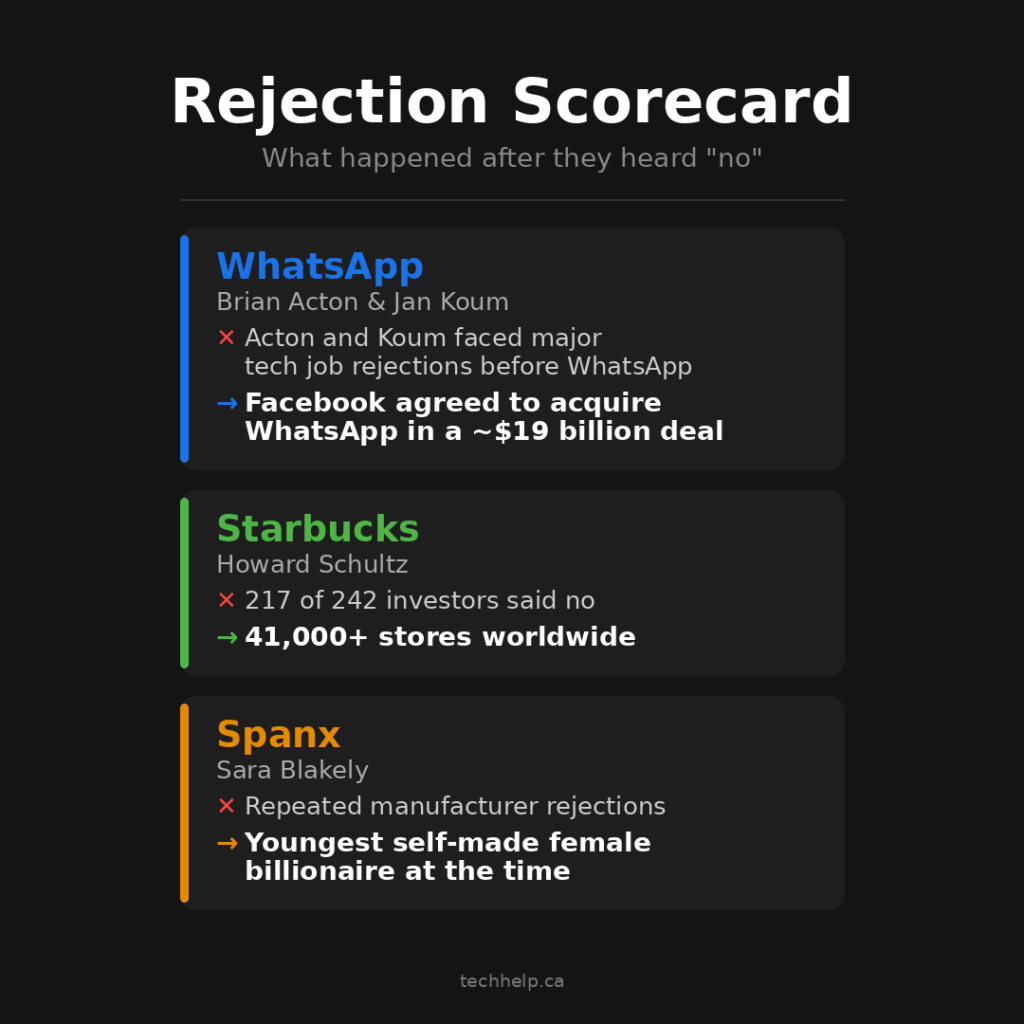
Brian Acton and Jan Koum (WhatsApp)
After leaving Yahoo, both Brian Acton and Jan Koum unsuccessfully pursued jobs at Facebook. In early 2009, Koum began developing WhatsApp and incorporated the company that February. Acton, who was also turned down by Twitter that year, joined the effort later as the product started gaining traction.
By early 2014, WhatsApp had 450 million active users and was adding a million new ones every day. In February 2014, Facebook announced an agreement to acquire WhatsApp in a deal initially valued at about $19 billion.
Here’s the detail that makes the story unforgettable. Koum had immigrated to the U.S. from Ukraine at 16 amid a difficult political and antisemitic environment. His family relied on food stamps. When the agreement was signed, Koum went to the former welfare office where he’d once stood in line to collect food stamps and signed the paperwork there.
Howard Schultz (Starbucks)
According to Schultz’s account, he approached 242 investors while trying to finance Il Giornale. 217 said no. He eventually raised enough money to launch the coffeehouse concept anyway.
In 1987, Schultz raised another $3.8 million to acquire Starbucks’s stores, roasting plant, and name. Il Giornale adopted the Starbucks brand. As of June 2026, Starbucks had 41,304 company-operated and licensed stores worldwide.
Sara Blakely (Spanx)
Sara Blakely began calling hosiery manufacturers to pitch her idea for footless pantyhose. Without exception, they either laughed at her or told her the idea would never sell. She drove around North Carolina visiting mills that had already rejected her by phone, sitting in lobbies and waiting for five-minute meetings with owners.
One manufacturer finally called back. When Blakely asked why he’d changed his mind, he said he’d mentioned the idea to his daughters, and they were interested. Blakely launched Spanx with $5,000 in personal savings. She went on to become the youngest self-made female billionaire at the time.
What “massive success” actually means
It’s worth pausing on what the quote doesn’t say. It doesn’t say the best revenge is getting rich. It doesn’t say the best revenge is becoming famous. It says massive success, and that leaves room for a much broader definition.
The danger with revenge-driven motivation is when it stays pointed at the person who wronged you instead of the life you’re building. If you’re three years into growing a business and still picturing the look on your old boss’s face when they hear about it, you’ve stopped building for yourself and started performing for an audience that probably isn’t watching.
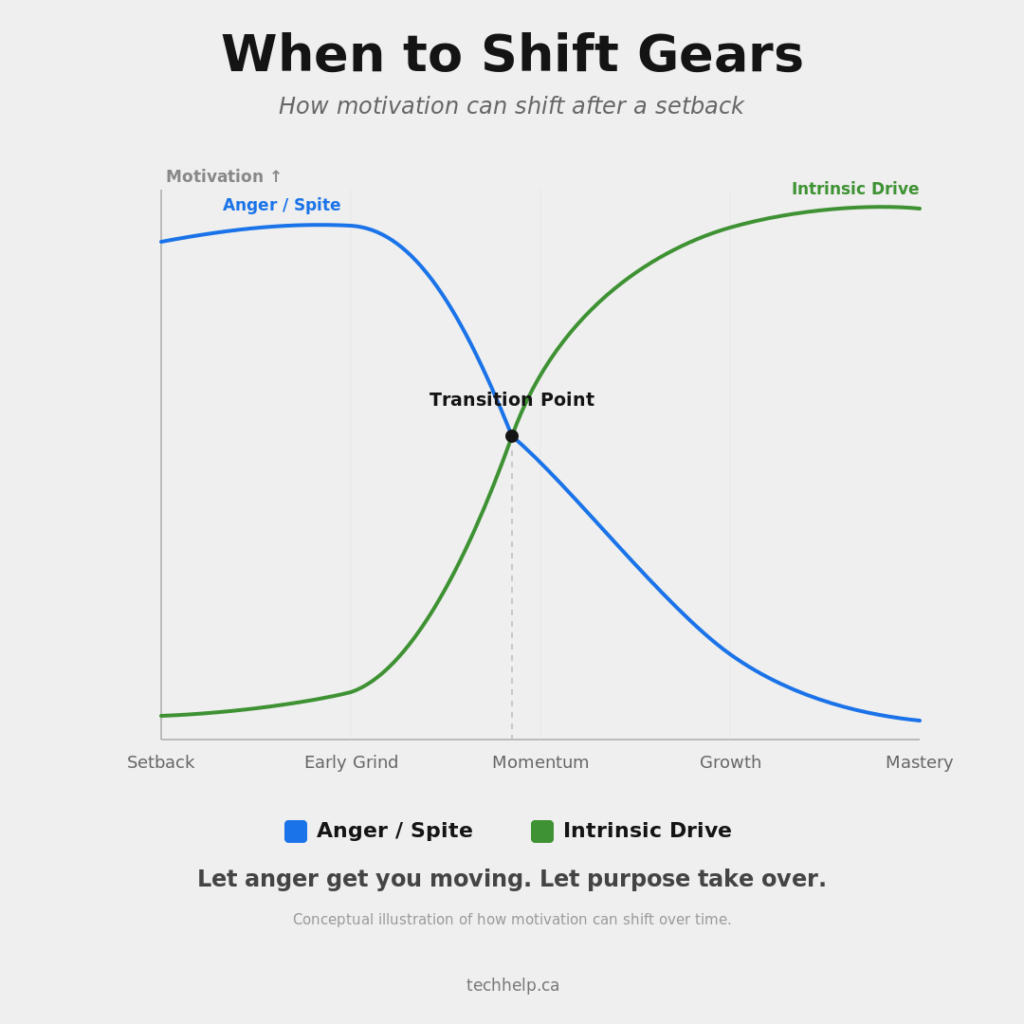
The shift from “I’ll show them” to “I’m doing this because it matters to me” is where revenge motivation can become something more sustainable. Once the work matters on its own, the person who doubted you stops being the audience.
How to put this into practice
Channeling frustration into forward motion sounds good in theory. Here’s what it looks like in practice.
Direct your focus inward, not outward. When something painful happens — a job loss, a failed pitch, a public embarrassment — the instinct is to fixate on the people involved. Acknowledge the emotion instead. Name it. You’re angry. You feel humiliated. That’s valid. Once you’ve named it, redirect. Pick a metric that measures your progress, not their awareness of it. Revenue, skills acquired, problems solved. The scoreboard should be yours, not theirs.
Set one concrete goal tied to the setback. Lost a major client? Land two better ones. Got passed over for a promotion? Build the skill that makes the next opportunity impossible to deny. The goal should be specific and measurable. Vague ambitions like “prove everyone wrong” don’t give you anything to work toward.
Use the anger to get moving, then let something better take over. Anger can help you push through the hard early part of a setback. But once the work develops its own momentum, don’t make spite responsible for keeping you moving. Replace it with daily habits that sustain long-term growth, purpose, curiosity, or whatever gives you a reason to continue without needing someone else to lose.
Protect your energy. Intensity doesn’t replace recovery. Sleep, exercise, and time away from the work aren’t luxuries. They’re what help you keep going long enough to reach the destination. Building grit without burning out is its own skill.
The real payoff
The quote isn’t really about revenge. It’s about refusing to let someone else’s opinion set the boundary for what you can do.
The best part of massive success isn’t the moment your doubters realize they were wrong. It’s the moment you realize you stopped thinking about them entirely because you were too busy building something worth your attention.
Years after standing in line there for food stamps, Koum signed the Facebook deal papers on the door of that former welfare office. The symbolism was hard to miss. By then, the rejection was a footnote. What he’d built was the story.
References
- https://quoteinvestigator.com/2018/09/02/living-well/
- https://www.poetryfoundation.org/poets/george-herbert
- https://www.magellantv.com/articles/saved-from-irrelevance-sinatras-comeback-led-to-the-pop-lp-and-the-concept-album
- https://www.oscars.org/oscars/ceremonies/1954
- https://www.apa.org/pubs/journals/releases/psp-pspa0000350.pdf
- https://www.forbes.com/sites/parmyolson/2014/02/19/exclusive-inside-story-how-jan-koum-built-whatsapp-into-facebooks-new-19-billion-baby/
- https://about.fb.com/news/2014/02/facebook-to-acquire-whatsapp/
- https://www.entrepreneur.com/leadership/how-howard-schultz-turned-an-entry-level-sales-job-into-a/378555
- https://about.starbucks.com/history/il-giornale/
- https://investor.starbucks.com/news/financial-releases/news-details/2026/Starbucks-Reports-Q3-Fiscal-Year-2026-Results/default.aspx
- https://thestoryexchange.org/sara-blakely-refused-fear-failure-stop/
- https://www.forbes.com/global/2012/0326/billionaires-12-feature-united-states-spanx-sara-blakely-american-booty.html

I can suggest related Tech Help Canada articles based on the topic you’re reading now.

Tech Help Canada Staff researches, writes, and reviews practical content for business owners and professionals. Our coverage spans business, marketing, SEO, technology, and the tools and systems people use to grow and operate online. We focus on clear, useful information backed by research, hands-on experience, and editorial review. Learn more about our team and editorial standards. Need help with something? Contact Us