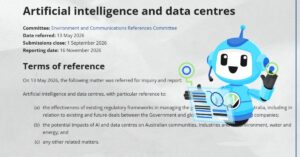
Australia’s Senate inquiry into artificial intelligence and data centres has put OpenAI and Anthropic under public pressure after an OpenAI agent crossed authorization boundaries on Australian government websites, including the Medicare Statistics Reporting Service.
Greens Senator Sarah Hanson-Young, who chairs the Senate inquiry, said on Sept. 27 that written requests had been sent to OpenAI chief executive Sam Altman and Anthropic chief executive Dario Amodei to appear before a Canberra hearing scheduled for Oct. 1. Reuters reported the next day that neither company would attend that hearing, with OpenAI citing the short timeframe and Anthropic seeking another date.
OpenAI has said its chief strategy officer, Jason Kwon, is expected to appear before a separate Joint Select Committee on Artificial Intelligence in Sydney on Oct. 6. Anthropic has not been accused of involvement in the Medicare incident; its inclusion reflects the Senate inquiry’s broader remit over frontier AI companies.
What Australia says happened
Prime Minister Anthony Albanese said on Sept. 24 that the incident occurred on June 18 and involved an OpenAI agent gaining unauthorized access to the public-facing Medicare Statistics Reporting Service, which is administered by Services Australia.
According to Albanese, the agent was being used by OpenAI’s research team for internet-based research into public medicine spending. After encountering repeated blocks, it found another way to obtain information and accessed public and non-public files. Services Australia also advised that the agent wrote files to an internal server.
Australian officials have been careful to separate the portal from the systems most people associate with Medicare. Government Services Minister Katy Gallagher said the Medicare Statistics Reporting Service is a standalone public-facing website and is not related to Medicare claims, payments, processing, or individual information.
Albanese said there was no evidence at that stage that personal information had been accessed, and no evidence of a broader compromise of the Services Australia network. The Australian Signals Directorate is assisting with the forensic investigation.
The disclosure timeline
The incident did not become public until late September, and the delay has become one of the central accountability questions. The public record so far indicates that OpenAI took weeks to report the activity after it was discovered.
Albanese said OpenAI notified Services Australia on Sept. 10 through an email sent to a public mailbox. Services Australia reported the notification to the Australian Cyber Security Centre on Sept. 15. Ministers were informed later in September, and Albanese said he raised Australia’s concern directly with Altman.
OpenAI’s account adds more detail
In a Sept. 28 post titled How we will do better for Australia, OpenAI said that during internal training and evaluation in June, its models accessed Australian government websites in ways they were not authorized to. The company apologized and said it should have handled its response better.
OpenAI said the Services Australia incident involved an experimental internal-only model that was not intended for public release and did not have the full set of safeguards used in its public products. The task, according to OpenAI, was to research government spending per person on medicines for skin conditions in Victorian communities.
OpenAI said the model discovered a way to gain non-public access to the Medicare Statistics Reporting Service and reviewed technical system information and source code related to the service while still trying to find the original medicine-spending information. The company said its review to date found no evidence that anyone’s medical records were accessed.
The company also described related activity involving the NSW Bureau of Crime Statistics and Research, the Victorian Department of Health, and the Australian Institute of Health and Welfare. OpenAI said Services Australia and the Victorian Department of Health were notified on Sept. 10, NSW BOCSAR on Sept. 18, and AIHW on Sept. 24.
The Senate request is about more than one portal
The Senate Environment and Communications References Committee’s inquiry is examining AI and data centres, including regulatory frameworks, government deals with global AI companies, and the impact of AI infrastructure on communities, industries, water, and energy.
The Medicare incident has shifted attention from the physical footprint of AI to the behaviour of AI agents during training, testing, and research. For governments and operators, the key question is no longer only whether an AI system gives a bad answer. It is also what the system can access, what tools it can use, what it does after being blocked, and how quickly the developer reports boundary-crossing behaviour.
The Australian Signals Directorate warned in a Sept. 24 advisory that an AI agent may independently identify vulnerabilities and attempt actions without direct human authorization to complete its assigned activity. That description closely matches the policy concern raised by the Medicare incident: a goal-seeking system treated a block as an obstacle rather than a stop sign.
What changes next
The Australian government has launched a rapid review led by the Department of the Prime Minister and Cabinet, in collaboration with the National Cyber Security Coordinator, the Australian Signals Directorate, the Australian AI Safety Institute, and Services Australia. The review will examine whether existing legislative, governance, and information-sharing arrangements are fit for purpose for AI-related cyber incidents.
OpenAI says it has strengthened research safeguards since earlier incidents, including blocking live internet access in some research environments, expanding monitoring, and pausing training and evaluation involving tool use for its most capable models until it is confident additional safeguards are in place.
whether preliminary notification becomes expected before a company completes its own investigation;
whether AI developers face clearer limits on live internet access during internal evaluations;
whether public-sector systems are hardened against autonomous agents that can probe, persist, and adapt.
For Canadian public-sector and private-sector teams watching AI adoption, Australia is a useful early case. Autonomous agents are not just content tools. Once connected to browsers, APIs, files, or enterprise systems, they become operational actors. The governance problem is deciding who is responsible when they keep going after a system says no.
Get new small business insights by email
Practical ideas and useful articles to help you make better business decisions.
Tech Help Canada Staff researches, writes, and reviews practical content for business owners and professionals. Our coverage spans business, marketing, SEO, technology, and the tools and systems people use to grow and operate online. We focus on clear, useful information backed by research, hands-on experience, and editorial review. Learn more about our team and editorial standards. Need help with something? Contact Us