The freelance platform’s client base has fallen from its 2023 peak, while spending per remaining client and freelancer-facing monetization products continue to rise.
Upwork still has valuable freelance opportunities. But freelancers who feel they have to sort through more low-paying, vague, or unserious job posts before finding the good work have numbers to back up that frustration.
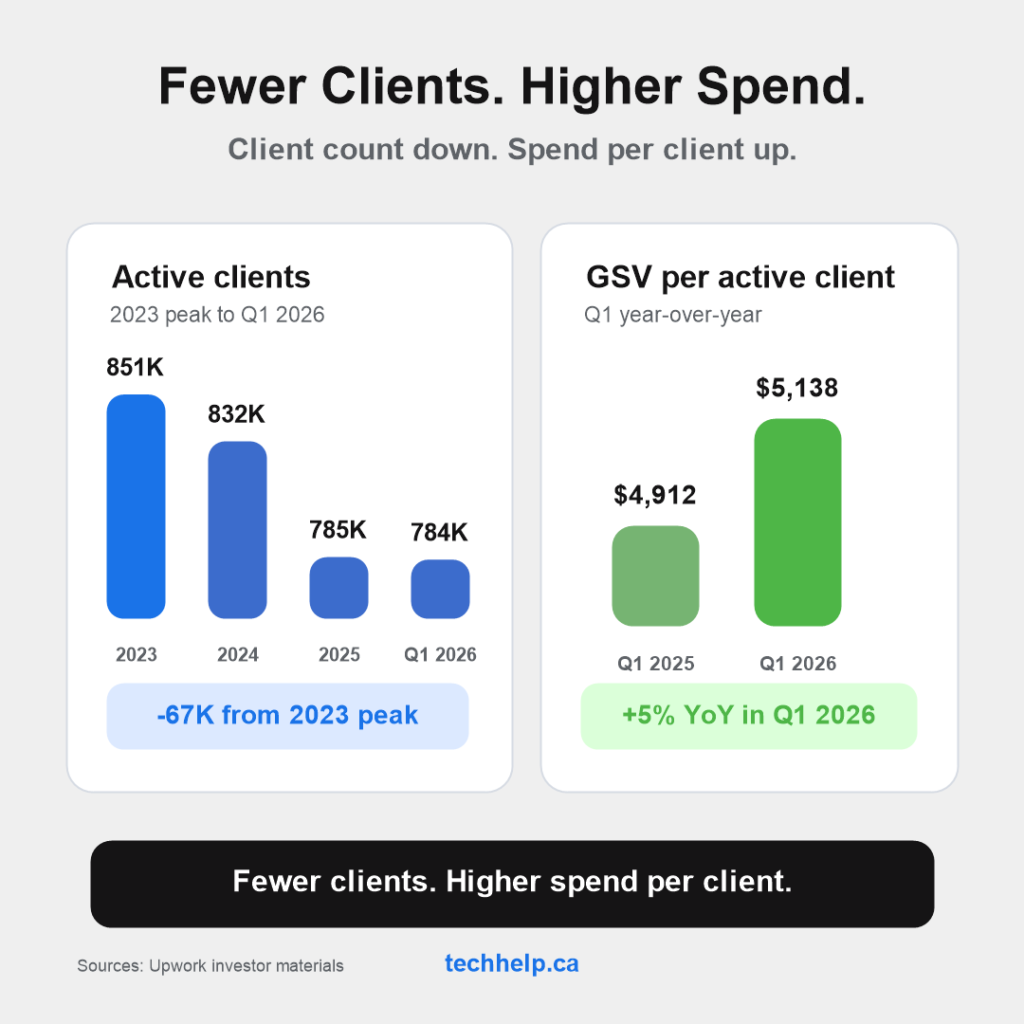
The platform’s active client base has been shrinking. Upwork finished 2023 with 851,000 active clients, which it described as an all-time high. That number fell to 832,000 at the end of 2024 and 785,000 at the end of 2025. By March 31, 2026, Upwork reported 784,000 active clients, down 3% from 812,000 a year earlier.
In its March 2026 quarterly filing, Upwork said the decline was driven by slower growth in new-client acquisition and lower retention among existing clients. Gross services volume, or GSV, was also almost flat in the first quarter at $987.1 million.
Yet Upwork’s marketplace revenue increased. That tension helps explain why Upwork can keep improving parts of its financial performance while some freelancers feel the marketplace experience has become harder to navigate.
Fewer clients are spending more
Although Upwork has fewer active clients than it did two years ago, the clients who remain are spending more.
GSV per active client reached $5,138 in the first quarter of 2026, up 5% from $4,912 a year earlier. Total revenue increased 1% to $195.5 million, while marketplace revenue rose 3% to $170.7 million.
The pattern suggests serious clients haven’t disappeared from Upwork. Spending appears to be becoming more concentrated among clients with ongoing relationships, larger projects, or more complex needs.
Upwork saw a similar pattern throughout 2025. It ended the year with 6% fewer active clients than in 2024, but GSV per active client increased 7% to $5,129. The company also reported record full-year revenue of $787.8 million and record adjusted EBITDA of $225.6 million.
For freelancers, that can create a split experience. Good work remains available, especially for specialists who can demonstrate outcomes, manage complex projects, or bring judgment that goes beyond completing a basic task. But those opportunities can be harder to find when the marketplace also contains low-budget jobs, vague requests, and clients testing how cheaply work can be done.
Upwork is earning more from marketplace monetization
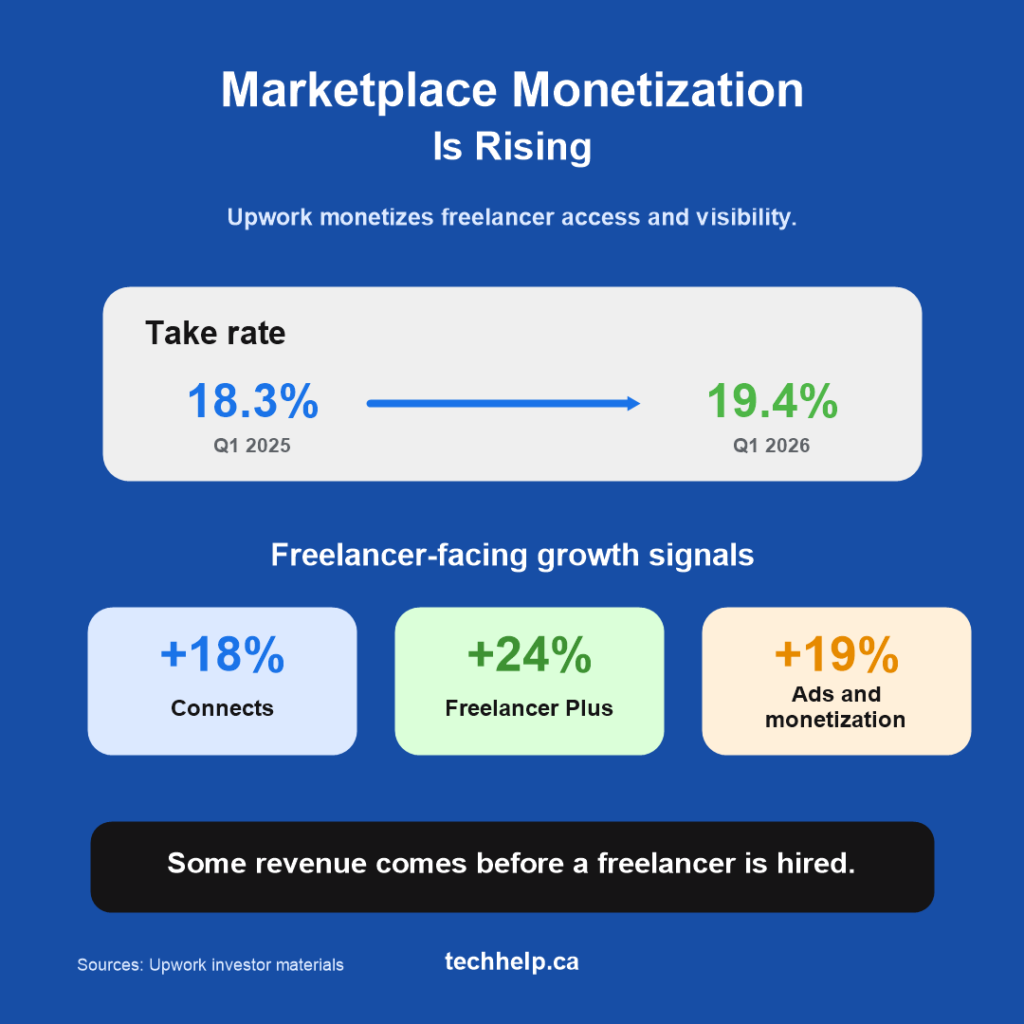
Upwork’s marketplace take rate increased from 18.3% in the first quarter of 2025 to 19.4% in the first quarter of 2026.
In its quarterly filing, the company said the increase reflected growing contributions from ads and monetization products. Upwork has also pointed to new advertising products, improvements to existing offerings, and optimization of its Connects pricing model as growth drivers.
Connects are virtual tokens freelancers use to submit job proposals. They can also be spent on visibility products, including boosted proposals and Upwork’s Availability Badge.
Upwork doesn’t regularly disclose the total dollar amount it earns from Connects. However, the company reported that Connects revenue grew 18% year over year during the third quarter of 2025. Freelancer Plus subscription revenue increased 24%, while overall revenue from ads and monetization products rose 19%.
None of that proves Upwork intentionally allows poor-quality jobs to remain on the platform so freelancers will spend Connects applying to them. It does show a tension in the marketplace model.
Upwork benefits when businesses hire freelancers and money changes hands. But it can also generate revenue from freelancers competing for visibility before anyone is hired. As those monetization products grow, the platform has more ways to earn from marketplace activity even when client count and transaction volume aren’t growing quickly.
AI is putting pressure on smaller jobs
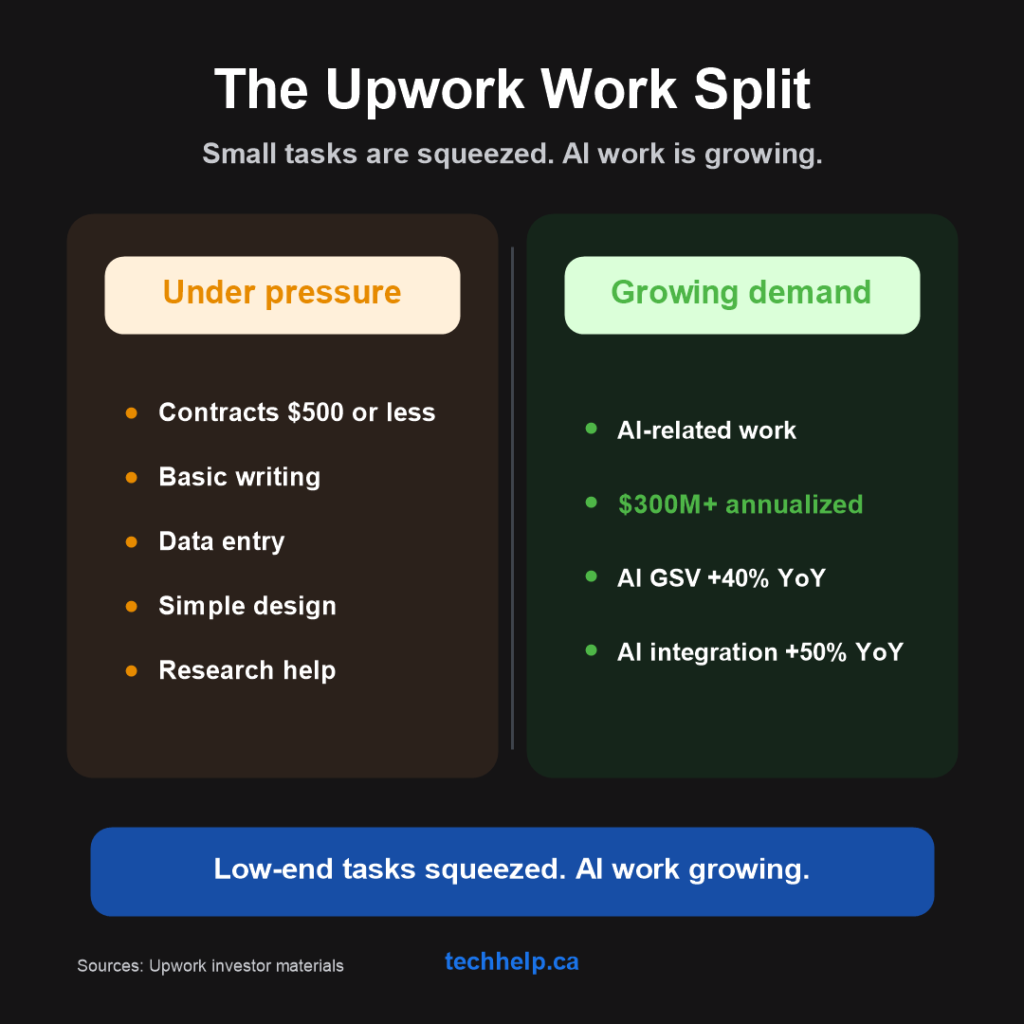
Artificial intelligence is also changing the kind of work appearing on Upwork. During Upwork’s first-quarter earnings call, management said the strongest pressure was concentrated in contracts worth $500 or less. Clients are using AI tools to supplement or replace simple tasks, and demand slowed materially from late February through early April before stabilizing at a lower growth rate than Upwork had expected.
That pressure won’t affect all freelancers equally. Basic writing, data entry, simple design, research assistance, and other execution-heavy work can now be completed or partially completed with inexpensive AI tools. Clients may still hire someone to improve the output, but they may expect the work to cost less because they assume AI has already done most of it.
That may help explain why some freelancers are seeing more jobs asking for large amounts of work at small budgets.
At the same time, AI is creating higher-value opportunities elsewhere on the platform. Upwork said AI-related work surpassed $300 million on an annualized basis in the fourth quarter of 2025, up more than 50% from the previous year. AI integration and automation work grew more than 90%.
In the first quarter of 2026, Upwork said GSV from AI-related work grew more than 40% year over year, while AI Integration & Automation grew more than 50%.
That tracks with the broader rise in small business AI adoption. Straightforward execution is being compressed, while demand grows for people who can integrate AI into a business, supervise its output, solve technical problems, or apply specialized judgment.
The platform itself is cutting costs
Upwork’s own operations are also changing.
In May 2026, the company announced a restructuring plan that included reducing its total workforce by about 24%. Upwork said the move was meant to build a more efficient operating model and position the company for profitable growth as work changes.
Upwork also lowered and widened its full-year 2026 revenue outlook while raising its adjusted EBITDA guidance. According to summaries of the company’s earnings call, the restructuring is expected to reduce the annualized cost base by about $70 million.
These actions don’t point to a collapsing platform. Upwork remains profitable, generates substantial cash flow, and continues investing in AI, larger small-business clients, and enterprise workforce services.
They do point to a platform in transition. Upwork’s traditional marketplace is facing weaker active-client growth. AI is reducing demand for some smaller assignments. The company is relying more heavily on larger clients, AI-related work, and marketplace monetization to support growth.
Upwork isn’t dead, but it’s becoming more polarized
The available data doesn’t support either extreme. Upwork isn’t empty of serious clients. Spending per active client is rising, AI-related work is growing, and high-quality opportunities still appear on the platform.
But freelancers who believe the marketplace has become more crowded with low-budget work also have reason to be concerned. Upwork has lost active clients since 2023, the smallest contracts are facing AI pressure, and revenue from products that charge freelancers for access and visibility is growing.
The bottom of Upwork is getting worse, the middle is becoming harder to find, and valuable work remains concentrated near the top.
For experienced freelancers, Upwork can still be a productive source of clients. It has repeatedly shown that it can generate valuable, long-term contracts.
What it may no longer provide is a dependable pipeline without consistent prospecting, careful job selection, and other sources of business development. The lesson is similar for many one-person businesses: if one platform controls your access to demand, you’re exposed when the platform changes.
Upwork is scheduled to report its second-quarter 2026 financial results on August 10 after market close. Those numbers should show whether active client demand recovered after the slowdown the company reported earlier this year.
Frequently Asked Questions
Is Upwork losing clients?
Upwork’s active client count has fallen from its 2023 peak. The company reported 851,000 active clients at the end of 2023, 832,000 at the end of 2024, 785,000 at the end of 2025, and 784,000 as of March 31, 2026.
Is Upwork still worth using for freelancers?
Upwork can still be worth using, especially for specialists who can show strong proof, handle complex work, and avoid low-quality job posts. It’s riskier as a sole pipeline because client count has declined and smaller jobs are under pressure from AI.
Why is Upwork making more marketplace revenue with fewer clients?
Upwork’s remaining active clients are spending more on average, and the company is earning more from ads and monetization products. Its marketplace take rate rose from 18.3% in the first quarter of 2025 to 19.4% in the first quarter of 2026.
How is AI affecting Upwork jobs?
AI appears to be pressuring smaller, simpler contracts while creating new demand for higher-value AI work. Upwork management said the greatest pressure in the first quarter of 2026 was concentrated in contracts of $500 or less, while AI-related work continued growing.
Should freelancers rely only on Upwork?
No. Upwork can be one channel, but freelancers are safer when they also build referrals, direct outreach, owned content, partnerships, and repeat-client relationships. A single platform can change its rules, pricing, visibility, or demand patterns at any time.
Get new small business insights by email
Practical ideas and useful articles to help you make better business decisions.
Tech Help Canada Staff researches, writes, and reviews practical content for business owners and professionals. Our coverage spans business, marketing, SEO, technology, and the tools and systems people use to grow and operate online. We focus on clear, useful information backed by research, hands-on experience, and editorial review. Learn more about our team and editorial standards. Need help with something? Contact Us