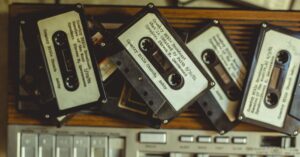
Which memory would make your next offer feel familiar to the people you’re trying to reach?
What is nostalgia marketing?
Nostalgia marketing uses references to the past to connect a product, service, or brand with memories and feelings associated with an earlier time. Those references might include familiar packaging, a childhood activity, an advertising character, or a shared cultural experience.
The connection doesn’t always depend on having lived through a particular decade. A 2024 review in the Journal of Marketing Management discusses nostalgia rooted in personal memories alongside nostalgia associated with historical periods people haven’t experienced directly. When planning a campaign, distinguish between something customers remember themselves and an older era they find appealing.
For a campaign brief, it’s useful to separate three related ideas. Retro describes a styling choice, brand heritage concerns your business’s history, and nostalgia concerns the audience’s connection to the past. An old-looking design alone doesn’t tell you whether you’ve made that connection.
Nostalgia can also sit within a broader escapism marketing strategy. Keep a nostalgia-led brief focused on a particular relationship with the past, rather than emotional relief in general.
What the research supports
A 2014 paper in the Journal of Consumer Research reported six experiments examining nostalgia and desire for money. The first analysed data from 69 University of Minnesota undergraduates. Participants who saw nostalgia-focused advertising copy reported greater willingness to pay for products than those who saw copy focused on making new memories.
Experiments 5 and 6 provided evidence for social connectedness as a mechanism in nostalgia’s effect on desire for money. These findings don’t establish how much a real campaign would sell, whether your customers would respond the same way, or what you could charge. Treat nostalgia as a creative approach worth testing, not a sales forecast.
Two nostalgia marketing examples to learn from
McDonald’s reworked a childhood meal ritual
On September 27, 2022, McDonald’s USA announced the Cactus Plant Flea Market Box, scheduled for an October 3 launch. The adult-focused collaboration combined a redesigned box, a collectible figurine, and a meal built around a Big Mac or 10-piece Chicken McNuggets. McDonald’s explicitly positioned the collaboration as a reimagining of a nostalgic experience for adult fans.
For a smaller business, consider the ritual rather than the scale of the collaboration. Opening a package, choosing a favourite, or discovering something inside can provide a starting point for an experience built around your own products. You don’t need to copy the branded characters to explore that structure.
Pepsi combined heritage with contemporary design
On March 28, 2023, Pepsi unveiled a visual identity that brought its globe and wordmark together, introduced electric blue and black, and incorporated animated elements. PepsiCo described the design as combining the brand’s heritage with contemporary elements.
Use that approach as a design prompt rather than a reason to restore every old asset. Choose a recognisable element from your own history and consider how it could work on today’s packaging, screens, and promotional materials. Keep the reference intentional instead of reproducing an entire era.
How to build a nostalgia marketing campaign
1. Choose a customer group and a business goal
Start with a group you can describe through a relevant shared experience. Customers who bought your first product suggest a different campaign from people who remember a particular shopping ritual. Avoid treating an age bracket as proof that everyone shares the same memories.
Then choose one primary action you want the campaign to encourage. That might be a repeat order, a product trial, an event booking, or a qualified enquiry. Make that decision before choosing the visual style, so you have a standard for evaluating the creative.
2. Find the memory in customers’ words
Speak with customers before committing to an era or reference. Ask what they remember about the experience, which details stand out, and what they’d enjoy revisiting. Leave room for someone to say the reference means nothing to them.
Look for concrete details you can use in a brief, such as the packaging they kept or the routine around a purchase. If you sell to businesses, ask about shared work experiences or industry milestones rather than automatically reaching for childhood references.
Use these conversations to refine the idea, not to claim you’ve proved demand. If the association appears relevant only to a particular customer group, consider a campaign for that group instead of making it your entire brand identity.
3. Give the memory a useful role in the offer
Choose something customers can buy, book, try, or attend, then explain how the remembered experience connects to it. A retailer could explore reissuing a product customers have requested.
A newer company can draw on a familiar experience without pretending it has a long history. Describe a product as inspired by a particular tradition if that’s accurate. Don’t imply it’s an original family recipe, an anniversary edition, or a returning favourite unless those claims are true.
Keep the present-day benefit visible. The memory might introduce the offer, but customers should still understand what they’re getting and why it’s useful now.
4. Keep the reference, not the inconvenience
Choose a small number of recognisable cues rather than filling every surface with period details. You might use an illustration inspired by your original packaging, a familiar product shape, or an old photograph from your business archive. Give each element a reason to be there.
Keep product information readable and the next step obvious. A vintage-inspired campaign can still have current prices, clear delivery details, and straightforward mobile ordering. Don’t make customers decode the reference before they can understand the offer.
5. Check accuracy, permissions, and audience fit
Review what the campaign implies as well as what it says. If you show an earlier version of a product, explain which version customers will receive. If you use a newly created illustration, don’t present it as an authentic archive image.
Check usage rights before building a campaign around old photographs, music, artwork, or advertising. In Canada, the Copyright Board explains that using a copyrighted work, or a substantial part of it, generally requires the owner’s permission, subject to exceptions. Don’t assume age makes an asset free to reuse; get qualified advice when rights are uncertain.
Finally, test the idea with people who don’t share the reference. Ask whether they can still understand the product and offer. Use a specific experience rather than claiming everyone remembers the same good old days.
A small-business campaign you could adapt
Consider a fictional neighbourhood bakery promoting a cinnamon bun sharing box. Suppose its customer conversations repeatedly mention stopping at a bakery after school. The campaign could reference that ritual through original artwork showing a paper bag on a kitchen table, paired with a current photograph of the actual product.
A promotional message might read like this:
The after-school stop, ready to share.
A box of cinnamon buns for your next catch-up. Preorder online and choose your pickup time.
The bakery wouldn’t need to claim that its recipe is decades old or suggest that customers have visited since childhood. The campaign draws on a remembered experience while making a current offer. The product photograph, box contents, price, and pickup details should remain easy to find.
For comparison, prepare a product-led version that promotes the same box without the nostalgic headline or illustration. Keep the product, price, availability, and ordering options the same so you’re testing the creative approach rather than a different deal.
Measure the action, not just the reaction
Google Analytics defines an A/B test as a randomized experiment in which different versions are shown to random samples of users at the same time. For a website test, use that structure to compare your nostalgia-led creative with a product-led version. Choose your primary outcome before launch.
Record the following for each version.
Visitors and completed actions: Record how many visitors were assigned to each version and how many completed the intended action. Compare conversion rates rather than raw totals alone.
Costs and resulting revenue: Include creative production, special packaging, and fulfilment costs when judging whether the campaign is worth repeating.
Customer feedback: Note what people remember about the brand, product, and offer. Treat comments as qualitative feedback, not proof that nostalgia increased sales.
Plan the test’s evidence requirements before starting, using guidance appropriate to your testing method. Adobe’s A/B testing documentation warns that early differences can appear by chance when observations are few. Don’t declare a winner simply because one version leads after the first few orders.
If your traffic is too limited for a reliable comparison, describe the result as exploratory or inconclusive. You can still use customer interviews to improve the concept, but keep that learning separate from a claim that the campaign caused a sales increase.
Start with a memory you can name
Write a one-sentence brief naming the customer, the memory, the offer, and the action you want them to take. If you can’t connect those four pieces without a lengthy explanation of the reference, revise the idea before producing the campaign.
Get new small business insights by email
Practical ideas and useful articles to help you make better business decisions.
Tech Help Canada Staff researches, writes, and reviews practical content for business owners and professionals. Our coverage spans business, marketing, SEO, technology, and the tools and systems people use to grow and operate online. We focus on clear, useful information backed by research, hands-on experience, and editorial review. Learn more about our team and editorial standards. Need help with something? Contact Us