A strategy deck prepared for a Republican candidate for governor in Massachusetts says campaigns must now compete to become “the recommendation inside the AI answer.” The plan, which Reuters reviewed and reported on October 26, called for hundreds of AI-friendly policy pages, paid placements on websites chatbots already cite, YouTube and Reddit content, and tracking of chatbot responses so content could be adjusted “until the answers reflect the candidate’s platform.” On the progressive side, the Run for Something Action Fund sells campaigns a tool that tracks what chatbots say about candidates and recommends changes.
Marketers will recognize the playbook. It’s generative engine optimization, or GEO, the same work brands pay for to get mentioned in AI answers. Campaigns are doing it with a fixed deadline, opponents watching the same answers and researchers auditing what chatbots tell voters. What they’re finding, along with a McGill University audit of ChatGPT during Quebec’s election, shows where chatbots get their information and how easily a candidate, or a company, ends up described by someone else’s content.
What campaigns are paying for
The Massachusetts deck came from Visigent, an Austin, Texas firm, and was prepared for Mike Minogue, the Republican challenging Gov. Maura Healey. The Minogue campaign didn’t return Reuters’ calls and emails, and the reporting doesn’t say whether the plan was carried out.
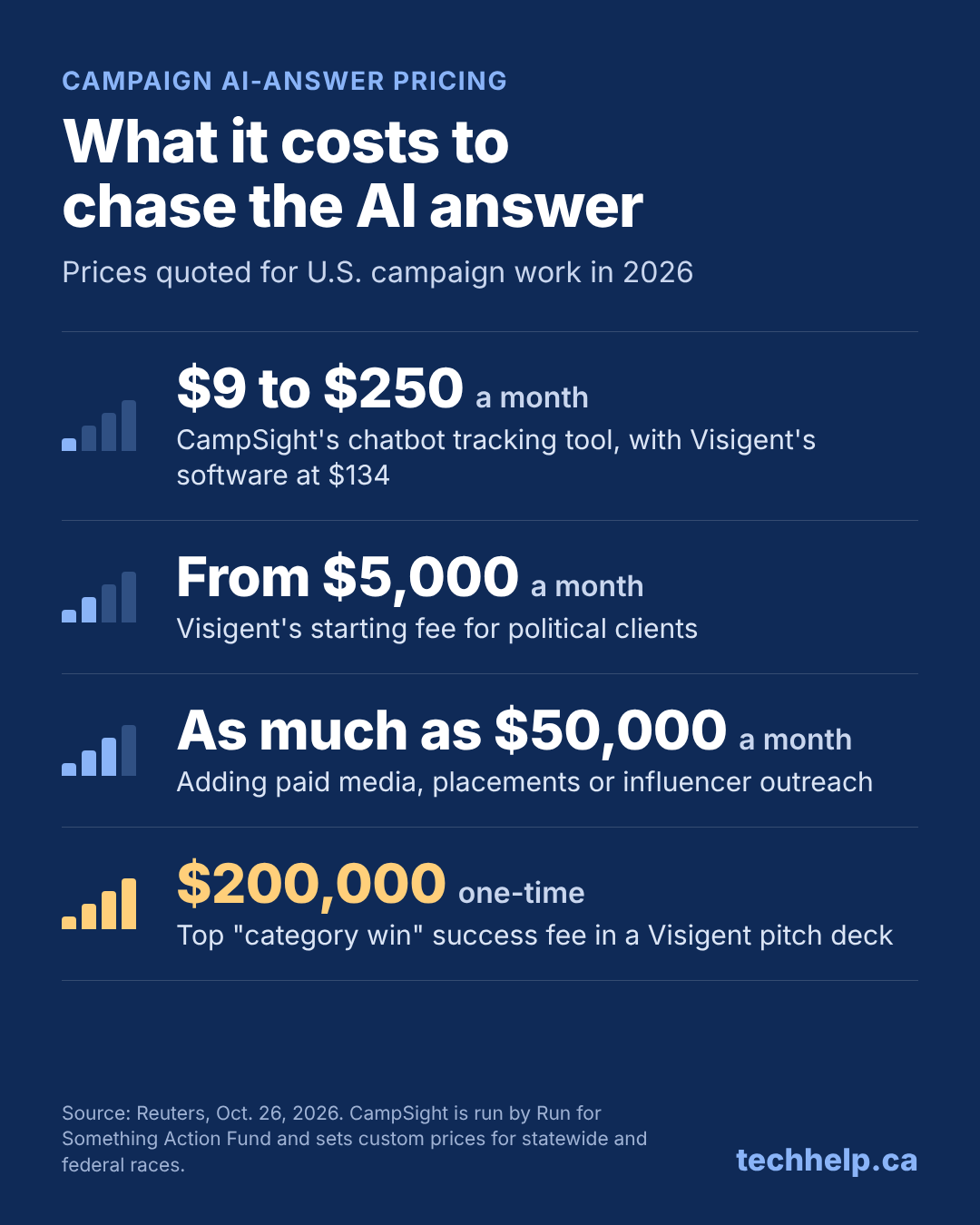
Visigent’s software costs $134 a month. Political clients start at $5,000 a month, CEO Thomas Howell told Reuters, and the bill could reach $50,000 once paid media, paid placements or influencer outreach are added. The deck lists a top success fee of $200,000 for a “category win.” Visigent has six political campaigns as clients, which Howell wouldn’t name. “If you don’t put the right information out there, who knows what the AI engines are going to grab onto,” he said.
Run for Something’s tool, CampSight, costs $9 to $250 a month, with custom pricing for statewide and federal races. Launched in June, it tracks how chatbots describe candidates and their opponents and which sources they cite. Amanda Litman, the group’s president, said on X that dozens of campaigns use it and more than 300 candidates and organizations are on the waiting list. Consultants report similar interest. Tim Chambers of Dewey Digital, part of the political consultancy Dewey Square, told Marketplace that candidates increasingly come to him asking, “Help us understand where we are in AI.”
So far, relatively few Americans use chatbots this way. A Pew Research Center survey of 5,273 U.S. adults, conducted October 12 to 18, found 8% say they’re using AI chatbots to find information about the 2026 elections, including 11% of adults under 50. Among those users, 76% are looking up where candidates stand on the issues, 71% are checking claims they’ve heard elsewhere and 40% want suggestions on how to make their vote choices. It’s a small group asking questions close to a decision, the kind of audience marketers pay to reach in search. Buying a political ad in ChatGPT isn’t an option, though. OpenAI has said it won’t let advertisers run political ads on its platform this cycle.
What campaign trackers say chatbots rely on
Both main sources for these findings have a stake in the work. Run for Something sells CampSight, and the other study came from a Democratic-aligned PR firm and an AI marketing platform. What they found is still specific enough to be useful.
When Run for Something looked at what ChatGPT said about candidates it had endorsed, some legitimate candidates in big statewide races weren’t showing up at all, chief technology officer Jordan Haines told WTOP. For a time, chatbots asked who was running in Mississippi’s Senate race wouldn’t list the Democratic candidate. Litman blamed the source material rather than the models. “That’s not malicious censorship, there wasn’t well-structured information about it,” she told NOTUS, the politics outlet that has since rebranded as The Washington Sun.
Reference sites carry a lot of weight. Ballotpedia, the nonprofit election encyclopedia, was a major source for the models the team studied, according to NOTUS. Haines told Marketplace that one candidate for Denver’s Regional Transportation District board, whose race chatbots didn’t recognize, set up Ballotpedia profiles for himself and his opponents to get it listed. The team also found that models cited Reddit and LinkedIn far more often than Facebook and Instagram, and that local news articles were more likely to be referenced than national outlets.
There’s no single answer to fix, either. Different chatbots gave different answers and drew on different sources, and Haines found that asking the same question in different languages produced different answers too.
The other study, which Orchestra commissioned from Evertune and shared first with NOTUS in August, used Georgia’s Senate race between Democratic Sen. Jon Ossoff and Republican Rep. Mike Collins as one test case. It found that Ossoff’s easy-to-read, well-annotated issue pages gave him the upper hand in citations, noting that “answer engines repeatedly return to Ossoff pages.” It also found Republicans had the advantage on economic storytelling. Chatbots mostly cited news coverage, with news explainers, party platforms and campaign websites among the strongest references, and they frequently cited YouTube clips of past interviews and coverage. The study’s advice to campaigns was to treat their websites “as resources, not just fundraising hubs.”
Quebec showed what fills the space when newsrooms opt out
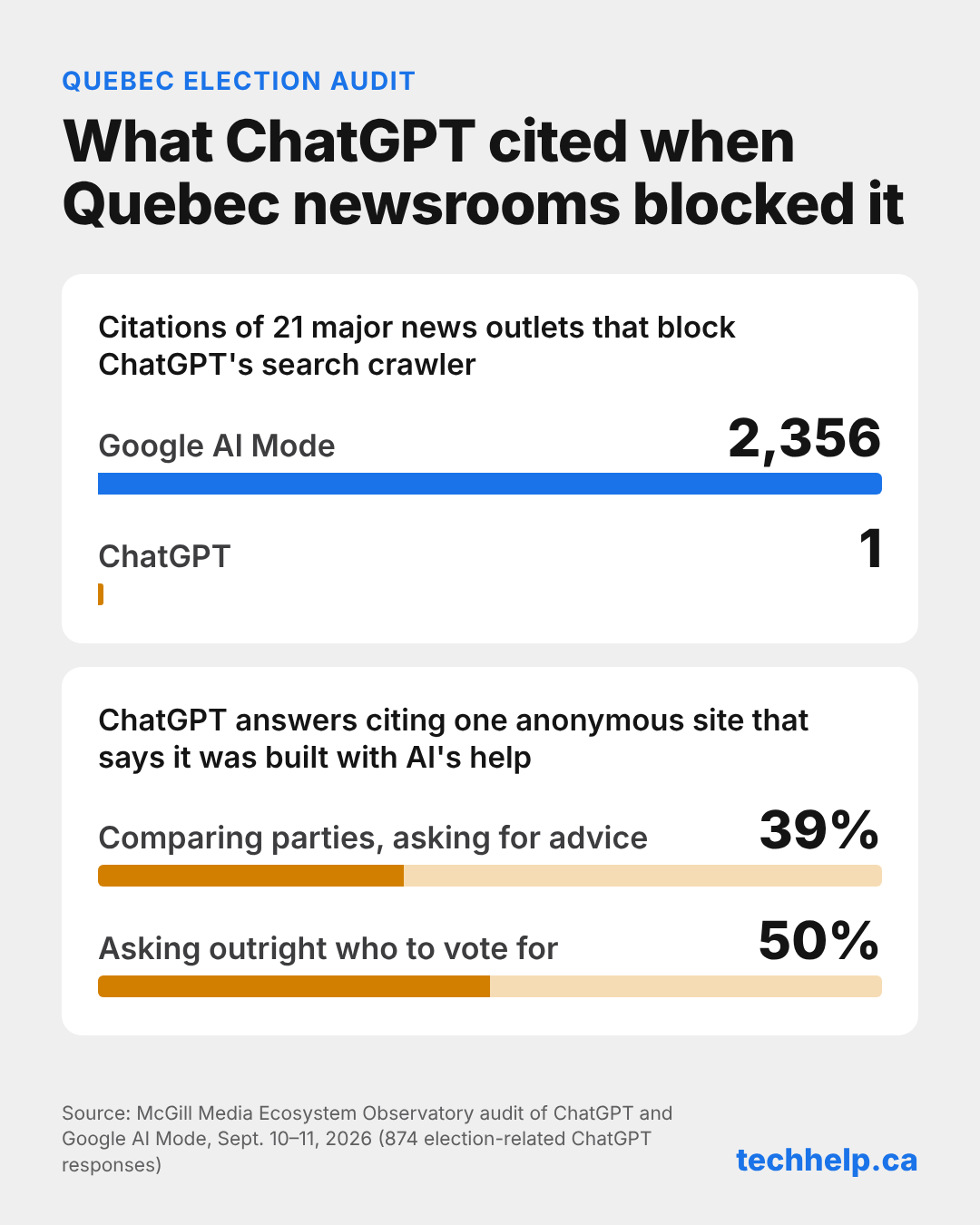
Canada got an early look at what happens when established news sources aren’t available to a chatbot. Ahead of Quebec’s October 5 provincial election, McGill’s Media Ecosystem Observatory audited ChatGPT and Google’s AI Mode on September 10 and 11. Twenty-one major French- and English-language outlets were blocking OpenAI’s search crawler, OAI-SearchBot. Of 874 election-related ChatGPT responses, only one cited content from any of them. Google’s AI Mode cited the same 21 outlets 2,356 times.
Something else took their place. An anonymous site registered on August 21, which describes itself as built with the help of AI, appeared in 39% of ChatGPT’s responses to queries asking it to compare party positions and make recommendations. When the question asked outright who to vote for, that share reached 50%. The site’s party-position summaries were last updated August 23, and it listed 35% of positions as lacking a “sufficiently documented position at this time.”
ChatGPT was also willing to pick a side. Asked who to vote for based on a user’s stated preferences, it made a voting recommendation in 81% of queries, though not consistently. Aengus Bridgman, the McGill political scientist who led the study, told the House of Commons procedure and House affairs committee on October 8 that “from one day to the next it went from recommending a political party to not recommending a political party.”
Bridgman also told MPs the team estimates about 40% of Quebec voters went to chatbots for election information. The hearing was the first in the committee’s new study on AI and Canada’s democratic institutions, and Taylor Owen, an associate professor at McGill’s Max Bell School of Public Policy, told the same meeting that how AI systems provide election information can be legislated, The Canadian Press reported.
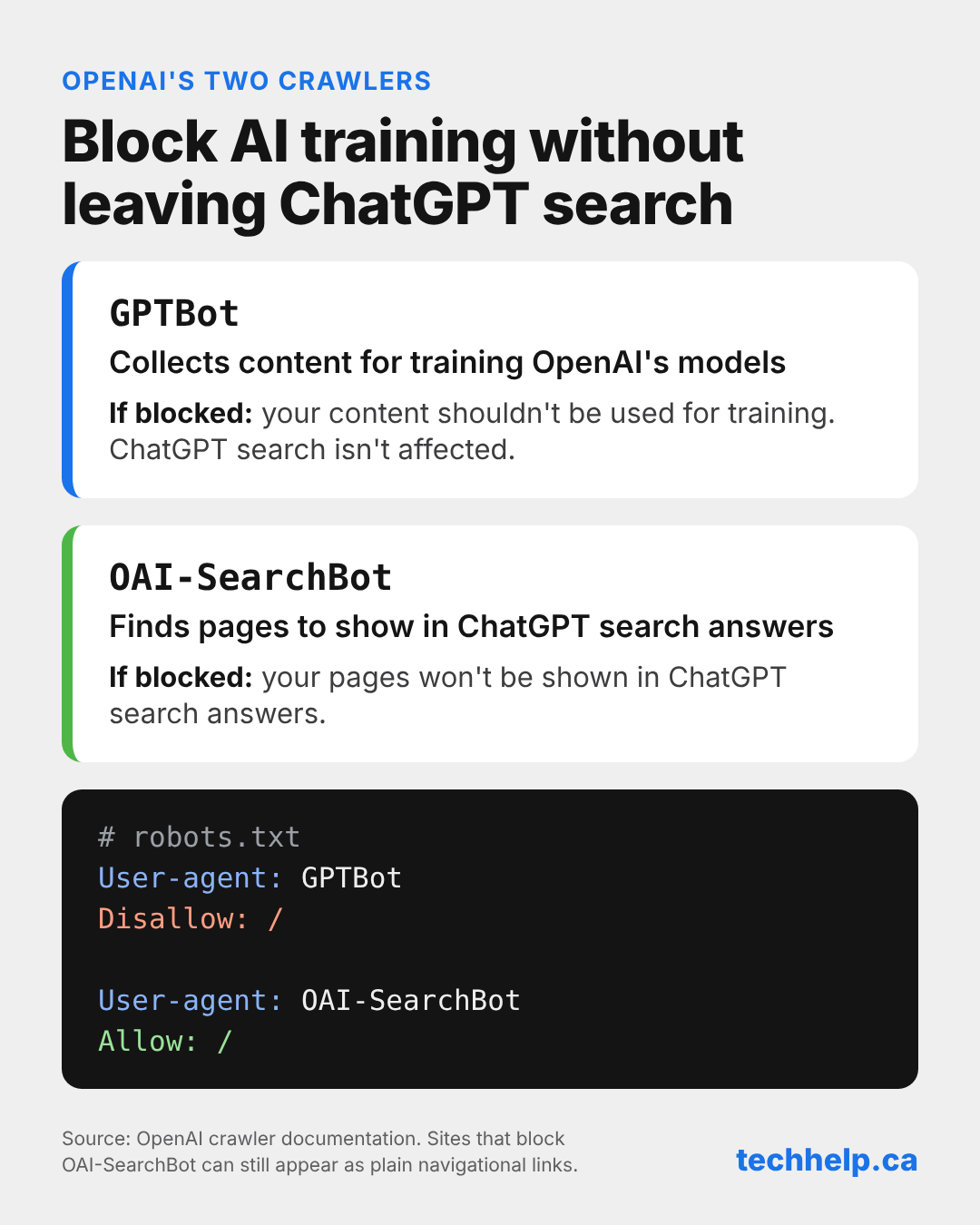
OpenAI’s crawler documentation spells out the trade-off. Sites that opt out of OAI-SearchBot “will not be shown in ChatGPT search answers,” though they can still appear as plain navigational links. Newsrooms have their reasons for blocking, including their objection to AI companies using their work without permission or payment. In Quebec, Bridgman said, the blocking sent chatbots looking elsewhere, and the audit shows where many of their answers landed.
Run for Something saw a similar pattern in U.S. races. Paywalled articles that rank well in Google were rarely included in chatbot answers, and publications that block AI scraping or have sued AI companies were less likely to show up, the team told WTOP and NOTUS.
Where optimization turns into manipulation
Some of what campaigns are doing is housekeeping, such as clearer issue pages, accurate listings and FAQ sections that used to be short blurbs and now go into detail. The Visigent deck’s paid placements are grayer, because the material a chatbot pulls from would then include content a campaign paid to put there.
Further along is a network that VisionHeight, an Israeli threat intelligence firm, described in an October 7 report. It found 37 anonymous political sites aimed at U.S. midterm races, including 10 posing as local news outlets. All were registered in a single evening, 36 of them in under eight minutes. Roughly 100,000 words of candidate content went up on September 30, and the phrase “is the stronger choice” appears more than 360 times across the network.
Every site’s robots.txt file invites 17 crawlers by name, including those run by OpenAI, Anthropic and Google. The report doesn’t name the candidates the sites favor, and VisionHeight couldn’t identify the operator. It cautioned that “none of this alone is proof” but concluded the sites were “most likely written by AI, written for AI.” CyberScoop reported that Perplexity cited one of them as the first source in an answer.
NPR reported on October 30 that the network mostly promoted Democratic candidates. In a test of 37 election-related questions, ChatGPT cited the sites in 19 responses, while Gemini cited none. NPR ran each question only once, so the results are a snapshot rather than a consistent citation rate. The network’s operator remains unknown.
Google already treats this kind of thing as spam in its own results. Its spam policies cover “attempting to manipulate generative AI responses in Google Search,” and its scaled content abuse policy targets using generative AI tools “to generate many pages without adding value for users.” OpenAI bans using its products “to create or distribute scaled campaign messaging,” but that rule covers how campaigns use OpenAI’s tools, not what they publish elsewhere for ChatGPT to find.
One tracker thinks the models have gotten harder to fool. When Run for Something started monitoring in the summer of 2025, Haines told Reuters, things said on Reddit were showing up in AI answers the next day. That fear “hasn’t really come to fruition” in 2026, he said, and “the LLMs have been pretty savvy about discerning accurate and reputable information from non-reputable information.” Meg Schwenzfeier of Caucus AI, which tracks how voters use AI, was more cautious, warning Reuters that chatbots speak with authority and can take in large amounts of unvetted information.
What businesses can borrow from the campaign playbook
Candidates get a hard stop on November 3. A business lives with whatever chatbots say about it indefinitely, which makes the campaign findings worth borrowing.
Ask what customers would ask, and keep asking. CampSight runs queries as voter personas, such as a parent focused on child care or a retiree focused on Social Security. A business can do the same with its own customer types, in each chatbot that matters and each language it serves, and log the answers over several weeks. When an answer can flip overnight, a single test says very little.
Build pages that answer, not just sell. Ossoff’s issue pages are the model. The business version is a clear page for each question a buyer brings, such as pricing, service areas, policies, comparisons and support, written so the answer is easy to lift.
Find the category’s Ballotpedia. Tracking which sites show up in answers about a business’s category shows where its listings and profiles need to be accurate and complete.
Look at robots.txt before blocking AI crawlers. OpenAI runs GPTBot for model training and OAI-SearchBot for ChatGPT search, and the two settings are independent. A business can block GPTBot to opt its content out of training and still let its pages show up in ChatGPT answers.
Ask a GEO vendor what it’s actually doing. Monitoring is the inexpensive part. Content production, placements and outreach drive the bigger invoices. Ask what counts as a “win” in any success fee, how results will be measured and whether the content plan would hold up under Google’s spam policies.
In Quebec, the AI-assisted site ChatGPT kept citing for voting advice didn’t even say who ran it. For most businesses, a rival gaming the system is a smaller worry than leaving the description of their own company to whatever a chatbot happens to find first.
Get new small business insights by email
Practical ideas and useful articles to help you make better business decisions.
Tech Help Canada Staff researches, writes, and reviews practical content for business owners and professionals. Our coverage spans business, marketing, SEO, technology, and the tools and systems people use to grow and operate online. We focus on clear, useful information backed by research, hands-on experience, and editorial review. Learn more about our team and editorial standards. Need help with something? Contact Us