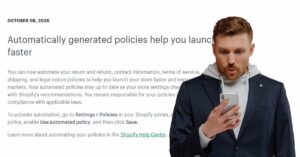
Shopify has added broader policy automation to the Shopify admin, giving merchants a way to generate and maintain several customer-facing policy pages from store settings instead of writing each one manually.
The update, announced in Shopify’s Oct. 8, 2026 changelog, covers return and refund, contact information, terms of service, shipping, and legal notice policies.
Shopify’s changelog says merchants can activate automation from Settings > Policies in the Shopify admin by selecting a policy, turning on “Use automated policy”, and saving the change.
The Shopify Help Center describes automated store policies as templates that use information from a store’s settings to generate and publish policy content. When relevant settings change, the automated policy content can update with them. Shopify says the policies also remain in sync with its recommendations.
That makes the feature more than a one-time policy template. Shopify is positioning it as a settings-driven policy system for merchants launching stores, updating operations, or expanding into new markets.
The policies are driven by store data
Shopify’s documentation shows that automated policy content can pull from specific store settings. For example, return terms can come from return rules, processing time can come from fulfillment settings, and shipping destinations can come from shipping zones and region markets.
Contact information can also be drawn from store settings, including details such as business name, address, email address, phone number, and, where applicable, VAT registration information.
For operators, the practical effect is clear: automated policies can reduce stale copy, but incorrect admin settings can also become incorrect customer-facing policy language.
The compliance caveat is part of the feature
Shopify says merchants remain responsible for the policies they publish. The company also says the automated policy templates are for informational purposes only, are not legal advice, and do not guarantee compliance with applicable laws.
The Help Center also warns that merchants may need to update automated templates or add specific disclosures in several cases, including auto-renewing subscriptions, regulated products such as alcohol, market-specific rules for product categories, and child-directed sites.
Shopify’s broader compliance guidance also says merchants need to comply with the laws of the jurisdictions where they and their customers operate, along with Shopify’s own terms and applicable platform policies.
Existing stores should treat activation as a content replacement
For existing stores, the change deserves extra care. Shopify says activating automation replaces the selected policy’s current content with Shopify’s automated template. If automated templates exist in other store languages, custom translations can be replaced too.
Shopify tells merchants to save a copy of any custom wording and translations they want to keep before turning automation on. It also says activating one automated policy does not activate automation for every policy.
If automation is later turned off for a policy, Shopify says the current policy content remains in place, but it no longer updates automatically when store settings change.
Shopify says past versions of return and refund, terms of service, shipping, contact information, and legal notice policies can be exported, and that changes are archived in all configured languages. The Help Center says Shopify saves past policies for two years, while merchants remain responsible for maintaining records as needed.
Privacy policy automation is related, but separate
The new store policy update sits beside Shopify’s earlier automated privacy settings. Shopify announced automated privacy settings for all merchants in July 2024, covering privacy policy generation, cookie banners, and data sale opt-out pages.
Shopify’s current customer privacy documentation says new stores have automated privacy settings activated by default. Existing stores can activate automated updates for the privacy policy, cookie banner, and data sharing opt-out page. That privacy workflow is managed separately from the policy controls in Settings > Policies.
What merchants should review before switching it on
For merchants considering the feature, the review list is operational as much as legal.
Public contact details: Shopify warns that policies are visible to customers and can include address, phone number, and email address. Stores operated from home may need suitable business contact details.
Return rules and return apps: Shopify says return terms can come from return rules, and merchants using return apps should check that generated policy language matches the app’s instructions.
Fulfillment and shipping settings: Processing time and shipping destinations can come from fulfillment settings, shipping zones, and region markets. Old shipping data can turn into published policy language.
Translated policies: Shopify tells merchants selling in multiple languages to review translated policies when moving between automated and manual content.
Special legal cases: Shopify flags subscriptions, regulated goods, market-specific product rules, and child-directed sites as cases that may require added disclosures or legal review.
Related: Tech Help Canada’s Shopify review covers pricing, apps, ecommerce features, AI tools, and the trade-offs of building a store on Shopify.
Get new small business insights by email
Practical ideas and useful articles to help you make better business decisions.
Tech Help Canada Staff researches, writes, and reviews practical content for business owners and professionals. Our coverage spans business, marketing, SEO, technology, and the tools and systems people use to grow and operate online. We focus on clear, useful information backed by research, hands-on experience, and editorial review. Learn more about our team and editorial standards. Need help with something? Contact Us