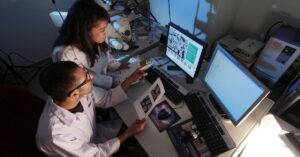
Anthropic’s newest AI story is not another chatbot button. It is a physical biology lab.
Reuters reported on September 18, 2026, that Anthropic has set up a wet lab in the San Francisco Bay Area, giving the maker of Claude a place to conduct physical biology experiments instead of keeping its life-sciences work entirely on computers.
A wet lab is where biological or chemical work happens with real materials, instruments, samples, and controlled procedures. That makes the move unusual for a company best known for large language models.
Anthropic’s head of life sciences, Eric Kauderer-Abrams, confirmed the lab to Reuters. A company spokesperson later clarified that the lab is not for drug discovery specifically, but declined to give more detail.
Why an AI company needs real experiments
Biology is not software. A model can read papers, write code, search databases, design candidate molecules, and analyze results, but the hard proof often comes when a physical experiment succeeds or fails.
That is the practical reason a Claude-maker might want a wet lab. If AI systems are going to be useful in life sciences, they need a feedback loop between prediction and reality. A model can propose a protein design, a robot or scientist can test it, the results can be measured, and the model can use that evidence to improve the next round of work.
Anthropic has already been moving in that direction. In August, the company said external evaluators produced and tested Claude-designed protein binders against 15 targets and found binders against 14 of them. Anthropic framed the work as an early-stage research task, not a finished medicine, but it showed why physical validation remains central. A design that looks promising on a screen still has to survive contact with the lab.
Claude Science brought the lab into software
On June 30, Anthropic released Claude Science in beta, describing it as an AI workbench for scientists. The product is meant to bring research tools, data sources, compute access, code, figures, and auditable artifacts into one environment.
According to Anthropic, Claude Science can work with genomics, single-cell analysis, proteomics, structural biology, and cheminformatics, among other research areas. The company said it can run on a lab’s own infrastructure, including local machines, Linux systems, and high-performance computing nodes, so large or sensitive datasets do not have to be moved wholesale into Anthropic’s systems.
That software layer explains part of the biology push. Claude is not only answering questions about science. Anthropic is building products that sit inside scientific workflows.
The wet lab adds hardware to the loop
The wet lab makes Anthropic’s life-sciences strategy more concrete because it connects software to physical experiments.
In August, Anthropic previewed the Model Hardware Standard, a shared specification for AI agents to operate physical devices such as microscopes, liquid handlers, and robotic arms. The company said the research preview was being opened to an initial group of scientific research labs and advanced manufacturers.
Reuters reported that Anthropic wants to push how Claude can direct robotic units to carry out experiments with limited human intervention. Anthropic also said human oversight and involvement remain essential for safety, and Kauderer-Abrams described AI-driven lab execution as being in the “very early innings.”
That distinction matters. The current signal is not that Claude is independently running a biology lab. It is that Anthropic is building the pieces for AI-assisted experimentation: scientific workbench software, verified model access for life-science teams, hardware-control standards, and now a place where real experiments can be run or coordinated.
The safety debate comes with the science
Anthropic’s biology push lands in a sensitive moment for AI safety. In its September 2026 threat intelligence report, the company said it had identified five case studies of actors using its models in ways that could support biological weapons development. Anthropic also said it did not assert that the people involved intended harm, which underlines the core problem in biology: the same knowledge can be useful for legitimate research and dangerous misuse.
The day before Reuters reported the wet lab, Anthropic announced its Life Sciences Verification Program. The program gives verified life-science professionals access to Anthropic models with safeguards that are more permissive for biology work than the company’s generally available models. Anthropic said applicants go through checks covering research credentials, security standards, and ethical oversight, with extra vetting for higher-risk uses.
That is the bind Anthropic is trying to manage. Useful biology AI must allow serious researchers to do work that consumer-facing models might block. But the more capable and permissive the system becomes, the more the company has to rely on verification, monitoring, access controls, and trust.
The business tension is also real
Anthropic is not entering this space as a neutral tool vendor with no commercial overlap. Reuters reported that Anthropic provides life-sciences tools and services to major pharmaceutical names including Roche’s Genentech, Bristol Myers Squibb, and Novo Nordisk. At the same time, the company is building its own life-sciences capability.
That creates a trust question. Drug companies may want access to stronger AI systems, but they also care deeply about proprietary data and competitive research programs. Reuters reported that Anthropic is trying to wall off customer data, while Kauderer-Abrams said the company is not running clinical trials for now and is focusing on needs that industry would not address.
In practice, that positions Anthropic closer to preclinical research, lab automation, and scientific infrastructure than to a traditional pharmaceutical company bringing drugs through human trials. The boundary will still be watched closely, especially if Anthropic’s internal biology work grows.
What the lab does not prove
The existence of a wet lab is significant, but it should not be read as proof that Claude can autonomously discover safe, effective medicines. Several limits remain clear from the public record.
Anthropic has not disclosed the lab’s exact research scope.
The company has not said it is running human clinical trials.
No public evidence shows Claude independently discovered a drug candidate ready for patients.
The company has not resolved the broader dual-use risk around advanced biology models.
Many operational details, including biosafety level and staffing, remain undisclosed.
The unusual part is the direction of travel. Anthropic is treating Claude less like a chat interface and more like a component in scientific infrastructure: a reasoning model, research workbench, verified access system, hardware-control layer, and now a lab-connected biology program.
That makes the story more consequential than another AI product update. The next frontier for AI companies may not be a better sidebar in a productivity app. It may be software that proposes experiments, lab systems that run them, and governance strong enough to decide who gets access to that loop.
Get new small business insights by email
Practical ideas and useful articles to help you make better business decisions.
Tech Help Canada Staff researches, writes, and reviews practical content for business owners and professionals. Our coverage spans business, marketing, SEO, technology, and the tools and systems people use to grow and operate online. We focus on clear, useful information backed by research, hands-on experience, and editorial review. Learn more about our team and editorial standards. Need help with something? Contact Us