
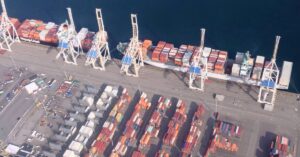
Canada’s newest counter-tariffs are not just a trade headline. For some small businesses, they are about to become a paperwork problem.
As of September 3, the federal government says new counter-tariffs of 15%, 25% and 50% are set to take effect at 12:01 a.m. on September 8, 2026. The duties apply to selected U.S.-origin goods, with rates matching the corresponding U.S. tariff rate on the same goods.
For a small manufacturer, food packager, repair shop, specialty retailer, or local distributor, the practical question is not whether the trade fight is fair. It is whether the next shipment contains a part, ingredient, tool, packaging material, machine component, or finished good that suddenly costs much more and cannot be replaced fast enough.
That is where Canada’s tariff-remission process may become relevant, but remission is not automatic. It is not a general complaint form. It is a request for exceptional relief from duties that would otherwise apply. Finance Canada says the government will consider remission only where the circumstances are exceptional and compelling enough to outweigh the reason the tariff exists.
If your business imports from the U.S. and cannot switch suppliers, the work should start before the next invoice lands.
This is a news explainer, not customs, tax, or legal advice. Before filing, classifying goods, or claiming relief, talk to a customs broker, trade lawyer, accountant, or qualified trade advisor.
The September 8 tariff list is broad
Canada announced the new countermeasures on August 25 after the United States imposed 50% tariffs on $27.6 billion of Canadian goods effective August 22.
Finance Canada says the Canadian counter-tariffs will also cover $27.6 billion in imports from the United States. The list focuses on sectors including steel and aluminum, dairy, appliances, agricultural equipment, pulp and paper, plastics, electronics, furniture, clothing and apparel, fish and seafood, and certain derivative products.
The rate depends on the tariff item. Some listed goods face 15%. Others face 25% or 50%.
The product list is based on tariff classification, not casual product labels. A business may describe an item one way internally while customs classifies it under a more specific tariff item.
For importers, the first step is boring but necessary: confirm the Harmonized System classification, country of origin, tariff rate, shipment date, and whether the goods are covered by the September 8 list.
Finance Canada also says the countermeasures do not apply to U.S. goods already in transit to Canada on the day the tariffs come into force.
Small importers are already exposed
The pressure is not theoretical.
On September 3, the Canadian Federation of Independent Business said preliminary survey results showed 49% of small importers sourcing from the U.S. have products directly hit by Canadian counter-tariffs. CFIB said impacted businesses reported median monthly costs of $65,000, and 11% of affected importers would stop being financially viable if the Canada-U.S. trade war lasts three months or more.
The affected sectors include manufacturing, wholesale, retail, and construction.
That mix matters because small firms often have less room to absorb a tariff while they wait for a new supplier, renegotiate customer pricing, or change product specs. A larger company may have a procurement team, customs department, and alternate supplier map. A small firm may have one owner, one bookkeeper, one customs broker, and a supplier relationship that took years to build.
For those businesses, remission is worth understanding because it asks a practical question: is this product genuinely hard to replace from Canada or a non-U.S. supplier?
Remission is for exceptional cases, not general frustration
Finance Canada’s remission framework gives two main routes for exceptional relief.
The first is for goods used as inputs that cannot be sourced domestically, either nationally or regionally, or reasonably from non-U.S. sources.
The second is for other case-by-case circumstances that could have severe adverse impacts on the Canadian economy.
Both routes set a high bar. A tariff being expensive is not enough by itself.
A stronger file will usually answer questions like these:
- What exactly are you importing?
- What tariff item applies?
- Why do you need this specific product?
- Which Canadian suppliers did you contact?
- Which non-U.S. suppliers did you contact?
- What substitutes did you test or reject?
- What proof shows the alternatives do not work?
- What happens to your pricing, production, contracts, jobs, or investment if relief is denied?
The strongest argument is not “this hurts.” It is “here is the evidence showing why this cost cannot be avoided or absorbed without serious business consequences.”
Do not confuse the three relief paths
Businesses should separate three related ideas before they act.
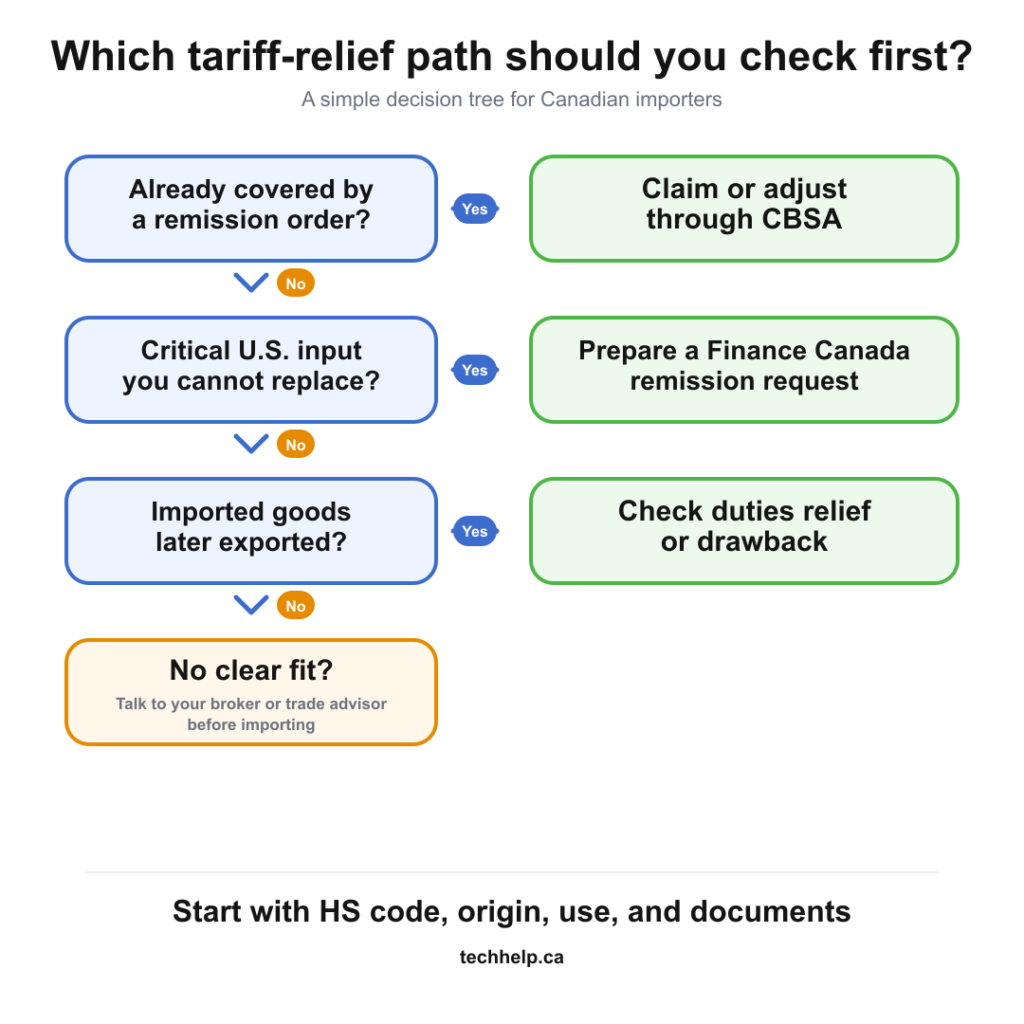
| Relief path | When it may apply | Where the work goes |
|---|---|---|
| Existing remission order relief | The goods already fit a generally available remission category or specific schedule | CBSA claim or adjustment process, supported by customs documents |
| Exceptional remission request | Existing relief is not available, but the business has a strong case for relief | Finance Canada remission request |
| Duties relief or drawback | The imported goods are later exported | CBSA duties relief or duty drawback programs |
This distinction matters because the evidence and timing are different.
If goods already qualify under an existing remission order, the issue may be how to claim the relief correctly through CBSA. If no existing relief applies, the business may need to prepare a specific remission request to Finance Canada. If the goods are imported and later exported, duties relief or drawback may be the better path to investigate.
Some businesses may have more than one category in the same supply chain. One item may qualify for existing relief. Another may need a specific remission request. A third may have no obvious relief path.
Assess the exposure product by product.
What Finance Canada asks for
Finance Canada’s submission template is detailed. That is good news and bad news for small firms.
The bad news is that the request takes work. The good news is that the template tells owners what kind of file they need to build.
At minimum, businesses should be ready to provide:
- Company details, including the 15-digit business number, corporate structure, locations, operations, and number of employees.
- A detailed description of the goods and the 8-digit tariff item or items. The 10-digit statistical level can be included where relevant.
- Annual import volume and value, excluding surtaxes, or the volume and value for the period where remission is requested.
- If goods have already been imported, customs documentation such as B3 forms and invoices showing tariffs paid.
- Evidence that the product or a substitute cannot be sourced from Canadian or non-U.S. suppliers.
- Contracts or other evidence if contractual obligations prevent switching suppliers.
- An explanation of whether the sourcing issue is temporary or transitional.
- The effect of remission on price, employment, production volume, investment, or other operations.
- Names and locations of Canadian competitors, plus information on how remission could affect those competitors.
- Any supporting material such as letters, independent studies, supplier correspondence, or market data.
That is a lot for a small company. It is also a map.
If you think you may need remission, start collecting the evidence now instead of waiting until the duty is already built into your landed cost.
Proving you cannot switch suppliers is the core work
The sourcing evidence may decide the strength of the request.
Finance Canada asks for evidence demonstrating the inability to source the product, or substitutes, from Canadian or non-U.S. suppliers. That can include request-for-proposal notices, names of companies contacted, replies from those companies, and additional information on the company’s sourcing model.
A weak file says, “We cannot find another supplier.”
A stronger file shows:
- The current U.S. supplier, product specs, volume, lead time, quality requirements, and price.
- The Canadian suppliers contacted, with dates, replies, quotes, refusals, or technical reasons they cannot supply.
- The non-U.S. suppliers contacted, with the same documentation.
- Any failed tests, certification problems, compatibility issues, minimum order quantities, shipping constraints, or lead-time problems.
- Contract clauses that prevent an immediate change.
- The operational consequence if the input is unavailable or uneconomic.
For small businesses, email trails matter. Quote requests matter. Supplier replies matter. Technical spec sheets matter. Purchase orders matter. If the claim depends on an input being irreplaceable, the evidence has to show the failed alternatives.
Manufacturers need a cost file too
Manufacturers face another layer of work.
Finance Canada asks businesses using the goods in a manufacturing operation to provide the cost of producing one unit of the finished product. That cost breakdown includes the tariffed input, other imported articles, Canadian materials, labour, overhead, and administrative and selling expenses.
The request also asks for the unit selling price of the finished product and how remission would affect the cost and selling price.
That pushes the application beyond import paperwork. It becomes a cost-accounting exercise.
A manufacturer may need to show how a tariffed input flows into the finished product, how much of the final cost it represents, and whether the business can pass that cost on without losing customers or contracts.
For small firms, this may be the hardest part. It requires financial detail, not just a statement that margins are tight.
Confidential information still needs handling
Finance Canada says confidential information must be marked as confidential and will be protected by the government.
But there is a catch: enough non-confidential information has to be provided so the government can engage with domestic producers where short-supply issues are raised.
That means applicants should be careful but not vague. If every meaningful detail is hidden, the government may not have enough information to test the claim. If too much is disclosed, the business may reveal information it should have protected.
The practical move is to prepare two versions of sensitive evidence where needed: a confidential version with full commercial detail and a non-confidential summary that explains the issue without exposing more than necessary.
Existing remission relief is separate
Some relief already exists outside a new exceptional remission request.
Finance Canada’s tariff relief page says generally available remission has been granted under the United States Surtax Remission Order for goods used in public health, health care and public safety, aluminum goods used as manufacturing inputs, and steel goods used as manufacturing inputs in the auto and aerospace industries. It also says remission is available for a wider range of goods under schedules to the order and for certain categories of motor vehicles.
CBSA’s Customs Notice 25-19 explains how claims for relief or refunds under that remission order are administered. The notice says claims must be made by the importer and supported by relevant documents such as commercial accounting documents, purchase orders, commercial invoices, Canada customs invoices, bills of lading, or waybills.
CBSA also lists special authorization codes for different categories of remission and says corrections or adjustments may be available if remission was not claimed when goods were accounted for.
This is why businesses should not jump straight to a new Finance Canada remission request without checking whether an existing remission category already applies.
Goods that are later exported may have another route
If imported goods are later exported, tariff remission may not be the only option.
Finance Canada’s tariff relief page points companies to two CBSA programs for goods eventually exported: the Duties Relief Program, which can allow eligible businesses to import commercial goods without paying duties, and the Duty Drawback Program, which can refund duties already paid on imported goods that are later exported.
Those programs have their own rules. The point is not that every exporter qualifies. The point is that businesses should check the right relief path before assuming the only option is a new remission request.
For companies with cross-border supply chains, the first question may be whether the goods stay in Canada, become inputs in Canadian production, or leave Canada again.
What small businesses should do before September 8
If your business imports from the United States, use the next few days to build a basic tariff file.
Start with the products most likely to hurt cash flow, customer pricing, production, or contract performance.
For each product, record:
- The tariff classification and product description.
- Country of origin and whether the good is U.S.-origin for the Canadian counter-tariff list.
- Shipment status, including whether goods are already in transit before September 8.
- Annual import value and expected import value over the next 30, 60, and 90 days.
- Whether an existing remission order, exemption, duties relief program, or drawback program may apply.
- Supplier alternatives contacted in Canada and outside the U.S.
- Contracts, purchase orders, invoices, customs documents, and technical specs.
- Expected cost impact on unit economics, pricing, jobs, production, and customer commitments.
Do this even if you are not sure you will file.
The exercise will help you decide whether to absorb the cost, raise prices, delay purchases, change suppliers, file for relief, or ask customers to accept different timing.
It will also give your customs broker, accountant, trade advisor, or lawyer something useful to work with.
If your business sells into the U.S. as well as importing from it, our earlier piece on new 50% U.S. tariffs on Canadian products covers the export-side risk. If logistics costs are part of the same pressure, our Panama Canal article explains how freight surcharges can move from shipping routes into landed cost.
Watch the limits
Remission can help in specific cases. It should not be treated as a rescue plan for every business affected by tariffs.
The government may consult domestic producers. It may reject a file that lacks evidence. It may take time. Relief may depend on how the goods are classified, how they are used, whether substitutes exist, and whether the public-policy case is strong enough.
There is also no guarantee that remission, if granted, will arrive quickly enough to solve an immediate cash-flow problem.
That is why small firms should treat remission as one part of a wider response. The same file that supports a remission request can also support pricing decisions, supplier negotiations, financing conversations, customer communication, and contingency planning.
Final take
For small importers, Canada’s tariff-remission process is not a shortcut around the trade fight.
It is a narrow path for cases where the business can prove necessity.
If a U.S. input is replaceable, the file will probably be weak. If the business can document failed alternatives, technical constraints, contracts, cost impact, and business consequences, the file gets stronger.
The September 8 deadline makes the timing uncomfortable. But the practical move is clear: identify the affected goods, check the relief paths, gather the documents, and build the evidence before the tariff becomes another unexplained cost sitting inside the business.
Frequently asked questions
What is tariff remission in Canada?
Tariff remission is relief from duties that would otherwise apply. For Canada’s U.S. counter-tariffs, Finance Canada says remission is considered only in exceptional and compelling circumstances, such as inputs that cannot be sourced domestically or reasonably from non-U.S. suppliers.
Who can request remission from Canada’s U.S. counter-tariffs?
Finance Canada says only companies registered in Canada are eligible to make remission requests under the U.S. tariff-remission framework. Businesses should confirm eligibility and documentation requirements with a customs broker, trade advisor, accountant, or lawyer before filing.
What proof should a business gather for a remission request?
A business should gather tariff classifications, import values, customs documents, invoices, supplier emails, quote requests, contracts, technical specifications, evidence of failed Canadian or non-U.S. sourcing, and details showing the effect on prices, jobs, production, investment, or contracts.
Is tariff remission automatic if a U.S. supplier cannot be replaced?
No. Remission is not automatic. Finance Canada assesses requests, may consult other federal departments and interested parties, and requires enough evidence to show that exceptional circumstances outweigh the reason for applying the tariff.
Is a Finance Canada remission request the same as a CBSA refund claim?
No. A Finance Canada remission request is for exceptional relief where existing relief is not available. A CBSA claim or adjustment may apply when goods already qualify under an existing remission order or another customs relief program.
What if imported goods are later exported?
If goods are eventually exported, a business may need to look at CBSA’s Duties Relief Program or Duty Drawback Program. These programs have separate eligibility rules and may be more relevant than a new remission request in some cross-border supply chains.

I can suggest related Tech Help Canada articles based on the topic you’re reading now.

Tech Help Canada Staff researches, writes, and reviews practical content for business owners and professionals. Our coverage spans business, marketing, SEO, technology, and the tools and systems people use to grow and operate online. We focus on clear, useful information backed by research, hands-on experience, and editorial review. Learn more about our team and editorial standards. Need help with something? Contact Us