Ranking helps, of course. You need visibility before search can send you customers. But a page can rank for the wrong query, attract the wrong visitor, earn clicks that never convert, or sit in Google Search Console with thousands of impressions and barely any business value.
Successful SEO connects search visibility to a useful business outcome. The right people find you, trust the page they land on, take the next step, and remember your brand when they are ready to act.
If you’re trying to grow a small business, SEO can’t be treated like a game of collecting rankings. It has to support leads, sales, appointments, subscriptions, product discovery, quote requests, local visits, or another outcome that matters to the business.
What SEO success looks like now
SEO success means your website earns qualified visibility in search and turns that visibility into meaningful action.
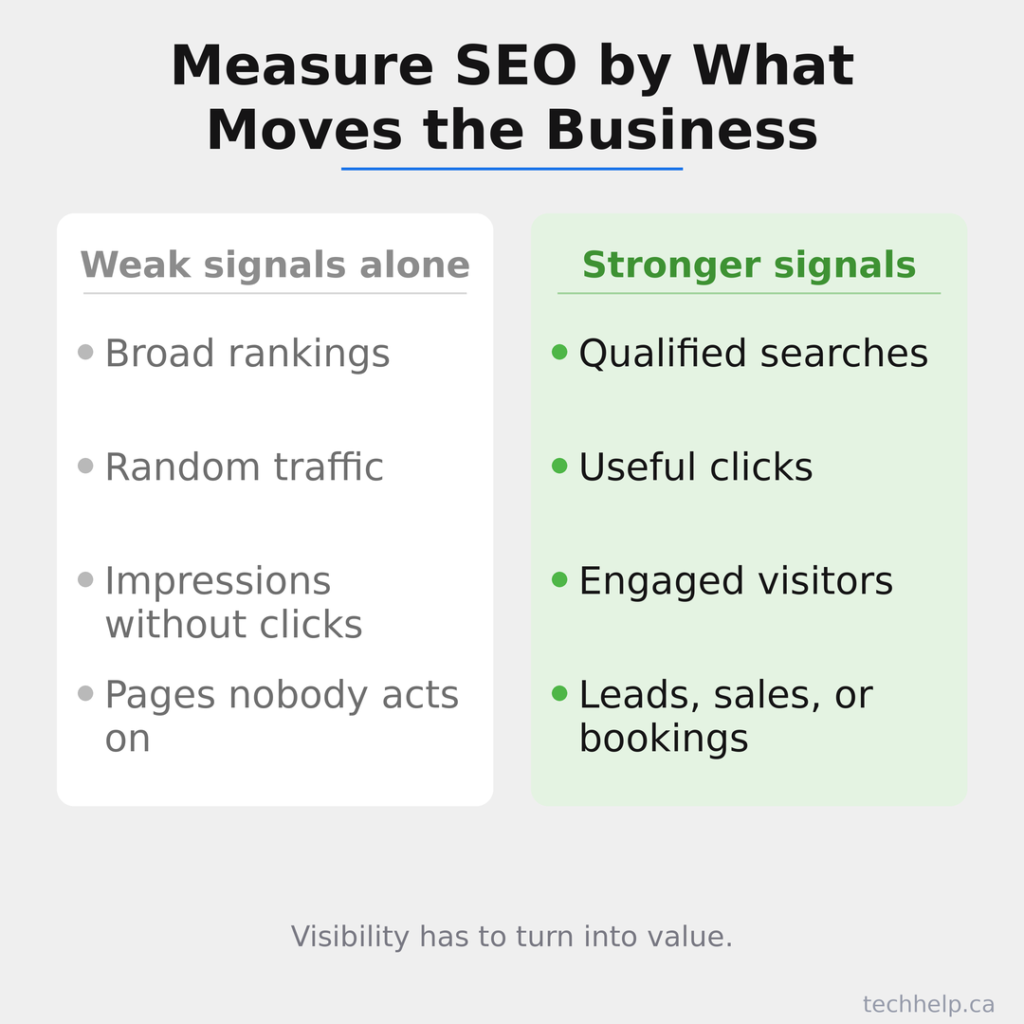
That may sound simple, but it changes how you judge the work. Page-one rankings are useful. Traffic is useful. Impressions are useful. None of them prove success on their own.
Use a stronger scorecard.
Weaker signal
Stronger signal
Ranking for a broad keyword
Ranking for searches that match your offer
More organic traffic
More qualified visitors from useful queries
More impressions
More impressions from topics you want to own
A high-ranking blog post
A page that attracts, educates, and moves people forward
More backlinks
Better links from relevant, trusted sources
Better SEO scores
Faster, clearer, more useful pages
More content published
More pages that answer demand better than competitors
A business can publish a lot, rank occasionally, and still feel stuck. Another business can win with fewer pages because each page has a sharper job.
SEO success starts with better alignment, not simply more work.
The mistake is treating SEO as one finish line
The old version of SEO advice often made success sound like one thing: get to page one.
Page one still matters, but search has more moving parts now. A result can compete with ads, local packs, videos, product results, featured snippets, AI Overviews, forums, brand sites, review sites, and other search features. A ranking position is only one part of the path.
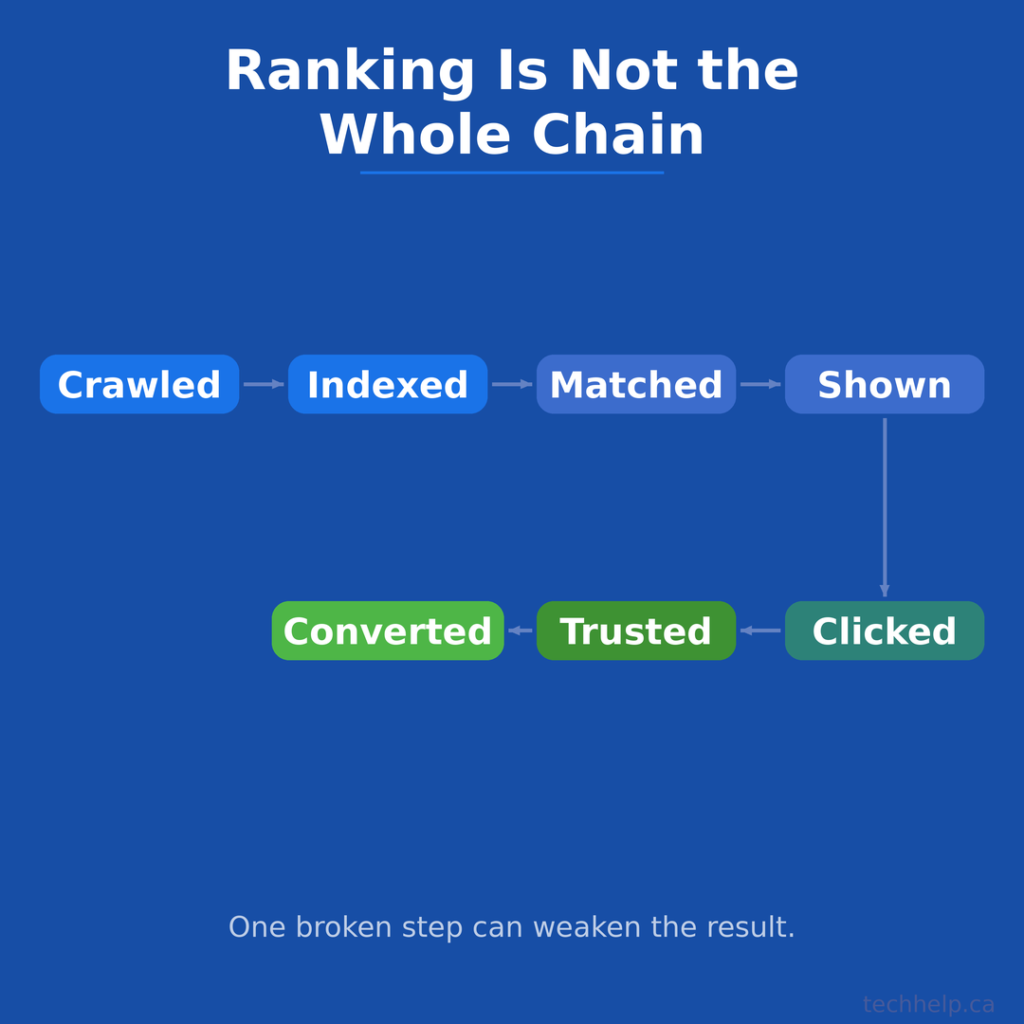
Before a search visitor becomes a lead or customer, several things need to happen. Google has to discover the page. The page has to be crawlable and indexable. The content has to match the query. The result has to earn the click. The page has to satisfy the visitor. Then the next step has to be clear enough for the visitor to take it.
If any part of that chain breaks, the ranking alone won’t save you.
1. Define what the search should produce
Start by deciding what SEO should do for the business.
For a local service business, the goal may be calls, form submissions, bookings, or direction requests. For an ecommerce brand, it may be product revenue, category page growth, email capture, or repeat purchases. For a publisher or education site, it may be engaged readers, return visits, newsletter growth, or links from other sites.
You don’t need every page to sell directly. Some pages build trust. Some answer early questions. Some support link building. Some help existing customers. Some move readers to a stronger commercial page through internal links.
But every page should have a job.
Before you create or refresh a page, answer these questions:
Question
Why it helps
Who is searching for this?
It keeps the page focused on a specific audience.
What problem are they trying to solve?
It prevents thin content that only repeats the keyword.
What should they do next?
It connects the page to a business outcome.
How will we measure success?
It stops SEO from becoming guesswork.
If you can’t explain what the page is supposed to earn, it’s hard to know whether SEO worked.
2. Match search intent before you write
Search intent is the reason behind the query.
Two people can use similar words and want very different things. One person searching for “SEO success” may want a definition. Another may want a practical plan. Another may be trying to understand why their current SEO work is not producing leads.
Your page has to meet the intent behind the keyword, not just include the keyword.
For informational searches, the visitor usually wants an answer, framework, checklist, comparison, example, or explanation. For commercial searches, they may be comparing options. For local searches, they may want proximity, trust, availability, and proof. For transactional searches, they may be ready to buy or contact someone.
This is why keyword research shouldn’t become keyword stuffing. The keyword tells you there is demand. Intent tells you what the page has to deliver.
If the searcher wants a practical explanation of SEO success, give them a way to judge it. Show what to measure, what to improve, and what to avoid. Don’t bury them under generic definitions they have already seen a hundred times.
3. Build pages worth choosing
Useful content is still the foundation of SEO.
Google’s own guidance keeps pointing in the same direction: create helpful, reliable content for people, use the words people would use to find it, and make the page easy for search engines to understand.
That doesn’t mean chasing a magic keyword density. It means writing naturally around the topic while placing important terms in sensible places: the title, main heading, subheadings, introduction, image alt text where relevant, link text, and body copy.
The old “calculate your keyword density” approach creates bad writing fast. A page can mention the target phrase many times and still fail if it doesn’t answer the question better than competing pages.
A stronger SEO page usually does four things:
Page element
What it should do
Title and intro
Make the searcher feel they landed in the right place.
Main body
Answer the question with depth, clarity, and useful judgment.
Examples or frameworks
Make the advice easier to apply.
Next step
Help the reader keep moving without forcing a sales pitch.
This is also where experience helps. If you know the customer, the objections, the buying process, and the common mistakes, the page can say something more useful than a generic SEO rewrite.
A page like that has a better chance of earning clicks, links, shares, and trust.
4. Make the site easy to crawl and easy to use
Good content still needs a working website around it.
Search engines need access to your pages. Visitors need the page to load, display properly, respond quickly, and make sense on the device they are using. If your site blocks important resources, hides key content, breaks on mobile, loads too slowly, or makes navigation confusing, your content has to fight the site itself.
Start with the basics:
Area
What to check
Indexing
Important pages can be found and indexed.
Internal links
Related pages connect naturally and use helpful anchor text.
Mobile experience
Content, forms, menus, and buttons work well on phones.
Speed
Main content loads quickly and the page stays responsive.
Layout stability
Text, buttons, images, and forms do not jump while loading.
Security
Pages use HTTPS and avoid trust-breaking errors.
For a deeper look at mobile and search, see our guide to responsive website SEO. If speed is the issue, our website page speed for SEO guide explains how to prioritize fixes without obsessing over perfect scores.
Technical SEO doesn’t need to be intimidating. At the small business level, many wins come from removing obvious blockers, keeping the site healthy, and making important pages easier to discover.
5. Earn authority without chasing cheap link tricks
Links still matter, but the way you earn them matters more than the count.
A link from a relevant website can help people discover your page, give search engines more context, and support trust. A pile of weak links from unrelated sites can create risk, waste time, or make your SEO look manufactured.
The best link building starts with something worth referencing. That could be a useful guide, original data, a practical template, a calculator, a strong opinion backed by evidence, a comparison, a local resource, or expert commentary that adds something others have not already said.
Then you promote it to people who have a reason to care.
Our link building strategies guide goes deeper into how to earn backlinks without leaning on spammy shortcuts.
The simple rule is this: if the link would still make sense for the reader even if Google didn’t exist, you’re usually closer to the right kind of link.
6. Measure what moved, then improve the pages that matter
SEO success improves when you measure the right things and act on what you learn.
Google Search Console gives you the search side: impressions, clicks, click-through rate, average position, queries, pages, countries, devices, and search appearance data. Analytics gives you the behavior side: engagement, conversions, revenue, form fills, calls, assisted journeys, and page value.
Look at both.
If impressions rise but clicks don’t, your title, snippet, search feature competition, or intent match may need work. If clicks rise but leads don’t, the page may attract weak-fit traffic or fail to make the next step clear. If one page loses traffic while the rest of the site stays stable, you may have a page-level issue. If many pages drop at once, you may need to look at a technical, algorithmic, tracking, or demand problem.
Good SEO is iterative. You publish, measure, improve, promote, update, and repeat. That’s how a page gets stronger over time instead of fading after launch.
What AI search changes about SEO success
AI search has changed how people encounter information, but it hasn’t made SEO irrelevant.
Google’s guidance for generative AI features says the same foundational SEO practices still apply because AI Overviews and AI Mode use Google’s Search ranking and quality systems to retrieve and highlight content from the web.
The practical takeaway is simple: do not chase fake “AI SEO” shortcuts. Build pages that are useful, crawlable, original, specific, and easy to understand. Add examples, data, experience, definitions, comparisons, and clear explanations where they help the reader.
AI search may reduce some simple clicks, especially for questions that can be answered quickly. That makes stronger pages more important, not less. If your page only repeats surface-level facts, it becomes easier to summarize and ignore. If it gives readers judgment, proof, structure, and a useful next step, it has a better chance of being remembered, cited, clicked, or trusted.
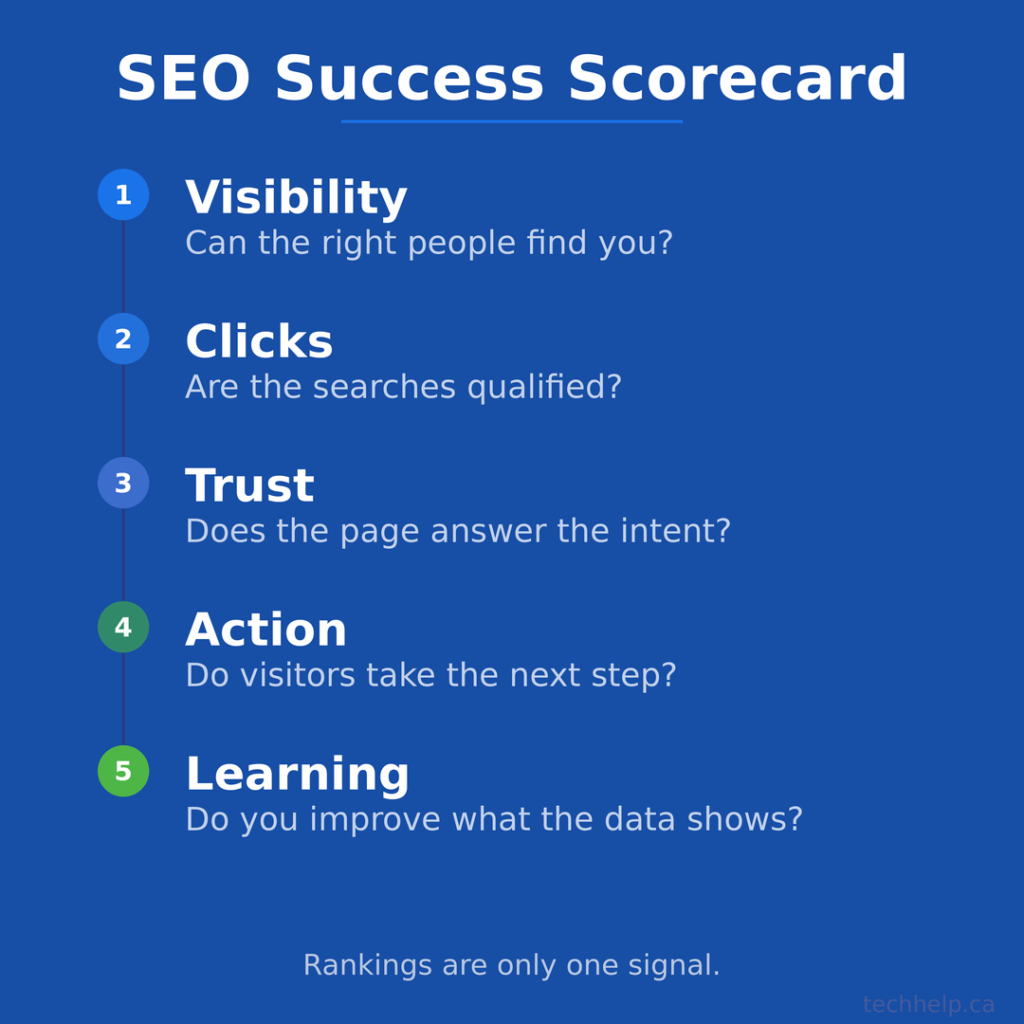
A simple SEO success scorecard
Use this scorecard when reviewing your site each month.
Area
What good progress looks like
Visibility
More impressions for searches tied to your business, not just random topics.
Clicks
More qualified visitors from the queries and pages you care about.
Intent match
Searchers stay, read, click, contact, subscribe, or continue to useful pages.
Content quality
Pages answer the query with enough depth, clarity, and originality to be worth choosing.
Technical access
Important pages can be crawled, indexed, rendered, and used on mobile.
Authority
Relevant sites, partners, publications, or communities reference your useful pages.
Business impact
Organic search contributes to leads, sales, bookings, calls, revenue, or another defined outcome.
You don’t need every number to rise every month. SEO has seasonality, competition, algorithm changes, search feature changes, and business cycles. The point is to know which signals matter and which ones are distractions.
What to do first
If your SEO feels scattered, choose one important page and make it stronger.
Pick a page that supports a business goal. Check the intent behind the target search. Rewrite or expand anything thin. Improve the title and introduction so the visitor knows they are in the right place. Add helpful internal links. Fix obvious mobile, speed, or layout issues. Then track impressions, clicks, CTR, rankings, engagement, and conversions over the next few weeks.
That’s SEO success in motion.
Not overnight magic. Not a keyword-density formula. Not publishing content just to say you published.
It’s the steady work of making your website easier to find, easier to trust, and easier to act on.
Frequently Asked Questions
What is SEO success?
SEO success means your website earns useful search visibility and turns that visibility into business value. Rankings matter, but they are only one signal. Strong SEO also brings qualified clicks, engaged visitors, leads, sales, calls, bookings, subscriptions, or another outcome your business cares about.
Is ranking on page one enough to call SEO successful?
No. Page-one rankings can help, but they do not guarantee useful traffic or revenue. A page can rank for the wrong search, fail to earn clicks, or attract visitors who never take the next step. SEO works best when rankings support a clear business goal.
How long does SEO take to work?
SEO timelines vary by competition, site history, content quality, technical health, and authority. Some changes may show movement within weeks, while competitive topics can take several months or longer. The better question is whether your visibility, clicks, engagement, and conversions are improving over time.
What should a small business measure for SEO?
Start with impressions, clicks, click-through rate, average position, ranking pages, search queries, organic conversions, lead quality, and revenue where possible. If you only track rankings, you may miss whether search traffic is helping the business.
Do backlinks still matter for SEO success?
Yes, links can still help search engines discover pages, understand context, and evaluate authority. The quality and relevance of the link matter more than collecting as many links as possible. Links earned through useful content, trusted relationships, and genuine references are stronger than spammy shortcuts.
Does AI search change SEO success?
AI search changes how people may encounter answers, but it does not remove the need for strong SEO. Useful, original, crawlable, well-structured pages still matter. The main adjustment is that surface-level content is easier to summarize, so your pages need to provide clearer judgment, examples, evidence, and next steps.
What is the first thing to do if SEO is not working?
Choose one important page and diagnose the path from search to action. Check whether the page matches search intent, earns clicks, loads well, works on mobile, answers the question fully, links to the right next step, and tracks conversions properly. Fix the biggest blocker first.
Tech Help Canada Staff researches, writes, and reviews practical content for business owners and professionals. Our coverage spans business, marketing, SEO, technology, and the tools and systems people use to grow and operate online. We focus on clear, useful information backed by research, hands-on experience, and editorial review. Learn more about our team and editorial standards. Need help with something? Contact Us