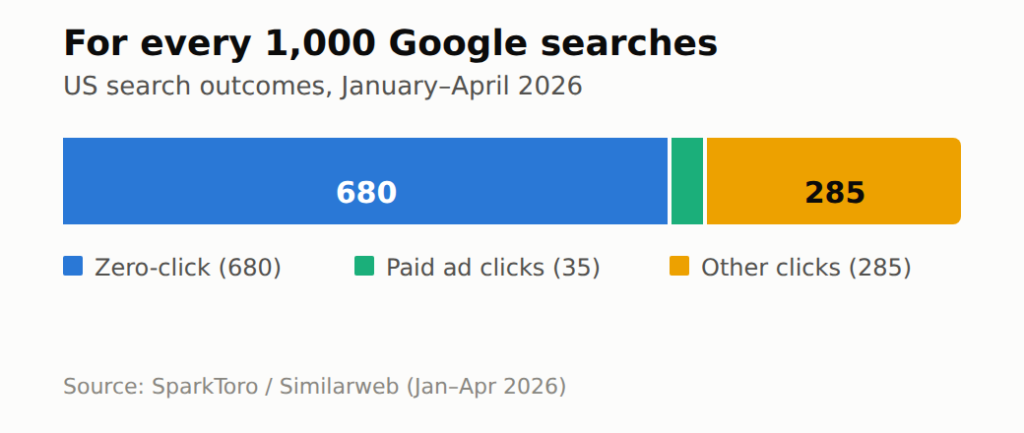
For every 1,000 Google searches in the United States during the first four months of 2026, roughly 680 produced no click to any website. Not to a news publisher. Not to a local business listing. Not to an online store.
The searcher typed a query, got what they needed, or decided they didn’t, and moved on without visiting a page.
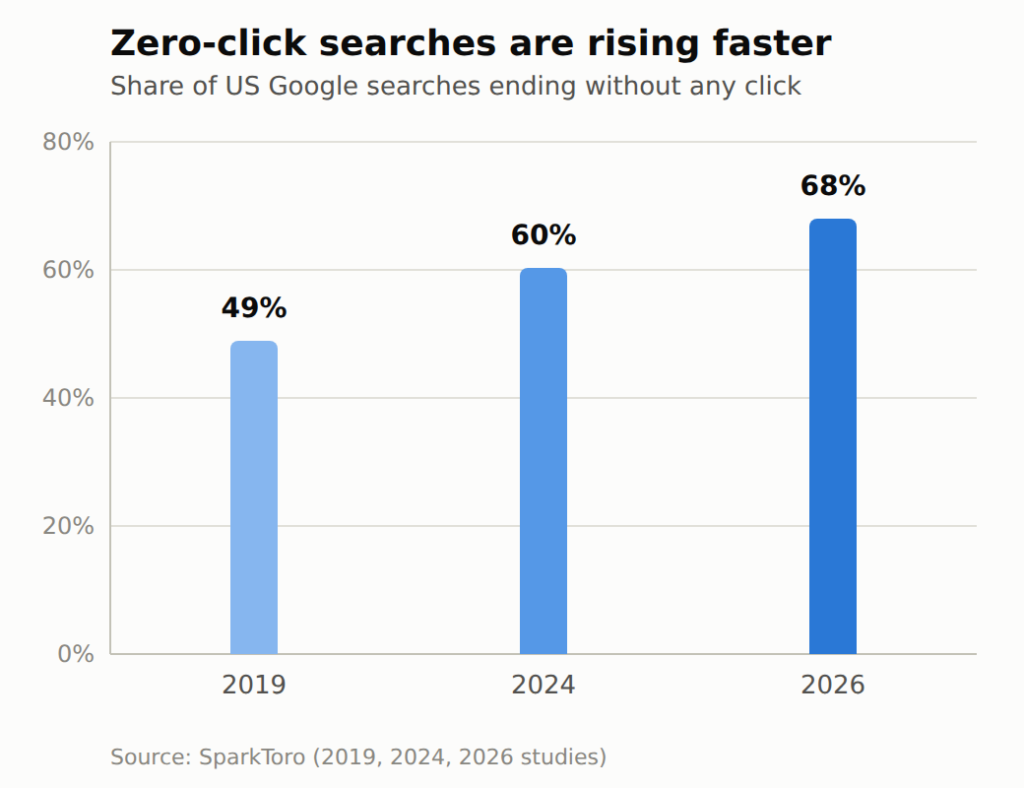
That 68.01% zero-click rate comes from SparkToro’s latest analysis, which used Similarweb clickstream data across desktop and mobile web searches. It’s a steep jump from the 60.45% zero-click rate SparkToro measured in 2024 and the roughly 49% rate from its original 2019 study.
The acceleration is the story. It took five years for zero-click searches to climb by roughly 11 percentage points, from 2019 to 2024. It took just two more years to add nearly eight more. Google’s AI features appear to be one of the main forces pushing that trend, and the latest data doesn’t suggest a near-term reversal.
The numbers behind the shift
SparkToro has tracked zero-click search across three major studies, each using the best clickstream panel available at the time. The data providers changed, so the figures aren’t a perfect apples-to-apples time series. The direction is still hard to ignore.
In 2019, using data from the now-defunct Jumpshot panel, SparkToro found that roughly 49% of US Google searches ended without a click. By 2024, that figure had climbed to 60.45%, based on data from Datos, now part of Semrush. In the first four months of 2026, using Similarweb’s panel, it reached 68.01%.
The 2024-to-2026 jump is especially sharp. SparkToro said searches generating a click of any kind fell by 9.51 percentage points over that span, a 22.9% decrease. Searches that led to another Google search, instead of a click to any website, rose by 7.2 percentage points.
Put simply, more people are searching again instead of clicking through.
What happens to the other 32%
Not all clicks are equal, and the shrinking pool of searches that still produce a click has shifted in composition.
Paid ad clicks have grown as a share of total search outcomes. SparkToro’s 2026 analysis estimated paid click rates at 3.12% on desktop and 3.81% on mobile, based on DigitalApplied benchmarks. That means for every 100 searches, roughly three to four result in someone clicking an ad.
Organic clicks to the open web – the free traffic that millions of businesses have built their online presence around – have been declining. SparkToro’s 2024 study found that only 360 out of every 1,000 US Google searches sent a click to a non-Google-owned, non-ad-paying property. Google-owned properties such as YouTube, Maps, and Google Images absorbed another portion.
The math is simple, but the consequence isn’t. When 68% of searches end with no click and a growing share of the remaining searches goes to paid ads or Google’s own products, the available slice for everyone else keeps getting thinner.
AI features are accelerating the shift
The biggest change between the 2024 and 2026 data is the spread of Google’s AI features in search.
AI Overviews, the AI-generated summaries that appear above traditional search results, now show up on more than 20% of Google searches, according to SparkToro’s summary of third-party research. When they appear, click-through rates can fall sharply. Seer Interactive’s tracking of 311 million organic impressions found that informational queries where a brand wasn’t cited in the AI response saw a 67% decline in organic click-through rates over 2025.
AI Mode adds another layer. Google launched the conversational search interface in 2025, and Search Engine Journal reported that Google disclosed its first AI Mode usage figures after one year. According to that reporting, AI Mode reached one billion monthly active users, queries were more than doubling every quarter, and AI Overviews reached 2.5 billion monthly users globally.
AI Mode accounted for just 0.34% of total Google searches during SparkToro’s January-to-April 2026 study period, so its direct contribution to the zero-click rate was still small. But SparkToro’s analysis found that 92% to 94% of AI Mode sessions ended without an external click, and AI Mode queries averaged roughly three times the length of traditional searches.
As adoption scales, AI Mode’s ability to absorb searches that might otherwise send traffic to websites grows with it. Both features push in the same direction: they answer more queries inside Google, reducing the user’s need to visit another site.
What this looks like for websites
The aggregate data translates into traffic losses for many websites. Ahrefs data cited by SparkToro tracked organic traffic share to more than 75,000 domains from June 2025 to May 2026 and found an eight-percentage-point decline, roughly a 22% drop. SparkToro co-founder Rand Fishkin also wrote that thousands of sites have reported significant traffic losses, while millions have likely experienced some level of decline.
The picture is especially stark for publishers. Press Gazette reported that Google search traffic to publishers fell by one-third globally year over year through November 2025. US publishers were hit hardest, with a 38% decline, compared with 17% in Europe. Press Gazette’s reporting connected part of that difference to European regulation, including the Digital Markets Act and its pressure on large platforms.
Several media executives now talk about search as a managed decline channel. Harry Clarkson-Bennett, SEO director at The Telegraph, told Press Gazette that search probably isn’t going to drive what it once did, even if it remains important. Stuart Forrest, global audience director at Bauer Media, told the publication that organic search is “undoubtedly out of the growth era.”
Not all content has been affected equally. Evergreen how-to articles, informational explainers, and affiliate content are more exposed because they answer query types that AI summaries can package quickly. Breaking news, branded searches, local business queries, and high-intent transactional searches have been more resilient because they depend on either fresh information, specific intent, or direct trust in a known source.
Fishkin’s recommendation from the 2026 study reflects that shift: businesses should invest in brand awareness and influence on the platforms where their audience already spends time, even when those efforts don’t create a direct website visit.
Google’s revenue tells a different story
While the open web receives fewer clicks from Google, Google itself has continued to grow.
Marketing Dive reported that Google’s ad revenue rose 15% year over year to $77.25 billion in Q1 2026, supported by 19% search growth and 11% YouTube growth. Google’s cloud segment, helped by AI infrastructure demand, grew 63% to $20 billion.
Those numbers explain the tension at the center of the zero-click trend. Google can send less traffic to the rest of the internet while still growing search and ad revenue. Fewer outbound clicks don’t necessarily hurt Google if search volume rises, ad placement becomes more valuable, and users keep returning to the platform for more queries.
The antitrust backdrop makes that tension harder to ignore. A US federal court previously found that Google illegally maintained a monopoly in online search. In 2025, the court rejected the Justice Department’s push to force a Chrome sale and imposed behavioral remedies instead, including restrictions on exclusive deals and requirements to share some search data with qualified competitors.
That outcome left Google with far more room to keep reshaping search than a structural breakup would have allowed.
What the data doesn’t capture
Any data story this broad needs caveats.
The biggest one is methodology. SparkToro used a different clickstream data provider for each major study. Jumpshot powered the 2019 work, Datos powered the 2024 work, and Similarweb powered the 2026 analysis. Each provider has different panel sizes, device coverage, and definitions of what counts as a search event. The trend is consistent, but the precise year-to-year comparisons carry that limitation.
The 2026 data also excludes searches made through the Google mobile app, which processes a significant share of mobile search behavior. SparkToro noted that Google tends to use zero-click features even more aggressively inside the app, so the true zero-click rate may be higher than 68%.
On mobile, the 2026 study used a 10-second inactivity threshold. If a user didn’t interact with the search results page for 10 seconds, the session was classified as zero-click. That could count some sessions where users were still reading the results page.
Finally, SparkToro’s 2026 figures are US-only. The 2024 study included European data and found a slightly higher zero-click rate in the EU than in the US, but click behavior can vary by market, regulation, device mix, and search habits.
Even with those caveats, the direction is clear. Zero-click searches are increasing. The pace has accelerated. Google’s AI features are pulling more answers into Google itself.
If your business depends on Google search for visibility, leads, or revenue, the signal is no longer subtle: traffic from traditional search is becoming less reliable, and search visibility now has to be measured by more than clicks.
Frequently Asked Questions
What is a zero-click search?
A zero-click search is a Google search that ends without the user clicking through to another website. The searcher may get an answer directly on the results page, refine the query, or leave without visiting a result. SparkToro’s 2026 analysis found that 68.01% of US Google searches in the first four months of 2026 ended without a click.
What’s causing the rise in zero-click searches?
Google has been answering more queries directly for years, but AI features appear to be accelerating the shift. AI Overviews now appear on more than 20% of searches, according to SparkToro’s summary of third-party research, and Seer Interactive found major click-through declines for informational queries where brands weren’t cited in AI responses. AI Mode is still a small share of total searches, but SparkToro found that 92% to 94% of AI Mode sessions ended without an external click.
How does this affect businesses that depend on Google traffic?
The practical impact is fewer visitors arriving from organic search. SparkToro cited Ahrefs data showing an eight-percentage-point decline in organic traffic share across more than 75,000 domains from June 2025 to May 2026, roughly a 22% drop. If your business depends on informational content to attract visitors, traditional search traffic may be less reliable than it used to be.
What types of content are most exposed to zero-click search?
Evergreen how-to articles, informational explainers, and affiliate content are more exposed because AI summaries can package those answers quickly. Breaking news, branded searches, local business queries, and high-intent transactional searches have been more resilient because they depend on freshness, specificity, or direct trust in a known source.
Does Google still make money if fewer people click?
Yes. Marketing Dive reported that Google’s ad revenue rose 15% year over year to $77.25 billion in Q1 2026, supported by 19% search growth and 11% YouTube growth. Fewer outbound clicks don’t necessarily hurt Google if search volume rises, ad placements become more valuable, and users keep returning to Google for more queries.
Get new small business insights by email
Practical ideas and useful articles to help you make better business decisions.
Tech Help Canada Staff researches, writes, and reviews practical content for business owners and professionals. Our coverage spans business, marketing, SEO, technology, and the tools and systems people use to grow and operate online. We focus on clear, useful information backed by research, hands-on experience, and editorial review. Learn more about our team and editorial standards. Need help with something? Contact Us