
I don’t usually do predictions. Most of them age badly, and the internet is already loud enough.
But this one feels worth putting on the record.
None of what I’m about to share is a guarantee. I’m reading incentives, product direction, and early user behavior.
If you can ask better follow-up questions without leaving Google, a lot of people won’t leave. And once a new default feels good enough, the old default starts to feel optional.
Below are my predictions and the reasons I think they’re plausible. (A few are already happening at a smaller scale. I expect them to show up more often as Google expands AI Mode and AI answers.)
1. Google Will Become AI Mode
AI Mode won’t be a place you go. It becomes the front door.
This is already how the experience is being shaped. Google is explicitly collapsing the journey from AI Overviews into follow-up questions and then into AI Mode.
They describe this as a more seamless conversational flow, and say testing showed people preferred an experience that naturally becomes a conversation.
Currently, the interface nudges you into a loop that feels less like searching and more like staying in a chat.
In many cases, you first get an AI overview when you search for something. If you click “Show More,” you’re given a longer summary and asked at the bottom if you’d like to deep dive in AI Mode.
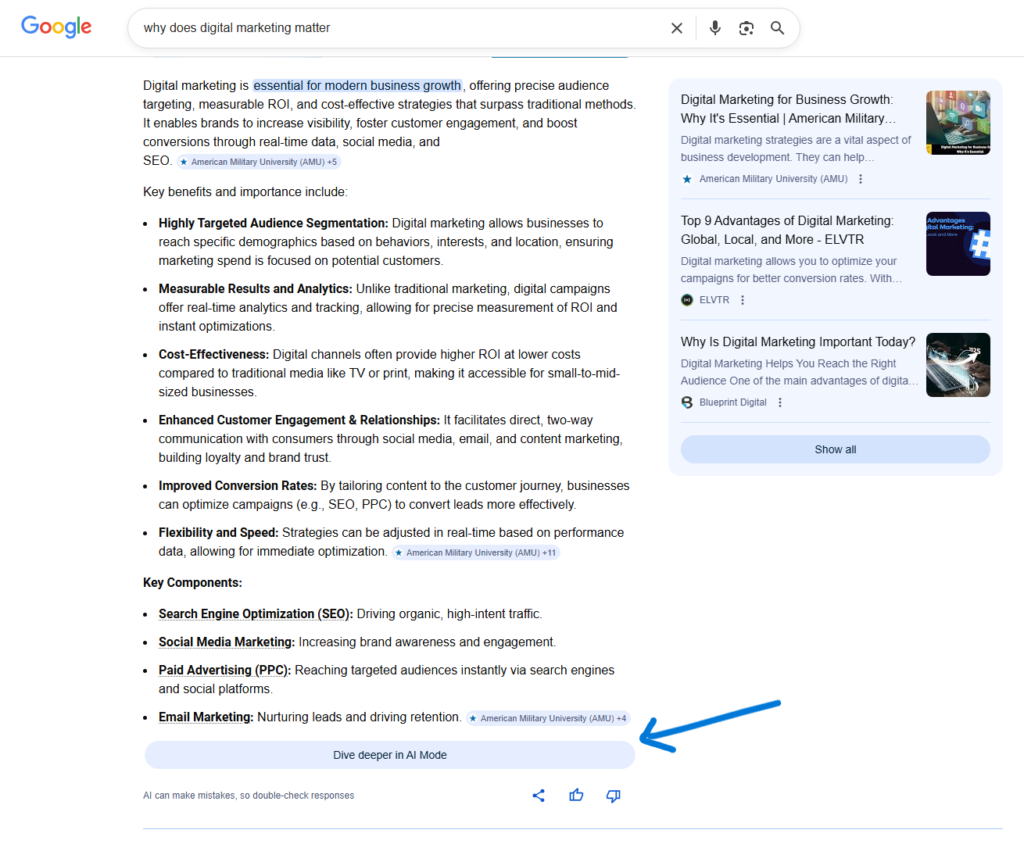
Classic results don’t disappear overnight. They become secondary. They’re what you use when you want to verify something, browse widely, or you simply prefer the old flow. Over time, the default will win, and in my estimation, that default will be AI Mode.
2. Clicks Will Keep Collapsing, Even When Content is Excellent
A lot of publishers are going to learn a frustrating lesson. You can do everything right and still get fewer visits.
Tailwind Labs’ CEO publicly pointed to this dynamic, saying AI has hurt their business and citing layoffs of most of the engineering team at the time.
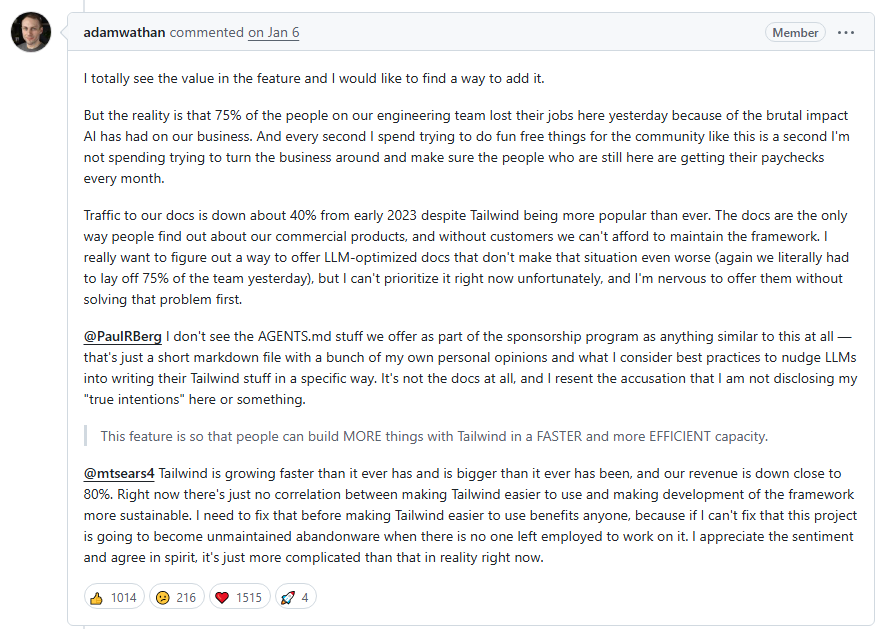
If the interface satisfies the intent, the click becomes optional. That’s the whole problem.
For years, informational content had a built-in advantage. If you wanted depth, you had to leave the results and read. AI changes that. Depth can be produced through follow-ups. You can keep drilling down without ever opening a page.
That doesn’t mean nobody clicks. It means the baseline keeps sliding down. You can see it in CTR studies already. Seer Interactive tracked thousands of informational queries over a period and found organic CTR on queries that showed AI Overviews fell 61% (1.76% down to 0.61%).
You’ll still see clicks when people are doing deeper research, when the stakes are higher, and when someone wants the full context instead of a synthesis. You’ll also see clicks when a user simply prefers reading a source directly.
But for everyday questions, a growing share of people will treat the answer inside Google as the finish line.
3. Commercial Investigation Will Get Partially Answered, and Creators Will Lose Credit
This is where it gets messy.
Even today, many buying decisions start with research that looks informational. For example, WordPress review, best accounting software, and is X better than Y terms.
If Google gives a solid, compact decision summary, many users won’t feel the need to visit the pages that did the work. They’ll learn from the synthesis, then go straight to the brand, the marketplace, or the app store.
That creates a real credit problem.
Affiliate publishers and reviewers don’t just want to be right. They need the click for attribution. If the user learns from your work and buys without ever visiting your site, you did the work and someone else gets paid.
I’m not saying affiliate marketing dies. I’m saying the squeeze will get worse across the funnel, including top-funnel informational queries and mid-funnel review content that can be summarized.
4. Destination Content Will Outperform Pure Information
If AI makes information easier to consume without visiting the source, then the safest content is the content that isn’t just information.
The web still needs places where the action happens. AI can summarize a comparison, but it can’t fully replace doing.
The pages that hold up better tend to have something you can’t get from a summary alone, like:
- Tools and calculators
- Templates and other downloads
- Interactive comparisons and selectors
- Original datasets and searchable databases
- Checkouts, sign-ups, and workflows that require interaction
Informational pages can still win. They’ll still be discovered. They’ll still be read.
But the more your page is the place where someone completes the job, the less vulnerable you are to being reduced to a paragraph.
5. AI Mode Becomes Default When AI Mode Prints Money
Google’s timeline isn’t only about product quality. It’s also about economics.
Google makes most of its revenue from ads. In Alphabet’s latest annual filing (year ended Dec 31, 2025), total revenue was $402.836B and Google advertising revenue was $294.691B (about 73% of total).
The interface that becomes the default will be the interface that protects or grows revenue.
AI Mode is powerful, but it changes how people move. Less scrolling. Fewer traditional clicks. More satisfaction without leaving.
So the switch flips when advertising inside the AI experience works. In a way that feels native to the flow, so Google can monetize without breaking the experience or collapsing advertiser confidence.
Once that’s solved, the pressure to keep AI Mode as a separate destination drops fast.
In a Google Ads update, the search giant mentions that Ads in AI Overviews expanded to desktop and more countries. It’s also testing ads in AI Mode in the US, including ads that can appear below and integrated into AI Mode responses.
6. Inclusion Will Matter More Than Ranking in Some Niches
In classic search, you fought to rank.
In an AI-first search experience, you’re trying to be included and to rank within what gets included.
Even when the answer is synthesized, the interface still shows sources and links. On desktop, for example, you can often see a list of sites alongside the response. That means there’s still competition for position and visibility, not just a binary in or out.
Being cited or referenced can build awareness. But awareness doesn’t always pay the bills.
If you rely on visits to monetize, inclusion without clicks can be a downgrade. If you sell something that requires an on-site action, inclusion and strong placement matter a lot. It can push the right people to the right place.
7. Personalization Increases, and Rankings Become Less Predictable
As AI gets more capable, search results become less like a shared public list and more like a personalized output (Search has been context-aware for years, but mostly through more limited signals).
If two people can ask the same question and get answers that differ in meaningful ways, that changes how brands win.
In a more personalized world, familiarity becomes an advantage. It’s plausible that known entities get surfaced more often, even when the query is identical. For example, if a user recognizes a brand, has visited a site before, or regularly engages with a creator on other platforms, they may see that brand show up more often.
8. The Web Splits Into Instant Answers and Deep Dives
Most people don’t want to do research. They want to be done.
AI Mode serves that. It gives instant, coherent answers and lets you keep asking without opening tabs.
At the same time, some situations still demand deeper work, such as high-stakes topics, complex decisions, technical tasks, or anything that requires verification.
So the web becomes more polarized.
You’ll have a large set of queries where the synthesized answer is enough, and a smaller set where people still go deep. The deep visits may shrink in volume, but they can be more intentional.
Put another way, the traffic that remains can be higher quality, even as the total number of visits declines.
9. Human Traffic Shrinks as Bots and AI Agents Take a Bigger Share of the Web
Web activity is going to be dominated by three buckets:
- Bots that have existed for years, including scrapers and automated attacks
- AI crawlers and AI tools that browse and summarize at scale
- Humans
Bot traffic is already massive, and AI-driven crawling is accelerating. Imperva’s 2025 Bad Bot Report found automated traffic was 51% of all web traffic in 2024 (up from 49.6% in 2023).
On the AI crawler side, Cloudflare’s 2025 reporting showed “other AI bots” averaged 4.2% of HTML requests, while Googlebot alone accounted for 4.5%—and by early December, humans were under half of HTML request traffic in their view.
More tools will browse on behalf of users. Not just to answer questions, but to compare products, verify information, and complete simple tasks.
So raw request volume rises, but the true human share of what you see in logs shrinks.
That also means your analytics can look busy while your business isn’t.
More activity doesn’t automatically mean more humans and vice versa.
10. YouTube, LinkedIn, Email, and Communities Become More Important
If Google sends fewer clicks, brands will lean harder on channels that still deliver reach and repeat exposure.
That pushes more attention toward platforms where people spend time and build familiarity, like YouTube and LinkedIn.
It also increases the value of direct relationships, like email lists and communities.
Brands will want more than one way to be found (most already do — this just becomes less optional).
11. Pushback Escalates, and the Rules of Summarizing the Web Get Contested
As referral traffic declines, this becomes less of a marketing conversation.
It becomes a survival conversation.
In Europe, the European Publishers Council announced an antitrust complaint tied to AI Overviews and AI Mode. In the US, the Association of American Publishers said member companies moved to intervene in Google’s generative AI copyright litigation.
Publishers, creators, and regulators will push back harder with complaints, lawsuits, licensing demands, and policy proposals.
Some of this pushback will be about fairness. Some will be about competition. Some will be about public interest.
The details will vary by country and industry, but the direction is predictable.
If the incentive structure breaks, people will fight over the rules.
I’m Not Predicting the End of the Web
I’m predicting a change in who gets paid for discovery.
When answers happen inside the interface, a lot of value shifts away from earning the click and toward being the default choice. That’s not just a marketing shift. It’s a revenue shift across publishing, affiliate, lead gen, and the businesses built around them.
The safest assets will be the ones people seek out on purpose, and the ones that can’t be fully consumed as a summary.
Sources:
- https://www.sec.gov/Archives/edgar/data/1652044/000165204426000018/goog-20251231.htm
- https://blog.google/products-and-platforms/products/search/ai-mode-ai-overviews-updates/
- https://support.google.com/google-ads/answer/16756291
- https://cpl.thalesgroup.com/about-us/newsroom/2025-imperva-bad-bot-report-ai-internet-traffic
- https://blog.cloudflare.com/radar-2025-year-in-review/
- https://presswire.com/release/european-publishers-council-files-formal-antitrust-complaint-against-google-over-ai-overviews-and-ai-mode/
I can suggest related Tech Help Canada articles based on the topic you’re reading now.

Gabriel Nwatarali is the founder of Tech Help Canada and has worked in SEO, copywriting, and web strategy since the early 2000s. His work has helped drive more than 10 million app downloads and 2,900% organic traffic growth for startups, agencies, and brands across North America. He writes about SEO, marketing, AI, and the decisions that shape how businesses grow online, drawing on hands-on experience building websites, content systems, and digital strategies.