A Canadian family of four could spend $17,571.79 on food in 2026, up to $994.63 more than in 2025, according to Canada’s Food Price Report. That figure is a forecast for the year, not money families have already paid. The latest inflation data shows why the forecast still matters.
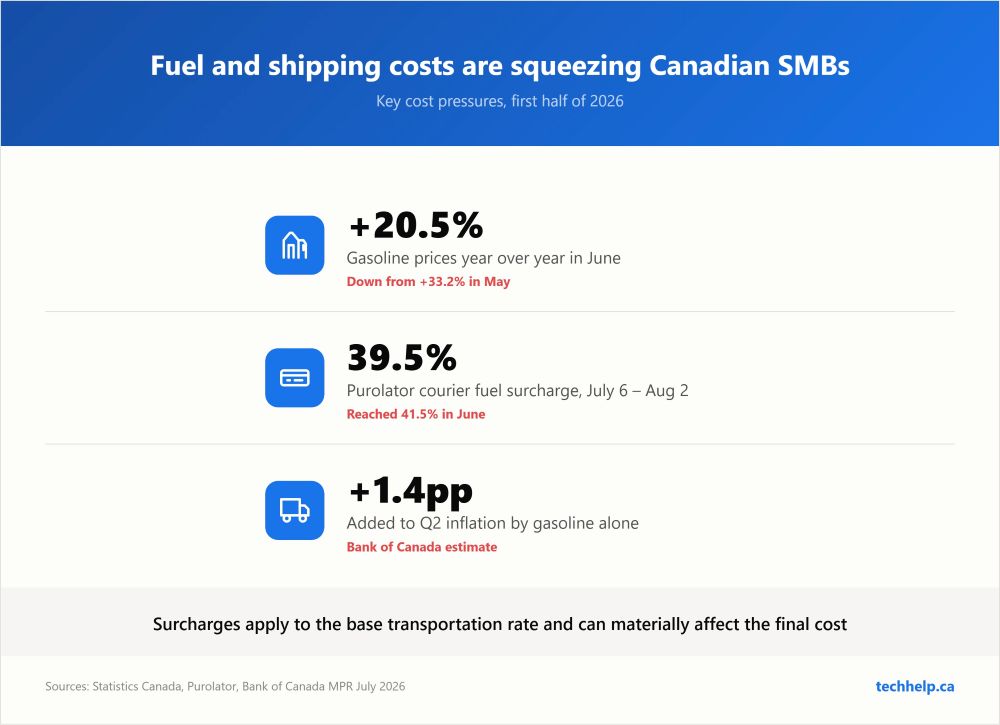
In June, grocery prices were 3.9% higher than a year earlier. Gasoline was up 20.5%, even after falling sharply from May. Purolator’s courier fuel surcharge is 39.5% for July 6 through August 2 after reaching 41.5% in June.
Canadian small businesses face pressure from both directions. Food, fuel, shipping and other inputs are more expensive, while customers are comparing prices, switching brands and trimming discretionary purchases. A blanket price increase or a broad discount won’t solve both problems.
The better response is to identify which costs are likely to persist, protect margin where it is under the most pressure, and make the value of every offer easier to see. That work can start now, without betting the business on an economic forecast.
Canada’s inflation rate is easing, but household pressure isn’t
Statistics Canada reported that the Consumer Price Index rose 2.8% year over year in June, down from 3.2% in May. Its two preferred core measures were lower: CPI-trim was 1.8% and CPI-median was 1.9%.
Those national measures suggest underlying inflation is close to the Bank of Canada’s 2% target. Prices remain well above earlier levels because inflation measures the rate of change, not the price level. A lower inflation rate means prices are rising more slowly; it doesn’t reverse the increases households have already absorbed.
The categories also matter. Grocery prices rose faster than the headline CPI for the 17th consecutive month. Transportation prices increased 6.7%, led by gasoline. When Statistics Canada removed gasoline from the calculation, the June inflation rate was 2.2%.
That difference explains why a customer can hear that inflation is easing and still feel worse off. The bills that arrive most often can move very differently from the national average.
Groceries and transportation are doing the damage
Grocery inflation remains above the headline rate
Canada’s Food Price Report 2026 forecast a 4% to 6% increase in total food prices for the year. It projected the largest increase for meat at 5% to 7%, followed by restaurants at 4% to 6% and vegetables at 3% to 5%.
The June CPI provides observed price changes rather than a full-year forecast. Food purchased from stores was 3.9% more expensive than a year earlier. Fresh or frozen chicken rose 5.7%, bread, rolls and buns rose 6%, and frozen food preparations rose 2.7%.
The two datasets answer different questions. The food report estimates what may happen across 2026. The CPI measures prices consumers actually faced in June. Together, they show continued pressure without implying that every family, product or region will experience the same increase.
Food prices were already about 27% higher than five years earlier when the 2026 report was released. That accumulated increase affects the money available for restaurant meals, subscriptions, professional services, retail purchases and other spending.
Fuel is feeding shipping and operating costs
Gasoline prices were 20.5% higher in June than a year earlier. That was an improvement from May’s 33.2% increase, and prices fell 10.2% from May to June. The monthly drop shows how quickly energy costs can change; the annual increase shows the pressure has not disappeared.
The Bank of Canada attributes much of the recent energy shock to the war in the Middle East and disruption to oil production and shipping. Its July Monetary Policy Report estimates that higher gasoline prices added about 1.4 percentage points to inflation in the second quarter. It expects other war-related costs, including diesel, shipping and commodity inputs, to peak later and pass through more gradually.
Carrier surcharges make that pressure visible to businesses. Purolator’s published courier fuel surcharge reached 41.5% for most of June and is 39.5% from July 6 through August 2. The percentage applies to the carrier’s base transportation rate. It isn’t a 39.5% increase in the customer’s complete shipping bill, but it can materially affect the final cost.
A business that receives inventory, delivers products or sends parcels should separate fuel-sensitive costs from the rest of its expenses. Volatile fuel costs may support a temporary delivery fee or narrower shipping zone. A lasting increase in supplier or labour costs may require a different pricing decision.
Customers are trading down without abandoning trust
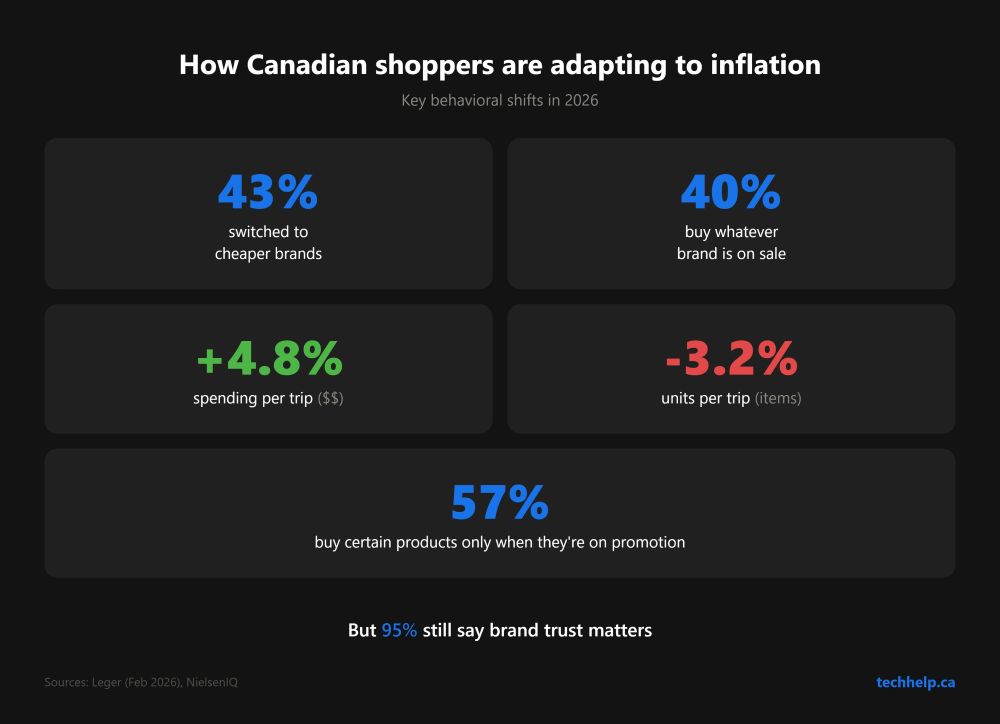
Canadian consumers have already changed how they shop. A February 2026 Leger survey found that 43% had switched to cheaper brands during the previous year and 35% had moved to private-label products. Fifty-seven percent said they bought certain products only when they were on promotion.
NielsenIQ found a similar pattern in fast-moving consumer goods. Dollar spending rose 4.8% while units purchased per trip fell 3.2%. Higher spending didn’t necessarily mean stronger demand; people were paying more while taking fewer items home.
The same research found that 40% of Canadians would buy whichever brand was on sale. Yet 95% still considered brand trust important. Price sensitivity and trust can coexist. A customer under pressure can search for a lower price and still avoid a seller or product they don’t trust.
For a small business, value needs to be concrete. State what is included, how long the product should last, what problem the service solves, when the customer will receive it and what happens if something goes wrong. If a lower-cost option exists, make the trade-off clear rather than forcing the customer to compare vague packages.
How to decide whether to raise prices
The pricing decision should begin with your own cost and margin data, not the national CPI. A 2.8% inflation rate doesn’t tell a restaurant what happened to chicken costs, a retailer what happened to freight, or a consultant what happened to software and labour expenses.
Separate volatile costs from persistent costs
Bank of Canada research on the 2025 counter-tariff episode illustrates the distinction. Using more than 110,000 online prices from seven Canadian retailers, researchers found that products subject to a 25% counter-tariff became about 6% more expensive relative to other products. That is roughly one-quarter pass-through, not a full transfer of the cost.
Many of those relative price increases reversed after most counter-tariffs were removed. The study covered a specific group of retailers and products, so it isn’t a universal pricing rule. It does show why the expected duration of a cost matters. Temporary costs may be absorbed, offset or handled with a temporary fee. Persistent costs are more likely to require a base-price change.
Price the affected offer, not the whole catalogue
Calculate contribution margin by product, service or customer segment. Include payment fees, packaging, fulfilment, discounts, returns and the labour required to complete the sale. Then identify where the gap actually exists.
You may be able to hold an entry-level offer steady while adjusting a premium option. You may need to change a delivery threshold rather than the product price. A low-margin item may need a larger correction than a high-margin item, even if both face the same supplier increase.
A competitive pricing analysis can help you compare the complete offer without copying a competitor’s sticker price or racing to the bottom.
Explain the change without overstating the evidence
The Bank of Canada study found that products visibly labelled as tariffed received larger and faster price increases. It didn’t measure whether customers liked those increases or whether an explanation prevented switching.
Clear communication is still useful. Tell customers what’s changing, when it takes effect and which parts of the offer remain unchanged. Name the relevant pressure when you can support it, but don’t turn a price notice into a long defence. Give customers a lower-cost option, smaller package, longer commitment or pickup choice when the economics allow it.
After the change, track unit volume, gross-margin dollars, conversion rate, repeat purchases, cancellations and customer questions. Revenue alone can hide a price increase that damages demand or a discount that destroys margin.
Do not disappear while customers are comparing harder
Business confidence remains weak. The Canadian Federation of Independent Business reported a June long-term confidence index of 49.6 and a short-term index of 46.1. An index below 50 means more owners expect weaker performance than stronger performance. Fuel costs affected about two-thirds of the businesses surveyed.
That is a reason to demand more from marketing, not to preserve every campaign automatically. Keep the activity that can be measured against qualified leads, repeat purchases, booked calls, revenue or gross margin. Pause work that produces attention without a business result.
A 2026 Constant Contact survey found that 41% of small-business owners across five countries considered inflation their top concern, while 68% planned to increase their marketing budgets and 74% expected to spend more time on marketing. Those are stated plans, not proof that spending more guarantees growth. They do show that many owners are responding to uncertainty with more market activity rather than silence. Our coverage of the survey explains why 68% of small businesses expected to increase marketing spending.
For a business with limited cash, owned and retention-focused channels deserve close attention. Email existing customers when stock, pricing or service options change. Follow up after purchase. Fix recurring complaints. Make reordering simple. Our guide to customer retention strategies can help organize that work.
The message should reflect what customers are deciding now: why this purchase is worth making, why your offer is reliable and which option fits a tighter budget. Constant promotion without that explanation will make the business louder, not more persuasive.
Canada isn’t in a technical recession, but growth is weak
Canada didn’t record two consecutive quarters of declining real GDP. Statistics Canada reported a 0.2% decline in the fourth quarter of 2025 followed by no growth in the first quarter of 2026. That doesn’t meet the common definition of a technical recession.
The Bank of Canada estimated that growth resumed at an annualized pace of 2.5% in the second quarter. It still expects only 0.7% growth for 2026 as a whole, followed by 1.8% in both 2027 and 2028.
Its central forecast has inflation moving close to 2% in early 2027. The main risks are the future Canada-U.S. trade relationship and the duration and economic effects of the war in the Middle East.
Even if the forecast holds, lower inflation won’t restore old price levels. Customers may remain selective while incomes and budgets catch up. Businesses should therefore use shorter planning cycles and their own operating data rather than waiting for one national indicator to provide an all-clear.
A 90-day response plan
Map the pressure. Compare the last 90 days with the same period last year. Separate supplier, labour, energy, delivery, payment and return costs by product or service.
Protect the right margin. Set a minimum contribution margin, then adjust the affected item, package, delivery rule or customer segment instead of applying one percentage across the business.
Build a clear value ladder. Offer a credible entry option, a strong middle choice and a premium option with specific added value. Make the differences easy to compare.
Protect existing demand. Contact recent and repeat customers with useful information, relevant offers and simple reorder paths. Resolve the problems that cause cancellations or returns.
Review the result every two weeks. Watch gross-margin dollars, units sold, conversion, average order value, repeat purchases, churn, shipping cost per order and customer questions. Keep, revise or reverse the decision based on what those measures show.
Canadian households are under pressure even as the headline inflation rate improves. Businesses are feeling many of the same costs. The practical response is neither panic discounting nor automatic price increases. It is a disciplined review of cost, margin, value and demand, followed by changes small enough to measure and specific enough to defend.
Frequently Asked Questions
Should I raise my prices during inflation?
Raise prices when your product-level costs and margins show that the current price is no longer sustainable. Separate temporary costs from persistent ones, calculate contribution margin for the affected offer, and consider a delivery fee, package change or targeted increase before changing every price. Track unit volume, gross-margin dollars, conversion and cancellations after the change.
How do I communicate a price increase without losing customers?
Tell customers what is changing, when it takes effect and what they will continue to receive. Give a specific, supportable reason when one is relevant, but keep the explanation brief. If possible, provide a lower-cost package, pickup option, smaller quantity or longer-term plan so the customer has a choice other than leaving.
Is Canada in a recession in 2026?
Canada wasn’t in a technical recession based on the quarterly data available in July 2026. Real GDP declined 0.2% in the fourth quarter of 2025 and was unchanged in the first quarter of 2026, so there weren’t two consecutive quarterly declines. The Bank of Canada estimated that growth resumed in the second quarter, but it still forecasts weak full-year growth of 0.7% for 2026.
Why are food prices still high in Canada in 2026?
Food prices reflect accumulated increases in commodities, labour, energy, transportation and other supply-chain costs. Canada’s Food Price Report forecast a 4% to 6% increase in total food prices for 2026 after food prices had already risen about 27% over five years. Statistics Canada reported that grocery prices were 3.9% higher year over year in June.
How does the Middle East war affect Canadian prices?
The conflict has disrupted oil production and shipping, raising the cost of gasoline, diesel, freight and some commodities. Gasoline prices in Canada were 20.5% higher year over year in June 2026, although they fell 10.2% from May. The Bank of Canada expects other war-related costs to reach consumer prices more gradually.
Should small businesses cut marketing when customers are spending less?
Don’t cut or increase marketing by default. Protect the work that produces qualified leads, repeat purchases, booked calls, revenue or gross margin, and pause activity that can’t be connected to a business result. With customers comparing more carefully, focus the message on clear value, reliability and options that fit different budgets.
Get new small business insights by email
Practical ideas and useful articles to help you make better business decisions.
Tech Help Canada Staff researches, writes, and reviews practical content for business owners and professionals. Our coverage spans business, marketing, SEO, technology, and the tools and systems people use to grow and operate online. We focus on clear, useful information backed by research, hands-on experience, and editorial review. Learn more about our team and editorial standards. Need help with something? Contact Us