Yes, digital marketing is a good career if you want work that combines creativity, data, technology, and business strategy.
The field has measurable demand, several routes to six-figure pay, and enough variety to support very different strengths. A search specialist, lifecycle marketer, analyst, copywriter, and marketing manager can all work in digital marketing without doing the same job.
There is a catch. Employers pay for outcomes, not familiarity with marketing terms or tools. The strongest candidates can acquire customers, improve conversion, interpret data, and explain what their work did for the business. AI is making routine production faster, which raises the value of judgment and commercial skill.
This article uses current U.S. employment projections, job-posting data, and 2026 salary benchmarks to show where the opportunities are, what the work pays, and who is likely to enjoy it. All salary figures are in U.S. dollars unless stated otherwise.
Is digital marketing worth it? The short answer
For many people, yes. Digital marketing offers three advantages that are hard to find together: a broad job market, skills you can use across industries, and more than one way to earn.
You can work for a company, join an agency, freelance, consult, or build your own business. You can specialize in a channel such as SEO or email, move into analytics or automation, or manage an entire marketing function.
The field is less attractive if you want predictable work that changes slowly. Platforms update their rules, attribution is imperfect, and performance is visible. A campaign can fail in public, with a dashboard showing exactly how much it cost.
Digital marketing is worth it when that feedback feels useful rather than threatening. People who enjoy testing, learning, and improving a result tend to have more staying power than people drawn to the field because it appears easy to enter.
Scope of digital marketing: the roles inside the field
Digital marketing is an umbrella term. It covers the work businesses use to attract, convert, and retain customers through websites, search engines, email, social platforms, online advertising, and other digital channels.
The scope of digital marketing includes four broad types of work.
Channel specialists
Channel specialists build depth in one area. Common roles include SEO specialist, paid search specialist, social media specialist, email marketer, content marketer, and affiliate manager.
These jobs suit people who like mastering a system and improving it over time. The risk is becoming too dependent on one platform. Strong specialists understand the customer journey and how their channel supports revenue, not only how to operate the tool.
Data, automation, and optimization roles
Marketing analysts, marketing automation specialists, conversion optimization specialists, and marketing operations professionals sit closer to data and systems.
Their work may include measurement plans, dashboards, customer segmentation, A/B testing, lead routing, lifecycle automation, and data quality. These roles often command higher pay because poor measurement and broken systems affect every campaign.
Creative and content roles
Copywriters, content strategists, designers, video producers, and creative directors turn customer insight into messages and assets.
AI can accelerate drafts and production. It cannot take responsibility for positioning, factual accuracy, taste, brand consistency, or the decision to publish. Creative professionals who understand performance data are harder to replace than those who only produce assets.
Strategy and management roles
Digital strategists, growth marketing managers, demand generation managers, and marketing directors decide where the company should compete, how to allocate budget, and how channels should work together.
These roles carry more responsibility because the work affects revenue, customer acquisition cost, and company priorities. They usually require evidence that you can manage trade-offs, not just campaigns.
Is digital marketing in demand? What the job market shows
The demand for digital marketing is real, but there is no single government category called “digital marketer.” The best public indicators track related occupations and employer postings.
The U.S. Bureau of Labor Statistics projects employment for advertising, promotions, and marketing managers to grow 6% from 2024 to 2034, compared with 3% for all occupations. It expects about 36,400 openings a year, although many will replace people who change occupations or leave the labour force rather than represent newly created jobs.
Market research analysts and marketing specialists provide another useful measure. BLS projects 7% growth from 2024 to 2034 and about 87,200 openings a year. It links that growth to businesses using more data to understand customers, evaluate marketing, and estimate product demand.
The 2026 digital marketing job market also shows clear demand for specialized skills. Robert Half counted 376,200 U.S. marketing and creative postings in 2025, including 64,900 digital marketing roles across seniority levels. Marketing automation manager postings grew 10% year over year, while analytics roles represented 19% of new digital marketing postings.
Its current hiring outlook reports that 65% of surveyed marketing and creative leaders plan to increase permanent headcount in the second half of 2026. At the same time, 45% say finding skilled professionals is harder than it was a year earlier.
Those digital marketing hiring trends point in the same direction: companies are hiring, but they are selective. Knowing how to post content or pull a report is a weak position. Employers are looking for people who can use analytics, automation, customer insight, and creative judgment to improve a business result.
Industries that need digital marketing
Almost every customer-facing industry uses digital marketing, but the work differs by business model.
Robert Half’s 2025 posting analysis found the most marketing and creative openings in manufacturing and distribution, with 32,600. Technology and IT followed with 31,600, financial services with 26,600, and consumer products with more than 20,000.
Its salary research also identifies healthcare, professional services, retail and ecommerce, and technology as industries competing for specialized marketing talent.
The need is practical in each case. Ecommerce businesses need acquisition, merchandising, retention, and conversion skills. Software companies need product marketing, demand generation, and lifecycle programs. Financial and healthcare organizations need marketers who can communicate clearly while working within tighter compliance rules. Professional services firms need trust, expertise, and qualified leads.
Industry knowledge can become a career advantage. A paid media specialist who understands subscription economics or a content strategist who understands regulated claims brings more value than a generalist who must learn the business from zero.
Best-paying digital marketing jobs and salary ranges
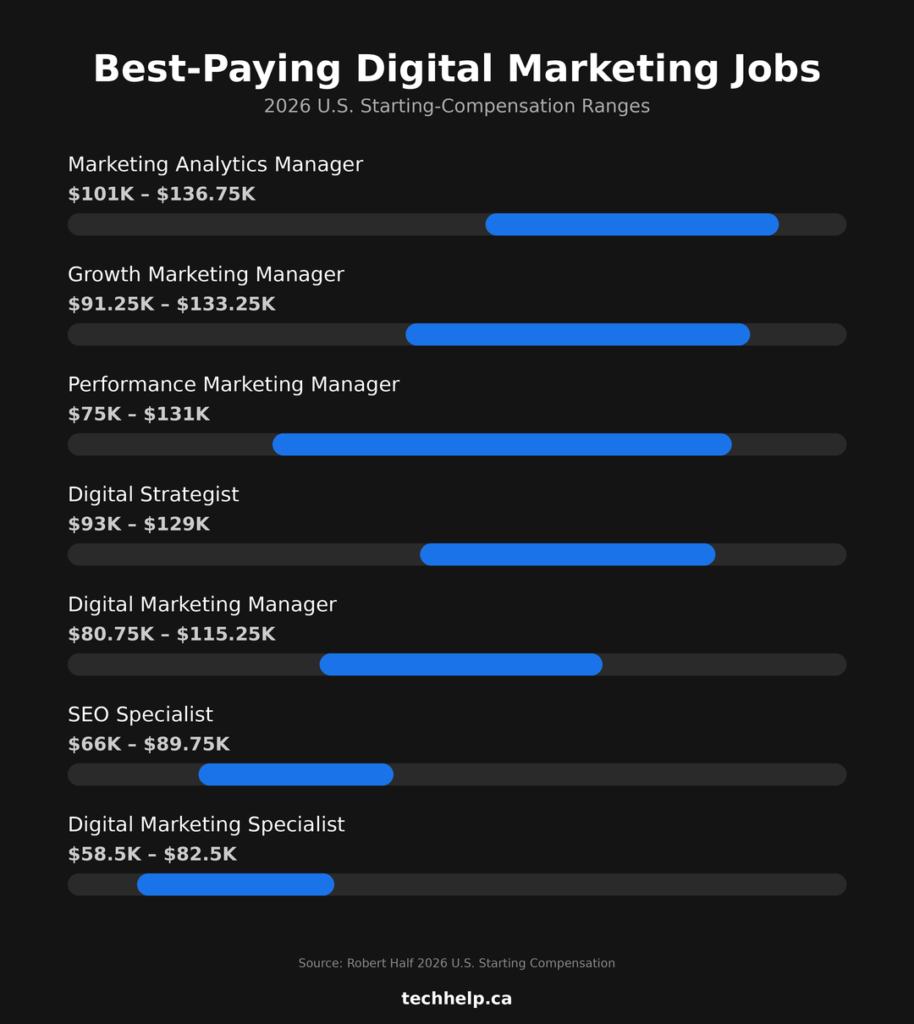
Salary comparisons are messy when one source reports starting pay, another reports base salary, and another includes bonuses. The table below uses one methodology throughout: Robert Half’s 2026 national starting compensation ranges for the U.S.
“Starting compensation” means expected pay for someone beginning a new position, not necessarily someone beginning a career. The figures exclude bonuses, benefits, and other incentives.
Role
Low
Midpoint
High
Marketing analytics manager
$101,000
$117,750
$136,750
Growth marketing manager
$91,250
$108,750
$133,250
Performance marketing manager
$75,000
$103,000
$131,000
Digital strategist
$93,000
$109,500
$129,000
Digital marketing manager
$80,750
$100,750
$115,250
SEO specialist
$66,000
$76,750
$89,750
Digital marketing specialist
$58,500
$69,000
$82,500
The best-paying digital marketing jobs in this dataset share one trait: responsibility for decisions. Analytics managers interpret performance, growth marketers coordinate acquisition, and strategists decide where budget and effort should go. The ceiling rises as the work moves from completing tasks to owning a result.
What increases your earning power
Specialization has a measurable effect. Robert Half found that 78% of more than 200 surveyed U.S. marketing and creative leaders offer higher pay to candidates with specialized skills.
Digital marketing strategy led the skills employers would pay more for, cited by 44% of leaders. AI and machine learning followed at 37%, marketing automation at 33%, and marketing research and analytics at 32%.
Treat those percentages as hiring preferences, not guaranteed pay premiums. Your salary still depends on the role, location, industry, company size, experience, and evidence you can produce.
The most persuasive evidence is usually a result with context: qualified leads increased while acquisition cost fell; organic traffic grew for commercially valuable searches; an email program produced more revenue without exhausting the list. A number without the starting point, timeframe, and your contribution is less convincing.
Career paths and how they progress
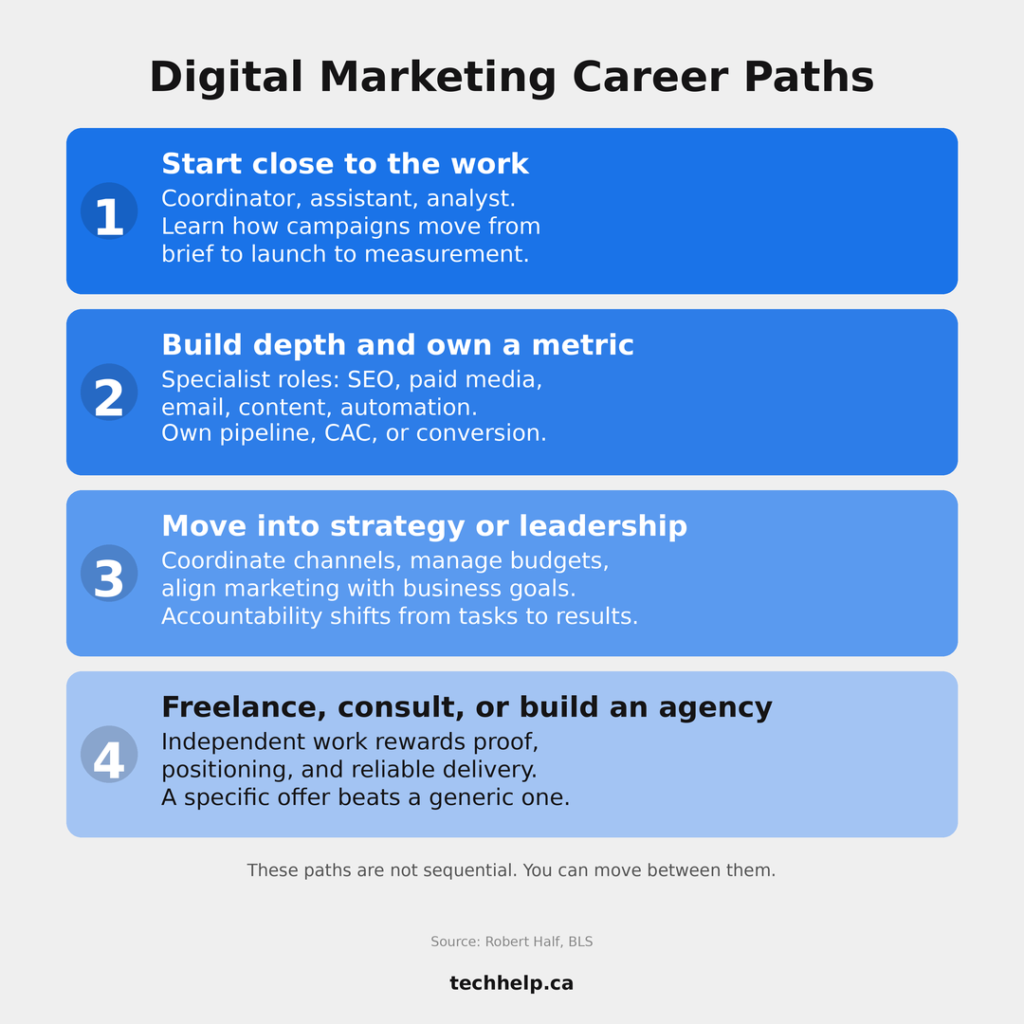
Digital marketing has several career ladders. You can move upward into management, deepen a specialty, or use your experience to work independently.
Start close to the work
Early roles include marketing coordinator, content assistant, junior SEO specialist, paid media associate, email coordinator, and marketing analyst. Our guide to entry-level digital marketing jobs explains what these positions involve.
The goal at this stage is to learn how work moves from brief to launch to measurement. You need enough technical ability to contribute and enough curiosity to ask why the campaign exists.
Build depth and own a metric
Specialists become more valuable when they can own a meaningful metric, such as qualified pipeline, customer acquisition cost, conversion rate, retention, or non-branded organic revenue.
Job titles at this stage vary widely. SEO specialist, lifecycle marketer, content strategist, paid media manager, and marketing automation specialist can all be mid-career roles. Scope and results tell you more than the word “manager” in the title.
Move into strategy or leadership
Senior marketers coordinate channels, allocate budgets, manage people, and explain decisions to executives. The job becomes less about operating every tool and more about setting priorities, resolving conflicts, and accepting accountability for the result.
Leadership is not the only route to higher pay. A technical SEO consultant or marketing operations specialist can build a strong career without managing a large team.
Freelance, consult, or build an agency
Independent work rewards proof, positioning, sales ability, and reliable delivery. A specific offer such as “email lifecycle strategy for subscription businesses” is easier to buy than “digital marketing help.”
Freelancing can lead to consulting or starting a digital marketing agency, but each step adds business responsibilities. Client acquisition, pricing, contracts, cash flow, and quality control become part of the job.
How AI changes the future of a digital marketing career
AI is already changing daily marketing work. It can accelerate research, generate variations, summarize data, automate workflows, and shorten the distance between an idea and a test.
McKinsey estimates that generative AI could create productivity value equal to 5% to 15% of total marketing spending. That is a productivity estimate, not a forecast that the same percentage of jobs will disappear.
The tasks most exposed are repeatable and easy to evaluate: first drafts, asset variations, routine reports, tagging, summaries, and basic campaign adjustments. The person using the output still has to check the facts, protect the brand, understand the customer, choose the strategy, and accept responsibility for the decision.
The future of a digital marketing career rests on that judgment layer. A marketer who only produces a first draft faces more pressure than one who can identify the right audience, make a defensible offer, design a useful test, and interpret the result.
AI fluency belongs in the skill set, but “knows AI” is too vague to impress an employer. A stronger claim is specific: you built an automated reporting workflow, reduced production time while preserving review, or used AI-assisted analysis to find an opportunity that improved campaign performance.
Remote work and freelancing are possible, not automatic
Digital marketing work often travels well because many tasks happen in browsers, analytics platforms, content systems, and meetings. Current hiring data still shows that fully remote roles are a minority.
Robert Half’s analysis of U.S. job postings in the first quarter of 2026 found that 70% of marketing and creative roles were fully on-site, 21% were hybrid, and 9% were fully remote. Flexibility exists, but candidates who insist on remote-only work are competing for a smaller share of openings.
Freelancing offers more control over location, but it replaces an employer with a set of clients. Income can fluctuate, and unpaid work such as prospecting, proposals, invoicing, and account management takes time.
The strongest freelance services tend to have a defined buyer, deliverable, and result. SEO audits, paid search management, email sequences, analytics implementation, and conversion work are easier to price than an open-ended promise to “handle marketing.”
Do you need a degree for digital marketing?
Digital marketing is not a licensed profession, so there is no degree that everyone must hold. Employer requirements still vary by role.
BLS says market research analysts and marketing managers typically need a bachelor’s degree. Management roles also tend to require related work experience. Many specialist and agency roles are more flexible, especially when a candidate has relevant experience, certifications, and a portfolio.
A degree can build a foundation in consumer behaviour, research, strategy, statistics, and communication. A portfolio shows whether you can apply those ideas. One does not automatically replace the other.
If you are self-taught, avoid collecting courses without producing work. Use training to build a project, then document the problem, your decisions, the execution, and the result. Our guide to marketing certifications can help you choose credentials that match the specialty you want.
The honest downsides of a digital marketing career
The work can be rewarding, but the pressure is not imaginary.
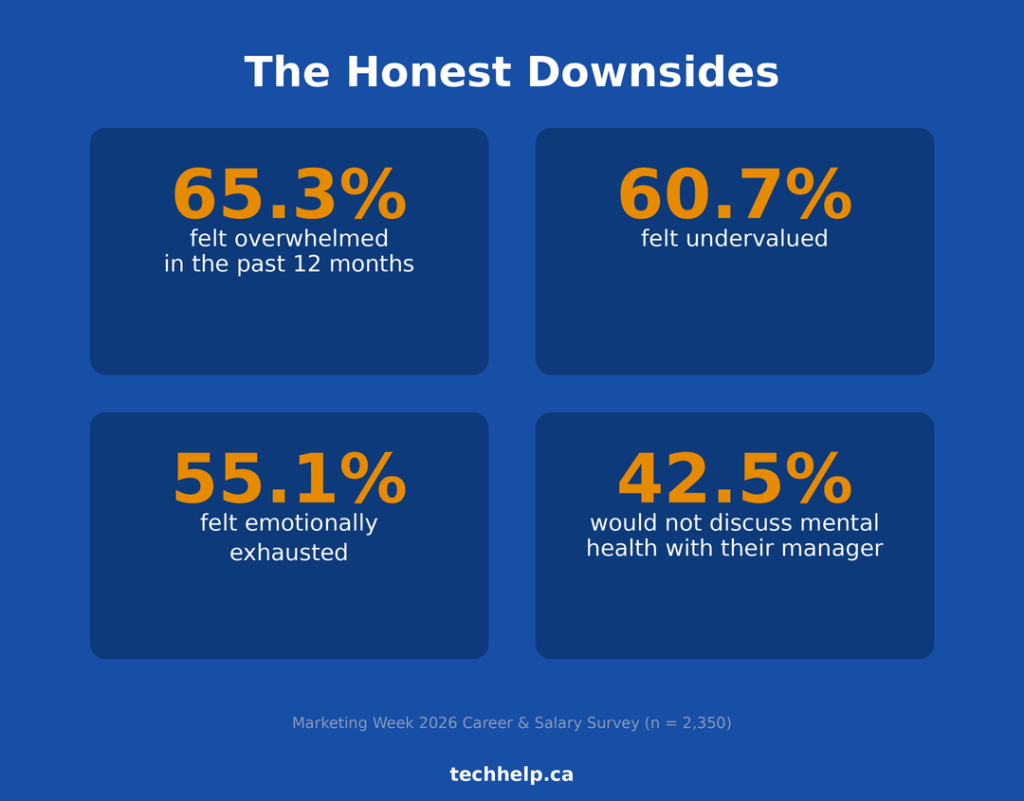
Marketing Week’s 2026 Career & Salary Survey found that 65.3% of 2,350 respondents had felt overwhelmed in the previous 12 months. It also found that 60.7% felt undervalued and 55.1% felt emotionally exhausted.
Those figures do not prove every digital marketing job is unhealthy. They do show that workload, recognition, and burnout deserve more than a passing mention when you evaluate the field.
Performance is visible
Dashboards make missed targets hard to hide. That accountability can improve the work, but it becomes destructive when a company sets unrealistic goals, underfunds the plan, or expects one channel to fix a weak product.
Attribution is imperfect
Customers encounter multiple messages before they buy. Privacy changes, cross-device behaviour, offline activity, and long sales cycles make it difficult to assign every sale to one campaign. You still have to make decisions without perfect evidence.
Platforms change
Search engines, ad platforms, email providers, and social networks update their algorithms and policies. Skills transfer, but tactics expire. Continuous learning is part of the job.
Agency and client work can be volatile
Agencies depend on client retention. Freelancers depend on a pipeline. In both cases, losing one large account can change workloads and income quickly. A varied client base and a clear specialty reduce the risk, but they do not remove it.
Who is likely to enjoy this career?
Digital marketing tends to fit people who are curious about behaviour, comfortable with numbers, and willing to revise their opinions when the results disagree.
You may enjoy it if you like writing, research, experimentation, problem-solving, or building systems. You do not need to love every part. An analyst and a brand copywriter can have opposite strengths and both build successful careers.
You may dislike it if you want stable rules, perfect information, or work that cannot be measured. The pace also becomes draining when every platform update feels like an interruption rather than a problem to solve.
Career changers can test the fit before making a major move. A digital marketing side hustle gives you a small project through which to experience deadlines, feedback, measurement, and client expectations.
How to start a digital marketing career
1. Choose a business problem, then a specialty
Start with a problem companies pay to solve: attract qualified traffic, generate leads, improve conversion, retain customers, or understand performance. Then choose a specialty that contributes to it.
This approach keeps you from becoming a tool operator with no sense of the commercial goal.
2. Read current job postings
Open 20 roles in your target specialty. Record the skills, tools, experience, and outcomes employers repeat. Separate requirements from preferences so you can see what actually blocks entry.
An SEO learner might begin with Google Search Console, GA4, a crawler, and a keyword research tool. A paid media learner needs the ad platform, analytics, tracking, and landing-page basics. An email learner needs segmentation, automation, copy, and deliverability fundamentals.
Learn enough to complete a project before adding more software.
4. Build a real project
Use your own site, help a local organization, volunteer for a nonprofit, or take a small paid engagement. Mock campaigns can demonstrate thinking, but live projects give you constraints and results.
Protect confidential data and get permission before showing client work.
5. Turn the work into a case study
Document the starting point, goal, constraints, decisions, execution, and outcome. Include failures and what you changed. A credible case study shows how you think, not only the final number.
6. Apply before you feel finished
You will never know every platform. Apply when you can demonstrate the core work, discuss a project honestly, and show that you can learn the missing pieces.
Use interviews as market feedback. If several employers identify the same gap, you have your next learning priority.
Final verdict: is digital marketing a good career?
Yes. Digital marketing is a good career for people who want a mix of creative, analytical, and commercial work and are prepared to keep learning.
The evidence supports the opportunity. BLS projects faster-than-average growth for marketing managers and market research analysts. Robert Half counted 64,900 U.S. digital marketing postings in 2025 and reports continued demand for analytics, automation, strategy, and customer-focused skills. Its 2026 salary data also shows several specialist and management paths reaching or exceeding six figures.
The opportunity is not evenly distributed. Routine execution faces more pressure from AI and lower-cost competition. Remote jobs attract more applicants because they represent a minority of postings. Higher pay goes to people who specialize, understand the business, and can prove their effect on a result.
If that trade-off still appeals to you, take one concrete step today: open ten current job postings, choose one specialty that matches your strengths, and build the smallest project that proves you can do the work.
Tech Help Canada Staff researches, writes, and reviews practical content for business owners and professionals. Our coverage spans business, marketing, SEO, technology, and the tools and systems people use to grow and operate online. We focus on clear, useful information backed by research, hands-on experience, and editorial review. Learn more about our team and editorial standards. Need help with something? Contact Us