
Beginning February 1, 2027, new creators will have to clear a much higher bar before they can share in YouTube’s advertising and Premium revenue. The issue is what happens during the gap between creating value for YouTube and qualifying for a share of it.
The new 4,000-to-7,999-hour gap
Consider what happens to a growing YouTube channel under the new rules.
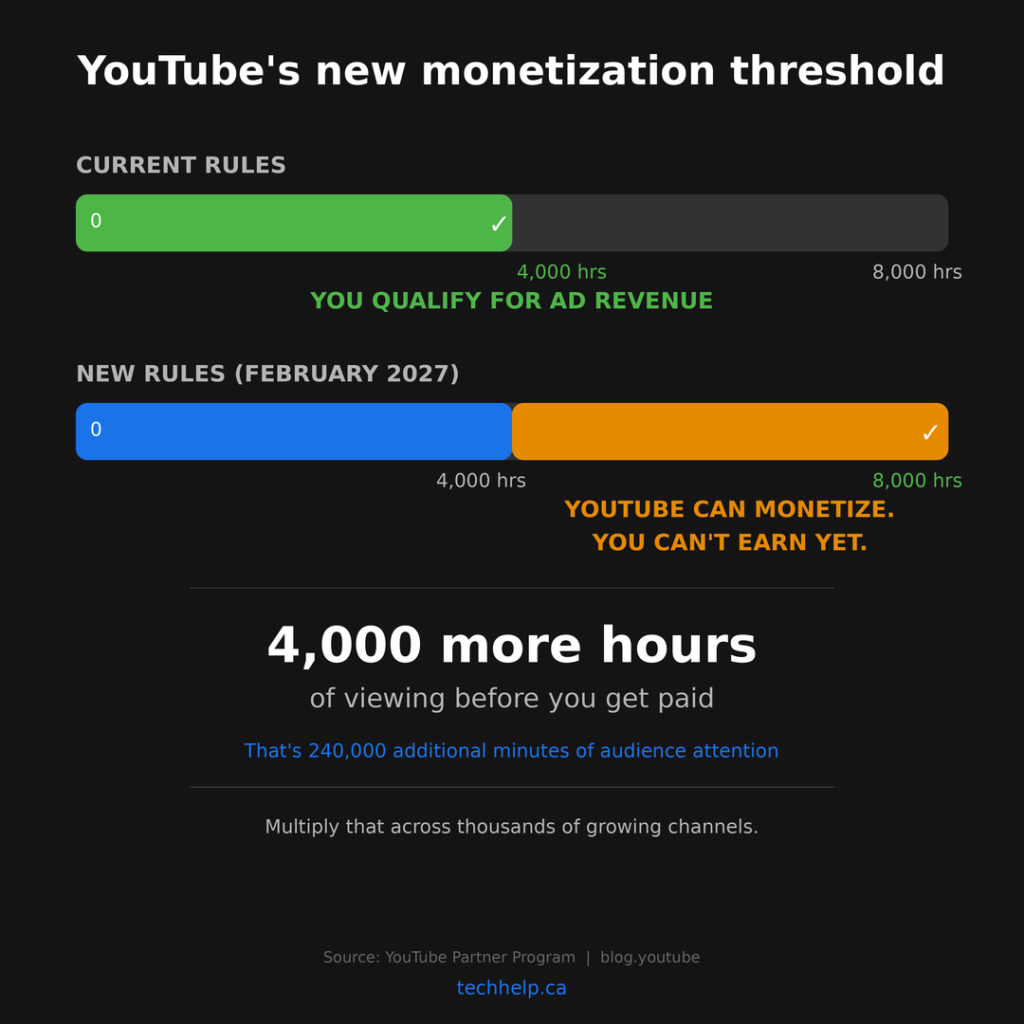
Today, a creator who reaches 1,000 subscribers and 4,000 public watch hours over the required period can qualify for the higher YouTube Partner Program tier that includes Watch Page ads, Shorts Feed ads, and YouTube Premium revenue.
Starting February 1, 2027, a new creator following the long-form route will need 8,000 qualified watch hours instead.
That creates a group worth paying attention to: creators with 4,000 to 7,999 watch hours. Under today’s rules, an otherwise eligible creator in that range could already qualify for ad revenue sharing. Under the new rules, a new creator in that same range won’t.
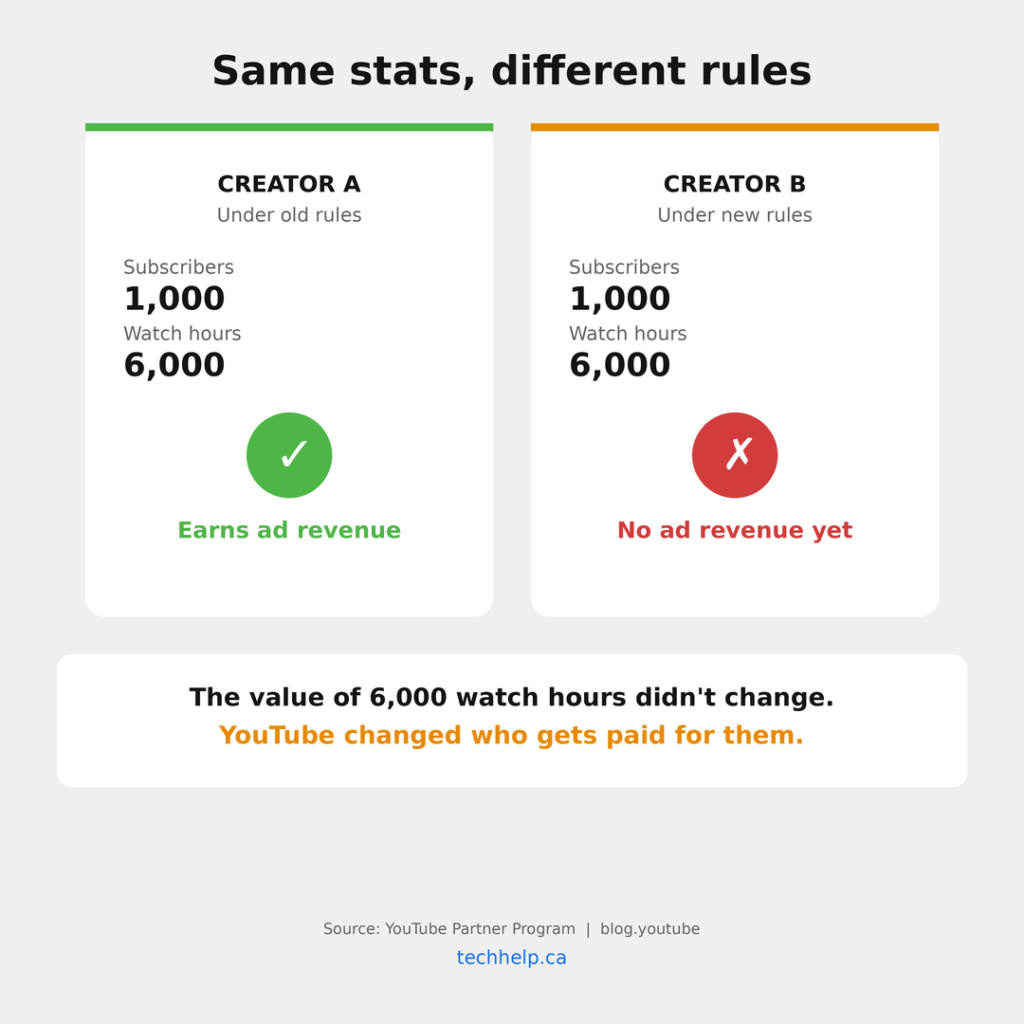
Take two creators with 1,000 subscribers and 6,000 qualified watch hours. One crossed the threshold under the old rules and can participate in advertising revenue. The other reaches the same numbers after the new requirements take effect and hasn’t earned enough watch time yet.
The value of 6,000 watch hours didn’t suddenly change. YouTube changed who gets paid for them.
This is what makes the change difficult to frame as merely a higher quality bar. YouTube’s Help Center explicitly states that “ads may appear on your uploaded videos even if you haven’t monetized the videos yourself” and that “YouTube may also place ads on videos in channels not in the YouTube Partner Program.”
When YouTube serves ads on a non-monetized channel, the creator receives no share of that advertising revenue.
So that 6,000-watch-hour creator’s audience is real, their videos are real, the watch time is real, and the advertising inventory can be real. YouTube can earn money from that viewing activity while the creator remains below the new revenue-sharing threshold.
Before, that creator would’ve crossed the ad-sharing line at 4,000 hours. Now the creator has to generate another 4,000 qualified watch hours before qualifying for revenue sharing, while YouTube retains the ability to serve ads during that climb. That additional 4,000 hours equals 240,000 more minutes of audience attention. Multiply that across thousands of growing channels, and the cumulative impact becomes significant.
We don’t know how much additional advertising revenue the higher threshold will generate for YouTube. That would require internal data. But the economic direction is clear: more creator-generated viewing can occur before YouTube is required to share advertising revenue with those creators.
There’s also a control dimension that’s easy to overlook. Creators with access to YouTube’s Watch Page monetization tools can choose whether to turn video ads on or off for individual videos. A creator who hasn’t qualified for the higher monetization tier doesn’t have that option. YouTube reserves the ability to serve ads on that content regardless.
Reaching the monetization threshold isn’t only about revenue. It also gives creators a say in how their work is commercially used. By doubling the threshold, YouTube is extending the period during which creators generate value without the same monetization controls available to creators who qualify for ad revenue sharing.
Shorts creators face an even higher wall
The long-form change is significant. The Shorts change may be even more severe.
New creators using Shorts to reach YouTube’s higher ad and Premium revenue-sharing tier will need 20 million qualified Shorts views within 90 days, double the current 10 million.
Twenty million views in 90 days works out to roughly 222,000 qualified Shorts views every day for three months. For a new creator trying to turn an audience into a revenue stream, that’s an enormous barrier.
Shorts creators also face an additional change that long-form creators don’t. Beginning February 1, 2027, creators will need at least 10 million qualified Shorts views during the previous 90 days to remain eligible for Shorts advertising and subscription revenue sharing. Channels that fall below that level can stay in YPP and continue earning from eligible long-form content, but their Shorts revenue sharing will pause until they cross the threshold again.
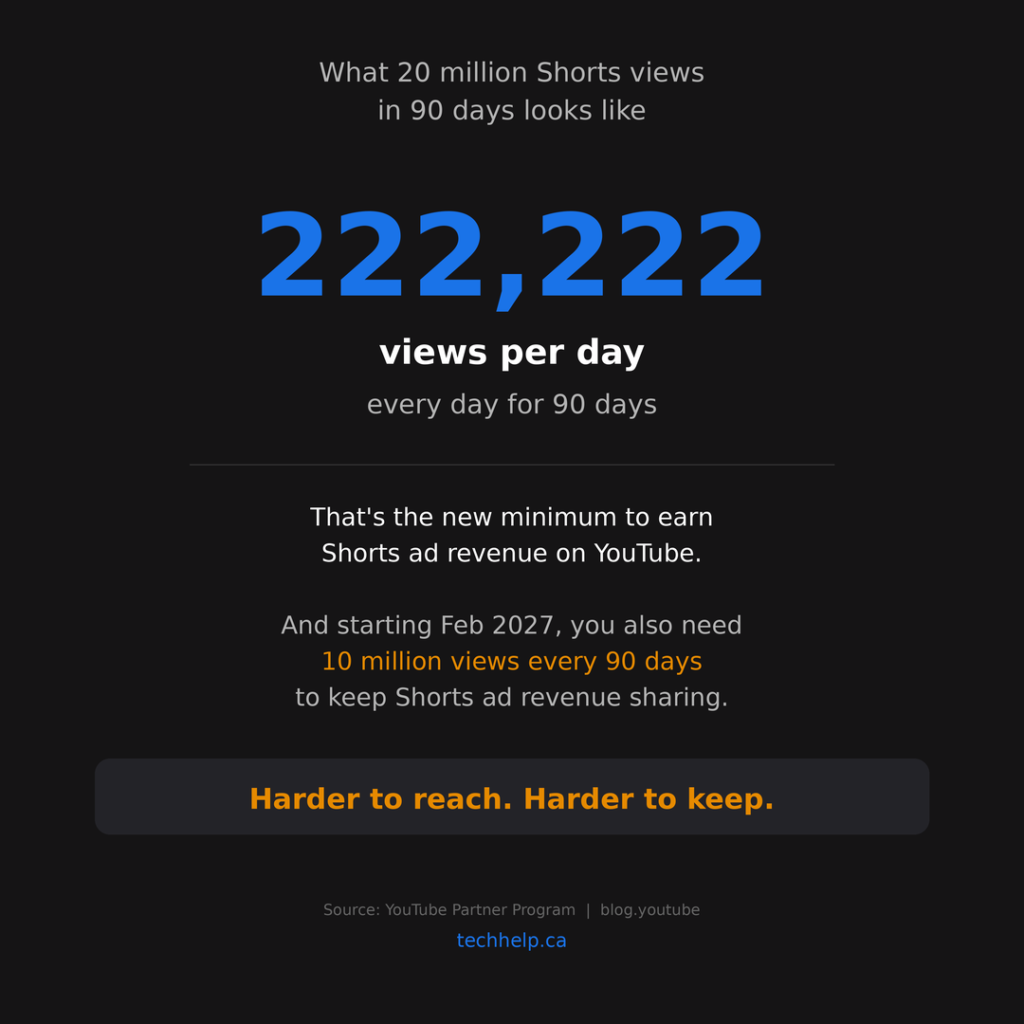
Shorts monetization is becoming both harder to reach and harder to keep.
Existing creators largely stay on the other side
YouTube says the new 8,000-watch-hour and 20-million-view entry requirements won’t affect creators already in YPP. An established long-form creator who qualified under the old requirements isn’t being told to reach 8,000 hours or lose access.
They made it through. It’s the next creator who has to climb the higher wall.
That creates an obvious incumbent advantage. Someone who built a qualifying channel under the old system retains their position. Someone building an equivalent channel under the new system has to generate twice as much watch time before receiving the same access to ad revenue sharing.
This also means established creators may have less incentive to push back against the change. They already have what aspiring creators are trying to get. The burden falls disproportionately on the people trying to become tomorrow’s established creators.
YouTube’s argument and what it’s offering
YouTube does have a case for what it’s doing.
The company says YPP now includes more than three million creators and describes these as the first significant changes to the program since 2018. YouTube says the new requirements will help it “meaningfully reward active creators” and that it expects to pay creators more overall in 2027 than in 2026.
YouTube is also keeping the lower entry thresholds for fan-funding and Shopping products unchanged. Eligible creators can still gain earlier access to features like memberships, Super Chat, Super Stickers, Super Thanks, and certain Shopping capabilities at current thresholds: 500 subscribers and 3,000 watch hours or 3 million views over 90 days.
The company is introducing new incentive programs too, including bonuses for YouTube Shopping, incentives for brand deals, and earnings boosts for creators who start or grow trends. It’s also expanding Premium Lite to all countries where YouTube Premium is available, adding another subscription revenue stream for partnered creators.
These are legitimate parts of the story. YouTube provides enormous value to creators. Hosting video at the scale YouTube operates costs real money. The platform handles over 200 billion daily Shorts views and more than a billion hours of watch time on connected TVs every day. It provides distribution, discovery, analytics, infrastructure, and audience access that would be extraordinarily difficult for an independent creator to replicate.
YouTube deserves to earn money from the platform it built. But that doesn’t answer the question this particular change raises.
If the content is good enough to monetize, why isn’t the creator?
YouTube should have standards for its Partner Program. It needs to fight fraud, protect advertisers, enforce content policies, and prevent people from gaming monetization.
None of those concerns explain why a legitimate creator with 6,000 qualified watch hours should be less entitled to participate in advertising revenue than an otherwise comparable creator who reached 6,000 hours under the old system.
Eight thousand hours isn’t inherently a quality standard. A channel with 7,999 watch hours isn’t necessarily worse than a channel with 8,001. It’s an economic threshold, and YouTube determines where it sits.
The uncomfortable part is that YouTube doesn’t need to wait for creators to cross it before their content has commercial value to the platform. It can already serve ads on videos from channels outside the Partner Program.
So the question stands: if a creator’s content is generating enough audience attention for YouTube to monetize, why isn’t that creator eligible to share in the revenue?
There’s a pattern worth watching
There’s an interesting historical comparison, though it shouldn’t be taken too literally.
A Library of Congress research guide on American women in early film describes the industry’s early decades as operating in “a relatively egalitarian atmosphere” where people moved freely between roles and women held significant positions as writers, directors, and producers. By the 1920s, the industry was consolidating into the studio era. Positions became specialized, creative decisions moved to production heads, and many of the people who had built the industry’s early years found themselves shut out of its economic structure.
YouTube obviously isn’t Hollywood, and becoming a YouTuber is still far more accessible than breaking into the traditional studio system.
But young industries often follow a recognizable arc. They start messy and open. People experiment. Newcomers break through. Rules are still being written. Then the industry matures, successful incumbents become established, platforms grow more powerful, and economic participation gets more structured. You can end up with a system that remains technically open while becoming much harder to enter at the level where serious money is made.
YouTube democratized broadcasting. Whether it continues to democratize the economics of broadcasting is a different question.
What new creators should take from this
The lesson isn’t to abandon YouTube. It remains one of the most powerful audience-building platforms available.
But creators should think carefully about building a business whose economics depend entirely on reaching a threshold controlled by someone else.
Use YouTube for distribution. Build an email list. Generate leads. Sell services. Attract sponsors. Sell products. Build memberships or communities. Send viewers toward something you control. And treat YouTube ad revenue as one revenue stream rather than the entire business model.
Today the threshold is 4,000 watch hours. Next year it becomes 8,000 for new creators. Nothing prevents that number from changing again.
YouTube gave almost anyone a camera — now it’s deciding who gets the check
YouTube started by giving almost anyone with a camera and an internet connection the ability to become a broadcaster. That part of the promise is still alive.
But there’s a growing gap between being allowed to broadcast and being allowed to share in the revenue your audience generates. Established creators who already crossed the threshold get to remain on the profitable side. New creators have farther to go. And during that journey, YouTube can continue benefiting commercially from the content and attention those creators produce.
YouTube didn’t just double the work required for new creators to qualify for ad revenue sharing. It expanded the class of creators whose audiences can generate commercial value for YouTube before YouTube shares that value with them.
Publishing on YouTube remains open, but getting paid is becoming more exclusive. YouTube can monetize the content whether the creator qualifies for a share or not.
References
- https://blog.youtube/news-and-events/youtube-partner-program-updates-2027-new-opportunities-earn/
- https://support.google.com/youtube/answer/2475463
- https://guides.loc.gov/american-women-moving-image/motion-pictures/silent-era

I can suggest related Tech Help Canada articles based on the topic you’re reading now.

Tech Help Canada Staff researches, writes, and reviews practical content for business owners and professionals. Our coverage spans business, marketing, SEO, technology, and the tools and systems people use to grow and operate online. We focus on clear, useful information backed by research, hands-on experience, and editorial review. Learn more about our team and editorial standards. Need help with something? Contact Us