
A 2,700-year-old Greek poem just became the highest-grossing R-rated movie of all time. No superhero IP. No franchise. No sequel. Just Christopher Nolan, a cast led by Matt Damon and Zendaya, and a story most people last encountered in high school English class.
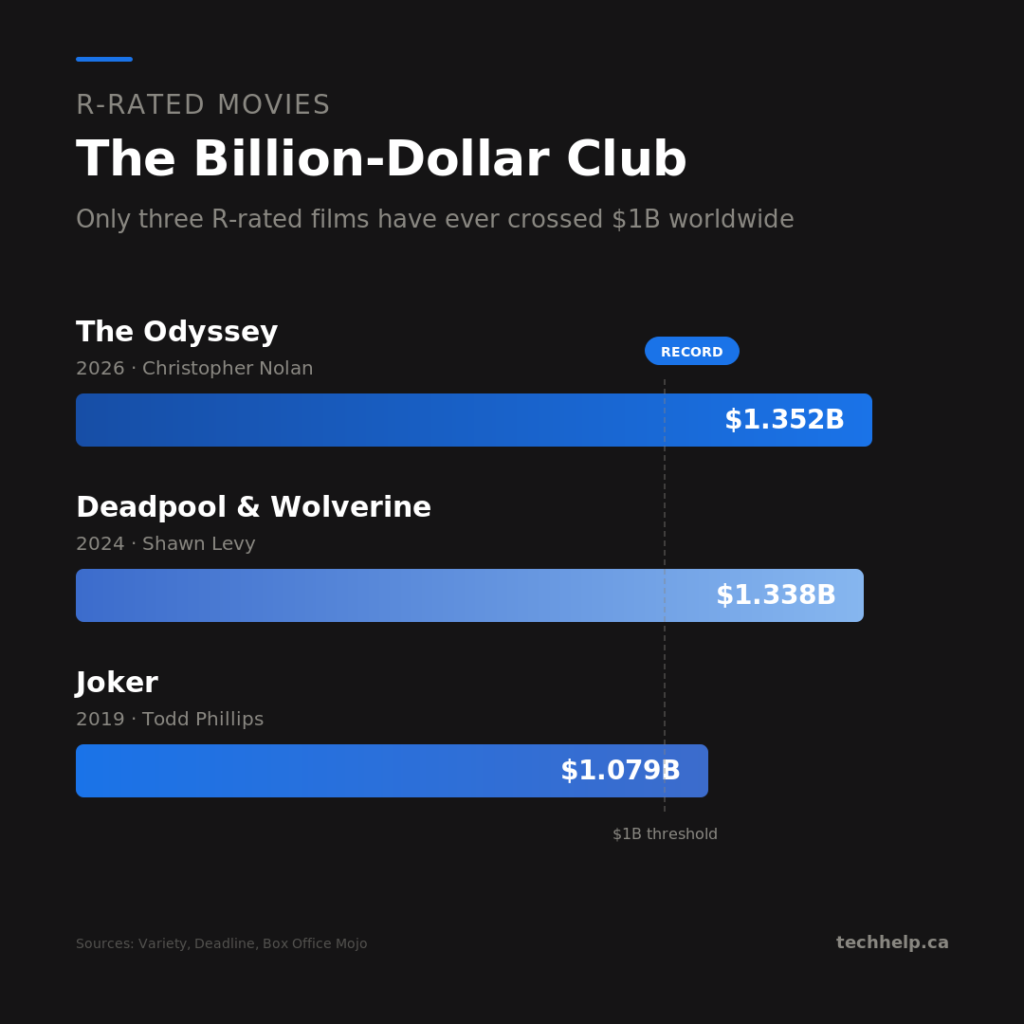
The Odyssey crossed $1.352 billion worldwide on August 20, passing Deadpool & Wolverine’s $1.338 billion record to become the highest-grossing R-rated movie of all time. As of August 24, it has climbed to $1.446 billion worldwide. On the surface, that’s a box office headline. Underneath it, there’s a business playbook worth studying.
Because several of the defining elements behind The Odyssey — from its R rating to its distribution strategy to its marketing — challenged conventional blockbuster logic. And each of those elements has a direct parallel for anyone building a business.
The record, by the numbers
At the time it broke the record, The Odyssey had earned $516 million domestically and $835 million internationally on a reported $250 million production budget plus an estimated $125 million in global marketing spend. It’s Nolan’s biggest film ever, surpassing The Dark Knight Rises ($1.085 billion) and Oppenheimer ($976 million). It opened to $123.5 million from 3,919 North American theaters, which at the time was the biggest live-action opening of 2026.
It’s also only the third R-rated movie in history to cross $1 billion, joining Joker ($1.079 billion in 2019) and Deadpool & Wolverine ($1.338 billion in 2024).
Why a narrower audience doesn’t have to mean a smaller opportunity
Here’s the part that should catch your attention if you run a business: on paper, The Odyssey’s R rating was a commercial constraint.
Hollywood has long treated PG-13 as the safer blockbuster target. Fewer age restrictions mean a larger potential audience. Studios routinely edited violence, language, and mature themes out of films to secure the broader rating. The logic felt airtight.
But three R-rated films have now blown past $1 billion, and The Odyssey did it without a single recognizable franchise character. The rating restricted unaccompanied attendance for viewers under 17, but it didn’t prevent the film from reaching a massive audience. Nolan’s adaptation was intense enough to earn an R for violence and some language, yet audiences responded: the film earned an A CinemaScore, a strong audience grade.
This maps directly to a trap that businesses fall into all the time. You water down your product, your positioning, or your messaging to appeal to the widest possible market. You avoid strong opinions because they might alienate someone. You soften your edge to avoid risk.
And then you wonder why nobody’s particularly excited about what you offer.
The Odyssey is a $1.35 billion reminder that you don’t have to optimize every decision for the widest possible audience. A product can accept real constraints and still reach a massive market.
When your name becomes your IP
Christopher Nolan occupies a position in Hollywood that almost no other director holds. His name, on its own, is enough to turn a movie into an event.
Think about what The Odyssey lacked compared to its competitors. Spider-Man: Brand New Day had six decades of Marvel fandom behind it. Toy Story 5 had four beloved predecessors and decades of nostalgia. The Super Mario Galaxy Movie had one of the most recognized characters on the planet. The Odyssey had a poem traditionally attributed to Homer and composed around 700 BC — and Christopher Nolan’s name.
Nolan proved this wasn’t a fluke with Oppenheimer, which turned a three-hour R-rated biography of a physicist into a $976 million global hit. The Odyssey raised the stakes further: ancient source material, no franchise fanbase, and none of the sequel momentum that usually comes with a billion-dollar blockbuster. It still became his biggest film ever.
He doesn’t chase trends. He doesn’t cater to algorithms. He’s built a track record of delivering a specific kind of experience (ambitious, visually immense, intellectually serious), and audiences trust that the next one will be worth their time and money.
For business owners, this is personal branding at its most powerful. When you consistently deliver at a high level, your reputation becomes your competitive moat. You stop competing on price. You stop needing gimmicks. Clients and customers choose you because of what your name represents.
That doesn’t happen overnight. It’s the product of years of work that earns trust one delivery at a time. But the compounding effect is enormous. Nolan doesn’t have to convince anyone to watch his next film. His track record does the convincing for him.
The scarcity engine: how limiting access created $1,000 resale tickets
The Odyssey is the first narrative feature shot entirely with IMAX film cameras. That’s not just a production footnote. It became the foundation of the film’s premium-format strategy.
Only 41 IMAX 70mm locations worldwide could show the film in the format Nolan positioned as its definitive presentation. Those theaters generated $6.3 million during opening weekend, averaging roughly $153,000 per location. Across IMAX’s broader network of film and digital screens, the format generated $52 million — about 20% of the movie’s worldwide debut.
Universal leaned into the scarcity instead of fighting it. Select IMAX 70mm tickets went on sale a full year before release — while Nolan was still shooting the film. The BFI IMAX in London sold 28,000 tickets in 24 hours, generating £750,000 in presales from a single theater. The Odyssey also secured a three-week exclusive run across IMAX’s network. After that window ended, digital IMAX screens began sharing space with other releases while the 41 IMAX 70mm locations continued showing The Odyssey.
The result was exactly what you’d expect when a high-demand product has severely limited supply, and the fear of missing out is real. Some IMAX 70mm resale tickets reached $1,000 per seat, with at least one two-ticket transaction reaching $2,000. AMC recorded its highest IMAX revenue ever through the first two weekends of a single film’s release. Some showings sold out seven weeks in advance, and the 70mm run was eventually extended by a full month.
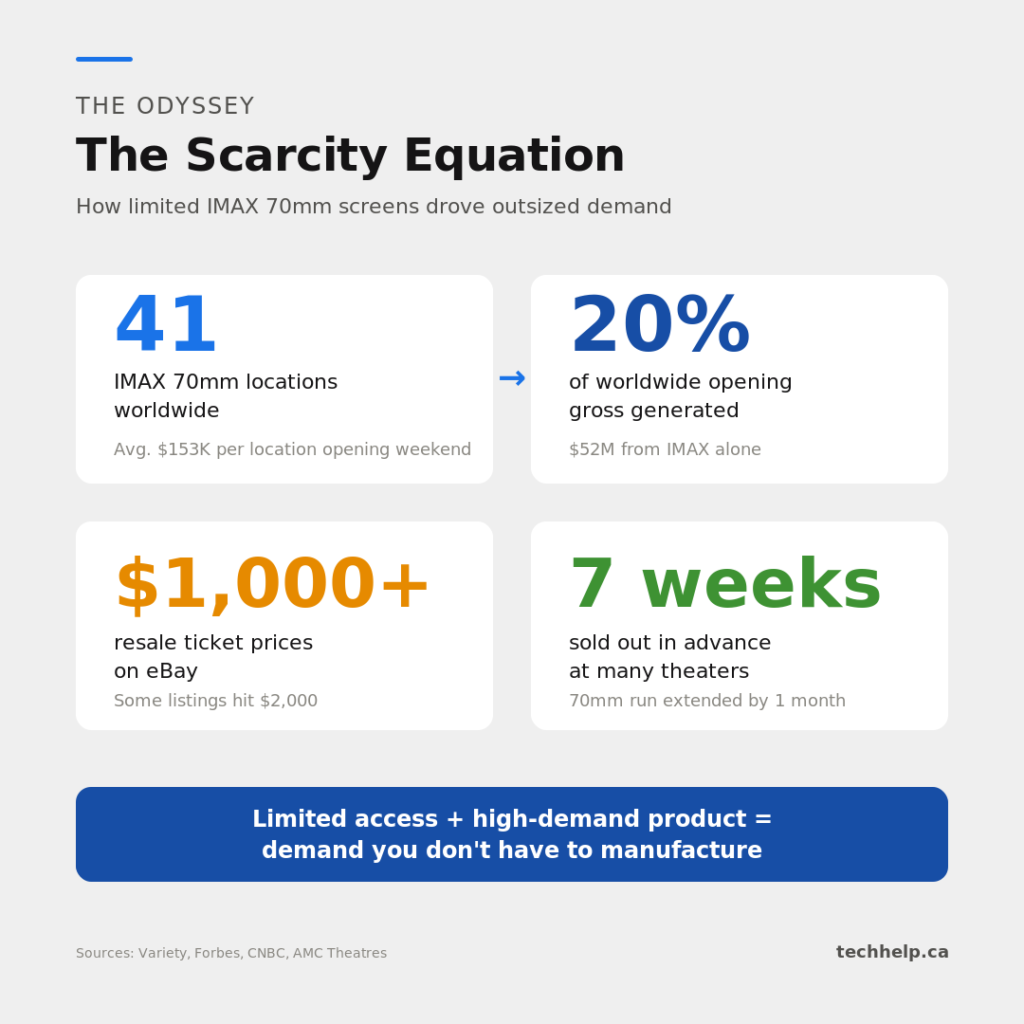
The business parallel here is straightforward. You don’t need to be available everywhere to be valuable. In fact, being everywhere can dilute your value. Controlled access, when backed by a genuinely desirable product, can increase perceived worth and intensify demand you don’t have to manufacture.
This applies whether you’re launching a product in limited markets, running exclusive membership tiers, or keeping your client roster small enough to deliver exceptional work. Scarcity isn’t about pretending you’re exclusive. It’s about actually being selective — and making sure the experience justifies the selectivity.
Premium pricing works when you invest in premium quality
Here’s where the strategy goes from interesting to impressive.
Premium formats became a major part of the opening-weekend business: enhanced formats accounted for 53% of The Odyssey’s domestic opening-weekend gross.
That didn’t happen by accident. Nolan burned through more than two million feet of 65mm camera film — roughly $3 million worth of raw stock at Kodak’s reported per-foot price. The production shot across six countries and leaned heavily on real locations, practical environments, and full-scale ships. The result was a visual experience that a standard screen couldn’t fully reproduce.
By August 17, The Odyssey had grossed more than $346 million on IMAX screens worldwide. The company reported July 2026 as its highest-grossing month in 50 years of operation. Its stock surged more than 30% to all-time highs after the film’s release.
The business lesson here is one that a lot of entrepreneurs get backward. Premium pricing is hard to sustain when you charge more without giving customers a meaningful reason to pay more. It works best when the experience makes the higher price feel justified. The gap between what you charge and what the customer experiences is what determines whether premium pricing builds loyalty or breeds resentment.
Most viewers will never consciously think about the cost of the film stock. But they notice the difference in the final product. That’s what separates genuine premium from inflated pricing.
Product-led marketing: when quality replaces manufactured hype
Universal initially made an unusual marketing choice with The Odyssey: it declined to hold the dedicated influencer-only previews studios increasingly use to generate early social buzz. Influencers still attended press and junket screenings alongside other media, but Universal didn’t build a separate preview cycle around them.
By 2026, influencer-focused advance screenings had become a common part of major studio marketing. Creators get early access, and studios hope the resulting social posts build momentum before opening weekend. It’s engineered buzz, and it has become part of the blockbuster playbook.
Nolan and Universal also showed they could generate enormous interest without making every piece of the campaign immediately available everywhere. Nolan’s first teaser debuted exclusively in theaters rather than online. When the first full online trailer arrived months later, it generated 121.4 million views across social platforms in its first 24 hours. The demand was already visible long before the film’s influencer-screening strategy became part of the conversation.
The film fell just 27.1% in its second weekend, an unusually strong hold for a blockbuster. Major releases that open above $100 million frequently fall 50% or more in weekend two. A hold that strong is consistent with powerful word of mouth and repeat demand — momentum the marketing campaign didn’t have to manufacture from scratch.
This is what product-led marketing looks like. When what you’re selling genuinely delivers, you don’t have to rely on artificial excitement. Selective marketing can signal confidence by giving the product room to carry the conversation. Saturation can still work, but it isn’t the only way to build momentum.
That doesn’t mean you skip marketing. Universal reportedly spent about $125 million promoting this film. But some of the campaign’s most distinctive choices focused on signaling quality — theatrical trailer premieres, IMAX positioning, and Nolan’s own reputation — rather than simply maximizing early social-media volume. The distinction matters.
The thread that connects all of it
Several elements of The Odyssey’s success point in the same direction: distinctiveness over maximum reach.
The R-rating restricted access for younger audiences without preventing mass appeal. The IMAX-centered strategy turned a scarce premium experience into part of the product itself. The premium-format strategy bet that audiences would pay more for a differentiated experience. The marketing leaned on genuine demand instead of trying to manufacture all of it.
That’s not a strategy reserved for directors with $250 million budgets. It’s a mindset. And it translates directly to how you build a brand, price a product, choose your customers, and decide what you’re willing to sacrifice to protect what makes you different.
The Odyssey didn’t break the all-time R-rated record by trying to be everything to everyone. It broke the record by being exactly one thing — executed at the highest possible level — and trusting that the right audience would find it.
That’s a bet worth making in any industry.

I can suggest related Tech Help Canada articles based on the topic you’re reading now.

Tech Help Canada Staff researches, writes, and reviews practical content for business owners and professionals. Our coverage spans business, marketing, SEO, technology, and the tools and systems people use to grow and operate online. We focus on clear, useful information backed by research, hands-on experience, and editorial review. Learn more about our team and editorial standards. Need help with something? Contact Us