If you’ve used Claude to draft an email, polish a blog post, or brainstorm product copy, the text you got back may now carry an invisible mark that identifies it as AI-processed.
Anthropic, the company behind Claude, has started embedding imperceptible watermarks directly into text generated by its newest models. Unlike a simple metadata tag or file property, this watermark lives inside the words themselves. Copy the text into a Google Doc, paste it into your CMS, drop it into a Slack message — the mark goes with it.
Here’s what’s actually happening, how the technology works, and what it means for anyone using AI in their business.
The EU law that triggered it — and why Anthropic applied it worldwide
The legal trigger is Article 50 of the EU AI Act. It requires providers of generative AI systems to mark their output in a machine-readable format so it can be detected as AI-generated. The compliance deadline kicked in on August 2, 2026.
Anthropic also signed the EU’s voluntary Code of Practice on Transparency of AI-Generated Content, a separate mechanism companies can use to demonstrate compliance. The code is voluntary, but it’s expected to become the practical benchmark for regulatory assessment. By late July 2026, roughly 190 organizations had signed it.
Here’s the consequential product decision: Anthropic didn’t limit the watermarks to EU users. According to the company’s support documentation, marking applies “wherever Claude is offered, worldwide.” Whether you’re in Toronto, Texas, or Tokyo, text from supported Claude models now carries the mark. The EU created the compliance requirement for systems within its scope. Anthropic chose to implement its marking architecture worldwide, including for customers outside the EU.
The watermark is active across every Claude surface: Claude.ai, the API, Claude Code, Cowork, Claude Tag, and cloud deployments through AWS, Google Cloud, and Microsoft Foundry. If it runs through a supported model, it gets marked.
One caveat: this currently applies to Claude models launched on or after August 2, 2026. Older models like Opus 5, Sonnet 5, and Fable 5 don’t carry the watermark yet, though Anthropic says it’s working on adding support during a transition period.
What Anthropic has confirmed about the watermark
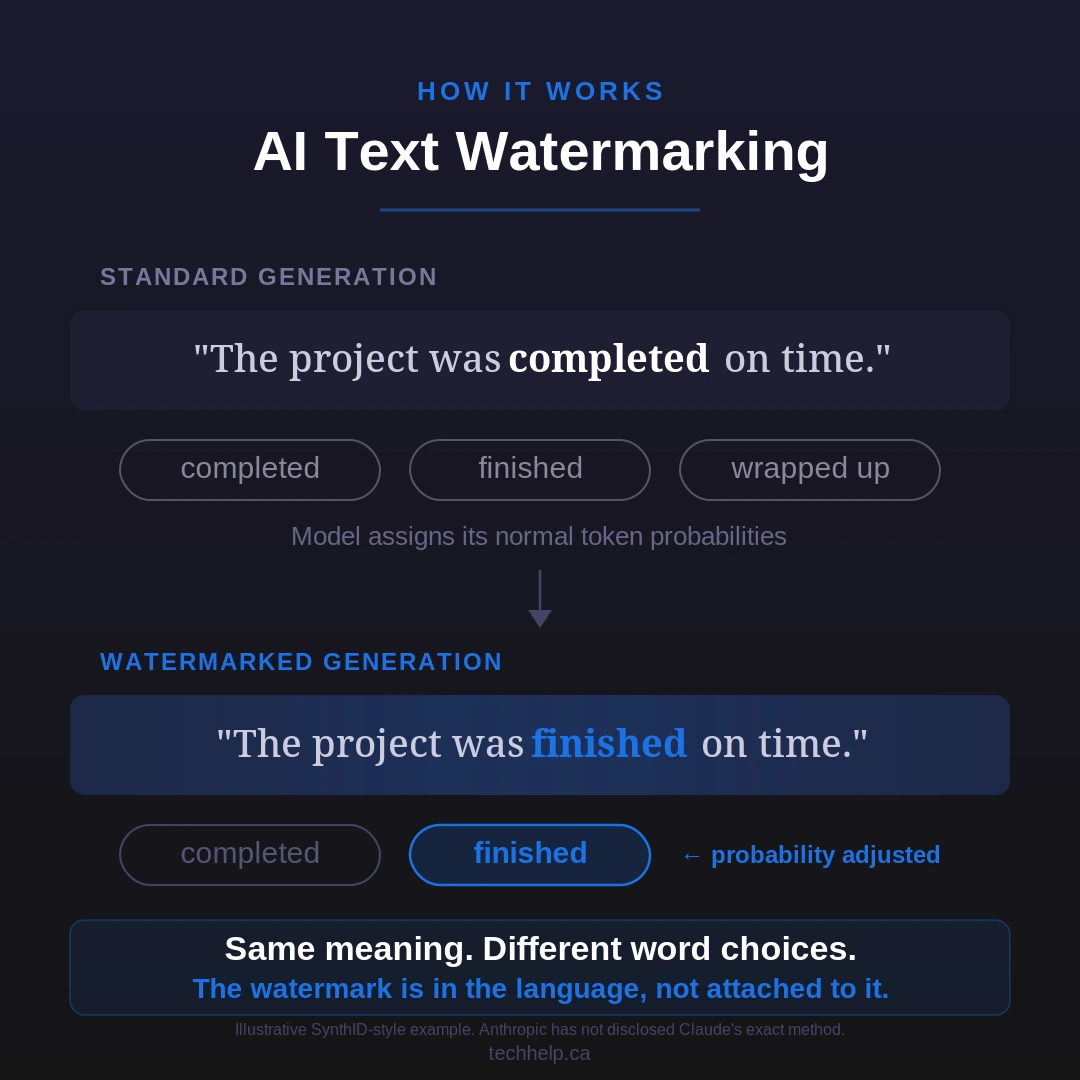
Anthropic says the watermark is “woven… directly into the text itself.” It’s not a hidden character, metadata tag, or digital signature attached to a file. Because it’s part of the text, it travels when you copy and paste it elsewhere.
That’s about as far as Anthropic’s published documentation goes on the technical side. The company says the watermark “doesn’t change the meaning, quality, or readability” of Claude’s output, but it hasn’t published the specific algorithm, detection threshold, or implementation details. More technical documentation is forthcoming.
For context on how text watermarking systems generally work: Google’s SynthID, which is already built into Gemini models, operates by adjusting token probability scores during text generation. The model nudges its selections according to a pattern a detector can recognize, creating a statistical signal distributed across the passage. Anthropic hasn’t disclosed whether Claude uses the same token-probability approach, so its exact implementation remains unknown.
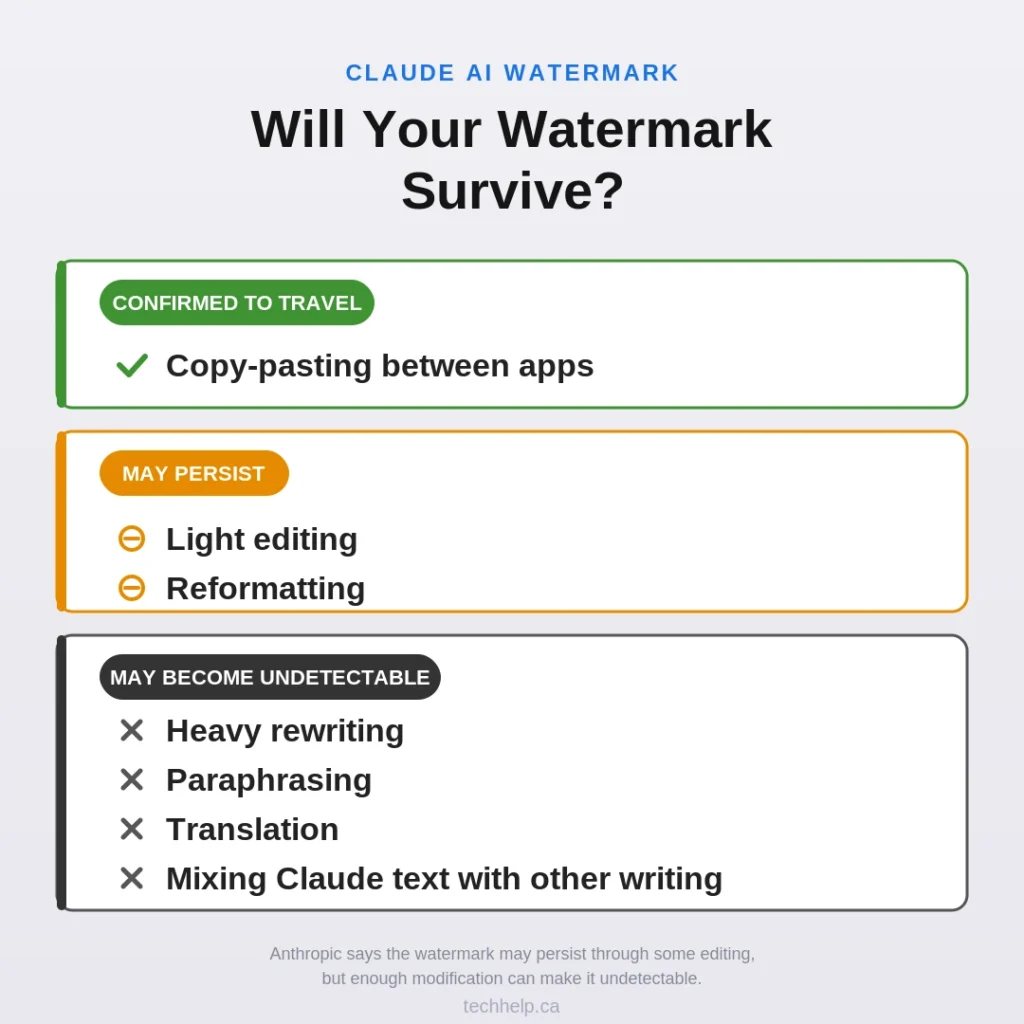
Anthropic confirms that the watermark travels with text when it’s copied and pasted elsewhere and may persist through some editing. Very short passages may also be difficult to detect reliably because they may not contain enough signal for detection.
Generated files get a different kind of marker
Text watermarks are only half of Anthropic’s marking system. When Claude generates a supported file type (such as SVG, PNG, and JPG images), it attaches signed provenance metadata using the C2PA open standard.
C2PA (Coalition for Content Provenance and Authenticity) is an industry-backed framework used by companies like Adobe, Microsoft, and OpenAI to record content provenance. If a signed C2PA label is present, it signals that the file was processed by Claude and lets you check whether the signed metadata has been tampered with. The signature is cryptographically verifiable.
The trade-off is durability. Unlike a text watermark, C2PA metadata rides alongside the file. Anthropic notes that metadata can be stripped through format conversion, re-saving, screenshots, or other processing. The text watermark is the more consequential half of this system because it’s far harder to separate from the content.
A watermark hit doesn’t mean what you think it means
This is the part most people will skip, and it’s the part that matters most.
Anthropic is explicit: detecting a watermark “does not, on its own, confirm the full provenance of the content.” A watermark means the text may have been processed by Claude. That’s it. It doesn’t prove Claude wrote it.
Consider a few scenarios where this distinction breaks down:
You write an entire blog post yourself. You paste it into Claude and ask it to proofread for grammar. The text that comes back may now carry the watermark — even though every idea and sentence originated with you.
A freelancer drafts your email newsletter. They use Claude to translate it into French for your Canadian audience. The French version may carry a Claude watermark. The English original won’t.
Your team writes a strategy document collaboratively, then uses Claude to clean up the formatting and tighten the language. The final version could carry the mark despite being 90% human-written.
The reverse is also true. Text generated entirely by Claude can lose its watermark through heavy editing, paraphrasing, translation into another language, or blending with other writing. Absence of a mark says nothing definitive about whether a human wrote it.
This matters because a professional might use AI to turn a three-hour workflow into a 30-minute workflow while still supplying the strategy, judgment, source verification, editing, and final approval. A watermark can indicate model involvement, but it can’t quantify the human expertise that went into the finished work.
The EU itself recognizes this distinction. Under Article 50, the visible labeling requirement for AI-generated text published on matters of public interest doesn’t apply when the text has undergone substantive human review or editorial control and a responsible person or organization holds editorial responsibility. Standard assistive editing (grammar correction, for example) can also fall outside the provider marking obligation if it doesn’t substantially alter the content or its meaning.
Anthropic published its caveats clearly. The question is whether the people interpreting watermark results (employers, clients, schools, content reviewers) will actually read them.
What this changes for businesses using AI
For most day-to-day business use, the watermark changes nothing about your experience. Claude still works the same way. The text reads the same. Your workflows don’t need to change.
But the implications surface in specific scenarios.
Content and freelance work
If you use Claude to help produce client-facing content, that content now carries a detectable trace of AI involvement. For many businesses, this is fine — AI-assisted content is standard practice. But if you’re in a context where AI use is sensitive (certain editorial environments, academic publishing, ghostwriting), this is a new disclosure surface that didn’t exist before.
Internal communications
Strategy memos, competitive analyses, investor updates: anything drafted or refined through Claude could carry the watermark. In most cases, nobody will check. But the possibility now exists, and for companies in regulated industries or contentious negotiations, it’s worth knowing.
Code
Anthropic says marking applies across Claude Code when supported models are used, but its current documentation doesn’t explain how the watermark behaves in source code specifically. The EU’s Article 50 guidance actually excludes source code from the provider marking obligation, treating it as a technical output rather than human-facing content. This is an area where Anthropic’s forthcoming technical guidance will matter most.
Products built on the API
This may be the most consequential angle in the announcement. A company can spend months building a proprietary content system, internal writing assistant, agency workflow, or SaaS product around Claude. If a supported Claude model sits inside that stack, Anthropic’s model-level marking applies to the generated text in that product too.
The company’s current documentation describes model-level marking across API output and doesn’t describe an opt-out. Anthropic advises developers to “independently assess what Article 50 requires” for their own products. The story here isn’t just about people copying text out of Claude.ai. It reaches every business that has built its own product on top of Claude.
How durable is the watermark?
Here’s what Anthropic has confirmed: the watermark travels with copied and pasted text, and it may persist through some editing. Heavy editing, paraphrasing, translation, or mixing with other writing can make the mark undetectable. Very short passages may not carry a reliable signal.
Based on how text watermarking systems generally work (drawing on published research from systems like Google’s SynthID), light edits such as fixing a typo, swapping a word, or adjusting a sentence are unlikely to destroy the signal. The statistical pattern is distributed across the full passage, so local changes don’t erase it. Things start to shift with heavier changes: restructuring paragraphs, rewriting arguments, and replacing large portions of the text can weaken or remove the mark entirely. Translation disrupts it further, since moving to another language changes the word choices where the signal lives.
Anthropic has not yet released a public detection mechanism for users or third parties. The company says it will publish detection tools and technical documentation, but hasn’t given a timeline.
Where the rest of the industry stands
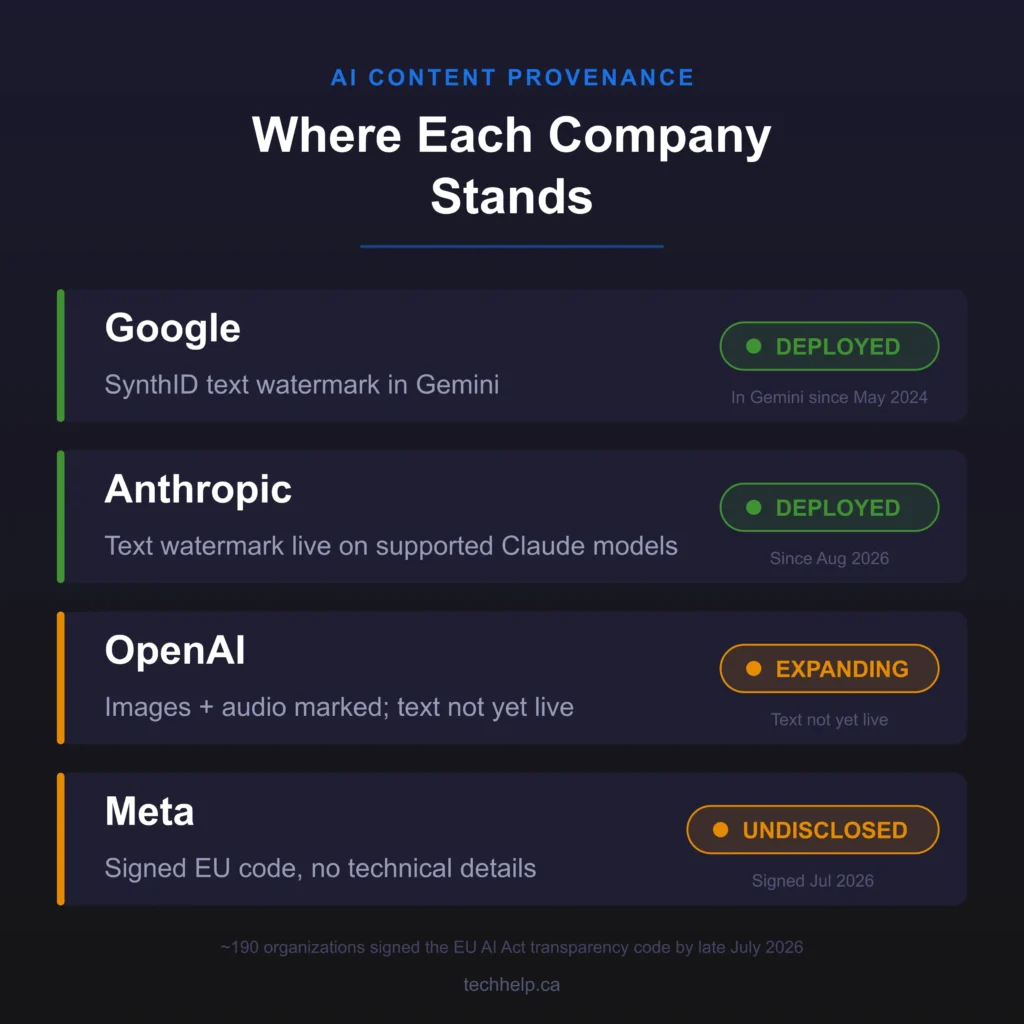
Anthropic isn’t acting alone. Those roughly 190 signatories to the EU transparency code include Google, Meta, Microsoft, OpenAI, Mistral, and Cohere. Pressure is clearly moving major providers toward content provenance.
Google is the furthest ahead on the technical side. Its DeepMind division open-sourced SynthID, a text watermarking system, back in October 2024. SynthID is already built into Gemini models and works by adjusting token probability scores during generation. Google has also made SynthID available for developers to add watermarking to other models.
OpenAI is taking an incremental approach. As of July 2026, OpenAI uses C2PA metadata and SynthID for supported images, and SynthID for supported audio generated through ChatGPT and the API. It also offers a public verification tool for supported provenance signals. OpenAI has stated its goal is to expand provenance signals to all modalities, including text, but it hasn’t publicly deployed a text watermark yet. Earlier reporting from 2024 indicated OpenAI had built a text detector with 99.9% accuracy but shelved it over concerns about false positives and potential stigmatization of non-native English speakers.
Implementation differs across providers: model-level watermarking, metadata tagging, provider-side verification, regional deployment, and open-weight alternatives all reflect different trade-offs. It’s too early to say every major AI API will adopt Anthropic’s exact worldwide, model-level approach. What’s clear is that the industry is moving toward more traceable AI text.
Could the watermark cost Anthropic customers?
Anthropic made a product decision that affects every paying customer worldwide, not just those in the EU. That raises a straightforward business question: will some customers leave because of it?
There’s no evidence of an exodus, and for most businesses the watermark won’t matter day-to-day. But the tension is real. A professional writer, agency, or SaaS company may be entirely comfortable disclosing AI assistance when appropriate and still object to a vendor embedding a persistent signal in their commercial output by default. The watermark isn’t something the customer chose. It’s something the model imposes.
This could become a factor in vendor selection. If Anthropic’s watermark creates enough friction for certain use cases, competing models or self-hosted architectures may become more attractive, not because they’re better at the task, but because they give the customer more control over what’s embedded in their output.
An open question is whether Anthropic will eventually give eligible non-EU or enterprise customers control over the marking layer. The company hasn’t announced anything like that. But if worldwide marking creates enough commercial resistance, the pressure to offer more granular control will grow.
What you should actually do about this
Don’t overhaul your workflows
The watermark doesn’t affect output quality, and for most business use, nobody will check for it. Continue using AI where it makes your work better.
Update your AI disclosure policies
If you serve EU markets or work with EU-based clients, Article 50’s transparency obligations may extend to your products. Google’s AI-generated ad terms already shift liability to the advertiser when AI creates the copy. Even if you don’t serve EU markets, having a clear internal policy on AI use protects you from future disputes.
Don’t treat watermark detection as proof of authorship
If your organization reviews content submissions from contractors, freelancers, or employees, write the distinction between “processed by AI” and “authored by AI” into your evaluation criteria now, before the first disagreement. The EU’s own guidance supports this distinction.
Communicate proactively with clients
If you use Claude in your workflow, consider getting ahead of the conversation. A client discovering a watermark in delivered work is a harder conversation than one where you’ve already explained your process.
Watch the detection tools
When Anthropic releases its detector, test it against your own workflows. Understanding what triggers a positive result and what doesn’t gives you more control than hoping nobody checks.
Evaluate your AI infrastructure
Self-hosted open-weight models can give businesses more control over whether and how provenance systems are implemented, subject to any legal obligations that apply. Open-weight models aren’t a guarantee of “no marks.” Google has open-sourced SynthID for anyone to add watermarking, and EU legal obligations may still apply depending on the business.
But if closed-model vendors increasingly dictate what gets embedded in your output, that strengthens the case for owning more of the inference layer.
Provenance is now part of the vendor decision
Anthropic’s watermark is the most visible move so far, but it won’t be the last. The technology is imperfect. It’s a signal, not a verdict, and it can be lost through enough editing. But the direction across the industry is clear.
Businesses don’t need to stop using AI. What’s changed is that provenance is becoming part of the vendor decision. The question is no longer only which model produces the best output. It’s also what the provider embeds in that output, who can detect it, and how much control you get as the customer.
Frequently Asked Questions
Does the watermark change how Claude’s text reads?
Anthropic says the watermark doesn’t change the meaning, quality, or readability of Claude’s output. The watermark is embedded directly in the generated text at the model level, so you won’t notice a difference in what Claude produces.
Can I opt out of Claude’s watermarking?
Anthropic’s current documentation describes model-level marking across supported Claude models, including API output, and does not describe an opt-out. The watermark is applied at the model level, which means it’s present wherever a supported model’s generated text is used.
Does the watermark apply to older Claude models?
Not yet. The watermark currently applies to Claude models launched on or after August 2, 2026. Older models like Opus 5, Sonnet 5, and Fable 5 don’t carry the mark, though Anthropic says it’s working on adding support during a transition period.
If I use Claude to proofread my own writing, will my text get watermarked?
It’s possible. Anthropic acknowledges that text processed by Claude (proofreading, translating, summarizing) can carry the watermark even if the original ideas and writing came entirely from you. A detected watermark signals that content may have been processed by Claude, not that Claude authored it. The EU’s Article 50 guidance recognizes this distinction and excludes standard assistive editing (like grammar correction) from the provider marking obligation if it doesn’t substantially alter the content. Anthropic’s own worldwide implementation may still mark text returned by a supported Claude model even where the EU’s standard-editing exception would apply.
Can schools or employers use this to detect Claude’s involvement?
Eventually, yes, once Anthropic releases its detection tools. But Anthropic is clear that a watermark hit shouldn’t be treated as proof of AI authorship. The watermark indicates processing by Claude, which could mean the person used AI for editing, translation, or formatting rather than writing from scratch. That distinction will matter for anyone using watermark results to make decisions about someone’s work.
Does the watermark survive translation?
Anthropic says heavy editing, paraphrasing, translation, or mixing Claude-generated text with other writing can make the watermark undetectable. So a translated version may no longer carry a reliably detectable Claude mark.
Are other AI companies doing the same thing?
Major providers are moving toward content provenance, but implementation varies. Google uses SynthID to watermark text generated through the Gemini app and web experience and has open-sourced the technology for other developers. OpenAI currently uses C2PA metadata and SynthID for supported images, and SynthID for supported audio. It says its goal is to expand provenance signals to text, but it hasn’t publicly deployed a text provenance system yet. Meta signed the EU transparency code but hasn’t detailed its technical approach. The direction is clear, but not every provider is adopting the same worldwide, model-level approach that Anthropic chose.
Why is Anthropic applying this worldwide and not just in the EU?
The EU AI Act’s Article 50 is the legal trigger, but Anthropic chose to implement its marking architecture worldwide for all supported models. This means customers in Canada, the US, and every other region where Claude is available are covered, even though the EU regulation doesn’t directly require that. This was Anthropic’s product decision, not a global legal mandate.
Get new small business insights by email
Practical ideas and useful articles to help you make better business decisions.
Tech Help Canada Staff researches, writes, and reviews practical content for business owners and professionals. Our coverage spans business, marketing, SEO, technology, and the tools and systems people use to grow and operate online. We focus on clear, useful information backed by research, hands-on experience, and editorial review. Learn more about our team and editorial standards. Need help with something? Contact Us