Saudi Arabia shut its East-West Pipeline after multiple attacks, putting pressure on one of the few routes built to move Gulf crude around the Strait of Hormuz.
Saudi Arabia’s East-West Pipeline is supposed to give oil shipments a way around Hormuz. After multiple attacks forced the kingdom to shut the line as a precaution, the fallback route itself is now part of the risk.
The Saudi Press Agency said an official source at the Ministry of Energy reported multiple attacks on the pipeline in the Riyadh and Madinah regions on Thursday, September 10, 2026. The ministry said the attacks caused injuries, medical care was provided, and emergency and technical teams moved to secure the line and assess its safety. Saudi Gazette reported the shutdown on September 11.
Saudi Arabia still has export options. The loss is flexibility. The East-West Pipeline is one of the main routes designed to reduce reliance on Hormuz, and it is no longer a theoretical backup. It is an active target, an operational question, and a new source of planning risk.
The backup route is now exposed
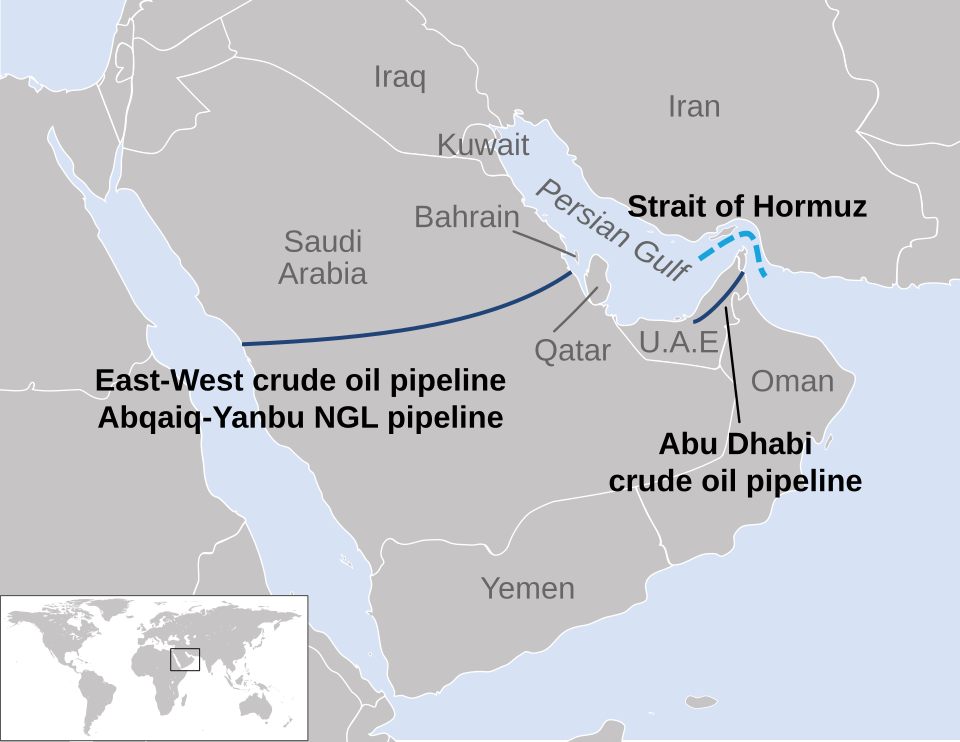
The East-West Pipeline moves crude from the kingdom’s eastern oil system to Yanbu on the Red Sea. For exporters, Yanbu lets tankers load outside the Persian Gulf, away from the Strait of Hormuz.
Saudi Arabia’s East-West Pipeline carries crude from the kingdom’s eastern oil fields to Yanbu on the Red Sea, providing an export route that bypasses the Strait of Hormuz.
AP reported that the pipeline, built in the 1980s, has played a larger role since the Iran war disrupted Hormuz traffic. By early June, Saudi Arabia had more than doubled exports from the Red Sea port at the end of the pipeline to more than 5 million barrels per day, AP reported, citing the International Energy Agency.
That scale changes how to read the shutdown. A pipeline that handles a small side flow can be treated as a backup detail. A pipeline that carries millions of barrels per day becomes part of the market’s main routing system.
If Hormuz becomes expensive, slow, or dangerous to use, the East-West route helps Saudi Arabia move crude across land and load tankers from the Red Sea instead. When that line stops, even as a precaution, the workaround becomes less dependable. Schedules tighten. Storage and loading plans get harder. Buyers and shippers have to think about where replacement barrels will come from and how long the new route will take.
Hormuz bypass capacity was already limited
The Strait of Hormuz is still the center of the risk. The IEA says about 20 million barrels per day of crude oil and oil products moved through the strait in 2025, equal to roughly 25% of global seaborne oil trade. Nearly 15 million barrels per day of crude oil passed through Hormuz that year.
The escape routes are much smaller than the chokepoint they are meant to relieve. The IEA says Saudi Arabia and the UAE are the only Gulf producers with operational crude pipelines that can meaningfully reroute flows around Hormuz, with an estimated 3.5 million to 5.5 million barrels per day of available alternative export capacity. The EIA puts combined bypass capacity from Saudi Aramco’s East-West crude pipeline and the UAE’s Abu Dhabi pipeline at about 4.7 million barrels per day in a disruption.
Those numbers show the ceiling. Alternative infrastructure can soften a shock, but it cannot fully replace Hormuz. It also depends on ports, crews, insurance, storage, tanker availability, and security around the route. A land pipeline solves one part of the problem and hands the next parts to the Red Sea export network.
The Red Sea route adds another chokepoint
The Saudi pipeline shutdown landed as the Red Sea route was already getting harder to use. AP reported that Yemen’s Houthi rebels captured Mayun Island, also known as Perim, inside the Bab el-Mandeb Strait at the southern entrance to the Red Sea. AP said Houthi gains around the strait could make Saudi Arabia’s Red Sea export route more complicated.
The Bab el-Mandeb channel is only 17 miles wide, according to AP. It sits between the Red Sea and the Gulf of Aden, so it is part of the path for ships moving between the Red Sea, the Arabian Sea, the Suez Canal, and wider global markets.
AP also reported that shipping through Bab el-Mandeb had fallen by about 60% since the Houthis began attacking some ships there in late 2023, citing Lloyd’s List Intelligence. Saudi Arabia has been sending some oil north through the Red Sea toward the Suez Canal or Egypt’s SUMED pipeline, but that creates a longer route for Asian buyers.
This is the hard part for logistics teams: shifting away from one danger can push cargo closer to another. Hormuz pressure makes the East-West Pipeline and Yanbu more valuable. More reliance on Yanbu makes the Red Sea route more valuable. More value means more exposure when the area around Bab el-Mandeb deteriorates.
The business cost comes from lost flexibility
Oil markets react to explosions and shutdown headlines, but businesses often feel the damage through less dramatic channels. The first hit may be a wider freight quote, a war-risk premium, a supplier delay, or a tighter delivery window. Then it becomes a pricing conversation.
If fuel, freight, or insurance costs are already landing in your invoices, this is the same margin problem we covered in our guide to shipping pricing strategy. You have to decide what you can absorb, what has to be passed through, and where contract terms need more flexibility.
The pipeline shutdown also connects to the pressure we recently covered in our piece on shipping through Hormuz. Lower confidence in a chokepoint does not have to stop all traffic to raise costs. It only has to make routing, insurance, and vessel scheduling less predictable.
For companies outside the energy sector, the useful move is not to forecast every turn in the Middle East. It is to look at the dependency map. Which supplier depends on a risky port? Which fuel surcharge can change with little warning? Which contracts assume normal transit times? Which inventory buffers only work if shipping lanes stay open?
The same logic applies beyond oil. A backup supplier, second carrier, alternate port, spare cloud region, or emergency manufacturer can look strong in a planning document. It becomes weaker if the backup relies on the same stressed network as the primary option.
The market is watching the workaround network
Saudi Arabia’s East-West Pipeline was built to give the kingdom options when Hormuz becomes difficult. The latest shutdown shows those options can narrow fast when conflict reaches the infrastructure meant to route around the chokepoint.
The market is not only watching whether ships can move through Hormuz. It is watching whether the full workaround network can stay reliable: pipelines, Red Sea ports, Bab el-Mandeb, Suez, SUMED, tankers, insurance, and the buyers waiting at the other end.
If that network keeps absorbing pressure, the market has room to adapt. If more pieces of the workaround start to fail at once, the cost does not stay confined to oil traders. It moves into freight bills, fuel costs, supplier reliability, and margins.
Frequently asked questions
What happened to Saudi Arabia’s East-West Pipeline?
Saudi Arabia shut down the East-West Pipeline as a precaution after multiple attacks in the Riyadh and Madinah regions on September 10, 2026. The Saudi Press Agency said injuries occurred and technical teams were sent to secure and assess the line.
Why does the East-West Pipeline matter for oil shipping?
The pipeline moves Saudi crude from the kingdom’s eastern oil system to Yanbu on the Red Sea, letting tankers load outside the Persian Gulf. That gives Saudi Arabia one of the few practical ways to move crude around the Strait of Hormuz.
How much oil normally moves through the Strait of Hormuz?
The International Energy Agency says about 20 million barrels per day of crude oil and oil products moved through the Strait of Hormuz in 2025. The U.S. Energy Information Administration reported 20.9 million barrels per day through the strait in the first half of 2025.
Why is the Red Sea route also under pressure?
AP reported that Houthi rebels captured Mayun Island, also known as Perim, inside the Bab el-Mandeb Strait at the southern entrance to the Red Sea. Shipping through Bab el-Mandeb had already fallen by about 60% since late 2023 attacks on some vessels, AP reported, citing Lloyd’s List Intelligence.
How can this affect businesses outside the oil industry?
The effect can show up through fuel volatility, freight surcharges, insurance premiums, longer transit times, supplier delays, and margin pressure. Businesses exposed to shipping or energy costs should review contract terms, buffers, and route dependencies.
Get new small business insights by email
Practical ideas and useful articles to help you make better business decisions.
Tech Help Canada Staff researches, writes, and reviews practical content for business owners and professionals. Our coverage spans business, marketing, SEO, technology, and the tools and systems people use to grow and operate online. We focus on clear, useful information backed by research, hands-on experience, and editorial review. Learn more about our team and editorial standards. Need help with something? Contact Us