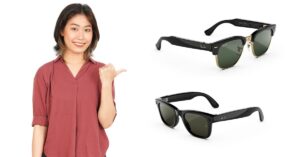
Meta’s smart-glasses strategy now has a privacy split. At Connect 2026, the company expanded camera-equipped Ray-Ban Meta glasses while also introducing Ray-Ban Meta Audio, an audio-only line that Ray-Ban lists as having no camera.
Meta said the new Ray-Ban Meta Audio glasses are its first-ever audio glasses and part of a larger expansion of AI eyewear with EssilorLuxottica. Ray-Ban’s product page lists Ray-Ban Meta Audio as audio only and notes that image and video capture are not available on that model.
At the same time, Meta announced Ray-Ban Meta Gen 3 with a 12 MP camera and 3K Ultra HD video recording. Meta says the camera models include a built-in LED light intended to let nearby people know when photos or videos are being taken. In a July privacy explainer, Meta said its camera-equipped AI glasses use a capture LED and that the camera disables if the LED is covered, physically tampered with or destroyed.
Semafor reported on Sept. 1 that Meta had disabled photo and video capture for thousands of users after detecting LED tampering. The same report said Meta estimated less than one-tenth of 1 percent of glasses sold had been tampered with. That puts the reported tampering problem in a small slice of the user base, but one visible enough to affect the reputation of the category.
The camera-free model gives Meta an answer for people who want calls, music and AI assistance without a forward-facing camera. It does not remove the concern around camera-equipped frames, especially in spaces where consent is hard to signal or verify.
Australia is turning concerns into design demands
Australia’s eSafety Commissioner has published safety recommendations for smart-glasses companies, including automatic face blurring for people who have not given informed consent, limits on retrieving information about members of the public, disabling recording when glasses are not being worn, and delays plus moderation for livestreaming.
The regulator also said it can investigate service-provider compliance with relevant Online Safety Codes and Standards and, in cases of non-compliance, take enforcement action including civil penalties of up to A$54.6 million.
ABC News added a security angle on Sept. 22, reporting that testing of two low-cost smart-glasses products found an attacker could impersonate glasses they did not own and use that to connect to the owner’s mobile app. Legal experts quoted by ABC said the flaws were serious and likely raised issues under Australia’s privacy, consumer and cyber-security laws.
The concern is no longer only bystander consent. It also includes whether owners can trust the apps and cloud systems attached to cheap wearable cameras.
France and local venues are focusing on consent
France’s data protection regulator, the CNIL, said a survey conducted from Jan. 22 to Jan. 29, 2026, among 2,128 adults found that 67 percent of respondents saw smart glasses as a privacy risk. The regulator said the devices can capture sounds, images and videos of nearby people, sometimes without those people being fully aware.
CNIL also said smart-glasses use is, in principle, subject to the GDPR and French data protection law. It reminded users that people whose image or voice may be captured have privacy rights and, where appropriate, consent must be obtained.
Venue policies are also filling gaps. Brisbane City Council’s pool and water park conditions ban the use of video and still cameras in change rooms and state that recording or photography, including through devices such as smart glasses, is not permitted on the premises without prior consent. That type of rule treats smart glasses less like ordinary eyewear and more like wearable camera equipment in sensitive places.
The strongest privacy objection centers on identification, not only recording. In April, the ACLU and more than 70 civil society organizations warned Meta against reported plans to add facial recognition to Ray-Ban and Oakley glasses. The groups urged Meta to halt and publicly disavow those plans.
WIRED reported in June that Meta removed unreleased face-recognition code from the Meta AI companion app after WIRED identified it. Meta’s communications vice president told WIRED no final decision had been made on the feature.
Semafor later reported that Meta’s wearables chief described facial recognition as a frequent request from the accessibility community but said it was not something Meta was looking to do at that time. That tension is now central to the debate: features that could assist some users may also make bystanders easier to identify, profile or harass.
Useful technology still needs public trust
Regulators are not treating smart glasses as harmful in every setting. Australia’s eSafety Commissioner said they can offer benefits for people with disability. The UK Information Commissioner’s Office has pointed to smart glasses that can support people living with dementia and help users better understand their surroundings.
The hard part is that assistive value and bystander risk often come through many of the same sensors: cameras, microphones and AI. Stronger LEDs, tamper detection and camera-free models answer part of the complaint. Regulators and venues are now asking for more, including face blurring by default, limits on real-time identification, safer livestreaming, stronger app security and rules for places where recording is inappropriate.
For the smart-glasses market, public acceptance may depend less on whether the frames look normal and more on whether people nearby can tell when they are being recorded, refuse being identified and trust that captured data is secured.
Meta’s audio-only branch signals there is demand for smart glasses without a camera, but it is not an end point. The backlash is becoming a test of whether wearable AI can earn permission from the people wearing it and from the people standing nearby.
Get new small business insights by email
Practical ideas and useful articles to help you make better business decisions.
Tech Help Canada Staff researches, writes, and reviews practical content for business owners and professionals. Our coverage spans business, marketing, SEO, technology, and the tools and systems people use to grow and operate online. We focus on clear, useful information backed by research, hands-on experience, and editorial review. Learn more about our team and editorial standards. Need help with something? Contact Us