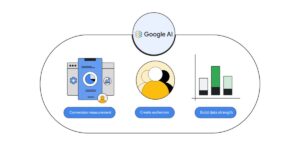
Google Ads has added IP address and interaction timestamp matching to Customer Match, expanding the signals advertisers can send when creating first-party audience lists.
The change is visible across Google’s Customer Match upload documentation and Data Manager materials. Search Engine Land reported the update on September 25, 2026; Google’s public Help Center upload page does not display its own revision date.
Google’s upload instructions now list Customer Match header names that include Email, Phone, First Name, Last Name, Country, Zip, User IP address, and a timestamp field. The two additions are the IP address and the interaction timestamp.
Google describes the IP address field as the address of the customer’s device captured at the exact moment of interaction. The timestamp refers to recorded interactions from the corresponding IP address, including the earliest and last recorded interaction times.
There is one formatting wrinkle. Google’s Help Center page says column headers must use the exact English names, but the same page uses more than one timestamp label, including User interaction timestamp, User Engagement timestamp, and User Interaction timestamp. Automated exports should be tested before being scheduled at scale.
The new fields are sent unhashed
Google’s instructions state that IP addresses and timestamps should be uploaded unhashed. That differs from contact fields such as email addresses, phone numbers, first names, and last names, which can be hashed by advertisers or hashed by Google Ads using SHA256 during plain-text uploads.
Google’s Customer Match data page says uploaded customer data is used to match customers to Google accounts and to check Customer Match policy compliance. The same page now says advertisers have the option to provide user IP addresses and interaction timestamps, which Google uses to improve Customer Match rates without hashing that data.
That difference matters because hashing has long been one of the main privacy safeguards associated with Customer Match contact-data uploads. Raw IP addresses are not just technical leftovers from web logs; they can identify a connection, a location signal, or a shared network context.
The timestamp rule creates a data-quality risk
Google says a timestamp cannot be sent without an accompanying IP address. If an IP address is uploaded without a timestamp, Google says the system defaults to the latest known user of that IP.
That fallback makes old or incomplete records more sensitive from a quality-control perspective. Google’s own IP address glossary says internet service providers sometimes assign the same IP address to a large number of computers, which means an address alone is not always a one-person signal.
Google’s Help Center documentation does not state how recent an IP observation must be to produce a reliable match, nor does it publish a quantified lift for advertisers adding these fields to manual Customer Match uploads.
Regional exclusions are explicit
Google says IP address matching is not supported for end users located in the European Economic Area, the United Kingdom, or Switzerland. Its Data Manager and Data Manager API materials also tell advertisers to exclude IP address sharing from users in those regions and to provide clear information about data collection, with consent where required by law or Google policies.
That makes a single global export risky if a customer list includes people from multiple regions. Advertisers with international traffic may need filtering at the data-source level, not only campaign-level geography settings inside Google Ads.
Canadian advertisers should treat IPs as customer data
Google’s regional restriction does not name Canada, but that does not make IP uploads a low-risk operational change for Canadian businesses.
The Office of the Privacy Commissioner of Canada lists an IP address among examples of personal information under PIPEDA in its public privacy guide. Separately, the Supreme Court of Canada held in R. v. Bykovets that an IP address attracts a reasonable expectation of privacy in the law-enforcement context. Neither source is specifically about Google Ads uploads, but both support a cautious approach to IP address handling.
Before using the new fields, businesses should confirm several points with the people responsible for privacy, analytics, and paid media:
whether IP addresses are being captured at the right interaction point;
whether consent and privacy notices cover advertising audience uploads;
whether records from excluded regions can be filtered before upload;
whether timestamps are stored with enough accuracy to avoid stale matches;
whether access controls, retention rules, and vendor terms cover the new export.
What the change means for advertisers
The upside is straightforward: advertisers may be able to build larger or more accurate Customer Match audiences when email, phone, or address data is incomplete. Google is clearly steering Customer Match workflows toward Data Manager and the Data Manager API, and IP ingestion fits that direction.
The timing is also worth watching. Google’s Ads Developer Blog said on May 28, 2026, that IP addresses with observation timestamps would support higher Customer Match match rates beginning in Q3 2026. Newer Data Manager API field-mapping documentation, last updated September 24, says match-rate improvements from these signals are expected to begin in October 2026. That suggests the file-format support may appear before every advertiser sees measurable lift.
The caution is just as clear. A higher match rate is not the same thing as better campaign performance. Google’s own Customer Match documentation says match rate shows how much of an uploaded list can be connected to Google users, not whether that list will perform well in campaigns.
For now, the safest interpretation is that IP address and timestamp matching should be tested, not rushed. Fresh, consented records with timestamps are more defensible than broad server-log exports. Performance should be measured against incremental campaign value, not only audience size.
This update shows where ad platforms are moving as third-party identifiers keep losing ground: more first-party data, more server-side and Data Manager workflows, and more responsibility on advertisers to prove that the data was collected and shared properly.
Get new small business insights by email
Practical ideas and useful articles to help you make better business decisions.
Tech Help Canada Staff researches, writes, and reviews practical content for business owners and professionals. Our coverage spans business, marketing, SEO, technology, and the tools and systems people use to grow and operate online. We focus on clear, useful information backed by research, hands-on experience, and editorial review. Learn more about our team and editorial standards. Need help with something? Contact Us