It’s easy to misunderstand good writing. It can look like better vocabulary, more confidence, or some natural feel for words.
Those things can help, but they’re not the job.
Your job is to make your reader’s next step easier. They showed up with a question, a problem, a decision, or a half-formed worry. Your writing works when it helps them move forward without making them fight the page.
That’s the useful way to think about how to become a good writer, especially if you write blog posts, articles, newsletters, landing pages, guides, or client content. You’re not just filling space. You’re reducing effort for someone else.
The reader-first writing loop
Most writing advice starts at the sentence level: use active voice, avoid rambling, choose better verbs, edit more.
That advice is useful, but it comes after a more important question: what is your reader trying to do?
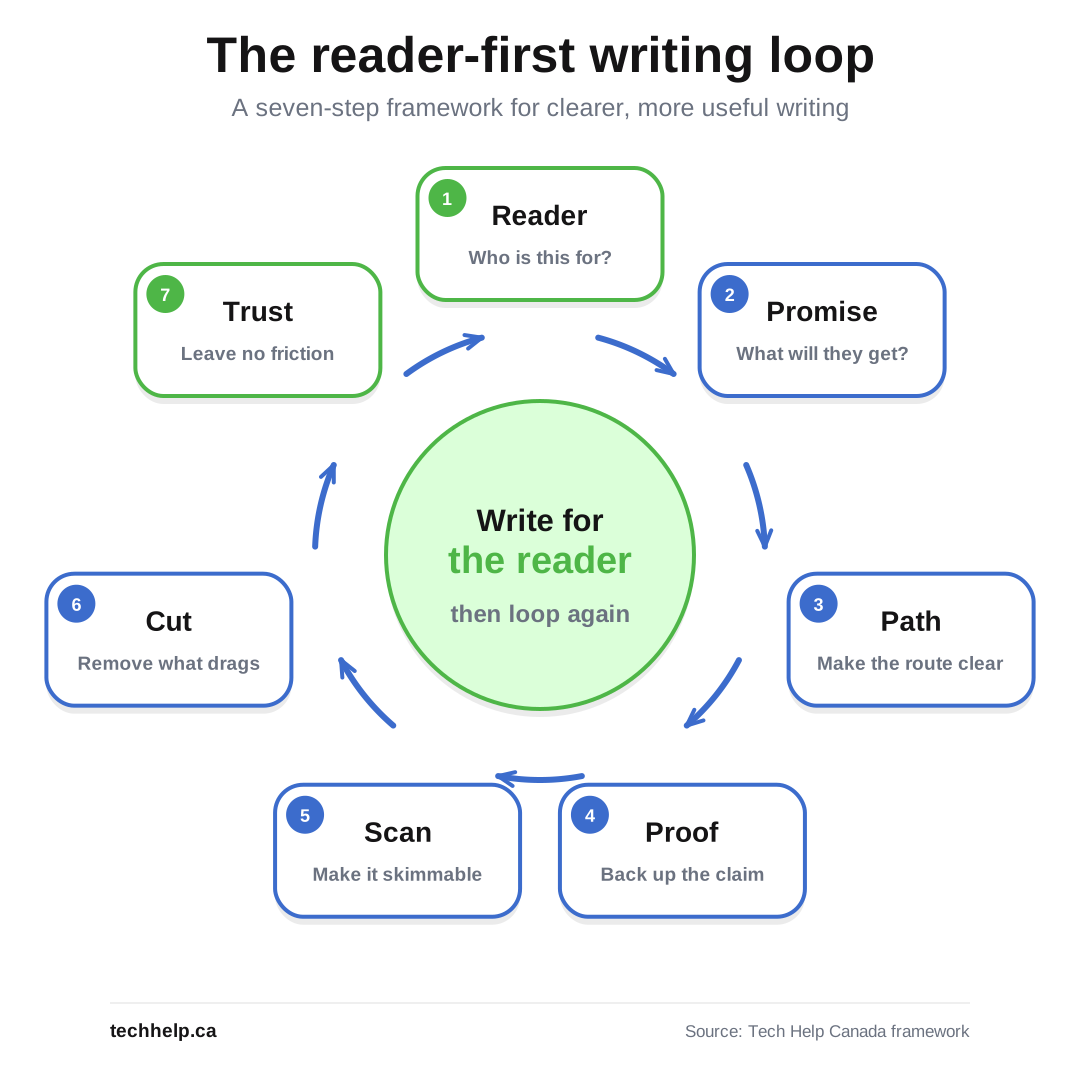
Use the reader-first writing loop before you draft.
Stage
Question to ask
How to use it
Reader
Who is this for?
Name the person, problem, and context before choosing the angle.
Promise
What will they get?
Give the page a job, not just a topic.
Path
What order helps them follow?
Put the useful answer early and build from there.
Proof
What makes this trustworthy?
Use examples, data, experience, screenshots, sources, or useful reasoning.
Scan
Can they find the parts they need?
Use headings, short sections, and useful formatting.
Cut
What is making them work too hard?
Remove throat clearing, filler, repetition, and vague claims.
Trust
Would they believe and use this?
Check facts, tone, context, and missing caveats before publishing.
You can use that loop on a blog post, a client article, a service page, or a LinkedIn post. It also keeps you from judging writing by how impressive it sounds. The better test is whether your reader can understand, believe, and use it.
Start with the reader’s job, not your topic
A topic isn’t enough. “Email marketing,” “website security,” “home renovations,” and “AI tools” are topics. Your reader doesn’t arrive because a topic exists. They arrive because they need help.
Their job may be to:
solve a problem
compare options
avoid a mistake
understand a change
make a purchase
explain something to someone else
decide whether an idea is worth their time
That’s why the first question isn’t “What should I say?” It’s “What job is this reader trying to finish?”
For example, a small business owner searching for content writing advice may not care about literary style. They may need to write a service page that earns trust, explain a product without sounding generic, or decide whether a draft from a freelancer is good enough to publish.
A new writer may have a different job. They may want to build skill, get paid writing work, or understand why their drafts feel flat. If you’re building writing as paid work, our guide on how to make money writing can help with the income side. This page is about the writing skill underneath.
Once you know your reader’s job, the page gets easier to plan. The opening gets more direct. The examples get more useful. The sections that only exist because “articles usually include this” become easier to delete.
Make one useful promise before you draft
Good writing usually has one main promise.
That promise doesn’t have to be dramatic. It just has to be specific enough to guide the page.
Weak promise: “This article is about writing better content.”
Better promise: “You’ll learn how to plan, write, and revise content around your reader’s task.”
The second version gives you a job. It also gives your reader a reason to keep going.
Before drafting, answer these four questions:
Question
Better answer
Who is your reader?
A beginner writer, marketer, founder, freelancer, or internal subject expert.
What are they trying to do?
Write content people can finish, trust, and use.
What do they probably believe now?
That better writing mostly means better wording.
What should they understand after reading?
Better writing starts with your reader’s task, then uses structure, proof, and revision to reduce effort.
This kind of brief keeps the article from drifting. It also makes editing less personal. You’re not cutting a paragraph because it’s “bad.” You’re cutting it because it doesn’t help the promise.
If you write for a business, this step becomes even more important. A page should connect to a broader content marketing strategy, not sit on the site as a random act of publishing.
Give the reader the useful answer early
Many weak articles spend too long warming up.
They start with broad statements. They define obvious terms. They tell your reader the topic is important. By the time the useful answer appears, your reader has already left.
Nielsen Norman Group’s eyetracking research backs this up. Its classic web-reading study found that 79% of test users scanned new pages, while only 16% read word by word. Later eyetracking research estimated that users often have time to read at most 28% of the words on a page during an average visit.
Long content can still work, but the page has to earn deeper reading.
Help your reader decide quickly:
Am I in the right place?
Does this page understand my problem?
Is the answer useful enough to keep reading?
Can I find the section I need?
That’s why the opening of a page shouldn’t merely introduce the topic. It should show your reader what they’ll be able to do, decide, or understand.
Use headings that carry the argument
Headings aren’t decorations. They’re your reader’s map.
A good test is to read only the H2s. If the headings don’t tell a useful story, the article probably has a structure problem.
Compare these two outlines.
Weak outline
Stronger outline
Introduction
Start with the reader’s job, not your topic
Writing tips
Make one useful promise before you draft
Headlines
Give the reader the useful answer early
Readability
Use headings that carry the argument
Conclusion
Build a revision system you can repeat
The weak version names categories. The stronger version tells you and your reader what each section does.
This is one of the fastest ways to become a better writer. Before you polish sentences, improve the path. If your structure is confusing, every sentence has to work harder.
Write with proof instead of volume
When a section feels thin, you may be tempted to add more words. That rarely fixes the problem.
Thin sections usually need proof, not length.
Proof can include:
a concrete example
a short before-and-after
a credible source
a number with context
first-hand experience
a screenshot or process note
a clear explanation of trade-offs
Google Search Central’s helpful content guidance points in the same direction. It asks whether content provides original information, reporting, research, or analysis, whether it adds value beyond copied or rewritten sources, and whether the page is something a reader would bookmark, share, or recommend.
For you, that’s a useful standard. Your page shouldn’t only sound correct. It should give your reader something they couldn’t get from a thin rewrite of the same search results.
Make the page easy to scan
Scanning isn’t a failure. It’s how people protect their attention.
Your reader may scan first, then slow down when they find the section they need. Good formatting helps that happen.
Use:
descriptive H2s and H3s
short paragraphs
lists when your reader needs steps, options, or checks
tables when your reader needs to compare
bold text only when emphasis helps
examples near the advice they support
A page can include a checklist, but the layout still has to help your reader move through the material without guessing where the value is.
For line-level help after the structure is working, see our writing tips editors use. Sentence polish is powerful, but it works best after the page knows what it’s trying to do.
Cut the sentences that slow the reader down
The easiest way to improve a draft is often subtraction.
Look for sentences that announce, delay, hedge, or repeat instead of helping your reader.
Slower writing
Better writing
What changed
Content can improve in many ways.
You’ll improve faster when you know what your reader needs first.
The sentence makes a claim instead of circling the topic.
Headlines play an important role in getting attention.
A headline should tell the right reader why the page is worth opening.
The sentence names the job of the headline.
Online readers are looking for useful information.
Readers come with tasks: solve, compare, decide, explain, or avoid a mistake.
The sentence becomes more specific.
Good content should be accurate and helpful.
Check every claim a reader might rely on before you publish.
The advice turns into an action.
You don’t have to make every sentence short. Rhythm matters. A longer sentence can work when it earns its place and is easy to follow.
The better rule is this: keep the words that help your reader think, and remove the words that make them wait.
Test the substance before you polish the style
Style is useful, but it can’t save an empty paragraph.
Here’s a quick test. Read any paragraph you’ve written and ask: if I stripped the style from this paragraph, with no clever phrasing, no rhythm, and no personality, would the information still be worth reading?
If yes, the substance is there and the style is a bonus.
If no, no amount of polish will fix it.
Use that test when a draft sounds good but feels thin:
What does your reader know now that they didn’t know before?
What decision can they make?
What example would make the point easier to believe?
Which claim needs support?
Which sentence sounds good but says very little?
If you want to get good at this, substance comes first. The web’s already full of polished writing that says very little. The opportunity is to write pages that actually help.
Run the draft back through the loop
The framework at the top is for planning. During editing, run the draft back through the same loop, but this time as a red-flag check.
Pass
Red flags to look for
Reader pass
The opening could apply to anyone, or your reader’s problem is vague.
Promise pass
The headline promises one thing, but the article delivers something else.
Path pass
Sections could appear in almost any order, or the useful answer is buried.
Proof pass
The main claims rely on assertion without examples, context, sources, or experience.
Scan pass
Long paragraphs, vague headings, or missing tables make the page harder to use.
Cut pass
Throat clearing, repeated points, padded sentences, or hedges slow your reader down.
Trust pass
Names, dates, numbers, claims, links, or caveats haven’t been checked.
This is also where AI-assisted writing needs human judgment. AI tools can help brainstorm, outline, summarize, and revise, but they can also produce confident generic text. If you use AI in the writing process, review the draft for accuracy, originality, examples, and search-quality risk before publishing. We’ve written about how to handle AI-generated content and search-quality risk specifically.
Practice becoming a better writer with a 30-day plan
Writing improves through focused practice. “Write more” isn’t enough if you repeat the same habits.
Try this 30-day plan:
Week
Loop focus
Practice
Output
1
Reader and promise
Pull five old drafts. For each one, identify your reader’s job and rewrite the opening to reach the useful point in the first two sentences.
Five stronger openings.
2
Path and scan
Rewrite the H2s before touching the body copy. Make the headings show the path through the idea.
Three outlines where the headings carry the argument.
3
Proof
Find thin sections and add one useful proof point to each: an example, data point, screenshot, source, or clearer explanation.
Five stronger sections.
4
Cut and trust
Run one full article through the loop, remove drag, and check every claim a reader might rely on.
One publishable draft.
The goal isn’t perfection in a month; it’s better instincts. After enough practice, you start seeing weak openings, vague claims, missing examples, and bloated sentences before they harden into the draft.
Make the reader feel considered
The standard advice isn’t wrong: better content does need originality, useful information, scannable formatting, strong headlines, and accuracy.
But those aren’t separate tricks. They’re all part of the same responsibility.
You have to consider your reader.
When you know who the page is for, make a useful promise, give the answer early, support the claim, organize the path, cut the drag, and check the work, the writing gets better because your reader’s experience gets better.
That’s how you get better at writing in a way that sticks. Not by chasing clever phrasing, but by making every draft easier to understand, easier to trust, and easier to use. Pick one draft you’ve been sitting on and run it through the loop. You’ll see the difference before you finish the first pass.
Frequently asked questions
What is the best way to become a good writer?
The best way to become a good writer is to practice around your reader’s task. Before you draft, decide who the reader is, what they need to understand or do, what proof they need, and what would make the page easier to follow.
How can a beginner become a better writer?
A beginner can become a better writer by improving one part of the process at a time. Start with openings, then headings, then examples, then sentence edits. Focused practice works better than simply writing more without changing the habit you’re trying to improve.
What skills does a good content writer need?
A good content writer needs audience understanding, research judgment, structure, headline writing, sentence editing, source handling, fact-checking, and the ability to explain ideas in a way readers can use. For business content, the writer also needs to understand the purpose of the page.
How do I make my writing easier to read?
Make writing easier to read by putting the useful answer early, using headings that describe the section, keeping paragraphs short, removing filler, and adding examples near the advice they support. The goal is to reduce the reader’s effort without removing useful detail.
How long does it take to become a better writer?
You can improve a draft immediately by making it more reader-focused, but becoming a better writer takes repeated practice. Most writers improve faster when they revise in passes: reader, promise, structure, proof, scan, sentence, and trust.
Get new small business insights by email
Practical ideas and useful articles to help you make better business decisions.
Tech Help Canada Staff researches, writes, and reviews practical content for business owners and professionals. Our coverage spans business, marketing, SEO, technology, and the tools and systems people use to grow and operate online. We focus on clear, useful information backed by research, hands-on experience, and editorial review. Learn more about our team and editorial standards. Need help with something? Contact Us