Creative marketing doesn’t mean doing random things for attention. It means finding a fresh way to reach the right people, make your offer easy to understand, and give them a reason to remember you.
If you’re a solopreneur or small business owner, you probably don’t have time to chase every trend. You need ideas you can test without draining your budget or distracting you from the work that actually pays.
The best approach is usually to borrow what already works in your market, then add one angle your competitors aren’t using. A restaurant can still mail flyers, for example, but it might pair them with a neighbourhood-only offer on its Google Business Profile, a door hanger with a trackable code, or a photo contest customers actually want to join.
Before you try a creative promotion
Creativity still needs structure. A campaign that gets noticed but doesn’t connect to a clear offer will waste attention. A campaign that collects emails without proper consent can create problems later. A campaign that looks funny internally but confuses customers won’t earn many buyers.
Before launching any idea below, answer four questions.
Who is this for? Name the customer segment, neighbourhood, event crowd, or buyer type.
What should they do next? Visit a page, book a call, scan a code, use a coupon, walk in, or reply.
How will you track it? Use a unique promo code, QR code, landing page, call tracking number, or intake question.
What rules apply? Check local bylaws, venue permission, contest rules, platform policies, privacy requirements, and disclosure rules.
That last point matters. In Canada, the Competition Bureau gives specific guidance for promotional contests and influencer-style promotions. The CRTC also outlines consent, identification, and unsubscribe requirements for commercial electronic messages under CASL. You don’t need to become a lawyer to market creatively, but you do need to avoid shortcuts that can damage trust.
9 creative ways to market your business
1. Use temporary chalk messages or street-level signs
Sidewalk-level messaging can catch attention because it interrupts a routine walk. Someone is not opening an app, checking email, or sorting mail. They’re walking past your message in the real world.
The key is to make the message useful, not just visible. A business needs more context than a logo or slogan: “Need lunch in 10 minutes? Burritos two blocks ahead,” “First yoga class this week? Scan for a free pass,” or “Dog grooming openings today — call before 3.”
Use removable chalk where permitted, get permission for private property, and check your municipality’s rules before marking sidewalks, streets, or public spaces. If chalk is not allowed, use portable signs, window decals, sandwich boards, or temporary event signage instead.
2. Put a stronger offer on door hangers
Door hangers are hard to miss because the reader has to remove them. That attention is valuable, but it lasts only a few seconds.
Don’t use that small space to introduce your entire business. Use it to sell one next step. A lawn care company might offer a spring yard assessment. A dog walker might promote a first-week trial. A restaurant might offer a Tuesday pickup special for nearby streets.
Keep the copy short: one pain, one benefit, one offer, one action. Add a QR code only if the destination is mobile-friendly and directly tied to the hanger. If someone scans for “free estimate,” don’t send them to your homepage. Send them to the estimate form.
3. Hire a local brand ambassador
An evangelist is not just a salesperson with a friendlier title. The right person already understands the community you want to reach and knows how to start natural conversations about your offer.
This works especially well for gyms, salons, food brands, local apps, events, specialty retail, and service businesses with strong customer experience. Give your ambassador a simple script, a trackable code, samples or demos if appropriate, and clear boundaries around what they can claim.
If they receive payment, free products, commissions, discounts, or other perks, make the relationship clear. Canadian Competition Bureau guidance treats material connections as something audiences should be able to see and understand, and the FTC gives similar guidance for U.S.-facing endorsements.
4. Turn shirts, hats, and totes into conversation starters
A shirt with only your logo is easy to ignore unless people already know the brand. A shirt with a specific message can create curiosity.
Instead of “Smith Accounting,” try “Ask me why your tax folder is costing you weekends.” Instead of “Downtown Boxing Club,” try “Your first punch is free.” The point is not to be clever for its own sake. It’s to make a stranger understand who you help and why they might care.
If you have staff, give them branded items they’ll actually wear. Cheap shirts that shrink, fade, or feel uncomfortable become closet inventory, not marketing.
5. Project or display your message where people already gather
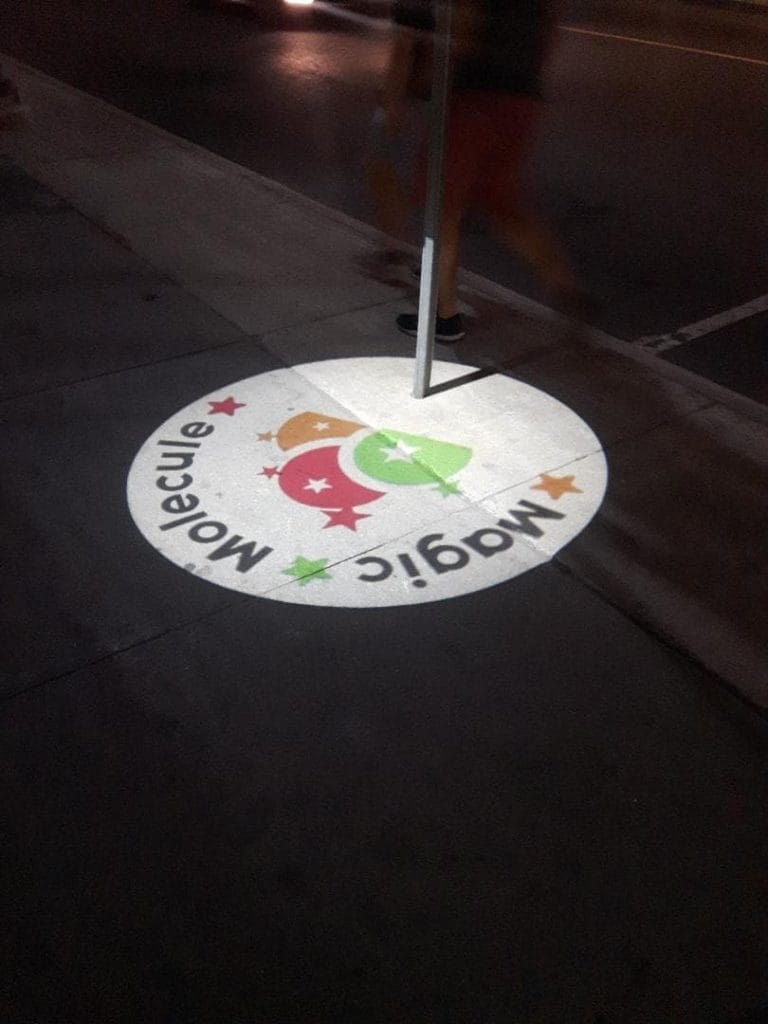
Nighttime projections, window displays, lightboxes, and pop-up screens can make a simple message feel bigger than it is. This can work well near events, nightlife areas, festivals, conferences, or busy pedestrian zones. Here’s a pretty good example.
But your logo alone is not enough. Pair the visual with a reason to act: a limited event offer, a short URL, a QR code, or a message people might photograph and share. “Open late tonight” can be more useful than a floating logo. “Show this photo for 15% off before midnight” is stronger still, if the offer is real and profitable.
Get property permission, avoid creating distractions for drivers or pedestrians, and check local signage rules before projecting anything in public.
6. Run a publicity stunt that does not feel staged
Publicity stunts still work when they connect to the business and give people something worth talking about. They fail when the stunt becomes bigger than the offer or feels manipulative.
A bakery could create a “giant cinnamon bun day” for charity. A repair shop could fix bikes for free in a park before the first big cycling weekend. A bookstore could run a silent reading hour in a public square with branded bookmarks and a local partner.
Keep it safe, honest, and tied to a business outcome. If the stunt needs deception to get attention, it’s probably not worth doing. The best version makes people feel like they discovered something worth sharing, not like they got tricked into promoting you.
7. Publish a short book, guide, or report
A book does not need to become a bestseller to become useful. For many service businesses, a short, practical guide can make sales conversations easier because it gives prospects proof of how you think.
A mortgage broker might publish a first-time buyer guide for one city. A consultant might print a short report on mistakes companies make before hiring. A fitness coach might produce a simple beginner plan for people returning after years away.
If you print copies, use them strategically. Bring them to meetings, include them in welcome packages, hand them out at events, or send them to high-value prospects. If you publish online, pair the guide with a useful landing page and a follow-up sequence that respects email consent rules.
For a stronger authority asset, treat it like useful content first and a sales tool second. Tech Help Canada’s guide on content writing services explains the difference between content built for trust and copy built for direct sales.
8. Sponsor a local sports team or community group
Local sponsorship can be more than a logo on a jersey. The real value comes from what you do around the sponsorship.
Before you spend the money, ask where your brand will appear, how often, who attends, what the organization can share with its audience, and whether you can create an offer tied to the season. A dentist sponsoring a youth soccer team might offer sports mouthguard appointments. A restaurant might create a “team night” bundle. A print shop might offer discounted banners to other sponsors.
Support the group genuinely, then build a campaign around that support. Take photos where appropriate, feature the team or organization on your channels with permission, and give the audience a reason to remember you beyond the cheque.
9. Run an online photo or video contest
A picture contest can work well because customers create the content and bring their own networks into the promotion. A salon might ask customers to share a post-new-style photo. A pet store might run a “best rescue story” contest. A restaurant might invite people to post their favourite meal photo from the past month.
Set the rules before you launch. In Canada, promotional contests need required disclosures, including prize information and details that affect the chances of winning. If you ask people to post publicly, make sure your rules cover eligibility, deadlines, winner selection, prize details, content permissions, and how entries will be used.
Also check the rules of the platform you use. Social platforms change their promotion rules, and some entry mechanics that seem common may still violate platform terms. Avoid forcing people to spam friends, and don’t imply a platform sponsors your contest unless that is actually true.
How to choose the right creative idea
Pick the idea that matches your buyer’s behaviour. A local restaurant, barber, gym, dentist, home service company, or retail shop can often get value from physical marketing because customers live or move nearby. A consultant, freelancer, coach, or B2B service provider may get more value from authority assets, small events, partnerships, or targeted outreach.
If you’re not sure where to start, match the idea to your main constraint.
If people do not know you exist: Try street-level signs, local sponsorships, collaborations, or a small stunt.
If people know you but do not act: Improve the offer on door hangers, Google Business Profile posts, email, and landing pages.
If people do not trust you yet: Publish a guide, collect customer stories, use ambassadors carefully, or build proof into every campaign.
If your competitors look the same: Add personality, a stronger guarantee, a better local angle, or a more memorable visual.
Creative promotion works better when your positioning is clear. If you need a simple framework for checking your offer, audience, price, promotion, and customer experience, review Tech Help Canada’s guide to the 5 Ps of marketing.
Test one idea before chasing the next one
Creative marketing gets messy when you launch five half-built ideas at once. Pick one. Give it a real offer, a clear audience, and a way to track results. Run it long enough to learn something, then improve it or move on.
The goal is not to look quirky. The goal is to become easier to notice, easier to remember, and easier to buy from.
Gabriel Nwatarali is the founder of Tech Help Canada and has worked in SEO, copywriting, and web strategy since the early 2000s. His work has helped drive more than 10 million app downloads and 2,900% organic traffic growth for startups, agencies, and brands across North America. He writes about SEO, marketing, AI, and the decisions that shape how businesses grow online, drawing on hands-on experience building websites, content systems, and digital strategies.