Most people overestimate what it takes to change their life. They wait for a defining moment, a major opportunity, or some kind of breakthrough that rewrites everything overnight.
But that’s rarely how it works.
The decisions that redirect your life are usually quiet. They don’t feel dramatic the day you make them. They feel boring, uncomfortable, or uncertain. Then a year or two later, you look back and realize that one choice changed the way you lived, worked, spent, loved, and thought.
If you’re building a business, a career, or a life that asks more from you, these are the kinds of decisions that matter. They’re simple enough to dismiss and serious enough to alter the direction you’re headed.
Commit to something for an entire year
Most people give up on things too early. They try something for a few weeks, maybe a few months, and when results don’t show up on schedule, they move on. That pattern repeats until quitting starts to feel like good judgment.
A year gives meaningful work enough time to breathe, whether you’re building a business, getting stronger, learning a skill, developing a relationship, or growing into a new role. These things don’t follow a 90-day timeline. They reward consistency, feedback, and patience.
The messy middle is where most people leave. The early excitement fades, results lag behind effort, and a newer idea starts looking easier. If you push through that phase, the work starts giving you information you couldn’t have earned from the outside.
You’re not committing to guaranteed success in a year. You’re committing to give something a legitimate chance before you judge it. There’s a meaningful difference between “this didn’t work” and “I didn’t stay long enough to find out.”
For entrepreneurs, this one decision can be the difference between building momentum and restarting forever.
Change your environment when it keeps you stuck
Willpower gets too much credit. People assume that if they’re struggling to stay disciplined, they just need to try harder. Sometimes the smarter move is to stop fighting the same conditions every day.
Your environment influences your behavior more than motivation does. James Clear has argued that environment often matters more than motivation because your spaces, cues, routines, and defaults quietly influence what you do before you even think about discipline.
This goes beyond your physical workspace. It includes the city you live in, the people you see often, the apps you open first, the conversations you keep having, and the version of yourself your daily routine keeps reinforcing.
If you’re trying to build something ambitious but your surroundings reward distraction, comfort, or small thinking, effort alone may not be enough. You may need a structural change: a different schedule, a better workspace, a new peer group, fewer digital inputs, or a move that places you closer to opportunity.
You can’t outwork an environment that’s working against you.
Choose a romantic partner who supports your growth
This is one of the most consequential decisions you’ll ever make, and it doesn’t get the strategic attention it deserves. The person you choose as a partner will influence your confidence, ambition, emotional health, and daily behavior.
Brooke Feeney, a psychology researcher at Carnegie Mellon University, has studied how close relationships affect personal thriving. Her work describes two forms of support. One helps people recover from adversity. The other helps them pursue opportunities, explore possibilities, and grow during stable periods.
That second form is easy to underestimate. A partner who comforts you when things go wrong matters. A partner who encourages you to take calculated risks, pursue better work, and become more capable during good times can change the pace of your life.
A 2017 study published in Personality and Social Psychology Bulletin found that people with supportive spouses were more likely to pursue challenging opportunities. Six months later, those who took on the challenge reported more personal growth, happiness, psychological well-being, and stronger relationship functioning.
On the other side, a partner who quietly needs you to stay the same can cost you years. This isn’t about finding someone who agrees with every decision. It’s about choosing someone who wants to see you grow, even when your growth requires discomfort, sacrifice, or a new version of the relationship.
Choose friends who want you to win
Your social circle isn’t neutral. The people you spend the most time with influence what feels normal, including how hard you work, how you spend money, how you talk about your goals, and how quickly you recover from setbacks.
You don’t need a study to know this. Spend enough time around disciplined people and discipline starts to feel ordinary. Spend enough time around people who mock ambition, avoid responsibility, or resent progress, and growth starts feeling socially expensive.
The influence works both ways. Being around people who are ambitious, honest, and intentional raises your standard. Being around people who are cynical, complacent, or resistant to growth pulls that standard down.
You don’t have to cut people out in a cold, transactional way. You do have to be honest about who gets the most access to your attention, your emotional energy, and your plans. If the people closest to you only feel comfortable with the old version of you, change will always come with extra friction.
The question isn’t whether your friends say they support you. It’s whether the way they live makes you more likely to become the person you say you want to be.
Remove drinking and drugs from your life
This isn’t a moral argument. It’s a practical one.
According to the CDC, excessive alcohol use causes about 178,000 deaths each year in the United States. That’s roughly 488 deaths per day. The economic toll is enormous too. The Recovery Research Institute notes that alcohol-related issues cost the U.S. about $250 billion annually through lost productivity, healthcare expenses, criminal justice costs, and other effects.
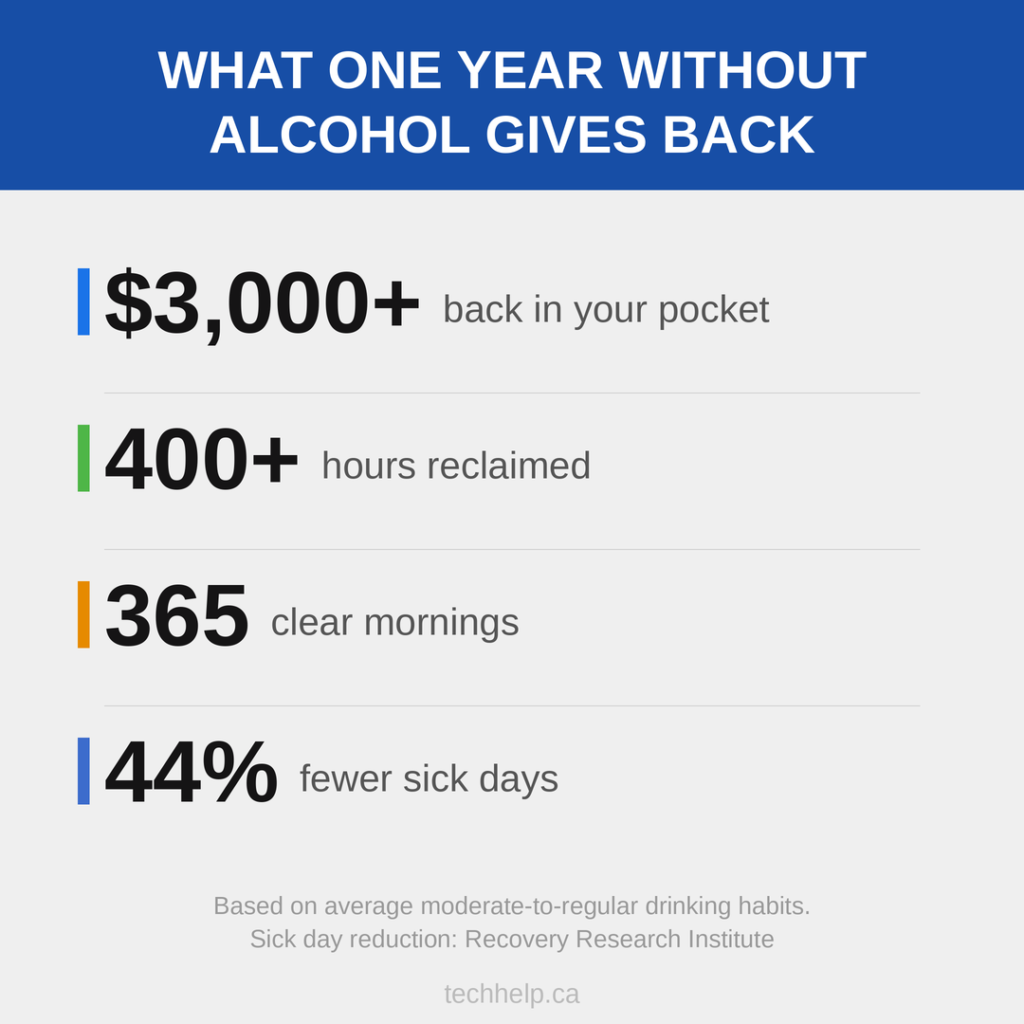
Those are the extreme numbers. The smaller costs are easier to ignore because they show up slowly: less energy, worse sleep, weaker focus, slower mornings, expensive nights out, and decisions you wouldn’t have made with a clear head.
Reducing use can help too. A review highlighted by the Recovery Research Institute found that reducing weekly drinking volume by about 30% was associated with fewer injuries and 44% fewer sick days over two years.
The same practical logic applies to recreational drug use. If a substance regularly costs you clarity, time, money, trust, or momentum, it’s not just a personal habit. It’s part of your operating system.
Removing substances gives you back mornings, energy, emotional steadiness, and money. For many people, it’s one of the highest-return decisions available. If dependency is involved, don’t turn this into a private willpower contest. Get professional support and let other people help you through it.
Stop chasing shiny objects
Every new trend, idea, and opportunity has a cost, even if you never fully pursue it. The cost is the attention it pulls away from the thing you’ve already started.
Shiny object syndrome is especially dangerous for entrepreneurs because opportunity is part of the job. You have to notice openings. You have to test ideas. But if every new possibility becomes a pivot, you never give anything enough time to mature.
The pattern usually looks the same. You start something, make progress, hit a plateau, and then spot something newer that seems faster, easier, or more exciting. So you switch. Then you repeat the same cycle with a different label.
The damage isn’t only the time spent on the new thing. It’s the momentum you lose on the original thing. Momentum is hard to build and easy to break. Every reset forces you back into the most fragile stage of the work.
Focus works like a filter. When a new opportunity appears, the better question isn’t “Is this interesting?” It’s “Is this more valuable than what I’m already building?”
Most of the time, it isn’t.
Protect your sleep
Sleep is the foundation underneath your focus, patience, emotional regulation, physical recovery, and decision-making. If you’re under-rested, every other part of your life becomes harder to manage.
The workplace cost alone shows how expensive poor sleep can become. The Sleep Foundation reports that almost 38% of U.S. employees experienced fatigue at work during the previous two weeks in one study. It also cites research estimating that fatigue costs employers about $1,967 per employee each year and about $136.4 billion nationally.
Canada is not immune to the same pattern. RAND estimated that insufficient sleep costs Canada about 0.85% to 1.56% of GDP and roughly 78,000 working days each year.
For someone building a business, the cost can show up as poor judgment long before it shows up as exhaustion. You become more reactive. You take longer to think. You misread problems, avoid hard conversations, and reach for easy distractions because your brain is trying to conserve energy.
Sleep isn’t a reward you earn after a productive day. It’s the infrastructure that makes a productive day possible.
Protecting your sleep means treating it as part of the work. Set boundaries around late-night tasks. Stop letting other people’s urgency take over your recovery. Build a wind-down routine that doesn’t depend on perfect discipline at midnight.
The upside of one more late night is usually smaller than the downside of another bad morning.
Take your physical health seriously
Exercise isn’t a vanity project. It’s one of the most reliable performance enhancers available, and it affects more than how you look.
Research from Cleveland State University, published in the Journal of Labor Research, found that people who exercised regularly earned between 6% and 10% more than sedentary peers. The finding is correlational, so don’t treat exercise as a salary button. Treat it as evidence that health, energy, confidence, and performance tend to travel together.
The connection is practical. Exercise improves mood, reduces anxiety for many people, strengthens focus, and increases energy. People who move consistently tend to think more clearly, regulate their emotions better, and sustain stronger output over time.
You don’t need a complicated routine. You need consistency. Walking daily, lifting weights, cycling, swimming, stretching, bodyweight training at home. The specific activity matters less than the habit of moving your body on purpose.
The mistake is treating your physical health as something you’ll get to later, once everything else is handled. Your body isn’t separate from your ambition. It’s the engine behind it.
Live below your means
Financial stress bleeds into everything. It affects your sleep, your relationships, your decision-making, and your ability to take smart risks. For many people, income is only part of the problem. Spending rises to meet whatever income appears.
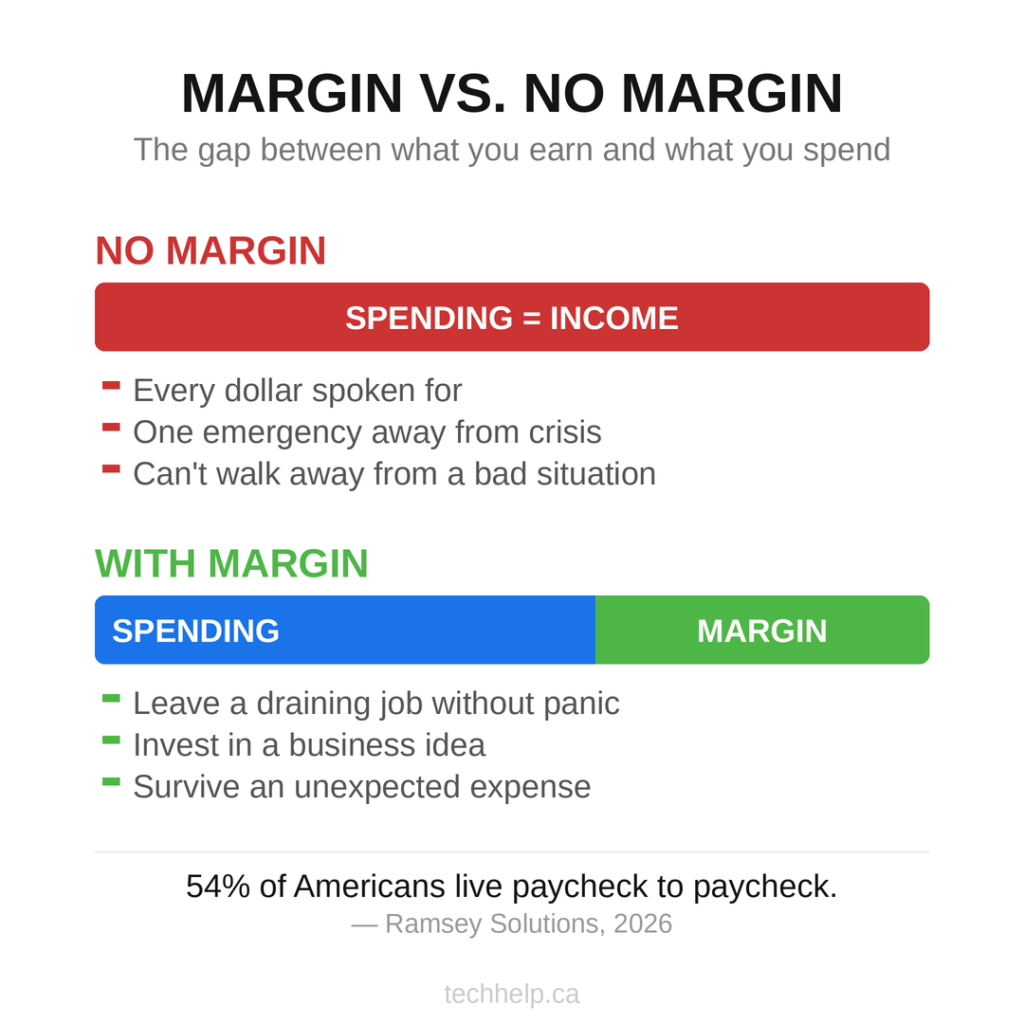
According to Ramsey Solutions’ 2026 State of Personal Finance report, 54% of Americans say they live paycheck to paycheck, up from 42% in 2021. About 34% describe their financial situation as “struggling” or “in crisis,” and 48% report difficulty paying monthly expenses.
In Canada, the pressure shows up differently but points in the same direction. Statistics Canada reported that households carried $1.76 in credit market debt for every dollar of disposable income in the first quarter of 2024, while debt-service payments took up 14.91% of disposable income.
Living below your means isn’t about deprivation. It’s about building margin. Margin is the space between what you earn and what you spend, and that space gives you options.
It’s the ability to leave a draining job without panic. It’s the breathing room to invest in a business idea. It’s the safety net that keeps one unexpected expense from turning into a crisis.
A lifestyle that requires every dollar you earn is not freedom. It’s pressure wearing nice clothes.
The shift doesn’t always require earning more. It often starts with spending intentionally, knowing what actually adds to your life, and being honest about what only adds to your monthly obligations.
Make one meaningful change
If you’ve read through this list and feel the urge to overhaul everything at once, pause. That instinct is understandable, but it’s also one of the fastest ways to quit before anything sticks.
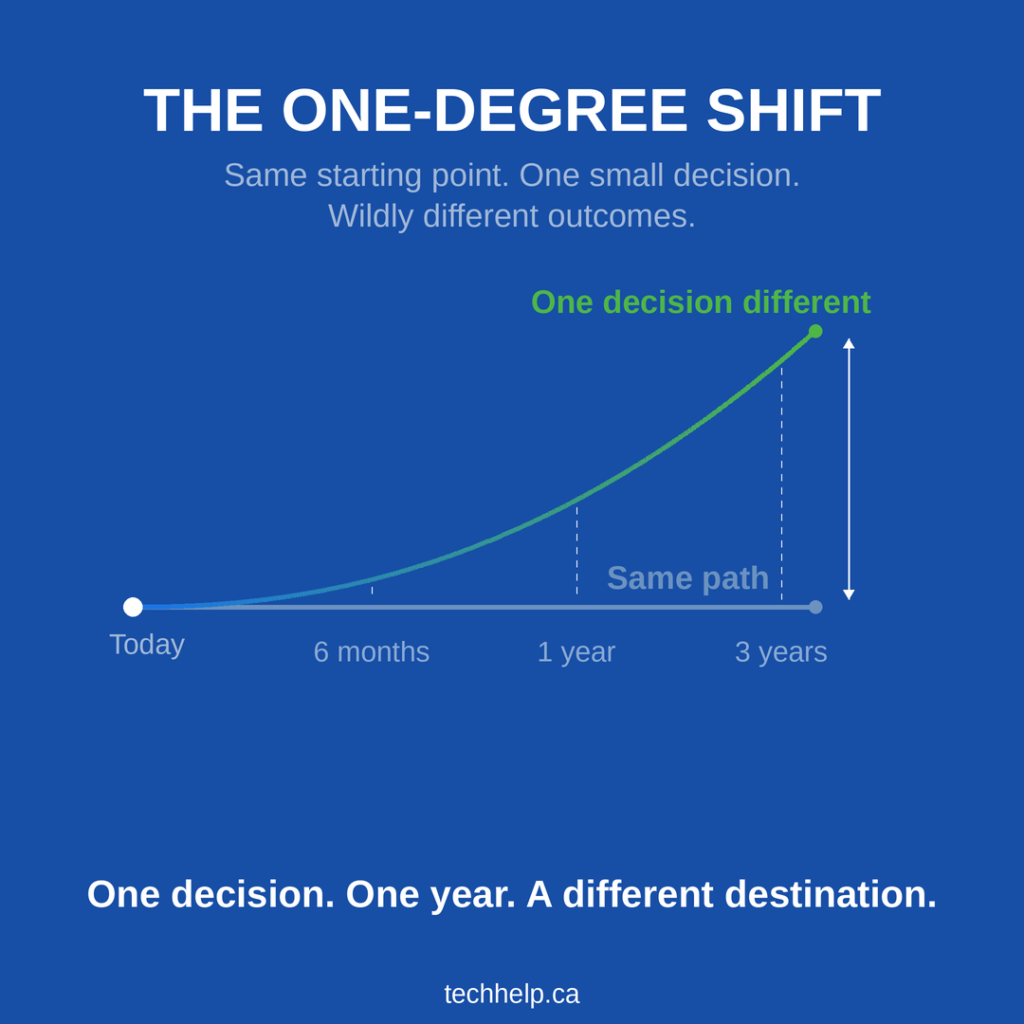
Small changes compound. One decision, held long enough, starts affecting other areas. Better sleep improves your patience. Better patience improves your decisions. Better decisions improve your money, relationships, and work.
Pick the one decision from this list that would create the most relief or unlock the most potential in your current life. Maybe it’s protecting your sleep because everything else suffers when you’re tired. Maybe it’s cutting back on drinking because you’ve noticed how much time and clarity it’s costing you. Maybe it’s committing to one business idea for a full year instead of bouncing between options.
Whatever it is, protect that decision. Don’t let the ambition to fix everything crowd out the discipline to change one thing.
You don’t need to rebuild your entire life this week. You need one decision strong enough to keep, and enough patience to let it change you.
Tech Help Canada Staff researches, writes, and reviews practical content for business owners and professionals. Our coverage spans business, marketing, SEO, technology, and the tools and systems people use to grow and operate online. We focus on clear, useful information backed by research, hands-on experience, and editorial review. Learn more about our team and editorial standards. Need help with something? Contact Us