
Two agencies can quote wildly different prices for work that sounds almost identical. One says $2,000 a month. Another says $15,000. Both quotes can be fair if the scope, seniority, strategy, creative work, and reporting expectations are different enough.
The mistake is comparing the monthly number before you understand what sits underneath it.
A retainer that includes SEO, paid ads, content, email, landing pages, analytics, and weekly reporting costs more than a retainer that covers four blog posts and a monthly summary. A senior strategy team costs more than a junior execution team. A paid ads program with creative testing and conversion tracking costs more than campaign maintenance.
So, how much do marketing agencies charge? For many small and mid-sized businesses, agency retainers often land somewhere between $1,000 and $10,000+ per month, depending on the service. Larger, multi-channel programs can climb well beyond that. Clutch’s 2026 pricing data shows many digital marketing projects fall between $10,000 and $49,999, while WebFX’s pricing guide puts full-service digital marketing at $1,000 to $10,000+ per month.
Those numbers are only a starting point. The useful question is not “what does an agency cost?” It’s “what level of support am I buying, and can it pay for itself?”
Quick agency pricing benchmarks
Most published agency pricing data is U.S.-leaning, so Canadian businesses should always confirm whether a quote is in CAD or USD. You should also separate agency fees from media spend, software, production, and one-time setup costs.
| Service | Common monthly range |
|---|---|
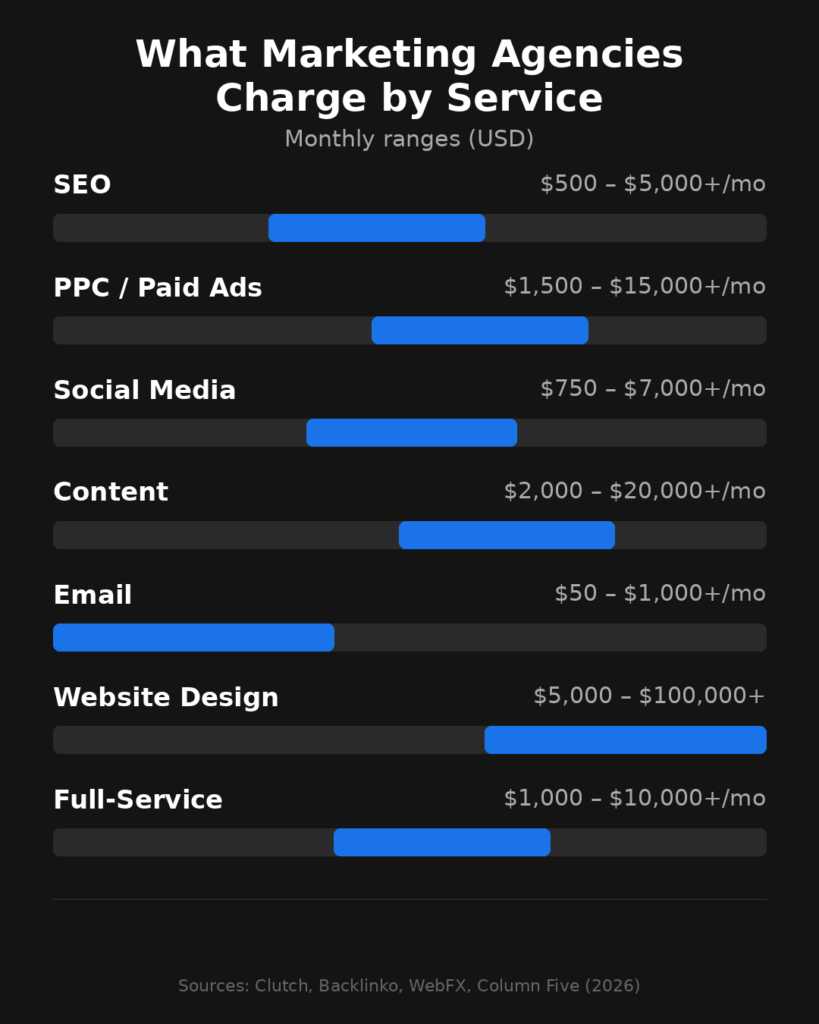
| SEO | $500 to $5,000+ |
| PPC / paid ads management | $1,500 to $15,000+ |
| Social media management | $750 to $7,000+ |
| Content marketing | $2,000 to $20,000+ |
| Email marketing | $50 to $1,000 for basic management, higher for complex automation |
| Website design | $5,000 to $100,000+ per project |
| Full-service digital marketing | $1,000 to $10,000+ per month |
These ranges come mostly from marketplace and agency pricing guides, including Clutch, WebFX, Backlinko, and Column Five. Treat them as benchmarks, not rules. A $3,000 local SEO retainer and a $3,000 content production retainer are not the same purchase.
The five pricing models agencies use
Most agencies use one of five pricing models. Some blend more than one, especially when a campaign includes strategy, media buying, creative production, and reporting.
Monthly retainer
A retainer is a fixed monthly fee for an agreed scope of work. It may cover SEO, content, paid ads, social media, email, reporting, or a mix of services.
Retainers work well when the marketing effort needs consistency. SEO, content, paid ads optimization, email, and social media usually improve through repeated work, not one-off bursts. The risk is vague scope. Before signing, make sure you know exactly what the agency will deliver each month, how often strategy is reviewed, and what counts as out-of-scope work.
Project-based pricing
Project pricing gives you a fixed price for a defined deliverable, such as a website redesign, SEO audit, brand refresh, campaign launch, or marketing strategy document.
This model works best when the outcome is clear. It becomes risky when the project is loosely defined, because every extra landing page, revision round, integration, stakeholder meeting, or post-launch change can become a new cost.
If you choose project pricing, ask what “done” means before the work starts.
Hourly pricing
Hourly pricing is common for consulting, training, troubleshooting, audits, and undefined work. Clutch data shows digital marketing agencies often charge $25 to $49 per hour overall, while specialized services such as SEO, PPC, email marketing, content marketing, and social media marketing commonly sit in the $100 to $149 per hour range.
A higher hourly rate is not automatically worse. A senior person who solves the problem in three hours can cost less than a junior team that needs 20. Ask for an estimated hour range, a budget cap, and a clear approval process before work continues beyond the estimate.
Percentage of ad spend
Paid advertising agencies often charge based on a percentage of your ad budget, a flat management fee, or a hybrid of both. Your ad spend is separate from the agency fee.
This is where many businesses misread the quote. A $2,000 management fee with $5,000 in media spend is not a $2,000/month program. It is a $7,000/month commitment before creative production, landing page work, or tracking tools.
For PPC or paid social, always ask whether the quote includes campaign setup, tracking configuration, creative testing, landing page recommendations, and reporting. A cheaper management fee can become expensive if all the important parts are billed separately.
Performance-based pricing
Performance pricing ties the agency’s fee to leads, sales, revenue, or another measurable outcome.
It can work, but only when tracking is strong, attribution rules are clear, margins are understood, and both sides agree on what counts as a qualified result. Be careful with guarantees that sound too clean. An agency can influence traffic, creative, campaigns, and conversion paths. It cannot control your close rate, product quality, inventory, customer service, or economic conditions.
What agencies charge by service
The service you buy affects the price as much as the pricing model. The ranges below are useful for planning, but the right quote still depends on scope.
SEO
SEO retainers commonly range from $500 to $5,000+ per month. Backlinko’s 2026 SEO pricing guide, based on a survey of more than 300 SEO professionals, found average monthly SEO costs of $1,000 to $2,500 and hourly SEO services averaging $50 to $100.
That lines up with WebFX’s broader SEO range of $500 to $5,000 per month, while Clutch lists SEO agency hourly rates in the $100 to $149 range for specialized digital marketing services.
The price rises when the work includes technical SEO, content strategy, local SEO across multiple locations, link acquisition, e-commerce SEO, analytics, and site migration support. If you’re comparing SEO quotes, this SEO cost guide can help you understand what usually drives the difference.
PPC and paid ads management
Paid ads management commonly ranges from $1,500 to $15,000+ per month before ad spend. The total budget depends on the platform, media spend, creative volume, landing page work, tracking setup, and how aggressively the business wants to test.
Agency fees may be flat, percentage-based, or hybrid. For a simple search campaign, a flat management fee may be enough. For a multi-platform program across Google, Meta, LinkedIn, TikTok, YouTube, and retargeting, the agency may need more budget for strategy, creative testing, analytics, and reporting.
The most important thing to separate is management cost from media cost. If the agency fee is $3,000 and the ad budget is $12,000, your monthly spend is $15,000 before any extra creative or landing page work.
Social media management
Social media management often runs from $750 to $7,000+ per month. The lower end usually covers basic scheduling and posting on one or two platforms. The higher end can include strategy, content creation, short-form video, community management, paid social coordination, creator outreach, analytics, and reporting.
The question is whether you’re buying posts or a social media system. Posts alone are cheaper. Strategy, creative testing, community management, and conversion tracking cost more because they require thinking, production, and iteration.
Content marketing
Content marketing can range from $2,000 to $20,000+ per month, with many B2B content agency programs clustering around $5,000 to $15,000 per month. Column Five’s 2026 pricing guide describes $5,000 to $15,000 as a common range for ongoing B2B content marketing, while WebFX lists content marketing at $2,000 to $20,000 per month.
The price depends on whether the agency is producing content or running a content strategy. Four basic blog posts per month are not the same as keyword research, editorial planning, thought leadership, interviews, case studies, sales enablement, video, design, and measurement.
If the agency charges a strategic-tier price, the work should include strategy and measurement, not just deliverables.
Email marketing
Basic email marketing management can start relatively low, especially if the work is limited to template setup and simple sends. More advanced programs cost more because they include segmentation, automation flows, deliverability, testing, copywriting, design, reporting, and revenue attribution.
WebFX lists email marketing at $50 to $1,000 per month for broad average pricing, but that range is usually too low for complex strategy and automation. A serious e-commerce or B2B email program with multiple flows, campaigns, testing, and reporting can cost several thousand dollars per month.
The right question is what the agency is responsible for. Sending newsletters is one scope. Building lifecycle email systems is another.
Website design
Website design projects commonly range from $5,000 to $100,000+. WebFX lists web design in that range, and the spread makes sense. A small brochure site for a local business is very different from a custom e-commerce site with integrations, user accounts, filtering, content migration, conversion testing, and ongoing optimization.
If you’re comparing website proposals, use our guide on how much a website costs as a second benchmark. It can help you separate design, development, copywriting, SEO, hosting, plugins, maintenance, and post-launch support.
Full-service digital marketing
Full-service digital marketing can run from $1,000 to $10,000+ per month for many businesses, and much higher for larger or more complex accounts. The price depends on how many channels the agency owns and how much strategy, creative, reporting, and optimization are included.
A small retainer might cover one focused channel. A larger retainer might include SEO, PPC, content, email, social, conversion optimization, creative direction, dashboards, and regular strategy calls.
Do not compare a single-channel retainer to a full-service retainer as if they are different prices for the same product. They are different products.
How business size affects agency budget
Business size changes both budget and complexity. A local company might need one or two channels done well. A mid-market company may need a coordinated program across search, paid ads, content, email, and analytics. An enterprise may need strategy, governance, creative production, internal stakeholder management, and sophisticated attribution.
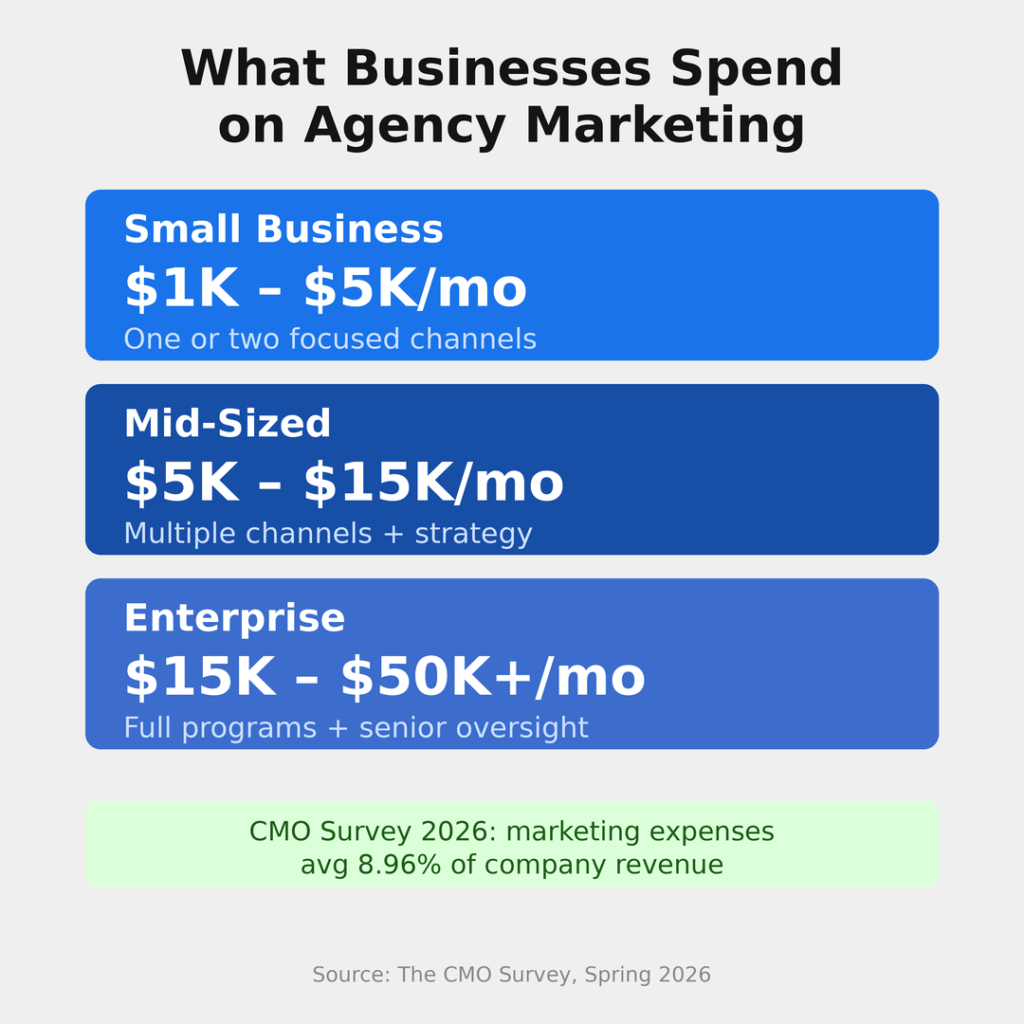
For broader budget context, The CMO Survey’s Spring 2026 report found marketing expenses averaged 8.96% of company revenues and 9.64% of overall company budgets among respondents. It also reported that digital marketing spending rose 8.20% in the prior 12 months, with respondents expecting another 10.40% increase in the next 12 months.
Those are not agency-only numbers. They include broader marketing expense categories. Still, they give you a useful guardrail: agency spend should fit inside the business’s wider marketing plan, not float as a disconnected monthly bill.
For a small business, that may mean starting with a focused $1,000 to $5,000 monthly investment. For a mid-sized company, $5,000 to $15,000 may be more realistic. For larger organizations, $15,000 to $50,000+ can be normal when the agency is handling strategy, creative production, analytics, and multiple channels.
The key is tying the budget to a business outcome. A $2,500 monthly retainer can be too expensive if it produces nothing. A $15,000 retainer can be cheap if it reliably supports revenue, customer acquisition, or retention.
What drives the price up or down
Agency pricing usually moves for predictable reasons.
Scope is the first driver. A single-channel local SEO engagement costs less than a program that combines SEO, PPC, content, email, social media, landing pages, and reporting. Every added channel increases coordination and production.
Seniority also changes the price. You’re paying for judgment, not just hours. A senior strategist who has seen hundreds of campaigns can spot problems faster and avoid expensive mistakes. A junior team may cost less, but they may need more oversight.
Competition matters too. A local service business in a smaller market needs a different effort than a national e-commerce brand competing in a crowded category. Competitive markets require more research, content, testing, creative, bidding, and iteration.
Creative production can move the quote quickly. Photo shoots, video production, motion graphics, landing page design, sales decks, brand systems, original research, and copywriting all add labour beyond campaign management.
Reporting depth is another driver. A monthly summary costs less than custom dashboards, call tracking, CRM integration, revenue attribution, and weekly strategy meetings. If you need the agency to prove ROI at a deeper level, expect to pay for the measurement work.
Location affects the range as well. Clutch lists U.S., Canadian, and Australian digital marketing agencies at $100 to $149 per hour, while several offshore markets sit lower. Lower rates can be useful, but only if communication, strategy, quality control, and accountability still work.
Tools can also change the total. Some agencies include software in the retainer. Others bill SEO tools, analytics platforms, call tracking, reporting dashboards, email software, and ad management tools separately. Ask what’s included before comparing quotes.
How to compare agency quotes
Do not compare quotes by price alone. Compare the work, people, terms, and accountability behind the price.
Ask what services are included, what deliverables you’ll receive each month, who will work on the account, how senior they are, and how much time they spend on strategy versus execution. Ask what happens in the first 30, 60, and 90 days. Ask which tools are included and which are billed separately.
For paid ads, confirm whether media spend is separate from management fees. For SEO and content, confirm whether strategy, technical work, content production, optimization, reporting, and meetings are included. For website projects, confirm whether copywriting, SEO setup, redirects, migration, testing, and post-launch support are included.
Then ask how success will be measured. A good agency should be able to connect its work to leads, revenue, pipeline, sales conversations, bookings, customer acquisition cost, retention, or another business metric that fits the engagement. If the reports focus only on impressions, followers, and clicks, push for stronger measurement.
Our guide to digital marketing metrics and KPIs can help you decide which numbers matter before you compare proposals.
Finally, ask for a sample report or a case study from a client with a similar size, industry, or challenge. The quality of the report often tells you how the agency thinks.
Red flags in agency pricing
A few pricing patterns should make you slow down before signing.
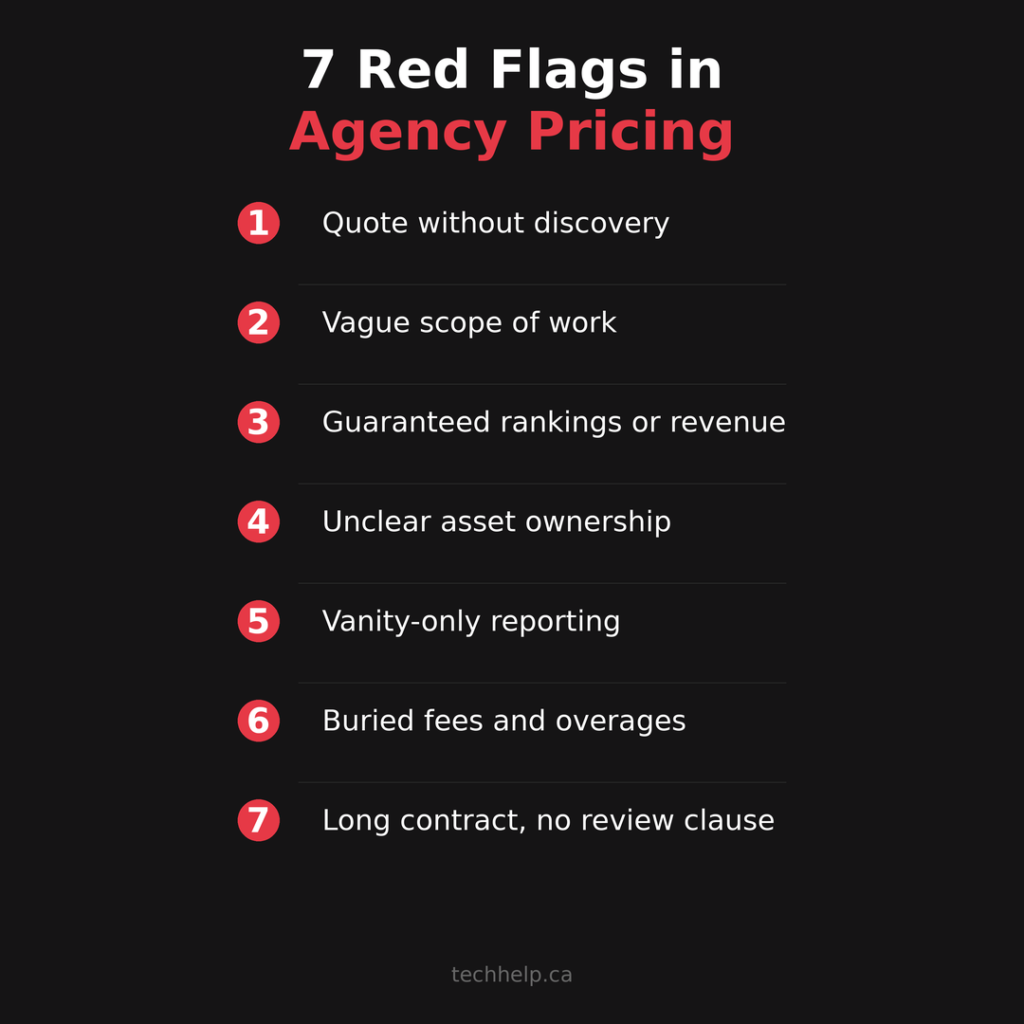
The first is a quote without discovery. If an agency gives you a detailed price before asking about your goals, audience, margins, sales process, current marketing, and budget, they are guessing.
The second is vague scope. “We’ll handle your marketing” is not a scope of work. You should know the channels, deliverables, meeting cadence, reporting cadence, tools, timelines, and responsibilities.
The third is guaranteed rankings or revenue without conditions. No agency controls Google’s algorithm, platform auctions, your sales team’s close rate, your inventory, or your customer service. Projections are fine. Guarantees need clear assumptions.
The fourth is unclear ownership. You should know who owns ad accounts, analytics accounts, landing pages, creative files, audience data, reporting dashboards, and website access if the relationship ends.
The fifth is reporting built around vanity metrics. Reach and impressions can matter, but they are not enough. You need to know whether the work is helping the business.
The sixth is buried fees. Setup fees, tool markups, creative production, landing page work, ad spend, overages, and cancellation terms should be clear before you sign.
The seventh is a long contract with no review point. SEO and content often need time, so a longer term can make sense. But there should still be defined points where both sides review performance, scope, and next steps.
What to do before you hire
Before you hire an agency, decide what business result you’re trying to create. More traffic is not always enough. You may need booked consultations, qualified leads, lower acquisition costs, stronger retention, better conversion rates, a new website, better reporting, or a clearer content system.
Then decide what that result is worth. A cost-benefit analysis can help you compare the agency fee against the potential upside and the cost of doing nothing.
If you’re unsure where to start, go narrow. Start with one focused project or service: an SEO audit, a paid ads test, a website conversion review, a local SEO build, or an email automation cleanup. Use that smaller engagement to judge communication, strategy, reporting, and follow-through before moving into a larger retainer.
The right agency will make the case for more scope with data, not pressure.
The price only makes sense when the scope is clear
Agency pricing ranges widely because agency work ranges widely. A $2,000 monthly retainer and a $20,000 monthly retainer are not the same product at different markups. They are different levels of service built for different needs.
Start with the outcome. Clarify the scope. Separate agency fees from media spend and tools. Compare the people doing the work, not just the logo on the proposal. Then judge the price against the business result you need.
The cheapest quote is not always the best value. The most expensive quote is not automatically the strongest. The best quote is the one where the scope, accountability, and expected return are clear enough that you can make the decision without guessing.
Frequently Asked Questions
What is a normal monthly retainer for a marketing agency?
Many small and mid-sized businesses see retainers between $1,000 and $10,000+ per month, depending on the service and scope. Single-channel work usually costs less. Multi-channel strategy, creative production, paid ads, reporting, and senior oversight can push the retainer much higher.
Does a marketing agency fee include ad spend?
Usually, no. Paid ads management fees are normally separate from the money you spend on ads. If an agency charges $2,000 per month to manage campaigns and you spend $5,000 on ads, your total monthly commitment is $7,000 before any extra creative, tools, or landing page work.
Should a small business hire a freelancer or an agency?
A freelancer can be a better fit for focused work, smaller budgets, or one clear deliverable. An agency makes more sense when you need multiple skills at once, such as strategy, copywriting, design, paid ads, SEO, analytics, and reporting. The right choice depends on scope, not prestige.
How do you know if a marketing agency quote is too high?
A quote is too high when the scope, seniority, deliverables, reporting, and expected business impact do not justify the price. Compare what is included, who will do the work, how results will be measured, and whether ad spend, tools, setup, or creative production are billed separately.
Are marketing agency prices usually in CAD or USD?
It depends on the agency and source of the pricing data. Many public pricing guides are U.S.-based, so Canadian businesses should always confirm whether a quote is in CAD or USD before comparing agencies. Exchange rate differences can change the true cost quickly.
Sources
- https://clutch.co/agencies/digital-marketing/pricing
- https://backlinko.com/seo-pricing
- https://www.webfx.com/digital-marketing/pricing/
- https://cmosurvey.org/wp-content/uploads/2026/03/The_CMO_Survey-Topline_Report-2026.pdf
- https://www.columnfivemedia.com/content-marketing-agency-pricing/

I can suggest related Tech Help Canada articles based on the topic you’re reading now.

Tech Help Canada Staff researches, writes, and reviews practical content for business owners and professionals. Our coverage spans business, marketing, SEO, technology, and the tools and systems people use to grow and operate online. We focus on clear, useful information backed by research, hands-on experience, and editorial review. Learn more about our team and editorial standards. Need help with something? Contact Us